George Kelly
 Studied by 0 people
 Call Kai
 Learn
Learn Practice Test
 Spaced Repetition
 Match
Match Flashcards
 Knowt Play
1/14

There's no tags or description
Looks like no tags are added yet.
Name | Mastery | Learn | Test | Matching | Spaced | Call with Kai |
|---|
No analytics yet
Send a link to your students to track their progress
15 Terms
Explain how Kelly developed his theory of personality.
Kelly developed his theory of personality based on his experience as a clinician, which led him to conclude that people function in the same way that scientists do.
Define personal constructs.
A personal construct is a unique way of looking at events in our lives to try to explain and predict future events.
Explain why constructs must be dichotomous.
All constructs must be dichotomous because they help us predict future events by distinguishing between two opposite alternatives. For example, to understand what is good, we must also understand what is bad. Without this dichotomy, a construct is useless.
Indicate why Kelly believed that we must always be revising our constructs.
Kelly believed that we must always be revising our constructs because the environment is always changing and new experiences can challenge our existing constructs. If we did not revise our constructs, we would not be able to adapt to or cope with new situations.
Define constructive alternativism.
Constructive alternativisim is the idea that we are free to revise or replace our constructs with alternatives as needed,
Describe how we anticipate events that are similar to past events.
Repeated events will have some similarities, and it is on the basis of these similarities that we are able to anticipate how we will deal with that type of event in the future.
Explain how our anticipation of events, and how other people will behave, influence our personality.
According to Kelly, people create personal cognitive constructs that they use to interpret and organize events and social relationships in their lives. These organized patterns of interpretation allow individuals to anticipate future events and predict how other people will behave. Based on these predictions, people choose how to respond and act. Over time, these consistent patterns of anticipating, interpreting, and responding to the world shape a person’s personality. Thus, personality reflects how a person habitually constructs and anticipates events, with interpretation being more important than the events themselves.
Indicate the fundamental postulate of Personal Construct Theory.
Kelly's fundamental postulate states that psychological processes are directed by the ways we anticipate events and construe our world.
Describe each of the corollaries of Personal Construct Theory.
Construction: Because repeated events are similar, we can predict or anticipate how we will experience such an event in the future.
Individuality: People perceive events in different ways.
Organization: We arrange our constructs in patterns, according to our view of their similarities and differences.
Dichotomy: Constructs are bipolar; for example, if we have an opinion about honesty, that idea must also include the concept of dishonesty.
Choice: We choose the alternative for each construct that works best for us, the one that allows us to predict the outcome of anticipated events.
Range: Our constructs may apply to many situations or people, or they may be limited to a single person or situation.
Experience: We continually test our constructs against life's experiences to make sure they remain useful.
Modulation: We may modify our constructs as a function of new experiences.
Fragmentation: We may sometimes have contradictory or inconsistent subordinate constructs within our overall construct system.
Commonality: Although our individual constructs are unique to us, people in compatible groups or cultures may hold similar constructs.
Sociality: We try to understand how other people think and predict what they will do, and we modify our behavior accordingly.
Describe Kelly’s assessment techniques.
Kelly’s primary assessment technique was the interview.
Self-Characterization Sketch: Client writes a character sketch of themselves as if they were the main character in a play (shows how the client perceives themselves in relation to others).
Role Construct Repertory (REP) Test: Client comes up with a list of important people in their life and compares them in triads (reveals client anticipations and expectations).
Fixed-Role Therapy: Client acts out the role of a make believe character (helps client try out new constructs and see if they work better than old ones).
Describe the modern research inspired by Kelly’s theory.
Research using the REP Test has found that:
Our personal constructs remain stable over time.
We chose friends whose constructs are like ours.
Spouses whose constructs were alike were happier.
Schizophrenics formed stable constructs of objects but not of people.
Delinquents identified with action heroes rather than real people.
People who score high in cognitive complexity tend to:
Score low in anxiety.
Have more than the traditional five factors of personality.
Be good at predicting how others will behave.
Have moderate to liberal political views.
Had more diverse experiences in childhood.
Adjust better to the stresses of college.
People high in attributional complexity:
Attribute the behavior of others to complex causes.
Have greater empathy and understanding of others.
Are sensitive to subtle signs of racism.
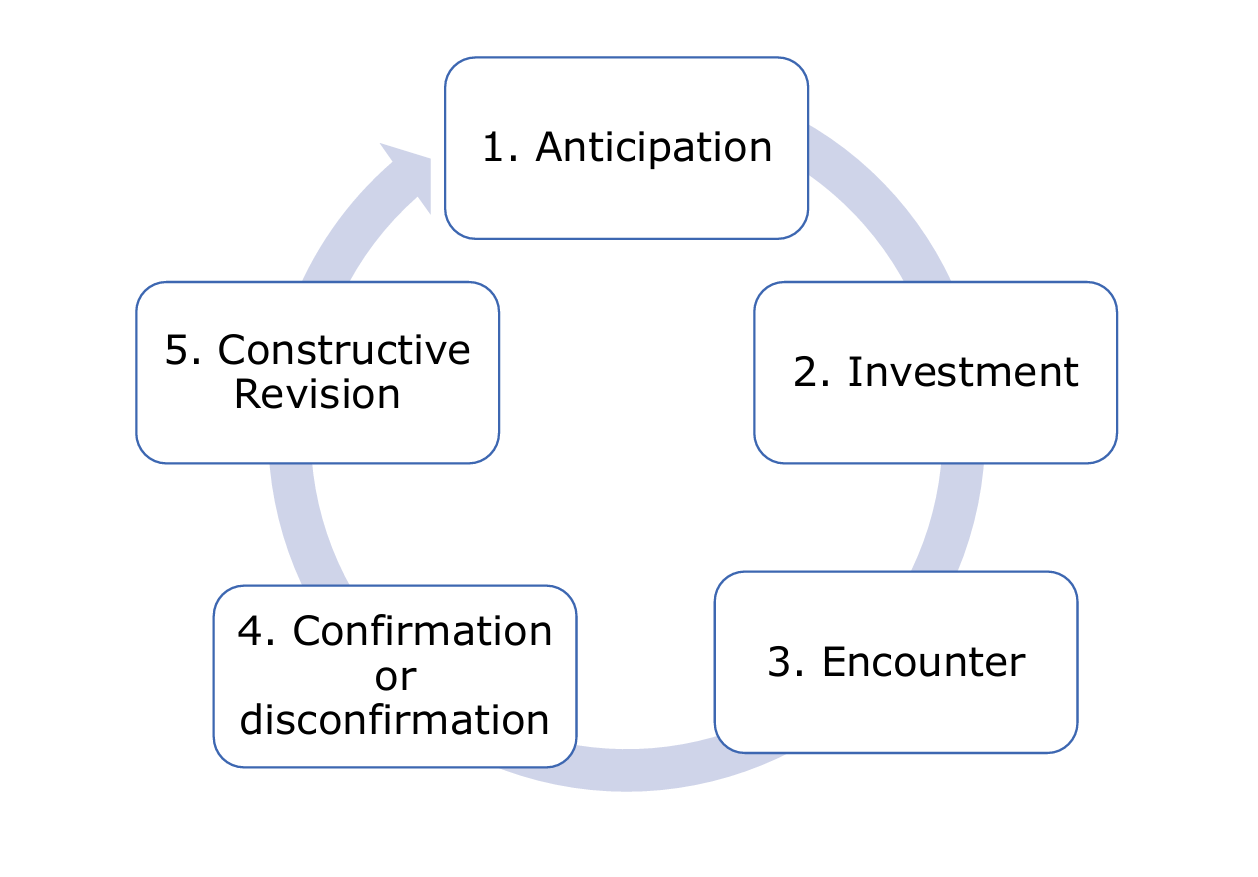
Describe and explain the experience cycle.
First, you anticipate what will happen by forming expectations based on your personal constructs. Then, you invest in those expectations by committing to them. After you encounter the actual event, your expectations are either confirmed or disconfirmed. Finally, through constructive revision, you adjust or revise your personal constructs based on what happened.
List the criticisms of Personal Construct Theory.
Overemphasizes intellectual and rational thinking and downplays emotion.
Assumes people act like scientists, which does not match the extreme or irrational behaviour clinicians often see.
Based on an unrepresentative sample (mainly Midwestern young adults).
Does not explain why people construe the same event differently.
Does not explain why people choose certain constructs over others.
Omits familiar concepts such as motivation and emotion.
Explain how personal construct theory differs from the other theories learned about in the course.
Personal Construct Theory differs from other theories in that it presents an optimistic view of human nature, portraying people as rational beings with free will who actively control their own lives. Unlike psychoanalytic theories, Kelly rejected the idea that behaviour is determined by unconscious conflicts, instincts, or past experiences. Unlike trait theories, he did not view personality as a set of stable traits. Instead, Kelly emphasized how people continually anticipate and revise their understanding of the world in a dynamic manner.
Evaluate Kelly's theory through the lens of a "scientific theory" (considering key principles such as testability, falsifiability, empirical support, predictive power).
Kelly’s theory is limited as a scientific theory. Many of its constructs are difficult to test or falsify because personal constructs are highly individualized and subjective. The theory relies heavily on idiographic methods, which limits its empirical support. Although the theory has some predictive value in understanding how individuals anticipate and respond to events, its predictions are not precise or easily measurable.
 Note
Note  Flashcards (132)