Quantum mechanics (from quantum waves S1)
 Call Kai
 Learn
 Practice Test
 Spaced Repetition
 Match
 Flashcards
 Knowt Play
1/28

Earn XP
Description and Tags
Equations, theory etc... for the quantum mechanics element of classical and quantum waves.
29 Terms
What is the space-time version of the wave function
Ψ(x,t) = Aei(kx-wt)

What is the space-only version of the wave function
𝛙(x) = Aeikx
What is Born’s interpretation (of the wave function)?
where dx is a small change in x. (delta x notation can also be used for dx).
* indicates that we use the complex conjugate (of the wave function). Not a multiplication.
He related the absolute square of space-only wave function to a probability density. This is a postulate.

What is the absolute square of the wave function equal to?
probability density
Properties of the wave function
It must be single-valued and continuous
It’s first derivative must be continuous **(why??)
—> This condition can be dropped at infinity potential boundaries
It must be normalisable
Postulates of quantum mechanics (=Bohr’s postulates??)
The properties of any quantum mechanical system are contained within the wavefunction
The wavefunction is interpreted as the probability amplitude with the absolute square interpreted as the probability density
How do we normalise the wave function?
∫−∞∞∣ψ(x)∣2dx=1

Why must we normalise the wave function?
To give the wave function a physical meaning. It gives the probability density. When we integrate this, it gives the probability of an event happening within a given range, which = 1 from - infinity to + infinity.
What is an observable?
A measurable physical quantity such as energy, momentum or position of a particle.
What is an expectation value?
“The expectation value of an operator is the average of the observable obtained after many repeated measurements on identical systems.”
What is an operator?
A mathematical function associated with an observable that acts on a wavefunction to produce another wavefunction.
Momentum operator
p^=−iℏdxd=iℏdxd
using identity -i = 1/i
Kinetic energy operator
E^k=−2mℏ2dx2d2
Total energy operator
E^=iℏdtd
Position operator
x^=x
Potential energy operator
V^=V(x)
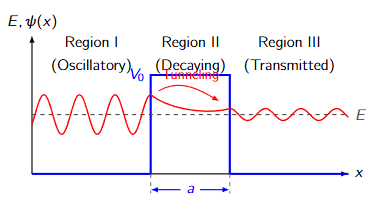
What is meant by quantum mechanical tunnelling? +draw diagram
When a particle with E < V(x) is incident on a potential barrier has a non-zero probability of passing through the barrier.
The wavefunction decays exponentially in the classically forbidden region
If the barrier is thin, the wavefunction emerges on the other side, hence quantum tunnelling.
Examples of quantum tunnelling
Scanning Tunnelling Microscope: Electrons tunnel across a vacuum gap from a surface to a probe tip
Alpha decay: Alpha particles tunnel through the Coulomb potential barrier of the nucleus
Ammonia (NH3) inversion: The nitrogen atom tunnels through the potential barrier of the hydrogen plane
What properties must the wavefunction of a quantum system possess?
must be a single-valued function of position and time
Must be continuous in space
The first derivative must be continuous (except at boundaries with infinite potential steps)
It must be normalisable
What are the postulates of quantum mechanics?
The properties of any quantum mechanical system are contained within the wavefunction
The wavefunction is interpreted as the probability amplitude with the absolute square interpreted as the probability density
What is the probability density function?
A function that describes the likelihood of outcomes for a continuous random variable.
What is meant by the probability amplitude?
A complex-valued function whose magnitude and phase collectively encode all measurable statistical information about a quantum state.
∣Ψ(x,t)∣2 or ψ(x)∣2 time-independent is used for stationary states.
What is meant by a stationary state?
Solutions to the Schrodinger equation with definite energies. The probability density is independent of time such that: ∣Ψ(x,t)∣2 = ψ(x)∣2
Energy eigenstates of the Hamiltonian operator.
What is meant by the Hamiltonian?
An operator that represents the total energy of a quantum system, including kinetic and potential energies.
H^ψ=Eψ
What is an energy eigenstate?
A stable quantum state where the total energy is definite (eigenvalue) and constant.
What is meant by localisation (for a quantum particle)
where a particle’s probability distribution is restricted to a finite region in space.
What is the definition of a free particle
Experiences no external forces
a particle that is travelling in a constant potential V(x) (assume = 0)
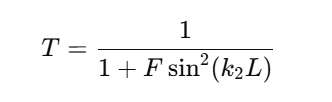
General transmission coefficient equation for E > V(x) for a rectangular potential barrier.
T=1+Fsin2(k2L)1
general transmission coefficient equation for E < V(x) for a rectangular potential barrier.
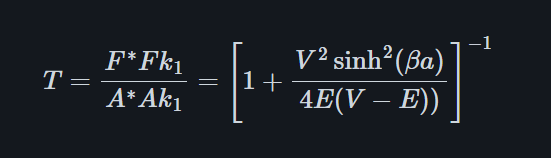
T=[1+4E(V(x)−E)V(x)2sinh2(βa)]−1 where β=ik2