Forces
 Call Kai
 Learn
Learn Practice Test
 Spaced Repetition
 Match
Match Flashcards
 Knowt Play
1/143

Earn XP
Name | Mastery | Learn | Test | Matching | Spaced | Call with Kai | Chat |
|---|
No analytics yet
Send a link to your students to track their progress
144 Terms
Scalar Quantity
A quantity that has a magnitude.
Magnitude
The size of a physical quantity.
Give some examples of scalar quantities.
temperature (°C)
mass (kg)
energy (J)
distance (m)
speed (m/s)
density (kg/m³)
How do you add scalar quantities?
The sum of scalar quantities can be found by adding their values together.
eg. Calculate the total mass of a 75 kg climber carrying a 15 kg backpack.
75 kg + 15 kg = 90 kg
How do you subtract scalar quantities?
Scalar quantities can be subtracted by subtracting one value from another.
A room is heated from 12°C to 21°C using a radiator. Calculate the increase in temperature.
21°C - 12°C = 9°C
Vector Quantity.
A quantity that has a magnitude and a direction.
Give some examples of Vector Quantities.
force (N)
displacement (km)
velocity (m/s)
acceleration (m/s²)
momentum (kg m/s)
How can the direction of a vector be given?
In a written description
Drawn as an arrow (the length represents the magnitude/quantity)
Resultant Force
The single force that could replace all the forces acting on an object, found by adding these together. If all the forces are balanced, the resultant force is zero.
How do you calculate a resultant force with two forces in the same direction?
Add the magnitudes of the two forces together
Two forces, 3 newtons (N) and 2 N, act to the right. Calculate the resultant force.
3 N + 2 N = 5 N to the right
How do you calculate a resultant force with two forces in the opposite direction?
Subtract the magnitude of the smaller force from the larger force
A force of 5 N acts to the right, and a force of 3 N act to the left. Calculate the resultant force.
5 N - 3 N = 2 N to the right
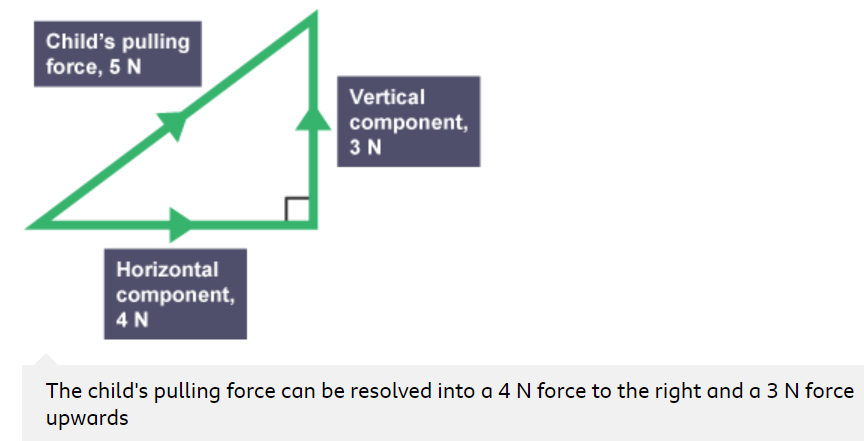
What do vector diagrams do?
Vector diagrams are used to resolve (break down) a single force into two forces acting at right angles to each other.
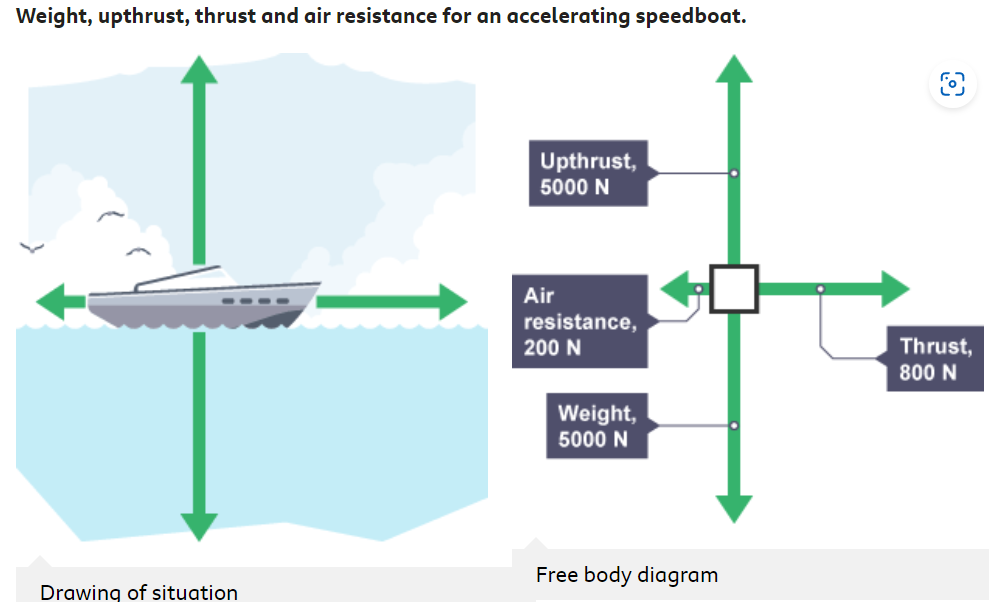
Free Body Diagrams
A simplified drawing of an object or system showing the forces acting on it. The forces are shown acting away from the centre of a box or dot.
Do free body diagrams need to be drawn to scale?
No, but it helps if they are and you have to label each arrow with the force and magnitude it represents.
How would you draw and label a free body diagram of an accelerating speedboat?
Contact Forces
Force exerted between two objects when they are touching.
Give some examples of contact forces.
Reaction Force (An object at rest on a surface)
Tension (An object that is being stretched)
Friction (When two objects slide past each other)
Air Resistance (An object moving through the air)
What happens when an object experiences a contact force?
Both objects experience the same size force, but in opposite directions
This is Newton’s Third Law of Motion
Non-contact Forces
The push or pull acting between objects that are not physically touching when they interact.
Give some examples of non-contact forces.
Magnetic Force (experienced by any magnetic material in a magnetic field) (two magnetic poles)
Electrostatic Force (experienced by a charged particle in an electric field) (opposite charges)
Gravitational Force (experienced by any mass in a gravitational field) (masses that attract)
Weight (gravity exerts its force through a field, an object doesn’t need to touch earth to have a weight)
How can you find a resultant force?
Adding two forces together
Resolving a single force into two component forces at right angles to each other
How do you draw a vector diagram?
Draw a right-angled triangle to scale, in which each side represents a force. Try to choose a simple scale, for example 1 cm = 1 N.
Use the example for help.
Air Resistance
A force of friction produced when an object moves through the air.
Attract
Objects that tend to move together because of a force between them attract each other.
Charged Particles
Particles, usually ions or electrons, that carry electrical charges.
Electric Field
Area surrounding an electric charge that may influence other charged particles.
Electrostatic Force
A force of attraction between particles with opposite charges.
Friction
A force that opposes or prevents movement and converts kinetic energy into heat.
Magnetic
Able to be magnetised or attracted to a magnet.
Magnetic Field
Area surrounding a magnet that can exert a force on magnetic materials.
Mass
The amount of matter an object contains. Mass is measured in kilograms (kg) or grams (g).
Reaction Force
Force exerted in the opposite direction to an action force.
Repel
Objects that tend to push apart because of a force between them repel each other.
Tension
Pulling force exerted by each end of an object such as a string or rope.
All objects with ____ produce a _______ _____. The more mass an object has the ________ its _________ ______ will be.
Mass, Gravitational Field, Greater, Gravitational Field
What is Gravitational Field Strength measured in?
g is measured in N/kg
9.8 N/kg on Earth
1.6 N/kg on the Moon
What is the equation for Weight, W?
mass x gravitational field strength
m x g
The weight of an object and its mass are ____ _____________.
directly proportional
Weight
The force acting on an object due to the pull of gravity from a massive object like a planet. The force acts towards the centre of the planet and is measured in newtons (N).
Centre of Mass
The point representing the mean position of the matter in a body.
Component Force
One of two forces, at right angles to each other, that can be added together to form a resultant force.
Work
Energy transferred by a force. Work done = force × distance moved in the direction of the force.
Work Done
The amount of energy it takes to do a task. Measured in joules (J)
One joule of work is done when a force of 1 N causes a movement of 1 m so it can also be measured in Newton-metres (Nm)
What is the equation for Work Done, W?
force x distance
F x s
Compression
A shortening in length, for example, as a result of being squeezed.
Deformation
Changing shape and/or size as a result of forces being applied.
Elastic
Elastic materials return to their original shape and size after being stretched or squashed.
Elastic Potential Energy
Energy stored in squashed, stretched or twisted materials.
Extension
Increase in length, for example, as a result of being pulled.
Inelastic
Inelastic materials do not return to their original shape and size after being stretched or squashed.
The relationship between force and extension becomes non-linear
Limit of Proportionality
The point beyond which Hooke's law is no longer true when stretching a material.
Proportional
When two quantities have the same ratio or relative size. For example, current is proportional to voltage if the current doubles when the voltage is doubled.
What is Hooke’s Law?
A law stating that the strain in a solid is proportional to the applied stress within the elastic limit of that solid.
What is the equation for Hooke’s Law?
Force = spring constant x extension
F = k x e
N = N/m x m
The higher the _____ _______ the _______ the spring
Spring constant, stiffer
Elastic Limit
The furthest point a material can be stretched or deformed while being able to return to its previous shape
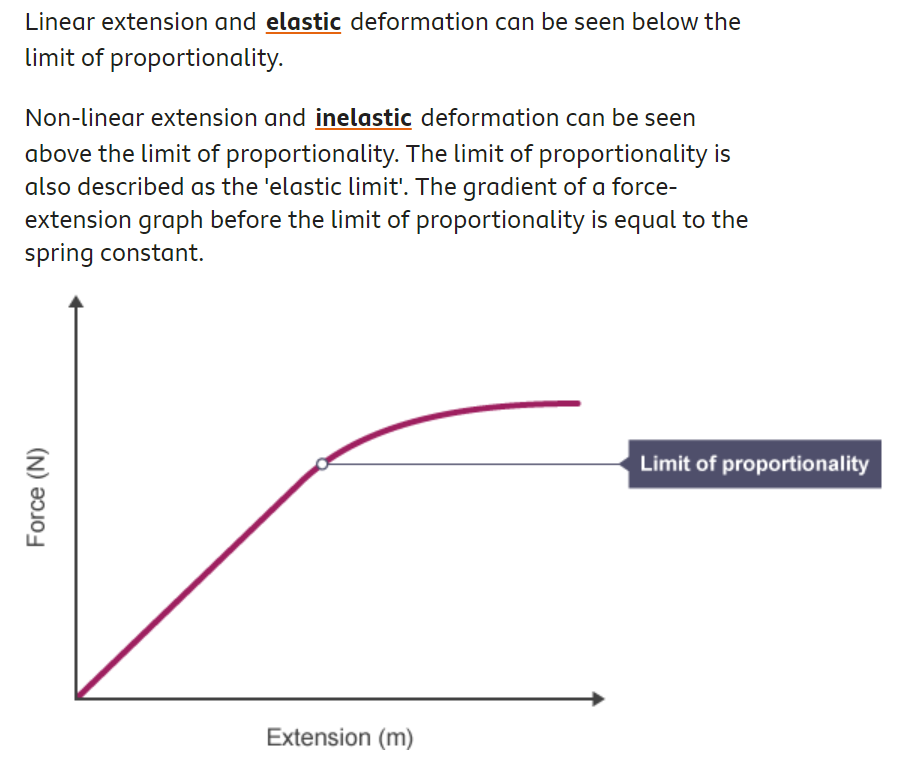
Force-extension graphs
Linear extension and elastic deformation can be seen below the limit of proportionality.
Non-linear extension and inelastic deformation is above the limit of proportionality/elastic limit. The gradient of a force-extension graph before the limit of proportionality is equal to the spring constant.
______ is done when a spring is extended or compressed.
Work is done when a spring is extended or compressed
What is the equation for elastic potential energy?
elastic potential energy = 0.5 × spring constant × (extension)2
Ee = 0.5 x k x e²
J = 0.5 x N/m x m²
Required Practical: how forces affect the extension of a spring
Secure a clamp stand to the bench using a G-clamp or a large mass on the base.
Use bosses to attach two clamps to the clamp stand.
Attach the spring to the top clamp, and a ruler to the bottom clamp.
Adjust the ruler so that it is vertical, and with its zero level with the top of the spring.
Measure and record the unloaded length of the spring.
Hang a 100 g slotted mass carrier - weight 0.98 newtons (N) - from the spring. Measure and record the new length of the spring.
Add a 100 g slotted mass to the carrier. Measure and record the new length of the spring.
Repeat step 7 until you have added a total of 1,000 g.
Required Practical: Results: how forces affect the extension of a spring
For each result, calculate the extension: extension = length - unloaded length
Plot a line graph with extension on the vertical axis, and force on the horizontal axis. Draw a suitable line or curve of best fit.
Identify the range of force over which the extension of the spring is directly proportional to the weight hanging from it.
Required Practical: Hazards: how forces affect the extension of a spring
Equipment falling off the table → bruises from heavy objects → use a G-clamp to secure the equipment
Sharp end of the spring recoiling if broken → damage to eyes + cuts → wear eye protection
Masses falling → bruises from heavy objects → carefully add each mass onto spring
Axle
A bar, rod or shaft which passes through a wheel or gear. The wheel or gear will rotate around the axle.
Force
Force used to move a load over a distance.
Force Multiplier
Something that increases the effect of a force.
Gear
A toothed wheel used with other gears to turn axles at different speeds.
Lever
A simple machine consisting of a pivot, effort and load.
Load
The overall force that is exerted, usually by a mass or object, on a surface.
Moment
A turning effect of a force.
Pivot
A point around which something can rotate or turn.
Equation of a moment
moment of a force = force × distance
M = F x d
Nm = N x m
If an object is _____ the total ______ _____ about a pivot is ____ to the total ________ _____ about that pivot
balanced, clockwise moment, equal, anti-clockwise moment
For a balanced object you can calculate:
The size of a force
The perpendicular distance of a force from the pivot
Give some examples of the different types of lever.
Arrangement of compoents | Examples |
|---|---|
effort - pivot - load | see-saw, crowbar, scissors |
pivot - load - effort | wheelbarrow, nutcracker |
pivot - effort - load | tweezers, cooking tongs |
How do simple levers work?
A simple lever could be a solid beam laid across a pivot. As effort is applied to rotate one end about the pivot. The opposite end is also rotated about the pivot in the same direction. This has the effect of rotating or lifting the load.
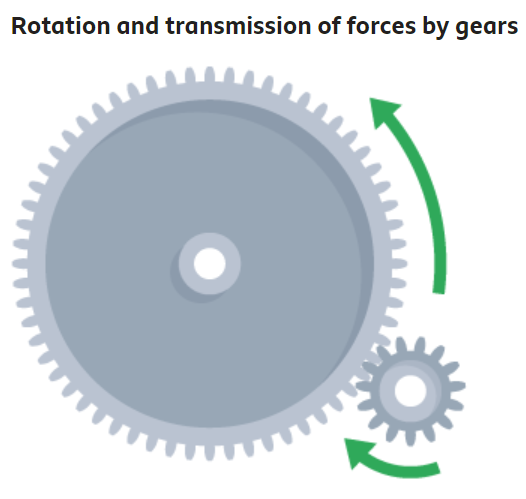
How do forces and moments act on gears?
The forces acting on the teeth are identical for both gears, but their moments are different:
If the driven gear is made larger is will rotate more slowly but with a greater moment. For example, a low gear ratio on a bike or car.
If the driven gear is made smaller it will rotate more quickly but with a smaller moment. For example, a high gear ratio on a bike or car.
How do gears rotate?
As one gear turns, the other gear must also turn. Where the gears meet, the teeth must both move in the same direction. In the diagram, the teeth of both gears move upwards. This means that the gears rotate in opposite directions.
Altitude
A measure of an area’s height above sea-level
Atmosphere
The layers of gases that surround the Earth. The important gases in the atmosphere are nitrogen, oxygen and carbon dioxide.
Fluid
A substance that can flow, such as a liquid or a gas
Normal
Acting at an angle of 90° to a surface or boundary
Pressure
Force exerted over an area. The greater the pressure, the greater the force exerted over the same area. It determines the effect of force on a surface.
Up-thrust
Upwards force exerted by a liquid or gas on an object floating in it.
What is the equation for pressure?
pressure = force ÷ area
p = F ÷ A
Pa = N ÷ m²
Pressure _______ as _____ increases in a ________
increases, depth, liquid
Equation for pressure in a liquid
pressure = height of column (water) x density x gravitational field strength
p = h x ρ x g
Pa = m x kg/m³ x N/kg
Give two key features of the atmosphere.
it is thin compared to the size of the Earth
it becomes less dense (atmospheric pressure decreases) as the altitude increases
What is the atmospheric pressure at sea-level?
101,000Pa
What happens when altitude increases?
the number of air molecules decreases
the weight of the air decreases
there is less air above a surface
Acceleration
The rate of change in velocity is measured in m/s²
Equation for Acceleration.
Acceleration = change of velocity ÷ time taken.
α= Δv ÷ t
m/s² = Δm/s ÷ s
or
a = (v² - u²) ÷ 2s
Deceleration
Slowing down or negative acceleration
Displacement
Quantity describing the distance from the start of the journey to the end in a straight line with a described direction
Distance
Numerical description of how far apart two things are.
Gradient
Another word for steepness. On a graph, the gradient is defined as being the change in the 'y' value divided by the change in the 'x' value.
Rate of change
The amount of change in the size of a quantity each second.
Speed
The distance travelled in a fixed time period, usually one second.
Tangent
A straight line that just touches a point on a curve. A tangent to a circle is perpendicular to the radius which meets the tangent.
Velocity
The speed of an object in a particular direction.
What can the speed of a person walking depend on?
age
terrain
fitness
distance travelled