The nervous sytem, senses, CNS, brain, temperature control
 Studied by 0 people
 Call with Kai
 Learn
Learn Practice Test
 Spaced Repetition
 Match
Match Flashcards
 Knowt Play
1/119

There's no tags or description
Looks like no tags are added yet.
Name | Mastery | Learn | Test | Matching | Spaced | Call with Kai |
|---|
No study sessions yet.
120 Terms
What is the nervous system
The nervous system is a rapid communication system that * detects and responds to changes inside and outside of the body.
What other system does the nervous system often work with to maintain homeostasis ?
The endocrine system
What are the two components to the nervous system
central nervous system and the peripheral nervous system.
How does the nervous system transfer messages?
Through neurones as electrical impulses
How is transmission of the action potential carried out?
What are the principle ions involved in this?
by movement of ions across the nerve cell membrane.
the extracellular cation sodium and intracellular cation potassium.
How do nerve cells communicate with each other
Nerves communicate with each other by releasing a chemical also known as a * neurotransmitter into tiny junctions between them called synapses
Where are neurotransmitters synthesised and how are they transported to where they are stored?
Synthesised by nerve cell bodies, and actively transported along the axons and stored in the synaptic vesicles
How are neurotransmitters release and why are they released?
Neurotransmitters are released by the process of exocytosis in response to the action potential.
What do neurotransmitters do once they are released in response to an action potential?
Once released they diffuse across the synaptic cleft, where they act on a specific receptor site on the post synaptic membrane
How long do neurotransmitters act on specific receptor sites on the post synaptic membrane and what happens to them after this?
This action is often short lived as immediately after they have acted on the post synaptic membrane - they are either inactivated by enzymes or taken back into the synaptic knob.
What is the dura mater ?
outer protective fibrous connective tissue sheath covering the brain and spinal cord,
What does the central nervous system comprise of ?
The brain and spinal cord
What is the pia mater ?
the innermost layer, attached to the surface of organs and is richly supplied with blood vessels to nourish the underlying tissues
What bony structures protect the Central nervous system
The skull and vertebral column
What makes up the meninges
3 layers - the dura mater, pia mater and arachnoid mater
What is the arachnoid mater
provides a space for many minute blood vessels and circulation of cerebrospinal fluid.
What is cerbrospinal fluid made up of? (8 components)
derived from the blood. Consisting of water, mineral salts, glucose and small amounts of leukocytes, creatinine, urea and plasma proteins.
What is cerebrospinal fluids main function?
What is its secondary function?
to * protect the brain and spinal cord by acting as a shock absorber between the brain and the skull - maintaining a uniform pressure around structures whilst keeping them moist.
carries some nutrients to the nerve tissue and carries waste away,
What is the blood–brain barrier (Blood-cerebrospinal fluid barrier),
what is its structure,
how does it protect the central nervous system?
blood-cerebrospinal fluid barrier - is a selective semi permeable wall of blood capillaries with a thick basement membrane.
It prevents, or slows down, the passage of some drugs and other chemical compounds and keeps disease causing organisms such as viruses from travelling to the central nervous system via the blood stream.
What are the two spaces associated with the meninges ?
the subdural space and the subarachnoid space
Where is the sub-dural space and what does it contain?
between the dural and arachnoid mater, and contains a very small amount of serous fluid. In both skull and spinal canal.
Where is the subarachnoid space and what does it contain?
separates the arachnoid and pia maters, - and contains cerebral spinal fluid (CSF). In both skull and spinal canal.
What is the epidural space and what does it contain
between the dura mater (outer meningeal layer) and the inner surface of the vertebral canal
contains fat, veins, arteries, spinal nerve roots and lymphatics.
How many ventricles does the brain have
what are they called
4
The right and left lateral ventricles, the 3rd ventricle and the 4th ventricle
What fluid is in the subarachnoid space, to the ventricles to the spinal cord?
Cerebrospinal fluid
How does blood reach the brain, what arteries
caratoid and vertebral
What is the name of the cerebral artery circle and what does it consist of?
The circle of willis
Vertebral arteries join together to form the basilar artery, which is combined with carotoid arteries
How is the cerebral cortex on each side of the brain supplied blood?
By three branches from the circle of willis and include the anterior, middle and posterior arteries.
What does the cerebrum control?
Nerve centre that control sensory activities, motor activities and intelligence.
What are the two hemispheres of the cerebrum separtated by?
Flax cerebri
What are the 4 lobes of the cerebrum
Frontal, parietal, temporal and occipital.
What is the outer layer of the cerebrum called and what it is comprised of and their function.
cerebral cortex
comprised of neuronal cell bodies to make up the cortexes grey matter
inner layer of axons which make up the cortex’s white matter and basil ganglia
Control the body’s motor control and steadiness
What are the function of Gyri and what are they separated by
To increase the SA of the Cerebralcortex
separated by Sulci
What physical actions does the cerbrum control
vision, touch, hearing, taste, smell, voluntary movements
What does the cerebrum control mentally
reasoning, emotion, intelligence, judgement, reasoning, memory and volunary movements.
What side of the body does the right hemisphere of the brain control?
The left side of the body
What is the diencephalon made up of ?
What other two structures are situated in this area?
Connects the cerebrum to the midbrain and is comprised of thalamus and hypothalamus.
Pineal gland and optic chiasma
What is the function of the Thalmus and what does it control
relays impulses from parts of the brain to the cerbral cortex
communicates information about pain, touch and temperature, fear and rage.
What is the function of the hypothalamus and what does it control
role in controlling the endocrine system
by controlling the output of hormones from both anterior and posterior lobes of the pituitary gland
temperature, appetite, emotional reactions and circadian rhythms.
What three structures doeas the brain stem consist of?
where is it situated
the midbrain, the pons and the medulla oblongata.
Below the Diencephalon
What does the midbrain control
How does it do this
Visual and auditory reflexes
Contains nerve pathways to the cerebral Cortex
Where is the Pons located
What does it control and what other region does it do this with?
The pneumotaxic centre
control repisration
With the medulla oblongata
What three functions does the medulla oblongata control?
Cardiovascular, respiratory and reticular activating system
What is the reticular activating system responsible for?
arousal, increased alertness and selective awareness,
vomiting coughing and hiccupping relexes
Which cranial nerves emerge from the Medulla oblongata
9, 10 and 12
Where is the cerebellum located?
posterior of the cranium (back of head)
What are the two hemispheres of the cerebellum separated by?
What does the cerebellum control
What is the function of the cerebellum
What are two additional roles of the cerebellum
The falx cerebelli
Muscle tone, coordination of skeletal muscles and balance
good posture, precision of actions, gait.
Learning and language processing
What does the lymbic system do?
Alloss the influence and regulation of emotions on the body
What is the lymbic system comprised of
Is it well understood?
A collection of structures deep within the brain surrounding the top of the brain stem.
Not fully understood
What is the spinal cord protected by?
The vertebral column
What is the spinal cord surrounded by?
The meninges and CSF
Where does the spinal cord start
Where does it end.
What structure is at the end of the spinal cord
The medulla oblongata and extends through the base of the skull
It extends down the vertebral canal to approximately the level of the second lumbar vertebra.
At this point it narrows to form the conus medullaris and then continues as a bundle of nerve roots called the cauda equina.
What nerves come off the conus medullaris
Cauda equina
What is the main function of the spinal cord?
to transmit sensory impulses from the body to the brain and motor impulses from the brain to the body
Why is the spinal cord important for reflex activity
allowing some responses to occur rapidly without direct involvement of the brain.
What are the two tissues that make up the spinal cord
Grey and white matter
What is the structure and function of grey matter in the spinal cord?
contains neuron cell bodies and is involved in processing sensory information and coordinating voluntary and reflex motor activity.
What is the structure and function of white matter in the spinal cord?
made up of myelinated nerve fibres organised into vertical columns called tracts. These tracts carry impulses up to the brain and down from the brain.
Where do upper motor eurones have their cell body?
In the cerebrum
Where do lower motor neurones have their cell body?
In the anterior horn of grey matter in the spinal cord.
What does the peripheral nervous system consist of?
What is its function?
31 pairs of spinal nerves and 12 pairs of cranial nerves
What are two parts of the peripheral nervous system?
The somatic nervous system and the autonomic nervous system
What does the somatic nervous system control?
What are the two main types of neurones involved in this?
What are their functions?
Voluntary movement and some involuntary skeletal muscles.
sensory- carry information from the nerves to the CNS and motor neurones
efferent- carry information from the brain and spinal cord to muscle fibres in the body.
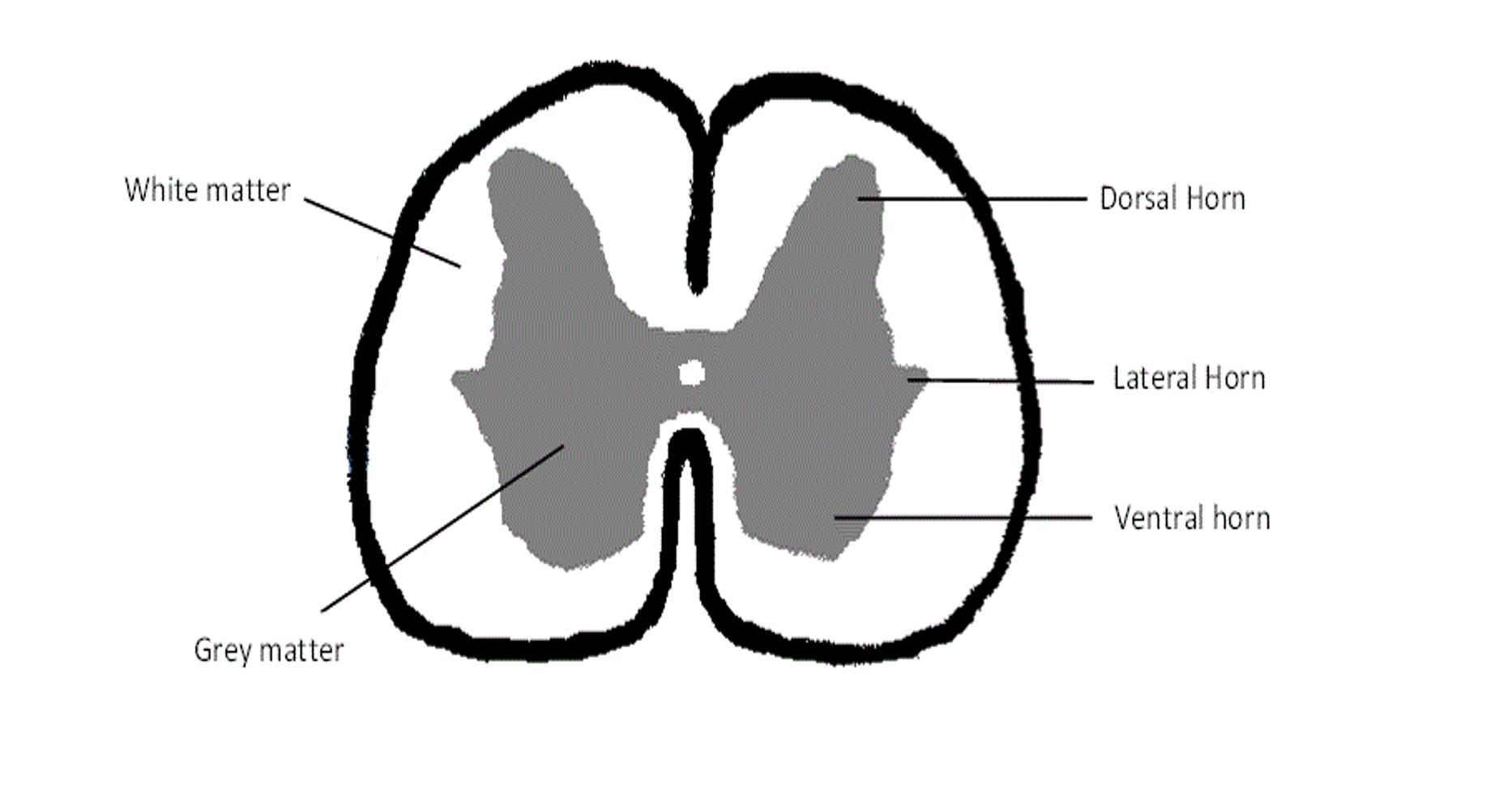
what is the structure of the spinal cord
What is is the structure of the peripheral nervous system to connect the CNS to the rest of the body.

What is the somatic nervous system
The somatic nervous system is the part of the nervous system responsible for voluntary movement and conscious sensation.
What are Afferent and Efferent nerves and their functions?
Afferent (sensory) nerves carry information from receptors to the CNS
Efferent (motor) nerves carry commands from the CNS to skeletal muscles
What is the somatic nervous system
•Somatic nervous system mainly controls voluntarily movement
What is the autonomic nervous system
The autonomic nervous system (ANS) is the division of the nervous system that controls involuntary bodily functions.
How many cranial nerves are there?
12 pairs
Where do the cranial nerves supply?
The head and neck(including sensory organs and skin)
What does the autonomic nervous system control?
automatic body functions such as glands and smooth and cardiac muscles.
What is sympathetic nervous system stimulation
The sympathetic nervous system, which prepares the body for action in stressful or dangerous situations (“fight or flight”), prepares to expend energy, increasing heart rate, blood pressure, pupil dilation and airflow while reducing digestion.
What chemical is released to trigger a sympathetic stimulation?
adrenogenic catecholamine noradrenaline
What does the parasympathetic nervous system do?
has a tendency to slow down the bodies reactions thus the activity of the parasympathetic nervous system balances the actions of the sympathetic division by working to conserve energy and create the conditions needed for rest and sleep.
What chemical is release for a parasympathetic stimulation
cholinergic neurohormone acetylcholine
What are senses?
Means for the brain to receive information about the body and environment.
What are the 5 special senses
mell, taste, sight, hearing and balance.
What is Olfaction?
Sense of smell
How is sense of smell (olfaction) different to the other 4 special senses?
What cranial nerve does it use?
It is relayed directly to the cerebral cortex via cranial nerve 1, without passing throught the thalamus first.
Where are the olafactory receptors? What are their function?
in the nose
convert chemical signals into electrical signals that travel along nerve fibres to the brain.
What type of sense is taste?
What structures detect taste stimuli?
chemical
Taste buds
What branch of the cranial nerve does taste from the anterior two thirds of the tongue, carry the taste?
Cranial nerve 7, chorda tympani
What branch of the cranial nerve carries taste from the posterior one-third of the tongue?
9 (glossopharyngeal)
10 (vagus )
How is taste transmitted from the stimuli to the brain?
This stimuli > taste bud receptor > medulla oblongata >thalamus >e taste centre of the cortex.
What makes up the visual system?
the eye
the accessory structures
the optic nerves – cranial nerve 2
optic tracts
optic pathways.
What type of action potential is the eye’s response to light
afferent (Towards the CNS with sensory information)
How is afferent sensory information relayed to the brain?
By optic nerves (cranial nerve 2) and tracks
What are accessory optical structures?
What are their function?
Tear glands, eyelids, eyelashes
Protectionfrom sunlight and damage
How does the eye regulate the amount of light that enters the pupil?
Why is this important?
light that enters eye via the pupil
regulated by the iris
which in turn is controlled by two groups of smooth muscles innovated by parasympathetic fibres from the occulomotor motor nerve (cranial nerve 3)
Control of light in this manner enables an individual’s vision to be focused.
What are the three parts of the organs of hearing and balance?
external, middle and inner ears.
What are the inner ears functions
both hearing and balance.
What are the main functions of the external and middle ears?
Hearing alone
What is the function of auricle?
Collect sound waves
What is the pathway from a sound stimulus to the brain?
auricle > tympanic membrane > inner bones > cochlear duct > hair cells of tectorial membrane > cochlear neurones (cranial nerve 8) > CNS (cerebral cortex)
What part of the brain translates sound?
The cerebral cortex
What 4 peripheral sources give the brain information on balance?
How is this done?
Eyes, muscles, joints and vestibular organs (hearing)
What are vestibular organs
sensory structures in the inner ear responsible for balance and spatial orientation.
What are the 3 bones within the ear?
malleus, incus and stapes
What structure within the inner ear is responsible for balance?
•Bony labyrinth: semicircular canals / membranous labyrinth
 Note
Note  Flashcards (33)