biomechanics definitions
 Studied by 0 people
 Call Kai
 Learn
Learn Practice Test
 Spaced Repetition
 Match
Match Flashcards
 Knowt Play
1/55

There's no tags or description
Looks like no tags are added yet.
Name | Mastery | Learn | Test | Matching | Spaced |
|---|
No study sessions yet.
56 Terms
Kinematics
Describes the motion of an object
Kinetics
Describes the forces associated with motion
Scalar
A variable which only has madnitude, but not direction
Force
Any action that alters the state of an object
Pressure
Force normalised to area (F/A)
Mass
Quantity of matter making up a body
Weight
Amount of force due to gravitational acceleration exerted on a body
Centre of Mass
The point at which the mass of the body is evenly distributed in all directions
Speed
Distance travelled over a given time m
velocity
Displacement over a given time
Acceleration
Vector - Change in velocity with respect to time
Strain
Proportionate change in length
Wolff’s law
Bone remodels in response to mechanical stress
Potential energy
A capacity to work due to gravity (in joules)
Kinetic energy
A capacity to work due to motion (in joules)
Work
Transfer of energy from one body to another through the application of force resulting in displacement (in joules)
Power
Rate of doing work (in watts, J/s)
GRF
Force exerted by the ground on a body in contact with it
Stride time
Time taken to complete one stride
Stride length
Distance travelled during one complete stride
Stride frequency
Number of strides per second
Stance phase
Portion of a stride in which a foot is in contact with the ground
Swing phase
Portion of a stride in which a foot is not in contact with the ground
Duty factor
Stance phase as a proportion of stride duration/time
Newton’s first law
Inertia - a body will keep doing what it’s doing unless another force acts upon it
Newtons 2nd law
Acceleration - if a force is applied to a body it will keep moving in the direction of the applied force
Newtons 3rd law
Action-reaction - for every action there is an equal and opposite reaction
Ground reaction force
Force exerted by the ground on a body in contact with it
What are the 3 methods of kinematic analysis
Optical Motion capture
Videography
IMUs
Optical Motion Capture
Pros:
Highly accurate and precise
3D analysis
Multiple strides can be recorded
Cons:
Expensive
Not easy to use in field conditions
Videography
Pros:
easy to set up
Inexpensive
Cons:
2D analysis only
Distortions & perspective errors
IMUs
Pros:
Inexpensive & portable
Easily used in field conditions
More accurate for measuring acceleration
Cons:
Integration error - less accurate displacement
Sensors need to be attached to subject
Battery/recording capacity
Efficient locomotion is reliant on?
Moving the COM with minimal energy expenditure
Minimising the amount the COM is displaced from the line of progression
overall it is the minimising loss to other energy forms
Spring-mass model
Used for running gaits
Consists of compressing (braking phase) and recoiling (propulsive phase)
Metabolic energy is saved by replacing concentric contractions with passive biological springs (tendons) controlled by isometric contractions which are less ‘expensive’
How does vertical displacement vary between trot and canter/gallop
In trot the upper body is raised and lowered twice, in canter/gallop it is raised once
The faster the speed, the lower the vertical movement
Resting BMR
Energy expenditure at rest
Net cost of locomotion (NCOT)
Energy input required to move the animal by 1m
Total cost of locomotion
Total amount of energy to move 1m
How does speed increase energy cost
More speed → more muscle force → more muscle contraction → higher rate of metabolic energy supply
Energy cost vs body size
Larger animals = more energy expenditure (increased net cost of locomotion)
But larger animals use relatively less energy per kg of body mass to travel a given distance (decreased specific cosy of locomotion)
Higher NCOT, lower specific cosy of locomotion
Advantages of longer straighter limbs
Lower stride frequencies + longer limbs = greater distance covered with each stride
Fewer steps = fewer muscle contractions
Factors influencing cost of locomotion
Inclines
Uneven/slippery surface
External temperature
How is stability increased
Lower COM
Increased area of contact
Larger area enclosed by contact points
Bones
High stiffness and strength
Can withstand high compressive loads
Weak when subjected to shear or tensile stress
Strategies to reduce stress on bones
Thicker bone (P=F/A) (areas = thickness)
Greater thickness = lower pressure
Animals move slower (lower forces)
Straighter limbs - higher EMA, lower muscle force w required, decreased musculoskeletal stress
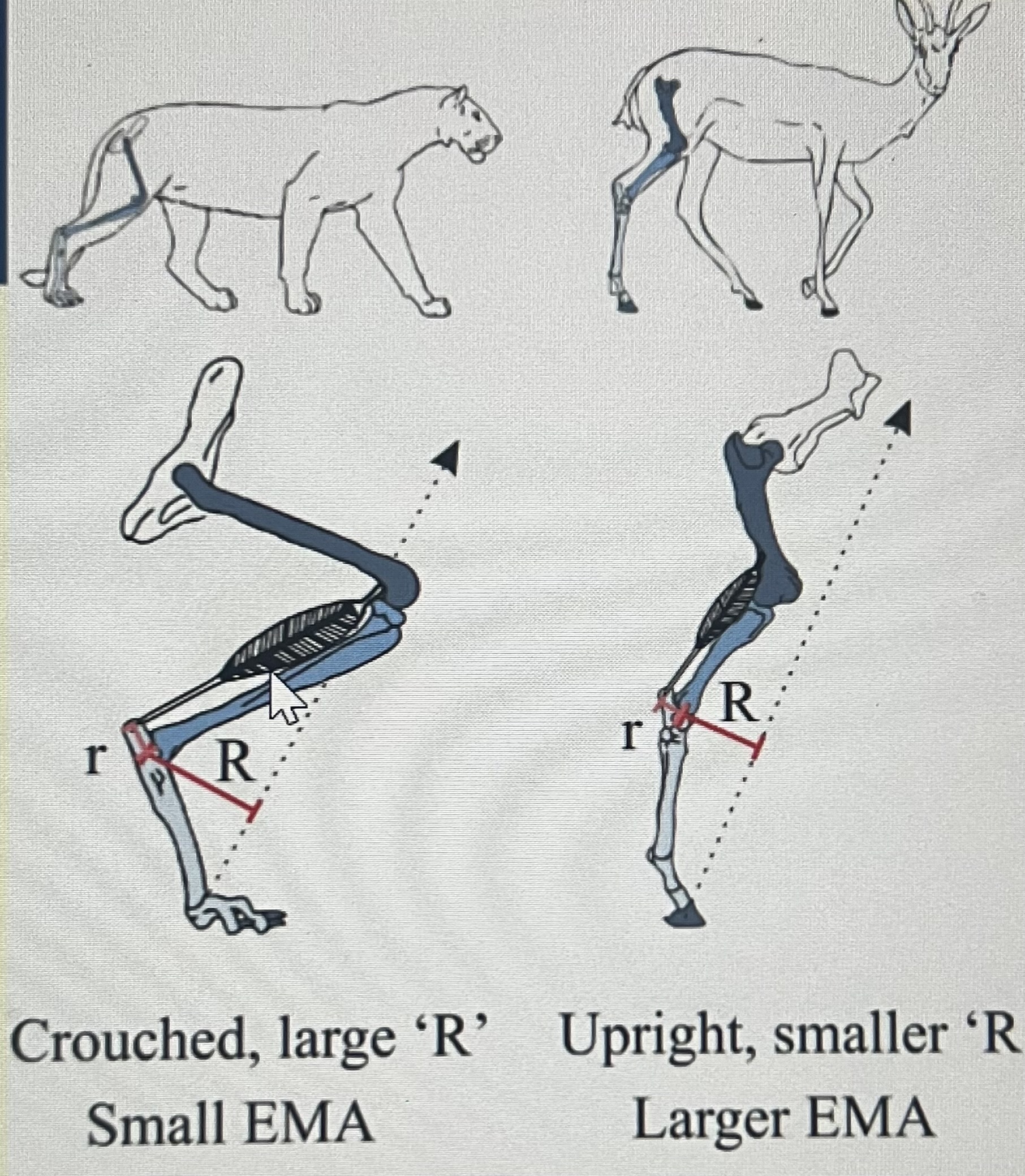
Effective mechanical advantage (EMA)
Measure of a given joints leverage against the GRF (relative suitability of the joint to resist gravity)
EMA = r/R
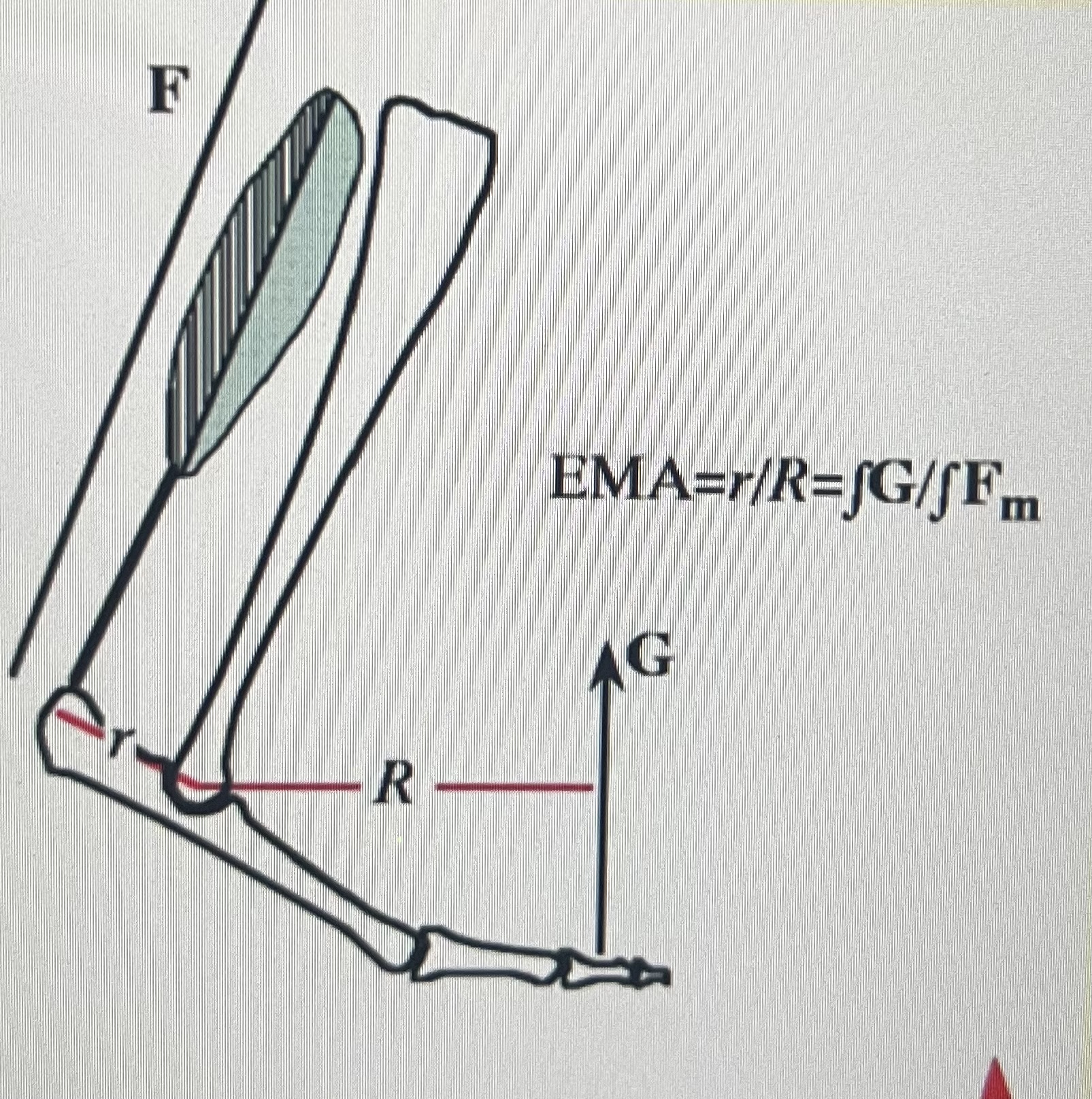
Advantages of an upright posture
GRF vector is more closely aligned with the long axes of the bones - reducing the bending moments in the bones
Advantages of crouched posture
More propulsion
How does animal size affect EMA
Small animals have crouched posture - lower EMA
Large animals have upright posture - higher EMA
How do tendons benefit locomotion
Crimped - allow lengthening without tensile forces
Stretch to store and release strain energy reducing energy expenditure
Beyond 8-10% strain - macroscopic failure
SDFT - most commonly injured structure
Disadvantages of efficient running locomotion (horses)
7% of energy stored in tendons released as heat causing core lesions in SDFT
Reduced bone mass increase risk of fracture in distal limb
How do ligaments support locomotion
Shorter and wider
More varied load thus collagen arrangement more variable
Scaling - square-cube law
Geometry - two systems are geometrically similar if any measurement from one is equal to an equivalent from the other multiplied by a constant.
An organism which doubles in length would result in 4x increase in SA
Volume - if we double the length, the volume and mass will increase by 8x
Allometry
How the size of a particular feature of an organism changes in relation to body size
Negative allometry - trait scales less than allometry
Positive allometry - trait scales more than allometry
Froude number: at what values does gait change?
At the same freude number, geometrically similar animals move in a dynamically similar fashion.
They use the same gait at the same froude number and change gaits at roughly the same froude number.
Walk to trot - 0.3-0.5
Trot to gallop - 2-3
Jumping
On landing, limbs experience forces equivalent to up to 4.5BW
 Note
Note  Flashcards (20)