Sensation and Perception Final
0.0(0)
 Studied by 0 people
 Call Kai
 Learn
Learn Practice Test
 Spaced Repetition
 Match
Match Flashcards
 Knowt Play
Card Sorting
1/241

Earn XP
Description and Tags
Last updated 1:34 PM on 4/21/23
Name | Mastery | Learn | Test | Matching | Spaced | Call with Kai |
|---|
No analytics yet
Send a link to your students to track their progress
242 Terms
1
New cards
Why is depth perception difficult?
Our world is 3D, and our retinas are 2D
2
New cards
oculomotor cues
using information from the actions of the muscles to determine how far away things are in depth
3
New cards
pictorial depth cues
relative and familiar size, overlap, shading, height
4
New cards
looming
as something gets closer to you, the visual area gets larger and larger
5
New cards
binocular disparity
the difference in the retinal images of the two eyes that provides information about depth
6
New cards
binocular disparity is most useful for...
things within 6 meters
7
New cards
two stages of binocular depth perception
stage 1: solving the stereo-correspondence problem
stage 2: calculating the retinal disparity
stage 2: calculating the retinal disparity
8
New cards
stereo correspondence problem
the task of measuring the disparity between the two matching image points in each eye
9
New cards
auto-stereograms
illusions caused when the eye solves the correspondence problem incorrectly
* images with repetition in them
* images with repetition in them
10
New cards
3 possible outcomes of calculating the retinal disparity
* zero disparity
* crossed disparity
* uncrossed horopter
* crossed disparity
* uncrossed horopter
11
New cards
Panum's area of fusion
the region of small disparity around the horopter where the two images can be fused into a single perception
12
New cards
Strabismus
can be caused by problems in the extra-ocular eye muscles, the neutrons that enervate the eye muscles, or problems in the part of the eye that directs eye movements and the person becomes cross-eyed
13
New cards
amblyopia
lazy eye caused by one eye having much worse acuity than the other
* brain starts supressing info from worse eye
* must be corrected early or proper depth perception may never develop
* brain starts supressing info from worse eye
* must be corrected early or proper depth perception may never develop
14
New cards
dimensional ambiguity
different actual size can produce the same size retinal image and vice versa
15
New cards
Emert's Law
the idea that the perceived size of an after image varies based on the projection surface
16
New cards
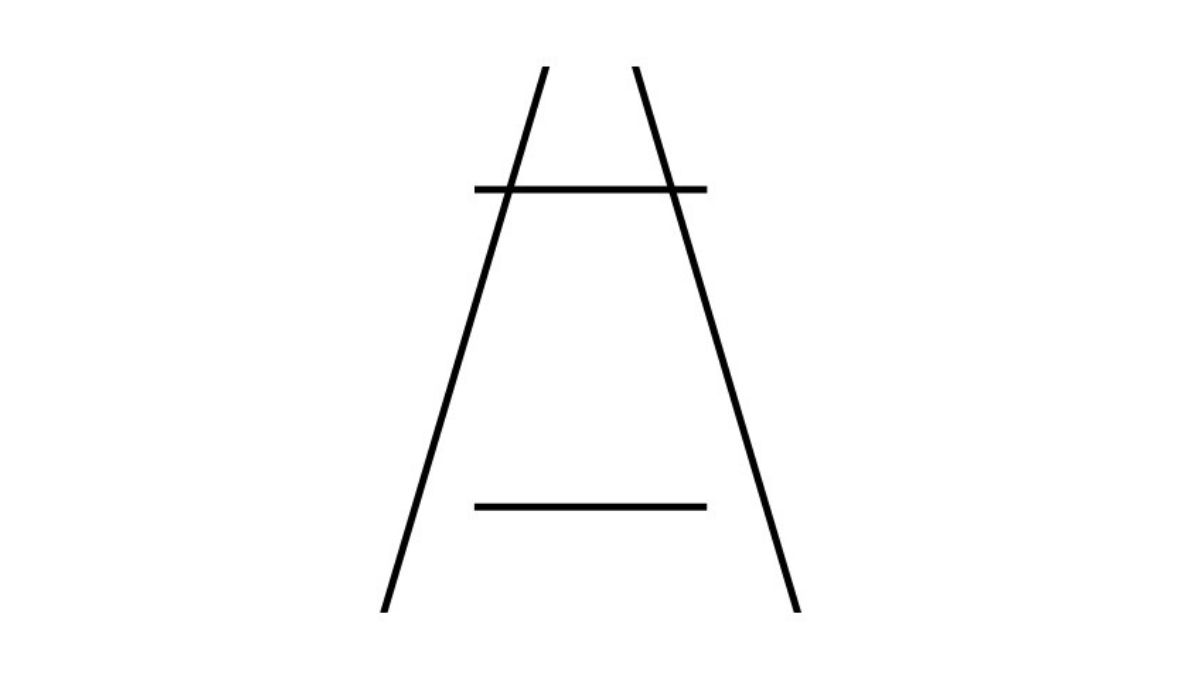
Ponzo illusion
An illusion of size in which two objects of equal size that are positioned between two converging lines appear to be different in size. Occurs because you can’t help using depth cues telling you that the top bar must be bigger
17
New cards
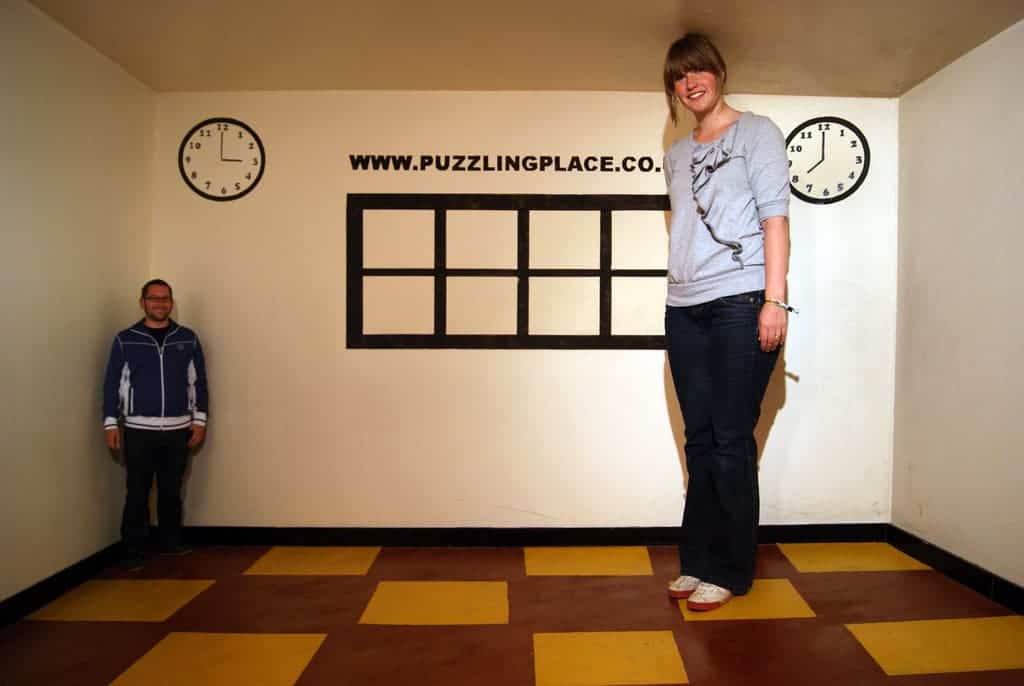
when do you lose size constancy scaling?
if the depth cues are missing or misleading (ex: Ames room)
18
New cards
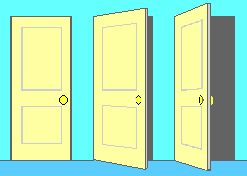
shape constancy
the tendency to interpret the shape of an object as being constant, even when its shape changes on the retina
19
New cards
how is shape constancy achieved?
depth factored in when interpreting object shape
20
New cards
spatially serial
one area at a time
21
New cards
spatially parallel
everywhere at the same time
22
New cards
three stage model of object perception
stage 1: low level vision
stage 2 : visual routines
stage 3: visual cognition
stage 2 : visual routines
stage 3: visual cognition
23
New cards
low level vision
recognizing simple features using a bottom-up approach and finding discontinuities (differences in brightness or colour to define edges) in a spatially parallel field
24
New cards
what happens without change
object becomes invisible if it stays on the same spot of the retina fro too long (ganzfeld)
* our eyes have a slight shiver to prevent this
* our eyes have a slight shiver to prevent this
25
New cards
Gestalt principles of organization
similarity
proximity
continuity
closure
connectedness
proximity
continuity
closure
connectedness
26
New cards
things that influence seeing figures
* figure is more likely to be seen is low in visual field
* figure has high spatial frequency information
* figure is more likely convex
* figure is meaningful or fits expectations
* figure has high spatial frequency information
* figure is more likely convex
* figure is meaningful or fits expectations
27
New cards
visual routines
focusing on one area at a time (spatially serial) to attend to the object
28
New cards
overt orienting
when we want to attend to something we make an eye movement toward that item so we can have the image of the object fall on the fovea in order to see things in high detail (slower, after)
29
New cards
covert orienting
the movement of attention from one location to another without moving the eyes/body (faster, first)
30
New cards
advantages of attending to something
* attended thing is seen more quickly and accurately
* seen in higher detail
* seen in higher detail
31
New cards
Tichener's Law of Prior Entry
if two things happen at the same time, the thing you were attending to seems to happen first
32
New cards
visual cognition
The ability to process visual information through top down processing by integrating to form object recognition.
where object file for current scene is matched to a representation in long term memory to see if the object is recognized as something that has been seen before (ex. last time I saw a black fluffy thing it was a dog)
where object file for current scene is matched to a representation in long term memory to see if the object is recognized as something that has been seen before (ex. last time I saw a black fluffy thing it was a dog)
33
New cards
problem in visual cognition
the retinal image is ambiguous. there may be many interpretations
34
New cards
Helmholtz
perception as unconscious inference
35
New cards
Ullman
visual routines are operations carried out on the image used to derive the spatial relations between selected parts of an image
36
New cards
illusory conjunctions
when attributes of one object drift onto another (ex. gun focus in eye witness testimonies) (ex. seeing a woman + a man with a beard, thinking you saw a woman with a beard)
37
New cards
integrative agnosia
can't combine attributes to make an object file (spatial relation problems)
ex: person trying to draw a person but the body parts are not connected properly
ex: person trying to draw a person but the body parts are not connected properly
38
New cards
Simutagnosia (Balint's Syndrome)
inability to perceive more than one object at a time
39
New cards
real motion
actual motion of an object
40
New cards
apparent motion
static motion ex: tv
41
New cards
disco stroboscopic effect
the strobe lights has an affect on the perception of movement. During the flash you see one image and when the flash is off you do not see it and then it flashes again and you see a new image
42
New cards
depth perception
ability to judge distance and 3D relations
43
New cards
visual angle
area covered on the back of the retina
44
New cards
atmospheric perspective
a lighting-based depth cue - the farther away an object is, the more air the light must pass through to reach us and the more that light can be scattered, with the result that distant objects appear less distinct than nearby objects
45
New cards
texture gradient
object elements get more condensed the further you are
46
New cards
binocular cues
clues about distance based on the different views of the two eyes
47
New cards
stereoscope
a device for presenting one image to one eye and another image to the other image
48
New cards
stereopsis
three-dimensional vision
49
New cards
autostereogram
person fuses different parts of the same picture to achieve 3D perception
50
New cards
oculomotor
cues based on our ability to sense the position of our eyes and the tension in our eye muscles
51
New cards
convergence cues
inward movement of the eyes when we see close up things
52
New cards
strabismus
crossed eyes
53
New cards
non-corresponding points
images of the objects that are not on the horopter
54
New cards
binocular depth cues
neutrons that respond to absolute disparity
55
New cards
absolute disparity
the visual angle between the images of an object on the two retinas
56
New cards
size constancy
Our perception of an object stays relatively constant, even at different distances (we don't believe someone got shorter when they are farther away)
57
New cards
misapplied size constancy scaling
doesn't work in a 2D image
58
New cards
Ponzo Illusion
An illusion of size in which two objects of equal size that are positioned between two converging lines appear to be different in size. Also called the railroad track illusion.
59
New cards
moon illusion
An illusion in which the moon appears to be larger when it is on or near the horizon than when it is high in the sky.
60
New cards
apparent distance theory
things on the horizon appear larger and get smaller as they raise vertically
61
New cards
Panum's fusion
fuse left and right image to get 3D
62
New cards
binocular rivalry
the competition between the two eyes for control of visual perception, which is evident when completely different stimuli are presented to the two eyes
63
New cards
Cheshire Cat illusion
an example of binocular rivalry
64
New cards
Ambylopia
lazy eye causing the other eye to lose some portions of vision
65
New cards
who doesn't see the tilt after effect
people without binocular vision
66
New cards
what type of visual deprivation is damaging
early deprivation
67
New cards
ocular dominance columns
cortical columns consisting of neutrons that receive signals from the left eye only or right eye only
68
New cards
visual scanning
movement of the eyes from one location or object to another
69
New cards
fixation
focusing on one object or person to recognize it
70
New cards
saccadic eye movement
a rapid, jerky movement from one fixation to another
71
New cards
how many times per second do you move your eye
3 times
72
New cards
overt attention
attention that involves looking directly at the attended object
73
New cards
covert attention
attention without looking
74
New cards
visual salience
areas of stimuli that attract attention due to their properties/difference from background
75
New cards
attentional capture
attention involuntarily drawn to something
76
New cards
salience map
a spatial layout that emphasizes the most behaviourally relevant stimuli in the environment
77
New cards
scene schema
knowledge of what a given scene typically contains
78
New cards
attention is influence by...
goals and interests
79
New cards
spatial attention
attention to a specific location
80
New cards
Posner
information processing is more effective at place where attention is directed
81
New cards
illusory conjunction
combinations of features from different stimuli
82
New cards
Balint's syndrome
a conditions caused by brain damage in the parietal lobe in which a person has difficulty focusing attention on individual objects
83
New cards
visual search
looking for a target object amongst other objects
84
New cards
conjunction search
scanning display in search of specific location
85
New cards
dual-task procedure
an experimental procedure in which subjects are required to carry our simultaneously a central task that demands attention and a peripheral task that involves making a decision about the contents of a scene
86
New cards
visual agnosia
inability to recognize objects
87
New cards
Simultagnosia
inability to perceive more than one object at a time
88
New cards
grouping by Pragnaz
every stimulus is seen as simply as possible
89
New cards
akinetopsia
motion blindness
90
New cards
image displacement signal
In corollary discharge theory, the signal that occurs when an image moves across the visual receptors.
91
New cards
motor signal
In corollary discharge theory, the signal that is sent to the eye muscles when the observer moves or tries to move his or her eyes.
92
New cards
corollary discharge signal
a copy of the motor signal that is sent to the eye muscles to cause movement of the eye. The copy is sent to the hypothetical comparator of corollary discharge theory
93
New cards
motion perception beings in which part of the brain
the striate cortex
94
New cards
swinging room experiment
optic flow created by walls hanging from chains. showed optic flow information is very important to balance;
misleading optic flow information can cause babies to fall over and adults to sway and have to brace themselves
misleading optic flow information can cause babies to fall over and adults to sway and have to brace themselves
95
New cards
stroboscopic motion
illusion of apparent movement; result from flashing a series off still pictures in rapid succession
96
New cards
Aubert-Fleischl Effect
underestimate speed and distance when tracking
ex: the clock pendulum
ex: the clock pendulum
97
New cards
where does the neural processing of motion start?
magno cells
98
New cards
corollary discharge theory
when we decide to move our eyes, the motor cortex sends signal to eye and a copy to the comparator
99
New cards
sound is…
mechanical energy: pressure waves (molecules pushing against one another)
100
New cards
compression
particles are close together
 Note
Note  Flashcards (46)