U1 Ch 3 - Livestock Reproduction - VET 217 Large Animal
 Studied by 0 people
 Call Kai
 Learn
Learn Practice Test
 Spaced Repetition
 Match
Match Flashcards
 Knowt Play
1/77

There's no tags or description
Looks like no tags are added yet.
Name | Mastery | Learn | Test | Matching | Spaced | Call with Kai |
|---|
No analytics yet
Send a link to your students to track their progress
78 Terms
What is absolutely essential for the success of any livestock operation?
Reproductive efficiency.
What is the ultimate goal of the large animal industry from a reproductive perspective?
To deliver a live neonate.
What is required to produce a live neonate, while being economically profitable?
Selection of superior animals for breeding;
Successful breeding, usually accomplished with estrous cycle determination and reproductive examination;
Successful conception using multiple breeding systems (in vitro fertilization, embryo transfer, artificial insemination, and live cover);
Successful implantation, which can be confirmed with the use of pregnancy detection;
Successful gestation;
Successful parturition.
What are some kinds of breeding systems that are closely related?
Inbreeding, crossbreeding, pure-breeding, outcrossing, & grading up.
Inbreeding?
Mating of 2 animals that are closely related.
Linebreeding?
Mating of several generation of offspring to particular animals or their descendants.
Crossbreeding?
Mating sires of one breed to dams of another.
Pure-breeding?
Mating of 2 animals of the same breed.
Outcrossing?
Practice of breeding animals from different families within the same breed (eg. for genetic diversity or line prestige).
Grading up?
Practice of breeding a grade animal to a purebred animal (eg. breeding Black Angus bulls to Brahman cows to create Brangus cattle, combining Angus meat quality with Brahman heat tolerance).
Broad ligaments?
Part of female anatomy that support the reproductive tract.
Ovaries?
Part of female anatomy responsible for developing follicles that produce oocytes.
Oviducts?
Connect ovaries to the uterus.
Endometrium?
Inner lining of the uterus.
Cervix?
Connects the uterus & vagina.
Vestibule?
Region behind the urethral opening that is a common passageway for both the urinary & reproductive systems, containing the suburethral diverticulum in cows & sows.
Suburethral diverticulum?
Blind pouch within the vestibule, just behind the urethral opening in cows & sows.
Vulva?
External genitalia.
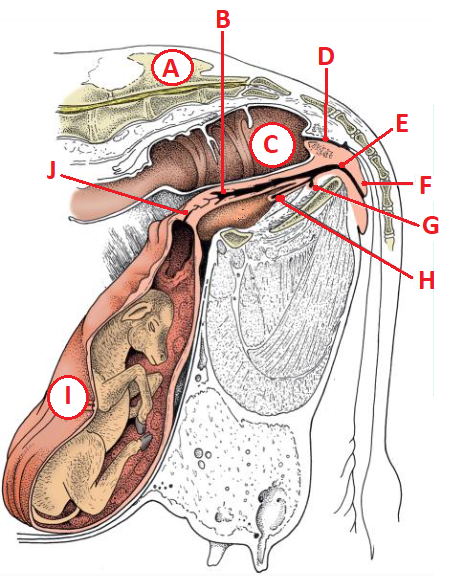
A = Sacrum
B = Vagina
C = Rectum
D = Anus
E = Vestibule
F = Vulva
G = Suburethral diverticulum
H = Urethra
I = Uterus
J = Cervix
Which stages does estrous typically involve?
Proestrus, estrus, metaestrus, diestrus.
Proestrus?
Begins with a decrease in progesterone, follicles develop on the ovary & follicular fluid, then estrogen starts to increase.
Estrus?
High estrogen triggers release of luteinizing hormone, which then triggers follicle rupture & ovulation.
Metestrus?
Production of progesterone begins after the prior stages of follicle rupture & ovulation, loss of follicular fluid, & estrogen decreases.
Diestrus?
If pregnant, progesterone increases & is produces until the end of gestation;
If not pregnant, prostaglandin will surge, the corpus luteum lyses, & progesterone begins to decline, resulting in a return to proestrus.
Ureters?
Where urine travels into the bladder from the kidneys.
Epididymis?
Tubular structure that stores, matures, & transports sperm from the tests to the vas deferens.
Vas deferens (aka deferent duct)?
Transports mature sperm from the epididymis to the urethra during ejaculation.
Seminal vesicle (aka vesicular gland)?
Secrete fluid that becomes mixed with sperm during ejaculation, providing sperm with energy (fructose) and creating an alkaline environment to protect them in the female reproductive tract.
Ampulla of the vas deferens?
Connects the vas deferens & seminal vesicle to create the ejaculatory duct.
Prostate?
Produces a seminal fluid that is secreted by the seminal vesicle.
Bulbourethral gland (aka Cowper’s gland)?
Located near the base of the penis & secretes a clear, lubricating mucus during sexual arousal, which neutralizes acidic urine residue in the urethra to protect sperm and helps lubricate the urethra for ejaculation.
Sigmoid flexure of the penis?
S-shaped curve in the penis of swine & many ruminants (bulls, rams, goats, etc.) that allows it to retract inside the prepuce when not erect, then straighten & extend out for copulation.
Glans penis?
Tip or head of the penis, containing the urethral opening.
Ischiocavernosus?
Perineal or pelvic muscle that contributes to penile rigidity during erection & aids other muscles during ejaculation & bladder emptying.
Retractor penis?
Muscle that holds the sigmoid flexure’s s-shape when the penis is not erect; relaxation of this muscle results in erection.
Scrotum?
External sack that holds both testicles & keeps them thermoregulated.
Testicles?
Responsible for spermatogenesis & made up of seminiferous tubules.
Prepuce?
Protective sheath covering the penis.
What are the male accessory sex glands?
Responsible for producing seminal fluids, including the vesicular gland, prostate gland, & bulbourethral (aka Cowper’s) gland.
Which accessory sex gland do male camelids (like llamas & alpacas) lack?
Vesicular glands.
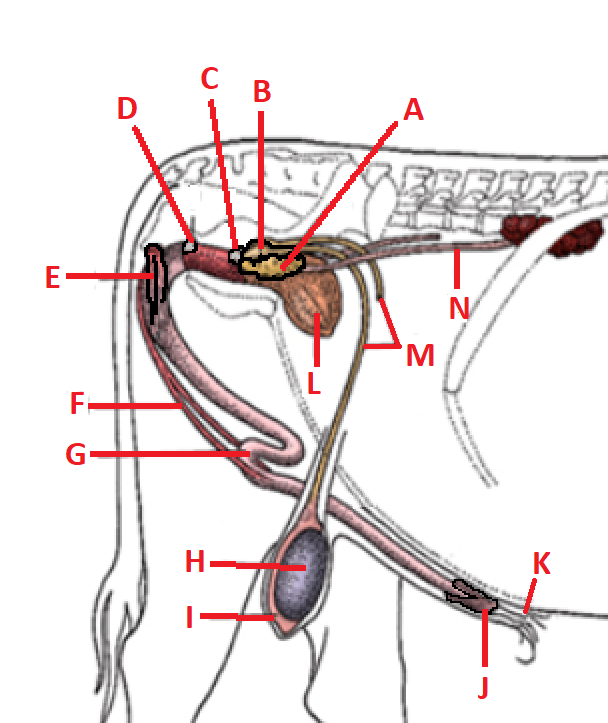
Bull.
A = Seminal vesicle (aka vesicular gland)
B = Ampulla of vas deferens
C = Prostate
D = Bulbourethral gland (aka Cowper’s gland)
E = Ischiocavernosus
F = Retractor penis
G = Sigmoid flexure of penis
H = Testicle
I = Epididymis
J = Glans penis
K = Prepuce
L = Bladder
M = Vas deferens (aka deferent duct)
N = Ureter
Spermatogenesis?
Process of making sperm, which takes place in the seminiferous tubules of the testis.
Phases of spermatogenesis?
Proliferation = cellular division; meiotic = genetic diversity; & differentiation = head, midpiece, & flagella.
Where is sperm released into? And where are they transported & stored?
Released into the lumen of the seminiferous tubules, then transported to the epididymis, where they continue to mature and are stored until ejaculation.
What is the primary goal of a breeding soundness evaluation (BSE)?
To evaluate the current state of fertility of an individual, with the realization that many factors can affect fertility.
What may be examined during a BSE?
Exam of external genitalia, sperm analysis, rectal exam of internal accessory glands, general health exam, & physical ability to breed females.
What are the 3 ways to collect semen?
Electroejaculator, artificial vagina, & natural stimulation.
Penile paralysis?
Inability to retract the penis into the prepuce as a result of nerve or muscle injury.
Phimosis?
Inability to extend the penis from the prepuce.
Parphimosis?
Inability to retract the penis back into the prepuce.
Priapism?
Prolonged erection unrelated to sexual desire.
What is included in a semen analysis?
Gross appearance, sperm motility, volume, grading, individual sperm motility, sperm concentration, total number of sperm, sperm morphology & primary vs secondary, live sperm percentage, & pH.
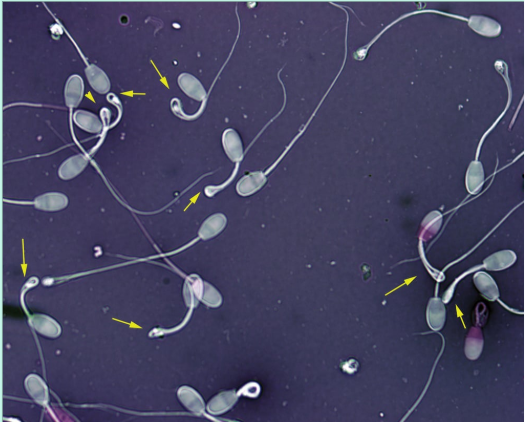
Distal mid-piece defect, often caused by stress, heat, or genetics.
What kind of information should gather for a patient history during a female reproductive exam?
Prior fertility, pregnancies, estrous cycle, illness, injury, current & previous medications, etc.
How should you prepare the external genitalia & structures during a female reproductive exam?
Wrap the tail & clean the perineum with soap & water.
What is the most common cause of infertility in mares?
UTI, which is usually silent with minimal or no external signs.
How can pregnancies be detected?
Rectal palpation, ultrasound via rectum, transabdominal ultrasound, doppler ultrasound, external palpation, abdominal radiographs, & laboratory tests.
What is not a reliable indication of pregnancy?
Failure to return to estrus or heat, which may indicate conditions other than pregnancy.
Horse pregnancy rectal palpation?
Can be detected as early as 18 to 21 days, but usually easier to confirm by day 28.
Cattle pregnancy rectal palpation?
Can be detected as early as 25 to 30 days.
What is the most common method of detecting pregnancies in cattle?
Rectal palpation.
Sheep pregnancy rectal palpation?
Can be detected as early as 60 days;
Female is placed on her back and a lubricated, palpation rod is inserted into the rectum, which is used to gently elevate & hold the uterus against the abdominal wall where it is palpated externally.
Goat pregnancy rectal palpation?
Palpation rods can be used, but is difficult & may result in rectal tears & abortions, since the female is likely to struggle while being restrained on her back.
Swine pregnancy rectal palpation?
Not commonly performed.
Horse pregnancy rectal ultrasound?
Can be detected as early as 10 to 12 days & is more reliable for confirming twins than rectal palpation.
What is the most common method of detecting pregnancies in horses?
Rectal ultrasound.
Cattle pregnancy rectal ultrasound?
Can be detected as early as 12 days.
Small ruminant pregnancy rectal ultrasound?
Can be detected as early as 18 days;
For sheep & goats a modified linear array probe for horses can be used, but may result in rectal tears.
Horse pregnancy transabdominal ultrasound?
Reliable method from about 80 days until term;
Performed through a clipped area on the ventral abdomen cranial to the mammary glands.
Sheep & goat pregnancy transabdominal ultrasound?
Can be detected as early as 35-45 days, but >90% accurate after day 60;
Performed while standing & clipping is often necessary.
What is the most common method of detecting pregnancies in small ruminants?
Transabdominal ultrasound.
External palpation (cattle)?
Aka ballottement; not highly reliable;
Requires a fetus of substantial size to be “bumped” with the hands through the abdominal wall, which then rebounds and gives a characteristic “bump” back against the operator’s hands, which have remained on the body wall;
Cattle should be beyond 6 to 7 months.
Heat detection?
Monitoring animals for estrous status.
Lordosis?
Characteristic standing response seen in some animal during estrus, where the female postures herself in a way that will allow males to mount.
What are some methods used for heat detection?
Observation of lordosis, rectal palpation (common in horses in cattle), vaginal exam (most useful in horses), & rectal ultrasound (most accurate for determining a mare’s estrous stage & used in cattle for IVF & embryo transfer).
Live cover?
Physical (natural) mounting and breeding that occurs between males and females.
What are the stages of labor?
3 stages;
1 = preparatory,
2 = expulsion of fetus (aka delivery of neonate),
3 = expulsion of placenta.
What are some clinical signs of impending parturition?
Swelling of vulva, relaxation of the muscles & ligaments of the hindquarters & tail head, thick mucus discharge from the vulva, enlargement of the udder, & distension of the uterus.
 Note
Note  Flashcards (31)