Serious offending: Violent offedning
 Studied by 0 people
 Call Kai
 Learn
Learn Practice Test
 Spaced Repetition
 Match
Match Flashcards
 Knowt Play
1/42

There's no tags or description
Looks like no tags are added yet.
Name | Mastery | Learn | Test | Matching | Spaced |
|---|
No study sessions yet.
43 Terms
What is violence?
Self-directed violence
interpersonal violence
collective violence
What is interpersonal violence?
A result of aggression, the direct, often face to face actions of an individual, including acts of neglect, which inflicts emotional, phycological, and physical harm on other people… may be carried out with premeditation or in the heat of the moments.
What is reactive aggression?
sometimes called hostile aggression
impulsive acts of violence
negative affect such as anger
What is proactive aggression?
Sometimes called instrumental aggression
premeditated acts of violence
carried out of achieve a gaol e.g., financial gain, revenge
What is murder?
Criminal homicide- causing the death of another person without leage justification or excuse.
Murder-unlawful killing of one human being by another with malice aforethought, either expressed or implied.
Malice aforethought- premeditation or mental state of a person who thinks ahead, plans, and voluntarily causes the death of another without legal justification
How to measure interpersonal violence?
There are two main sources
Crime survey of England and Wales (CSEW)
Police recorded crime- office for national statistics (ONS)
What is crime survey of England and Wales CSEW?
physical violence with injury
physical violence without injury
What is police recorded crime- office for national statistics (ONS)?
violence against the person
homicide
death or serious injury caused by unlawful driving
violence with injury
violence without injury
stalking and harrassment
What are trends in violent crimes?
7% decrease in violence with injury compared to previous years.
other sources such as the national violence surveillance network estimated that 145,217 people attended emergency units iin England and Wales for treatment of violence injuries in 2024.
2.4% high than in 2023, 31% lower than in 2014.
What are sex differences in violent offence characteristics? Male victims
perpetrators have more transient relationships with victims
strangers and acquaintances are more likely to be perpetrators than relatives or partners.
violence/homice more likely to occur outside the home
younger males are more likely to be victim of violent crimes in deprived areas of England.
What are sex differences in violent offence characteristics? Female victims
perpetrators more likely to have closer more initimate relationships with victims.
most commonly partners/former partners, relative, followed by acquaintances/strangers.
violent/homicide more likely to occur within the home
what does police data say about circumstances of homicide: police data?
most homicide result for a quarrel, revenge attack, or loss of temper (54%), which is more common when the suspect is known to the victim(67%)
36% of victims and 32% of suspects under the influence of alcohol and/or illicit drugs at the time of homicide.
56% of homicide involved either drug users or dealers (14% increase over 10 years)
Only 6% of homicides theft-related, and 4% related to ‘irrational acts”
What are the homicide trends in England and Wales?
535 homicides in year ending March 2025
Percentage of female victim fell (10%)
Teenage victims more likely to be killed by a sharp instrument (83%) than other age groups (46%).
What are global homicide trends?
In 2021, global homicide rate 58 per million
Highest rate of homicide in America (150 per million); largest rate in the world being Honduras (383 Per million)
40% of all homicides involved a firearm, 22% involved knives/sharp objects.
How do we explain interpersonal violence? Allen, Anderson & Bushman, 2018
General aggressive model
seeks to explain elements of an ongoing social interaction that influences the occurrences of aggression
Distal and proximate processes.
what are at play in a social encounter that may or may not interact with social violence
Distal processes are existing
proximate- Currently going on in the social encounter and transaction.
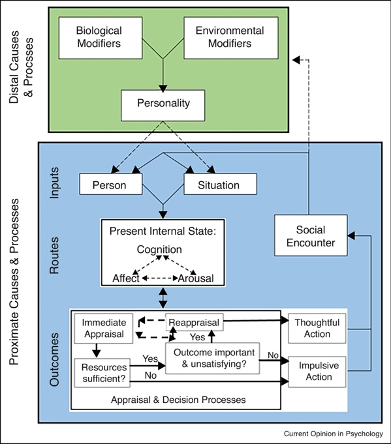
What are DISTAL FACTORS?
Pre-exist the situation that could unfold- our personality broken down to:
Biological modifiers (e.g., testosterone (dominance there is a testosterone rise when a team is winning in sports- dominant hand gestures preparation of aggression), serotonin (testosterone promotes aggression, serotonin prohibits), impaired executive functioning (developmental, structural/functional issues or brain injury))
Environment modifiers (e.g., cultural norms (certain acts of violence are seen as normal or seen was horrible crimes), familial/home environment (genetic or environmental), life conditions, deprivation (people who come from lower socioeconomic background might have greater risk of perpetrating violence), peer groups, group conflict, chronic exposure to violence- brought up in a home where violence and aggression is the norm).

What is general aggressive model: INPUTS
What is the input from a person.
Personal factors
Personality traits
Sex- males
Beliefs- beliefs of violence (self-efficacy) stronger men will have greater self efficacy because they ‘back themselves’
Attitudes-
Values- might be an honourable thing
Goals
Situational factors:
Aggressive cues (e.g., presence of weapons)
Provocation
Frustration of goals
Pain and discomfort (e.g., temperature, noise)
Drugs

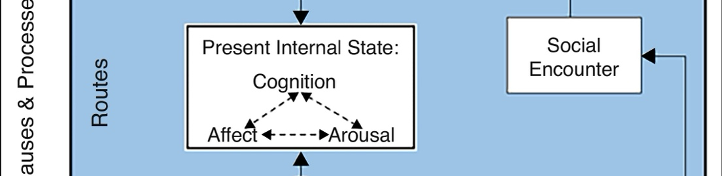
What is general aggression model: ROUTES
The person and situational factors influence the present internal state in though interconnections between cognitions, affect, and arousal.
Cognition
Aggressive/hostile thoughts; scripts
Affect
Mood and emotion (e.g., anger)
Arousal
Energised or provoked to anger/aggression
What is general aggression model: OUTCOMES
Immediate (automatic) appraisal and reflects ongoing thoughts about a situation.
how they appraise action and if this is immediate or prolonged.
if there is time in-between appraisal they are likely to re-consider.
If time allows and immediate appraisal is unsatisfying, reappraisal will begin. Otherwise, impulsive action is the result.
Reappraisal is more rational, considering alternative views,
Can still result in aggression.
can results is a thoughtful or impulsove action
if someone bumps into you - initially could interpret this as aggression or if you take extra time to think this could mean its busy and is likely to happen.
this action will affect the social encounter and the process will start over again,
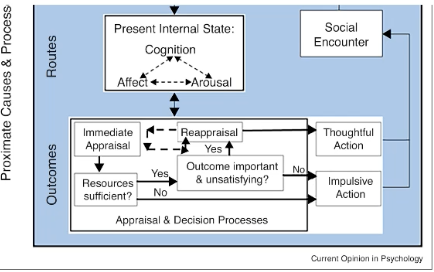
what is the cycle of the general aggression model?
- Integration of numerous interconnected factors.
- These may or may not evaluate in an aggressive act.
- Social encounter feeds back into distal processes.
The blue cycle will continue.
how actions can fed back into the situation.
What are distal causes: genetic influences?
Multiple genes acting combination, results in varying degrees of genetic predisposition to criminal behaviour in the total population (Raine, 1993)—nit concerned with a ‘criminal gene’, but how normal genetic variability may account for variations in behaviour.
- Exploring whether criminals are born leads us to explore heredity using a biosocial approach.
1) family studies; 2) twin studies; 3) adoption studies
What are genetic studies: family studies?
Farrington et al (2001) investigated patterns of offending among close family.
less than 10% od the families accounted fr more than 40% of arrests in the stuyd.
fathers offending was the strongest predictor of younger male’s offending
replicated in a five-generation study Dutch families (Bijleveld and Wijkam, 2009).
particulalry string relationships for serious offending.
What is genetic influence: Twin studies?
The generic differences between identical and non-identical twins presents opportunities for (admittedly, very rare) natural experiments.
Rowe and Osgood (1984) estimates that genetic components accounted for over 60% of self-reported delinquency.
Kendler et al (2015) estimated heritability of criminal behaviour to be 45% (similar for violent, white- collar, and property crimes0
Shared environment effects were stronger for males (27%) than females (18%).
What is distal: Social learning?
Bandura (1977)- behaviour is acquired through reinforcement and punishment, in addition to the observation of models.
- Aggression/criminal behaviour reinforced by tangible rewards it may bring to the individual as observed in three contexts.
- Family influence.
- Perr influence.
- Cultural symbols (e.g., visual media such as films or video games).
Heilmann et al., 2021 – some forms of punishment increase problem behaviours over time.
What is distal: familial influences on aggressive attitudes and values?
- Evidence for temporal stability of aggression and hostile attributions
- (e.g. Huesman, Dubow, & Boxer, 2009; Kokko, et al., 2009; Temcheff et al., 2008)
- 10% of families responsible for 40% of arrests (Farrington et al., 1996, 2001)
- Father’s offending behaviour was the strongest predictor of boys’ offending
What is distal: maladaptive environments?
- Physical abuse associated with later violent offending in (Lansford et al., 2007; Fitton et al., 2018)
- Gershoff (2002) meta-analysed effects of corporal punishment
- Increased immediate compliance with parental demands.
- Increased aggression, delinquent behaviour, decreased moral internalisation and quality of parent-child relationship.
- More recent meta-analysis: witnessing parental violence associated with subsequent interpersonal aggression (Goncy, 2020).
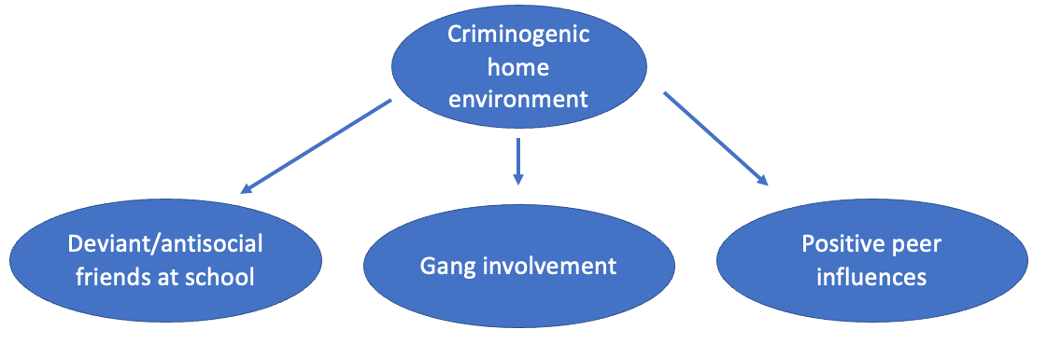
What is distal: pro-criminal influences?
promoting violence-
deviant/antisocial friends at school- home life can decide what friends you stay around- and if they are violent this violent behaviour is solidified.
gang involvement
positive peer influences- fsil to equipt children having a positive influence.
What is Distal: exposure to media?
‘Manfluencers’ and hypermasculinity/misogyny
- Honour ideology and hypermasculinity strong predictors of gun-ownership in male Americans (Matson et al 2017).
- Rottweiler et al (2024) – UK representative sample.
- Misogyny associated with willingness to engage in interpersonal violence, acceptance of violence against women, and violent extremist intention.
What are distal factors: psychopathic personality?
Cleckley’s Mask of Sanity (1941) provided criteria for psychopathy diagnoses (e.g., deceitfulness, egocentricity, failure to follow a life plan, grandiosity, flat emotion, inability to form deep connections, manipulativeness, superficial charm). a range of traits for psychopathy.
how psychopathic prisons are on the PCL measure.
Hare developed Psychopathy Checklist (PCL; PCL-R) which have dominated the field of psychopathy (Interpersonal; Affective; Lifestyle; Antisocial). they suggest crime is a core component of psycpathy.
key criticisms- In the Antisocial factor, Hare elevates criminality to a central feature of psychopathy.
Nonetheless, PCL-R scores strongly related to violence and reoffending (Hare et al., 2000).
Criticisms of Hare’s model of psychopathy…
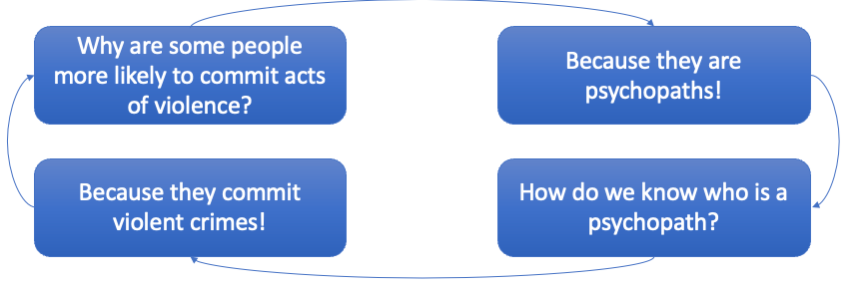
this idea creats a circle argument
high in psychopathy- they are psychopaths , know they are a psychopath because they commit violent crimes
However, many researchers have claimed that- amount other things- the use of PCL measures to predict violent offending is circular.
creating a cycle
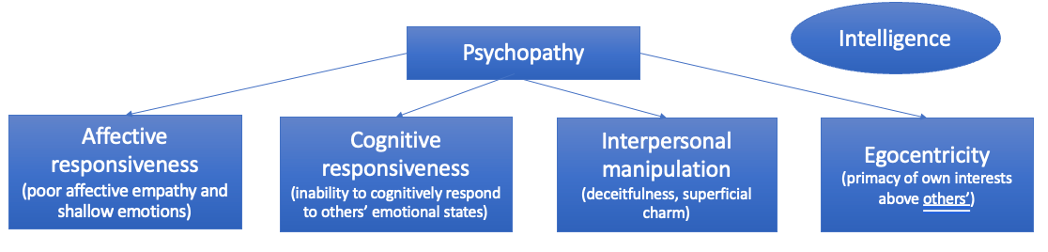
What is alternative modes of psychopathic personality? Boduszek 2018 (PPTM)
Boduszek et al., (2022) found different psychopathic personality dimensions associated with violence:
- Cognitive responsiveness – serial killings, homicide, weapon-related crimes, robbery
- Interpersonal manipulation – robbery, and a negative association with homicide
- Egocentricity – domestic violence
What are situational factors- substance/alcohol use?
- Drugs may increase preparedness for hostility, or affect internal state.
- Problematic drug use more strongly associated with IPV than alcohol (but both strongly associated; Cafferky et al., 2016).
Effect of problematic drug use invariant based on specific drug (i.e., amphetamines, cocaine, heroin/opiates, marijua
What is situational features- temperature?
Associations have been found but are not always straightforward:
Temperature and aggression within sport (Larrick et al., 2011)
- Increased retaliatory aggression when hot in baseball matches.
In Australia, hot temperatures associated with more violent offences (peaking around 30 degrees) reported of police (Stevens et al., 2024)
- This was the cause for domestic assaults, over violent acts, and sexual assaults.
What is situational factors: crowds?
- Violent crowds
- Lynching, rioting, vigilantism, and terrorism (de la Roche, 1996)
- Physical crowding
- Closed institutions
- Virtanen et al. (2011) – violent incidents in psychiatric inpatient units associated with the percentage of beds occupied
- Social action and riots
- Willmott et al., (2024) – different typologies of rioters (e.g., professional, revengeful, adventurer, victim-centric).
- Newly adopted (and dynamic) social identity?
What is situational factors: the presence of weapons?
- Penny, Walker & Gudjonsson (2011): S. Wales 16-18yrs school pupils
- Heightened wellbeing, confidence, increased personal power/self-defence, masculinity/cool
- Haylock et al. (2020): what increases likelihood of carrying weapons?
- Being a victim of knife crime, poor mental health, economic/social deprivation
- Brennan, Moore & Shephard (2010): adult male convicted violent prisoners
- Weapon users – more extensive delinquency history, higher trait aggression, more risk seeking
What are the internal states: anger?
Novaco, 2000; 20011
- A negatively toned emotion- an aroused state of antagonism towards the sources of aversion
- Provoked situationally by events perceived to constitute deliberate harm.
- May directly impel violent behaviour or threats in the absence of self-regulatory controls.
What are individual factors: Psychopathy?
-Nederlof et al., 2013 – schizophrenia and other psychotic disorders related to criminal acts of violence.
-Review of studies with a large sample (N > 500)
-Strong odds ratios (ranged from 2-28)
-Elbogen et al., 2012 – PTSD among war veterans (particularly coupled with high levels of anger/irritability) associated with arrests.
-Factors such as being young, male, having arrest history, alcohol/drug misuse, witnessing parental violence all potential confounders.
What is management of violent offenders?
Boot camps; scared straight programmes. Multisystemic therapy
Duty as forensic psychologists to be able to reliably ascertain risk of recidivism
What are characteristics of violent offenders?
Piquero, Jennings, and Barnes (2012)
-Violent offenders do not tend to reoffend.
-Small core of persistent, long-term violent offenders but these are the exception rather than the rule.
-Career criminals tend not to commit violent crimes (although higher level of violence than general population).
-Onset of violent offending tends to be older than other crimes.
-
What is the level of risk of violent offenders?
-Small percentage of violent offenders persistent, frequent, and more violent (Polaschek et al., 2004).
-These offenders usually assessed as ‘high risk’.
-Polaschek & Collie 2004 – treatment programmes are either:
-One-factor programmes – anger management, cognitive skills
-Multi-modal
What did Joliffe and Farrington (2006) find?
-Excluded domestic and sexual violence offenders.
-Total of 11 studies published between
-Interventions were successful in reducing general and violent reoffending.
-Interventions that addressed cognitive skills, anger control, used role play, included relapse prevention and had offenders complete homework were more effective.
-More intensive, multi-modal treatments were more effective.
-Very little in terms of a specialist violent offender treatment programme at this point, and evidence pretty weak
What is treating violent offenders?
-Evidence base very small and limited.
-Therapeutic climate may not be optimal (e.g., overcrowded environments, substance uses).
-Difficult to measure effectiveness (i.e., recidivism, heterogeneity of violent offenders).
-Psychopathic offenders present a particular challenge.
-Some may not be ‘treatment ready’, e.g., verbal skills, denial
E.g., murderers very unlikely to reoffend anyway (around 40% were rearrested, and only 1-3% rearrested for another murder), but other violent offenders may be more likely to reoffend.
What is pathways to desistance?
-Most violent offenders only commit one crime.
-Violent offending tends to decline smoothly and steadily when offender reaches 30 years of age.
-Desistance factors:
-Bad consequences of arrest
-Decline in physical prowess
-Being contentedly married
-Involvement in adult institutions (i.e., family, military, community, work)
-Increase in serotonin with age, decrease of dopamine
-The belief that they can stop offending (Lloyd & Serin, 2012)
-
 Note
Note  Flashcards (42)