General Senses, Olfaction and Gustation lab requirements
 Call Kai
 Learn
Learn Practice Test
 Spaced Repetition
 Match
Match Flashcards
 Knowt Play
1/19

Earn XP
Description and Tags
A set of flashcards based on sensory receptors, olfaction, and gustation from the lecture notes.
Name | Mastery | Learn | Test | Matching | Spaced | Call with Kai |
|---|
No analytics yet
Send a link to your students to track their progress
20 Terms
Free nerve ending
A type of sensory receptor that detects pain and temperature.
Hair follicle receptor
A sensory structure that detects hair movement.
Tactile (Merkel) disc
Modified epithelial cells associated with nerve endings that respond to light touch.
Tactile (Meissner’s) corpuscle
A sensory receptor that responds to light touch and pressure.
Lamellar (Pacinian) corpuscle
A sensory receptor that responds to deep pressure and vibration.
Ruffini corpuscle
A sensory receptor that detects skin stretch and sustained pressure.
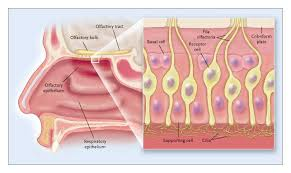
Olfactory epithelium
The sense of smell, involving olfactory receptor cells in the olfactory epithelium.
Olfactory receptor cells
Bipolar neurons in the olfactory epithelium responsible for detecting odorants.
Olfactory bulb
A structure in the brain where olfactory nerves synapse with neurons in the olfactory tract.
Gustation
The sense of taste, involving gustatory receptor cells in taste buds.
Taste buds
Structures containing gustatory receptor cells that detect taste.
Circumvallate papillae
Large papillae located at the back of the tongue, containing many taste buds.
Fungiform papillae
Mushroom-shaped papillae mostly located on the anterior part of the tongue, containing taste buds.
Foliate papillae
Papillae located on the sides of the tongue, containing taste buds.
Filiform papillae
Thread-like structures that cover most of the tongue; they do not contain taste buds.
CN VII Facial Nerve
Cranial nerve responsible for taste sensations from the anterior two-thirds of the tongue.
CN IX Glossopharyngeal Nerve
Cranial nerve responsible for taste sensations from the posterior one-third of the tongue.
CN X Vagus Nerve
Cranial nerve involved in taste sensations related to water receptors in the pharynx.
Trigeminal nerve
Cranial nerve that carries sensations of texture and temperature but not taste.
Anatomical and physiological basis of taste and smell interaction
Taste and smell work together because olfaction enhances flavor perception, as both senses activate at the same time.
Explore top notes

