lesson 70 Drugs Used in Reproduction
 Call Kai
 Learn
Learn Practice Test
 Spaced Repetition
 Match
Match Flashcards
 Knowt Play
1/39

Earn XP
Description and Tags
This set of flashcards covers the glossary of drugs used in reproduction, including their functions and applications.
Name | Mastery | Learn | Test | Matching | Spaced | Call with Kai |
|---|
No analytics yet
Send a link to your students to track their progress
40 Terms
GnRH Analogs
Induce estrus and synchronize ovulation in cattle, mares, and companion animals by stimulating the pituitary release of gonadotropins.
Follicle-Stimulating Hormone (FSH)
Employed in superovulation protocols to promote the development of multiple ovarian follicles.
Human Chorionic Gonadotropin (hCG)
Mimics the luteinizing hormone (LH) surge to trigger ovulation and support corpus luteum formation.
Equine Chorionic Gonadotropin/Pregnant Mare Serum Gonadotropin (eCG/PMSG)
Mimics FSH action and stimulates follicular development.
Prostaglandin F₂α Analogs
Induce luteolysis to regress the corpus luteum, synchronizing estrus cycles in cattle and other large animal breeding systems.
Progestins
Controls the estrous cycle by either maintaining or suppressing cyclicity; used for estrus synchronization and in pregnancy management across various species.
Oxytocin
Promotes uterine contractions during parturition and aids in postpartum milk letdown, critical for both large and small animal obstetrical management.
Dexamethasone
Utilized to induce parturition (especially in cattle) and to reduce inflammation within the reproductive tract; requires careful dosing to avoid adverse effects.
Melatonin
Regulates seasonal reproductive cycles by modulating the photoperiodic response, particularly in species such as sheep and goats that are seasonal breeders.
Cabergoline
Reduces prolactin secretion, beneficial in managing reproductive disorders—such as persistent corpus luteum issues or abnormal lactation—in various species.
HPG axis
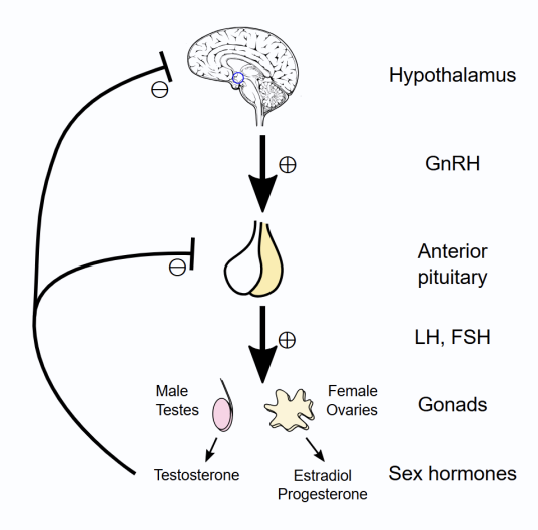
GnRH analogues
Gonadorelin, Buserilin, Deslorelin
GnRH analog role in reproduction
increases LH/FSH secretion→ follicular development and ovulation
GnRH usage
used in cattle for follicular regulation.
used in mares and bitches for estrus induction and ovulation
What else can GnRH treat besides ovulation induction
ovarian cysts, follicular cysts via LH release→ luteinization of cyst contraception via downregulation receptors
clinical use of gonadotropins (FSH/LH)
superovulation-multiple dominant follicles form in cattle and small animals
induction estrus in anestrus bitches and queens
considerations for gonadotropin usage
prolonged use leads to adverse effect like cystic endometrial hyperplasia
FSH and LH mechanism
-follicular development and estrogen production
and
-triggering ovulation
Human Chorionic Gonadotropin (hCG)
mimics LH, promotes ovulation and support luteal function
hCG usage
in mares for breeding
diagnostic stimularion to test testicular function (cyrptorchidism test)
Diagnostic usage hCG
take pre and post sample after injection and measure testosterone plasma lv. peak lv is expected within 6 hours
Prostaglandin
induces luteolysis and dissolves/regression corpus luteum→ lowers Progesterone levels allowing estrus cycle to reset
prostaglandin drugs
cloprostenol, dinoprost, tromethamine
prostaglandin usage in reproductive management
synchronize estrus cycles in cattle and other farm animal
pregnancy termination
progestins
controls estrous cycle and maintain pregnancy
contraceptive—> inhibits LH surge to prevent ovulation
estrus synchronization→ insert for couple days then remove→ surge or GnRH=increase LH and FSH
estrogens
induce estrus and treat ovarian dysfunction
risk of steroid hormones (progestins and esrtogens)
custic endometrial hyperplasia
in estrus synchronization protocol for cattle progestins are typically used to
extend the luteal phase to control cycle timing
progestins drugs
melengesrtol acetate-MGA
Controlled interal drug release device-CIDRs used to prevent ovulation and when removed synchronizes estrus follows
oxytocin
stimulate uterine contraction during parturition, promote milk letdown during lactation
glucocorticoid

