Plant Tissues, Reproduction, and Growth: A Detailed Overview | Quizlet
 Studied by 0 people
 Call Kai
 Learn
Learn Practice Test
 Spaced Repetition
 Match
Match Flashcards
 Knowt Play
1/99

There's no tags or description
Looks like no tags are added yet.
Name | Mastery | Learn | Test | Matching | Spaced | Call with Kai |
|---|
No analytics yet
Send a link to your students to track their progress
100 Terms
What forms a tissue in plants?
Similar cells working together.
What do different types of tissues form when they work together?
An organ.
What are the two distinct organ systems in vascular plants?
The shoot system and the root system.
What does the shoot system consist of?
Vegetative parts (leaves and stems) and reproductive parts (flowers and fruits).
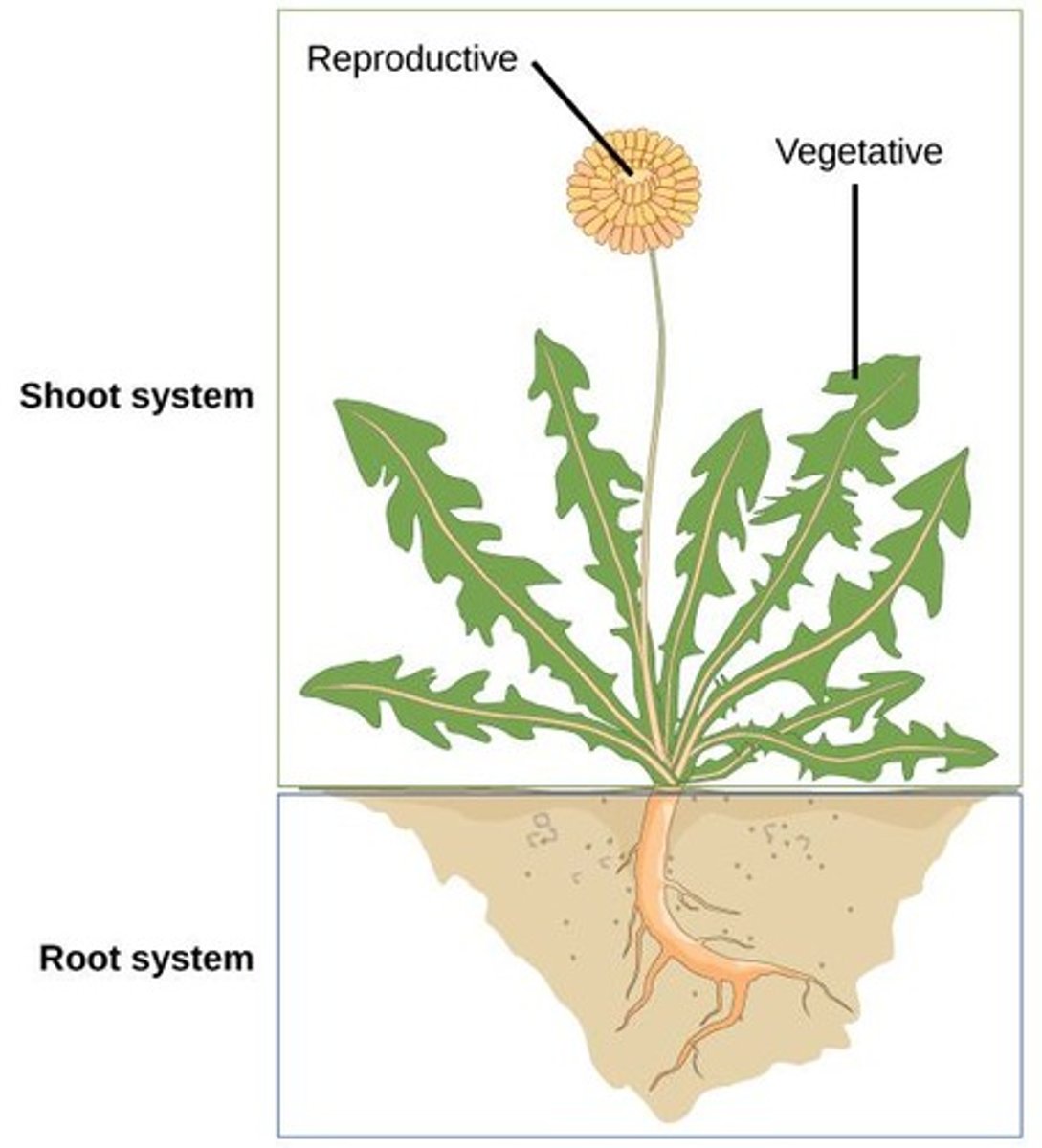
Where does the shoot system typically grow?
Above ground.
What is the primary function of the root system?
To support the plant and absorb water and minerals.
What are the two general types of plant tissue?
Meristematic tissue and permanent (non-meristematic) tissue.
What is the role of meristematic tissue?
It consists of cells that are actively dividing and growing.
What are the three types of meristematic tissues?
Apical meristems, lateral meristems, and intercalary meristems.
Where are apical meristems located?
At the tips of stems and roots.
What do lateral meristems facilitate?
Growth in thickness or girth of a maturing plant.
What is the function of intercalary meristems?
To enable growth in length from the base of leaf blades in some monocots.
What types of tissues do meristems produce?
Dermal, vascular, and ground tissue.
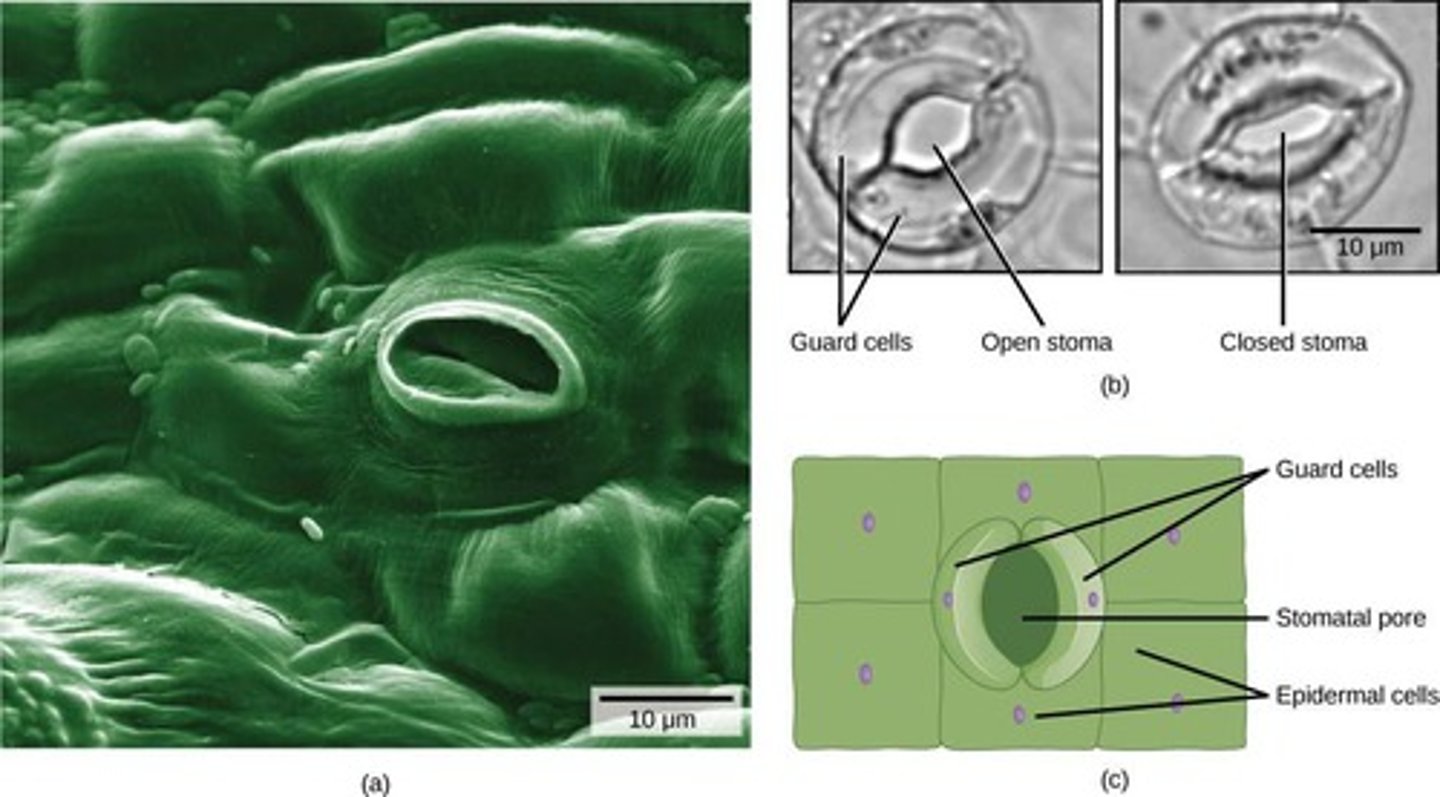
What is dermal tissue?
A simple tissue that covers the outer surface of the plant and controls gas exchange.
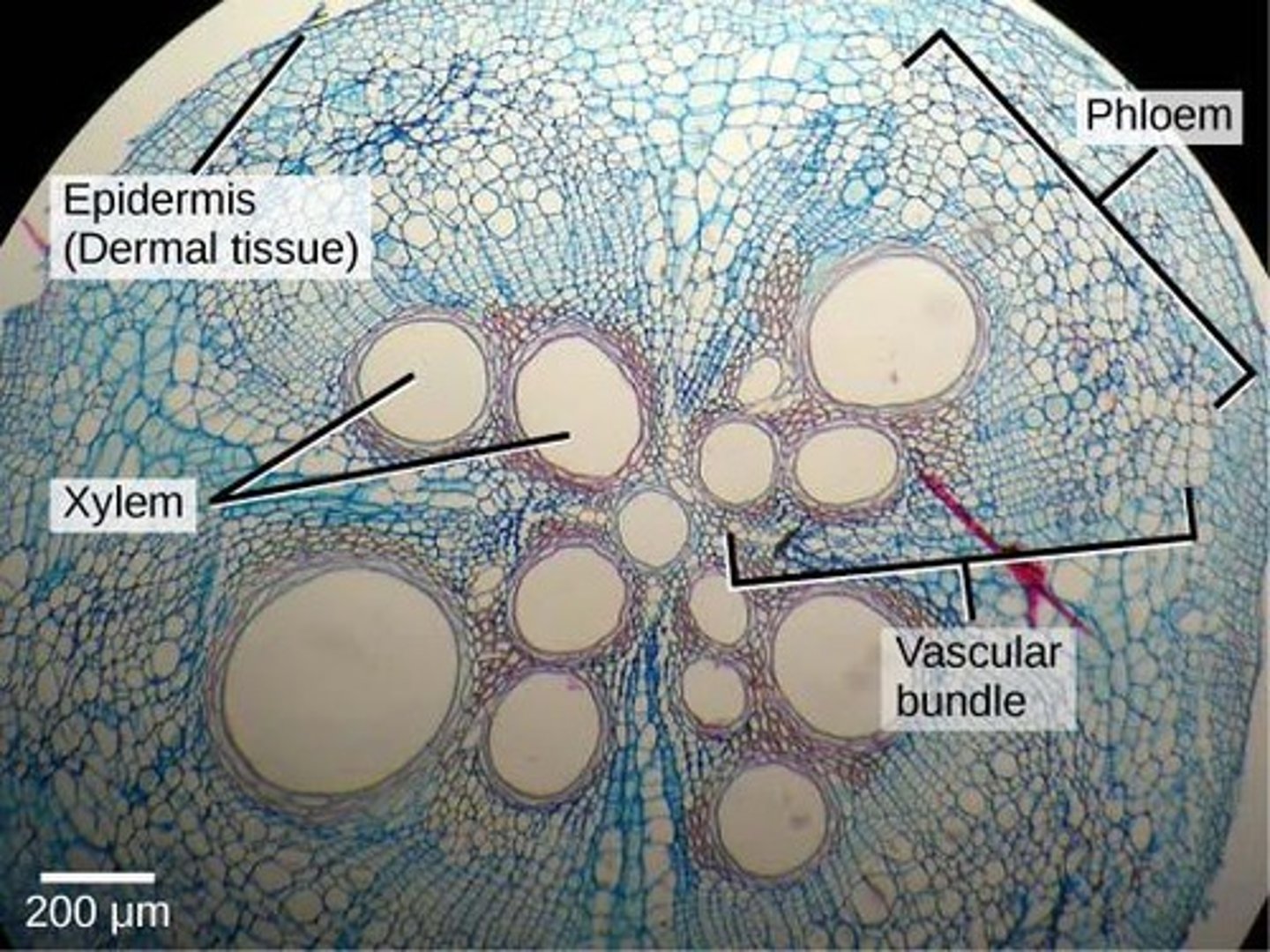
What is vascular tissue composed of?
Xylem and phloem.
What is the primary function of xylem?
To transport water and minerals throughout the plant.
What is the primary function of phloem?
To transport sugars throughout the plant.
What is ground tissue primarily made of?
Parenchyma cells, which provide sites for photosynthesis and storage.
What is the pith in ground tissue?
The tissue towards the interior of a stem or root.
What is the cortex in ground tissue?
The layer of tissue between the vascular tissue and the epidermis.
What is the main function of stems in plants?
To provide support and hold leaves, flowers, and buds.
What are nodes in plant stems?
Points of attachment for leaves, aerial roots, and flowers.
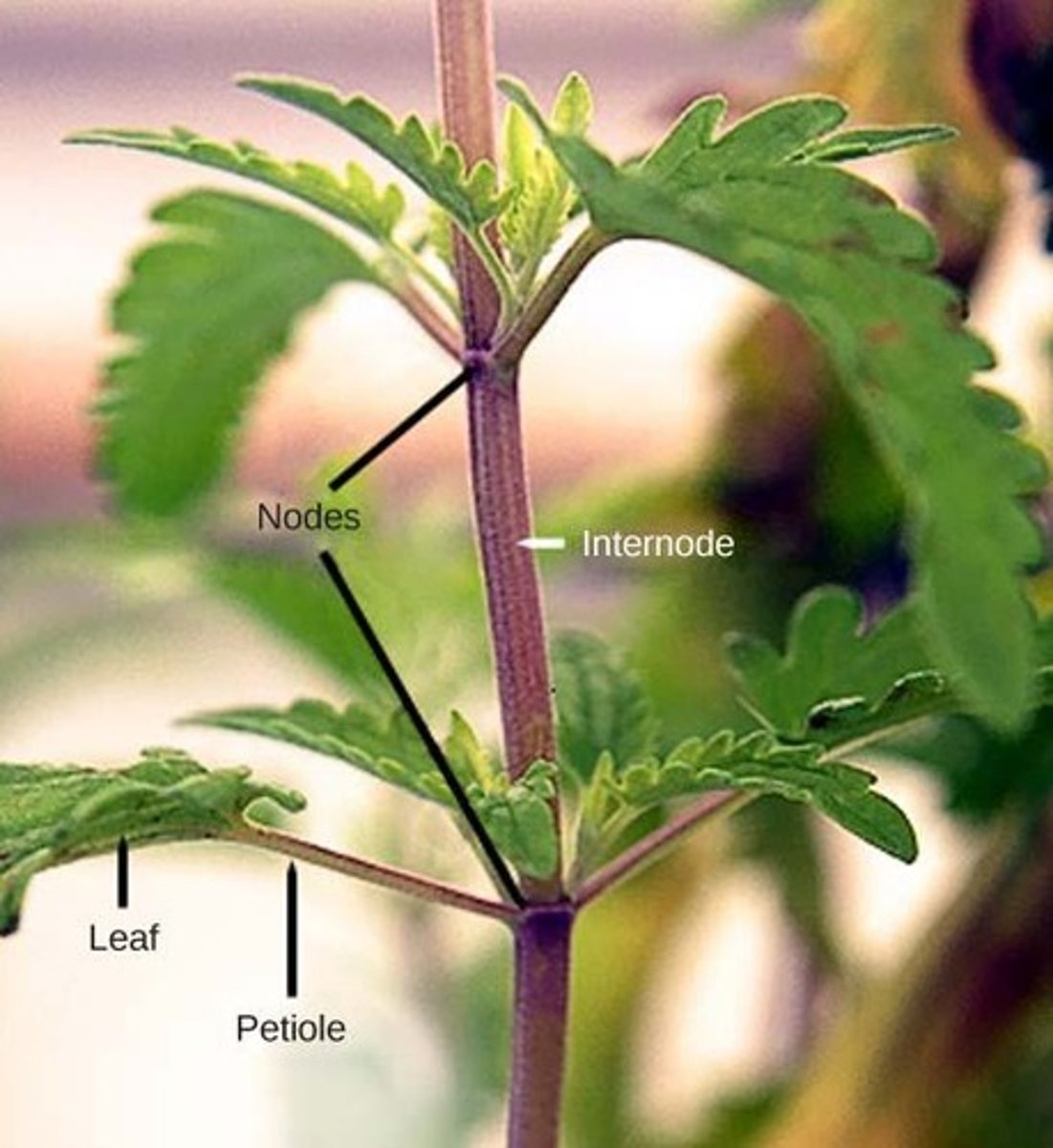
What is an internode?
The stem region between two nodes.
What is the petiole?
The stalk connecting the leaf to the stem.
What is the difference between primary and secondary growth?
Primary growth increases length, while secondary growth increases thickness.
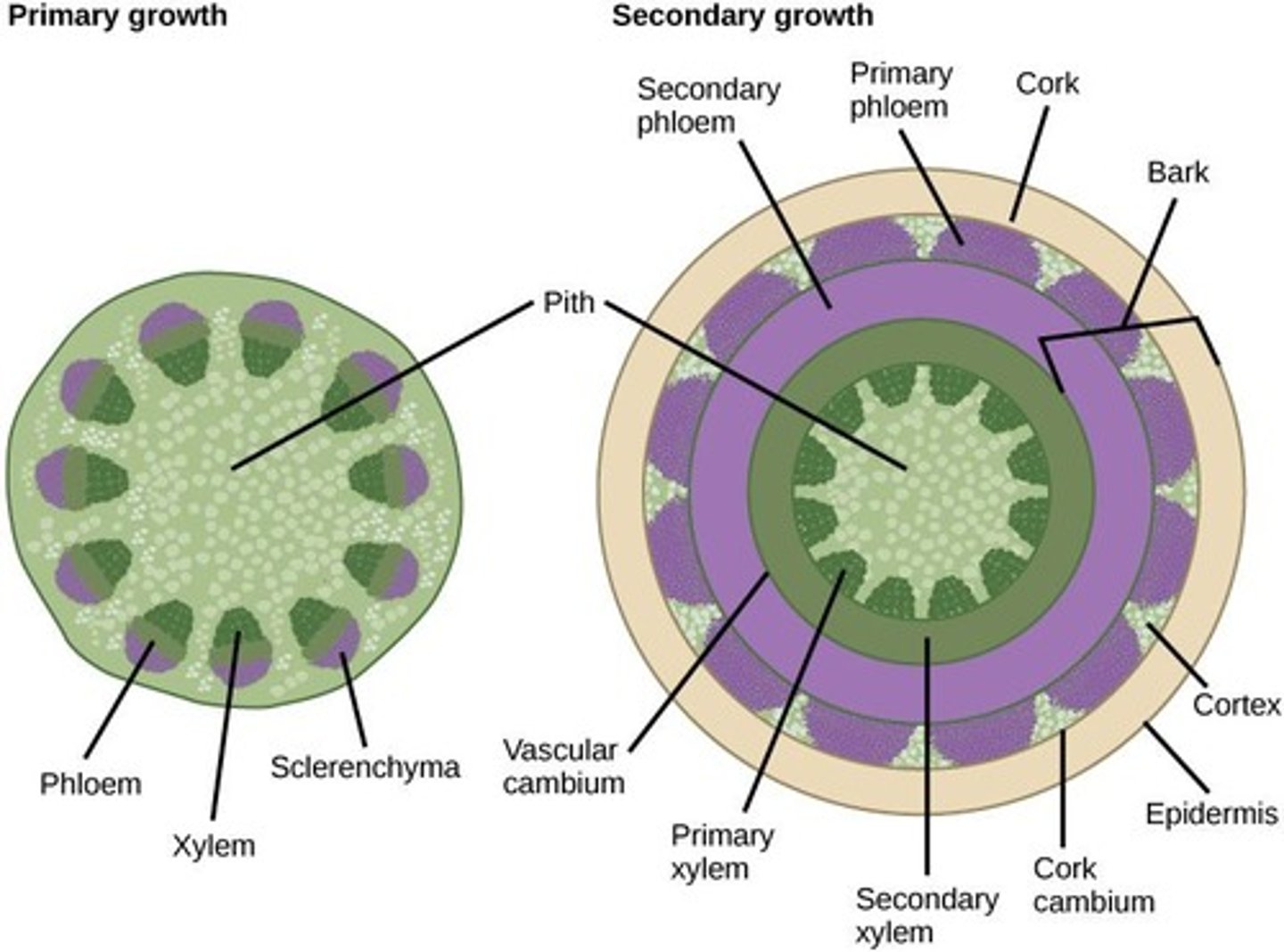
What type of growth do herbaceous plants primarily undergo?
Primary growth.
What is indeterminate growth in plants?
Growth that continues throughout a plant's life, such as in stems and roots.
What is determinate growth in plants?
Growth that ceases when a plant part reaches a particular size, such as leaves and flowers.
What are the three major functions of roots in seed plants?
Anchoring the plant to the soil, absorbing water and minerals, and storing products of photosynthesis.
What type of root system do eudicots typically have?
A tap root system.
What is the main characteristic of a tap root system?
It has a main root that grows down vertically with many smaller lateral roots arising from it.
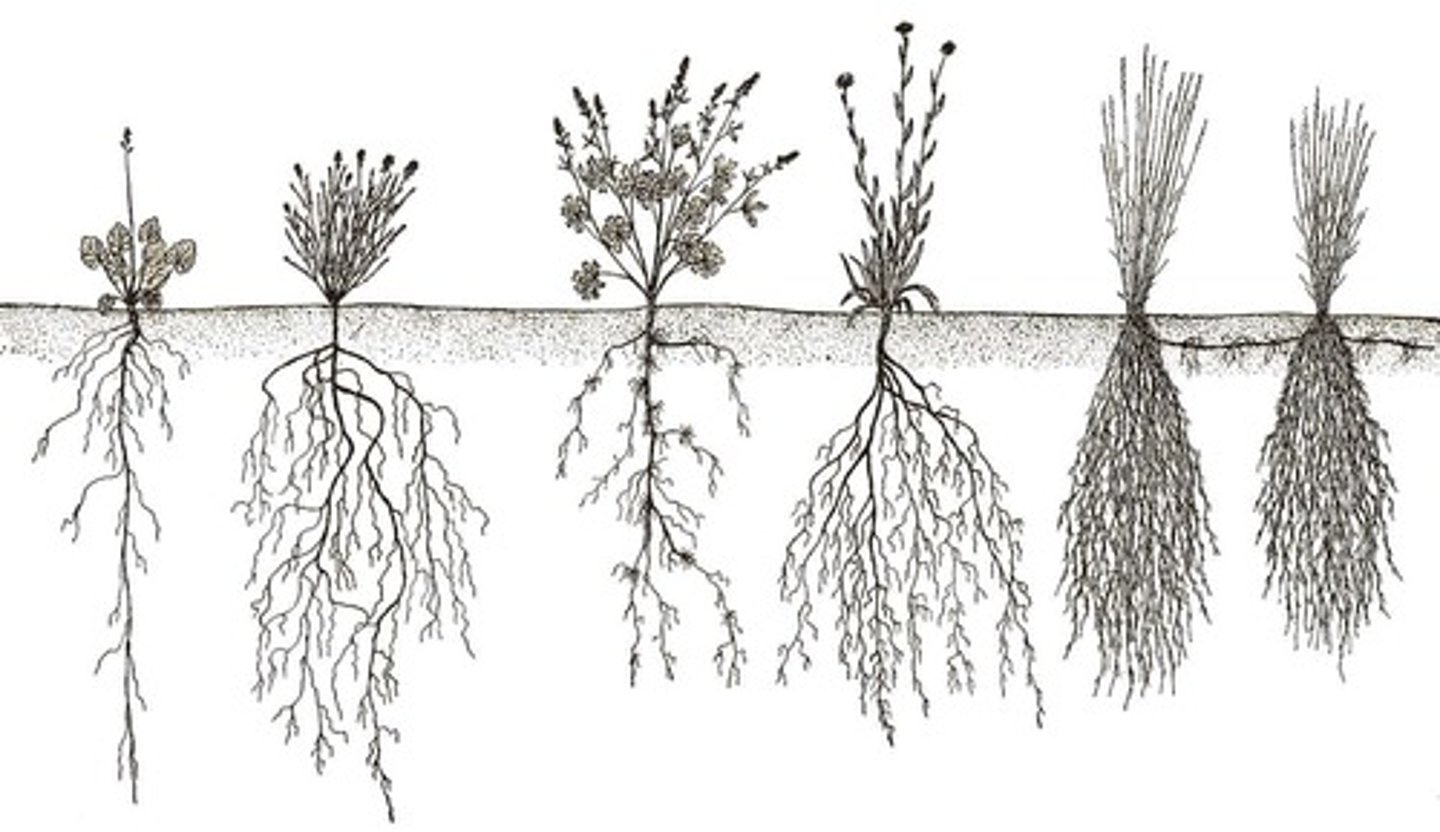
How does a fibrous root system differ from a tap root system?
A fibrous root system is located closer to the soil surface and forms a dense network of roots.
What adaptations do leaves have for photosynthesis?
Leaves are typically green due to chlorophyll, and their thickness, shape, and size are adapted to their environment.
What is the function of chlorophyll in leaves?
Chlorophyll is responsible for the green color of leaves and plays a crucial role in photosynthesis.
What is photomorphogenesis in plants?
The growth and development of plants in response to light.
Define phototropism.
A directional response of plants to blue wavelengths of light, where positive phototropism is growth toward light and negative phototropism is growth away from light.
What is gravitropism?
The movement of plants toward or away from the source of gravity, ensuring roots grow down and shoots grow up.
What are plant hormones?
Chemical messengers that affect all aspects of plant life, including growth, development, and responses to stimuli.
What is the role of auxins in plants?
Auxins are responsible for cell elongation and play a role in phototropism, gravitropism, and apical dominance.
What do cytokinins promote in plants?
Cytokinins promote cytokinesis and are involved in cell division, especially in growing tissues.
What are gibberellins and their effects on plants?
Gibberellins stimulate shoot elongation, seed germination, and fruit and flower maturation.
How does abscisic acid (ABA) function in plants?
ABA accumulates in response to stress, inhibiting growth and inducing dormancy in seeds and lateral buds.
What is unique about ethylene as a plant hormone?
Ethylene is a volatile gas produced by aging tissues and is involved in processes like fruit ripening.
What is the significance of photoperiodism in plants?
Photoperiodism allows plants to track time based on light exposure, influencing flowering and other seasonal behaviors.
What adaptations do leaves in tropical rainforests have compared to those in deserts?
Leaves in tropical rainforests have larger surface areas, while desert plants have smaller surface areas to minimize water loss.
What is the structure of a typical leaf?
A leaf typically has a leaf blade (lamina), which is the widest part, and may have a petiole that attaches it to the stem.
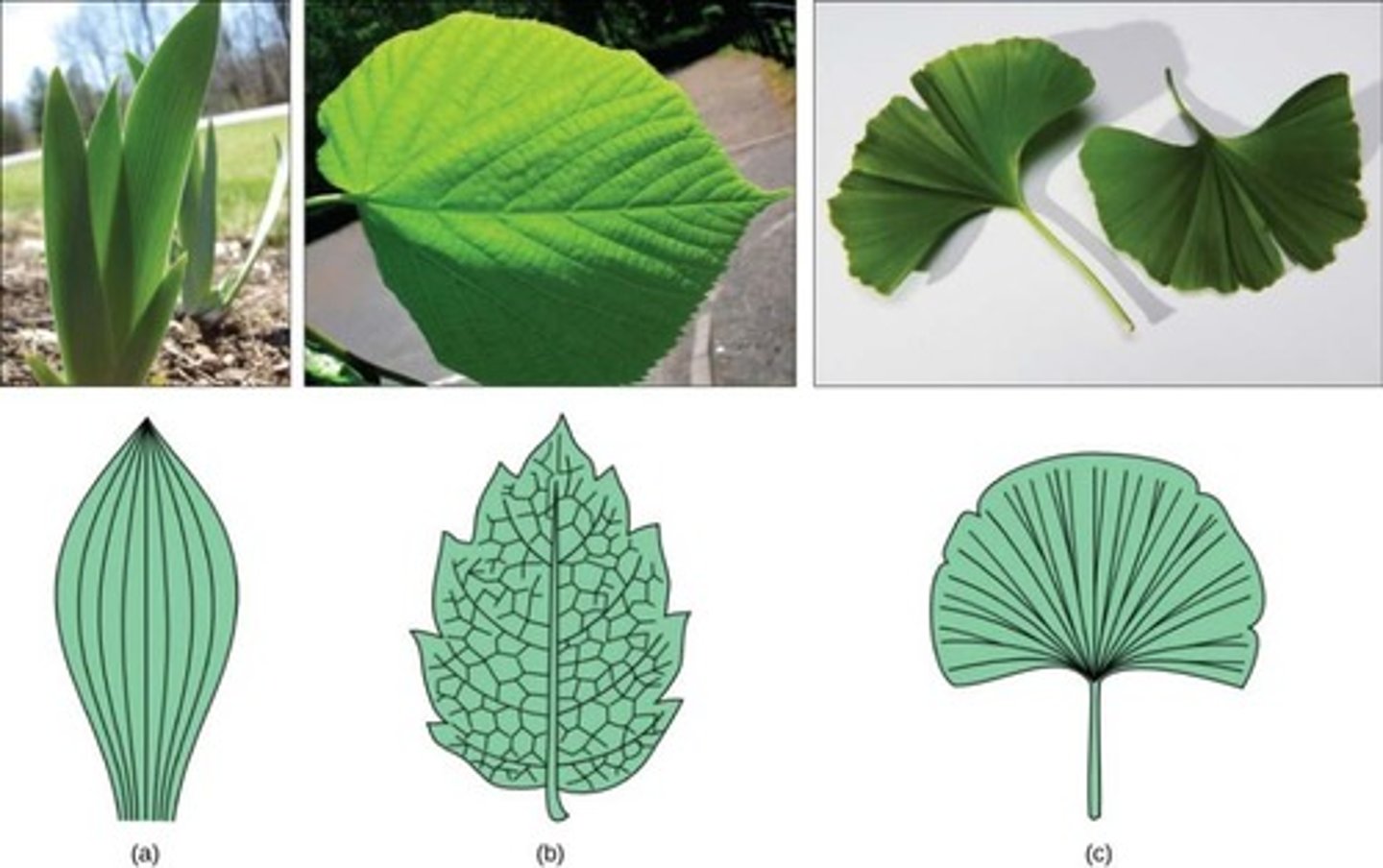
What distinguishes monocot leaves from eudicot leaves?
Monocot leaves have parallel venation, while eudicot leaves have a net-like venation pattern.
What is apical dominance in plants?
Apical dominance is the inhibition of lateral bud formation, triggered by auxins produced in the apical meristem.
How do plants respond to light using photoreceptors?
Plants use photoreceptors, which are proteins bonded to light-absorbing pigments, to detect light and mediate growth responses.
What is the role of chemical messengers in plant responses?
Chemical messengers relay information from receptors to effector systems to bring about appropriate plant responses.
What happens to seeds in response to abscisic acid during winter?
ABA blocks germination and promotes the synthesis of storage proteins, ensuring seeds do not sprout prematurely.
What is the effect of gibberellins on grape maturation?
Gibberellins promote larger fruit size and looser bunches in grapes, reducing the risk of mildew infection.
What is ethylene and its primary function in plants?
Ethylene is a volatile gas (C2H4) that promotes fruit ripening by stimulating the conversion of starch and acids to sugars.
How do people use ethylene to ripen fruit?
People store unripe fruit, like avocados, in a sealed paper bag to accelerate ripening due to the ethylene gas released by the first fruit to mature.
What are the four main parts of a typical flower?
The four main parts are sepals, petals, stamens (male reproductive structures), and carpels (female reproductive structures).
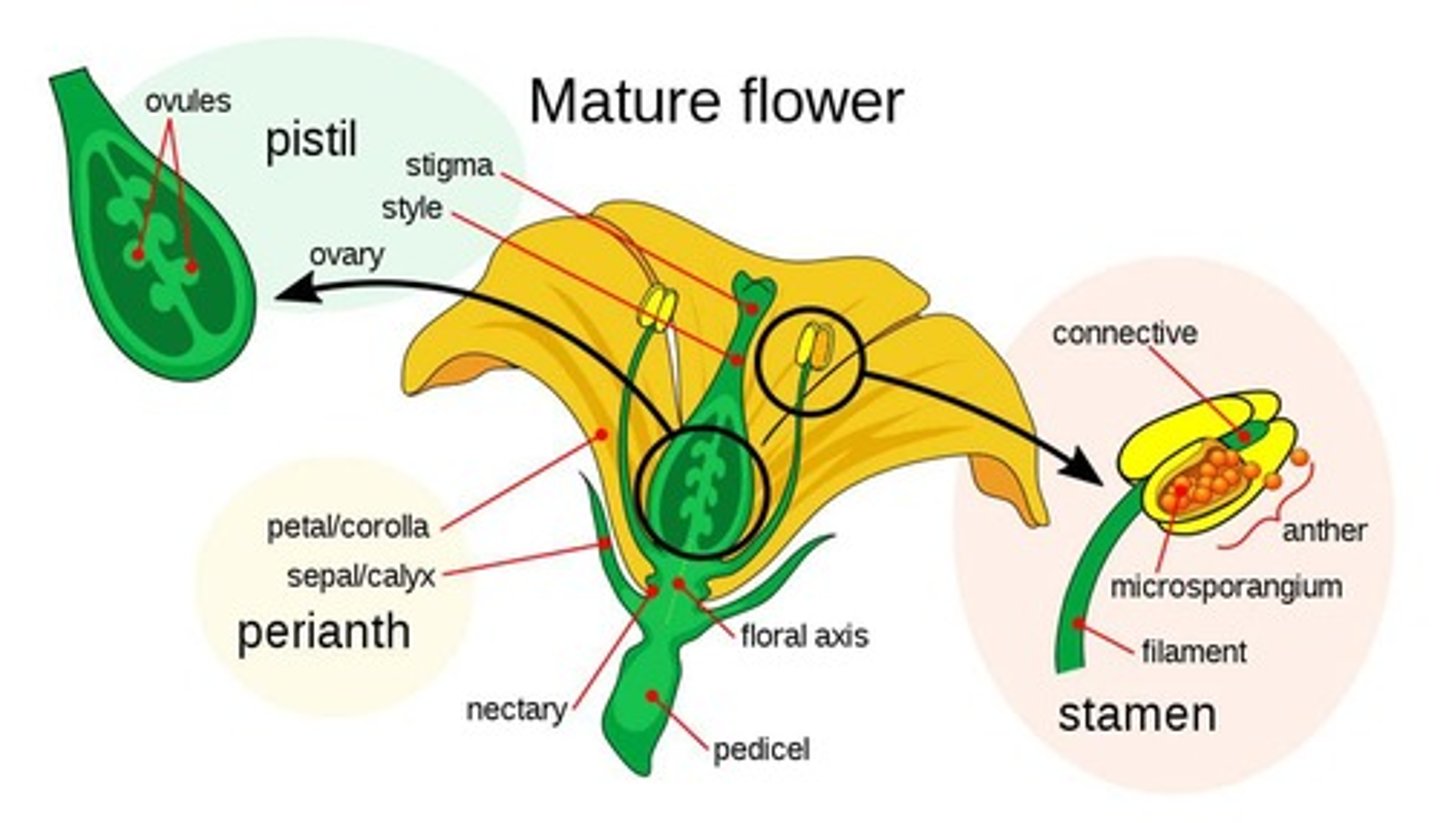
What is the role of sepals in a flower?
Sepals are green, leafy structures that protect the unopened bud of the flower.
How do the number of petals differ between monocots and eudicots?
In monocots, petals usually number three or multiples of three; in eudicots, petals are typically four or five, or multiples thereof.
What defines a complete flower?
A complete flower has all four whorls: sepals, petals, stamens, and carpels.
What are perfect flowers?
Perfect flowers contain both male (stamens) and female (carpels) reproductive parts.
What is a monoecious plant?
A monoecious plant has both male and female flowers on the same plant, examples include corn and pea.
What is a dioecious plant?
A dioecious plant has male and female flowers on separate plants.
Where does the male gametophyte develop in plants?
The male gametophyte develops in the immature anther within the microsporangium.
What is the structure of mature pollen grains?
Mature pollen grains contain two cells: a generative cell and a pollen tube cell.
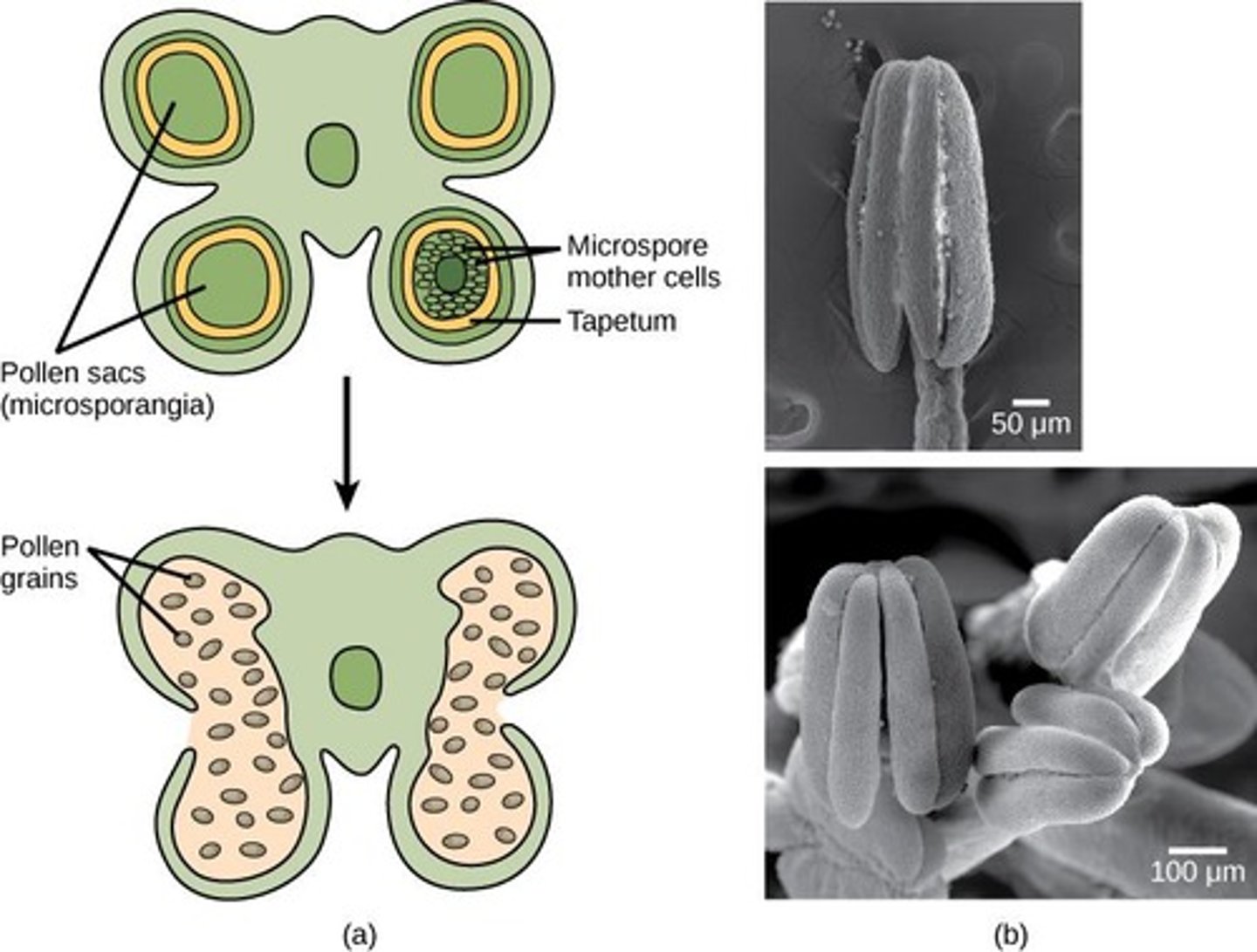
What happens during the germination of pollen?
During germination, the pollen tube cell forms a pollen tube through which the generative cell migrates to the ovary.
What are the two phases of female gametophyte development?
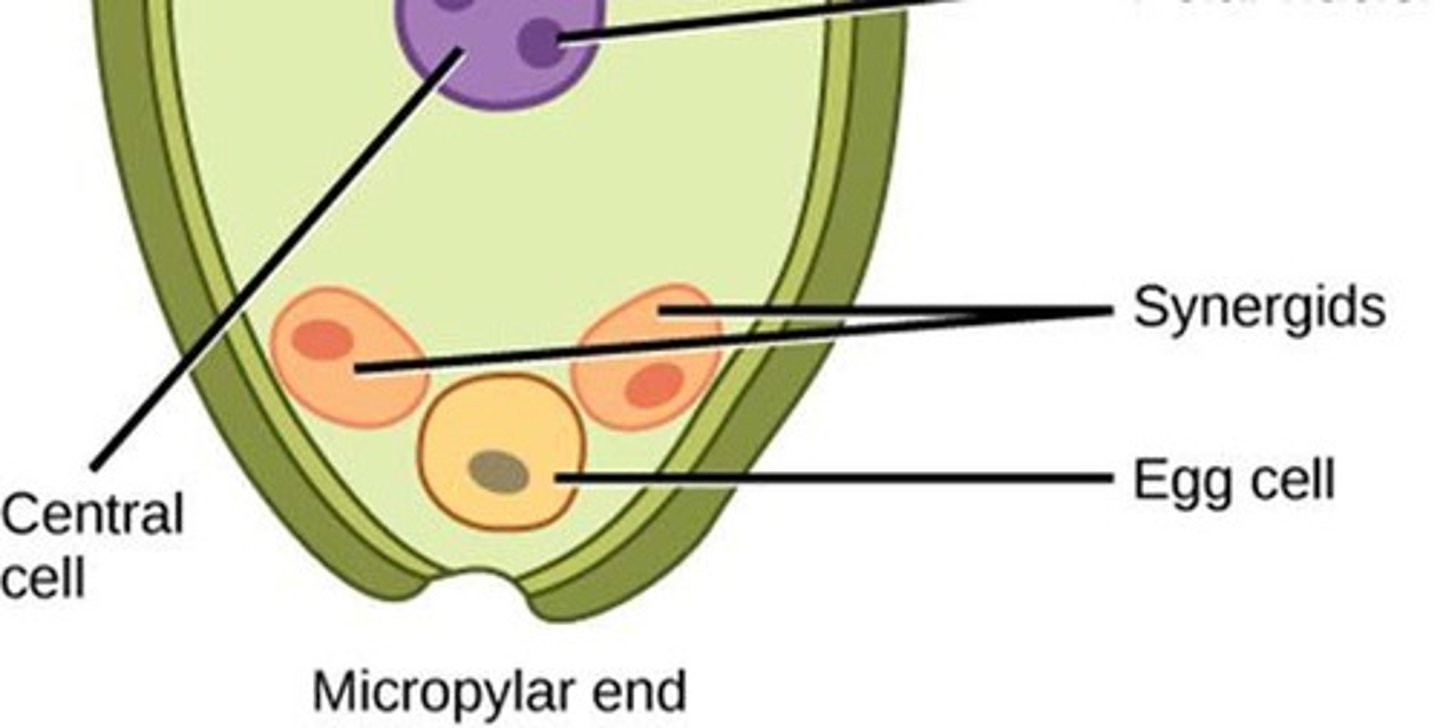
The first phase involves meiosis to produce four megaspores, one of which survives; the second phase involves mitosis to form an eight-nucleate, seven-cell female gametophyte.
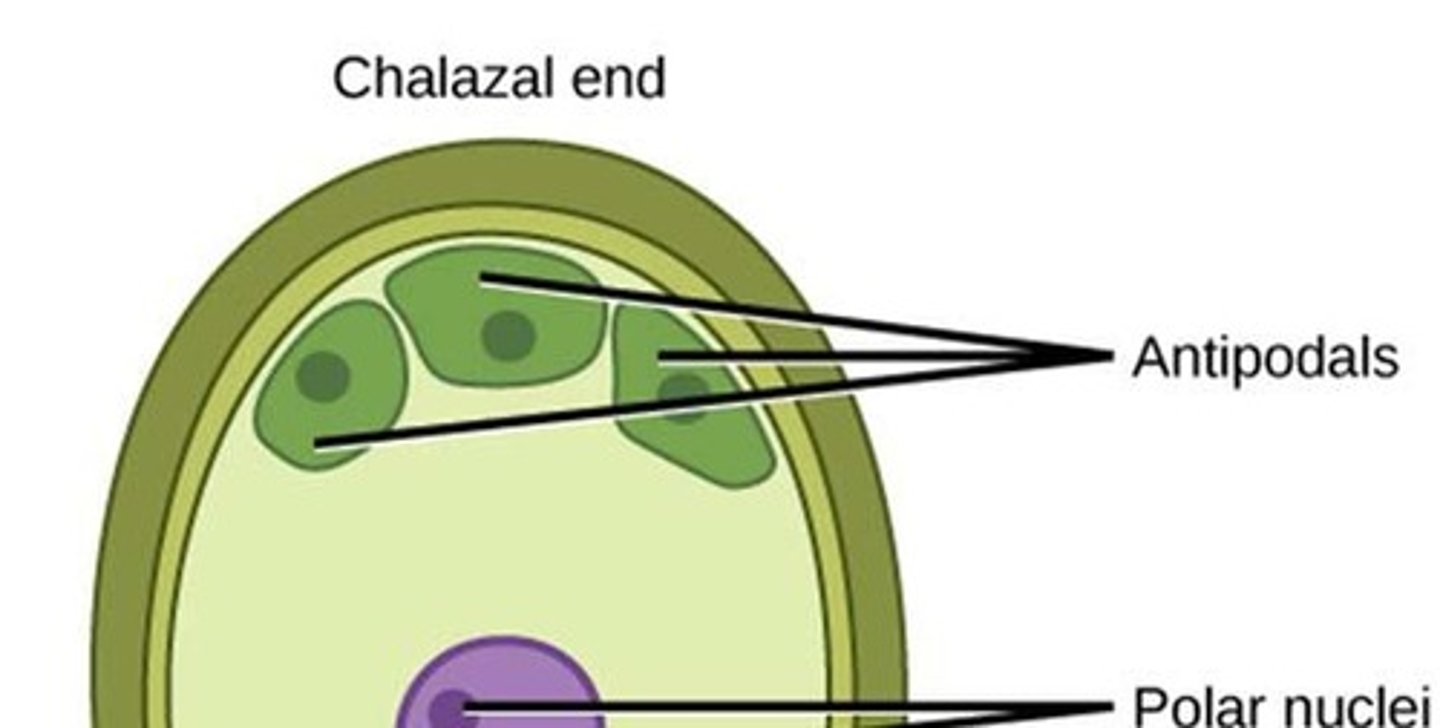
What is the role of synergid cells in fertilization?
Synergid cells help guide the pollen tube for successful fertilization and disintegrate after fertilization.
What is pollination in angiosperms?
Pollination is the transfer of pollen from the anther to the stigma of the same or another flower.
What are the two forms of pollination?
Self-pollination occurs within the same flower or plant, while cross-pollination occurs between different individuals of the same species.
Why is cross-pollination beneficial for plants?
Cross-pollination increases genetic diversity, which enhances survival in changing environmental conditions.
What adaptations do plants have to prevent self-pollination?
Plants may have flowers that mature at different times, physical features that prevent self-pollination, or separate male and female flowers on different plants.
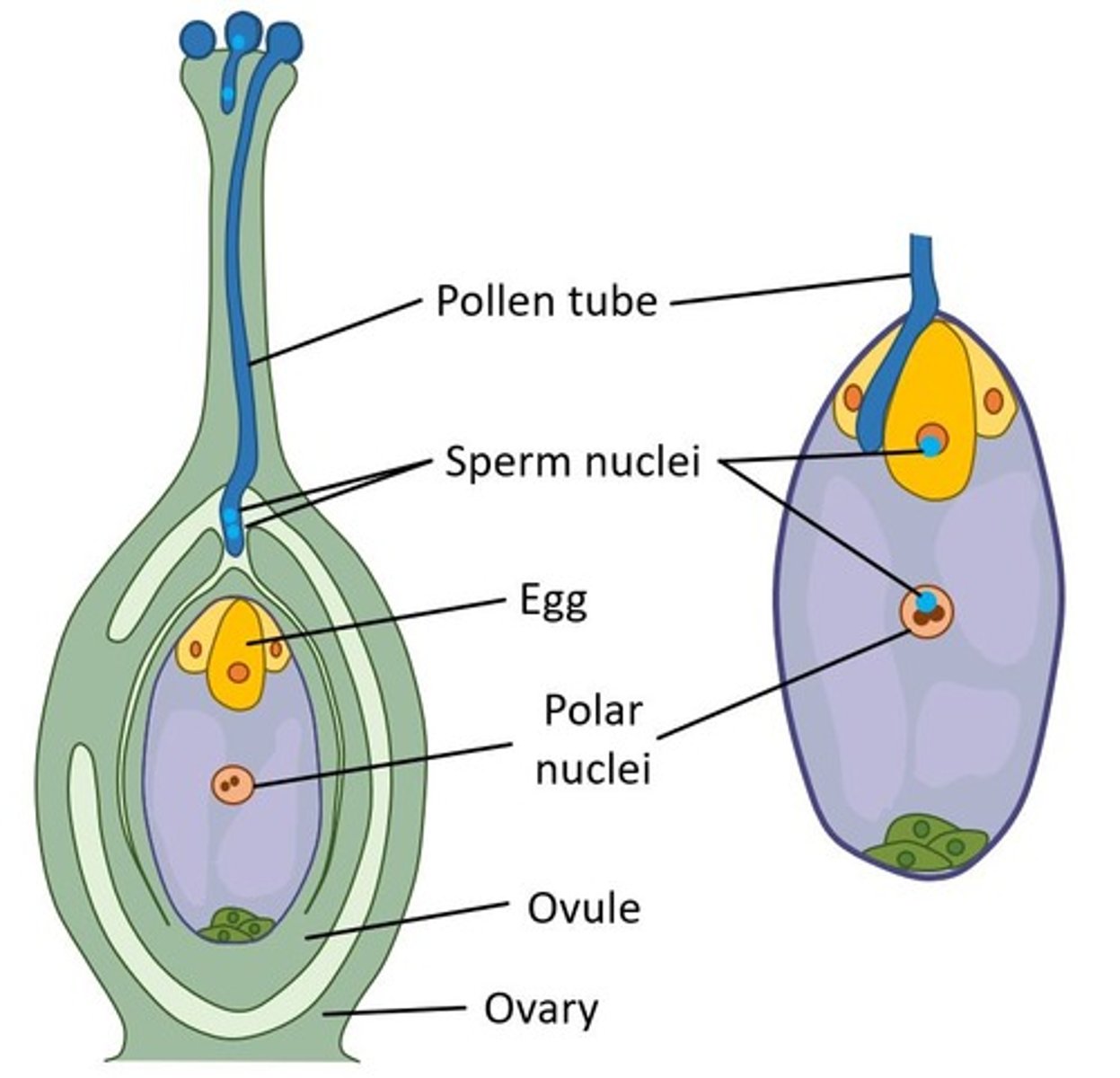
What is double fertilization?
Double fertilization involves the fertilization of the egg cell and the formation of a triploid endosperm from the fusion of a sperm cell with the central cell.
What is the micropyle's function in the ovule?
The micropyle is an opening that allows the pollen tube to enter the female gametophyte for fertilization.
What protects the megasporangium and embryo sac?
A double-layered integument protects the megasporangium and later develops into the seed coat.
What happens to the antipodal cells in the female gametophyte?
The antipodal cells, which are positioned opposite the micropyle, later degenerate.
What is the significance of the central cell in the female gametophyte?
The central cell fuses with a sperm cell to form the triploid endosperm, which nourishes the developing embryo.
What process occurs when the generative cell divides in plant reproduction?
It forms two sperm cells.
What guides the pollen tube to the ovule sac?
Chemicals secreted by synergids in the embryo sac.
What is the opening called through which the pollen tube enters the ovule sac?
The micropyle.
What is formed when one sperm cell fertilizes the egg cell?
A diploid zygote.
What does the other sperm cell fuse with during double fertilization?
The two polar nuclei to form a triploid cell that develops into endosperm.
What happens to the fertilized ovule after fertilization?
It forms the seed.
What does the ovary of a flower develop into after fertilization?
The fruit.
What are the four main types of fruits based on their origin?
Simple, aggregate, multiple, and accessory fruits.
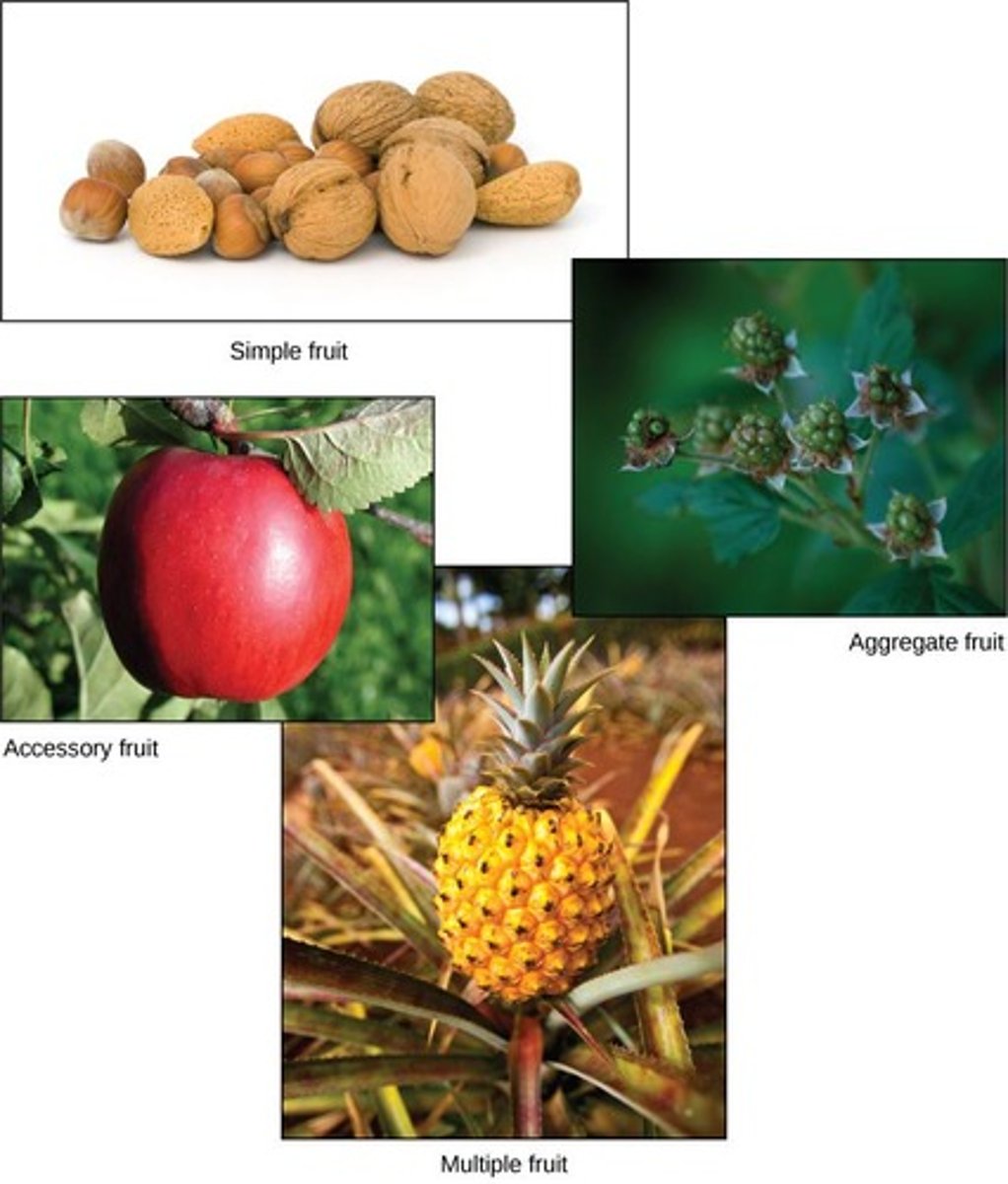
What is a simple fruit?
A fruit that develops from a single carpel or fused carpels of a single ovary.
What is an aggregate fruit?
A fruit that develops from more than one carpel in the same flower.
What is a multiple fruit?
A fruit that develops from a cluster of flowers.
What are accessory fruits?
Fruits that are not derived from the ovary but from another part of the flower.
What is the primary purpose of fruit?
Seed dispersal.
How do wind-dispersed fruits typically adapt for dispersal?
They are lightweight and may have wing-like appendages.
What characteristic do water-dispersed fruits have?
They are light and buoyant, allowing them to float.
How do animals contribute to seed dispersal?
They eat fruits and excrete the seeds away from the parent plant.
What is seed dormancy?
A period of inactivity or low metabolic activity in seeds.
What conditions can trigger seed germination?
Moisture, light, cold, fire, or chemical treatments.
What is scarification in seed germination?
Mechanical or chemical processes to soften the seed coat.
What is the typical structure of a mature seed?
A seed coat, cotyledons, endosperm, and a single embryo.
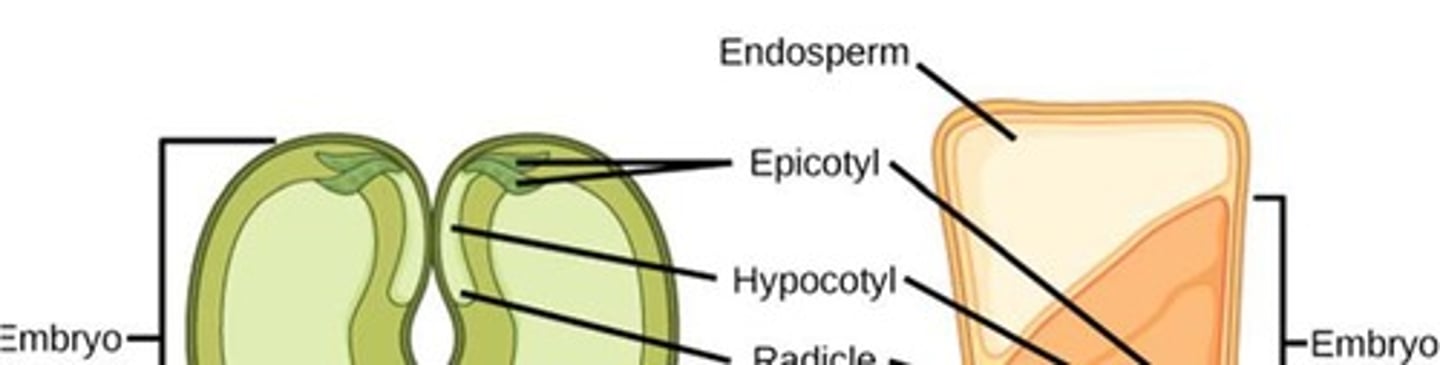
What are the three parts of an embryo in a seed?
Plumule, radicle, and hypocotyl.
What is the role of the radicle in seed development?
It is the region from which the root will develop.
How do eudicot and monocot seeds differ in germination?
Eudicots have a hypocotyl that extends above ground, while monocots do not.
What is the function of the coleoptile in monocot seeds?
It protects the primary shoot as it emerges.
What adaptations do small-seeded species have for germination?
They usually require light as a germination cue.
 Note
Note  Flashcards (106)