Monetary and fiscal policy (Demand side policies) + supply side
 Call Kai
 Learn
Learn Practice Test
 Spaced Repetition
 Match
Match Flashcards
 Knowt Play
1/43

There's no tags or description
Looks like no tags are added yet.
Name | Mastery | Learn | Test | Matching | Spaced | Call with Kai |
|---|
No analytics yet
Send a link to your students to track their progress
44 Terms
What is Monetary Policy?
Use of interest rates & money supply to influence level of AD and economic activities
What is the central bank?
Independent authority responsible for monetary policy in a country
Controls money supply and setting interest rate
Money supply = refers to the total amount of money in circulation (notes, coins, bank)
What are the 5 functions of central bank
1. Determines money supply and interest rate
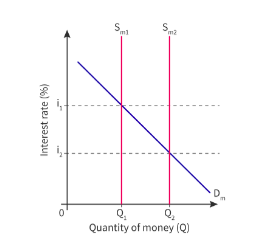
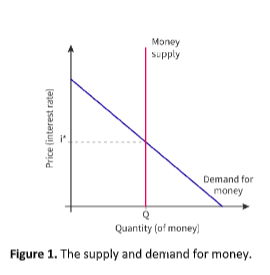
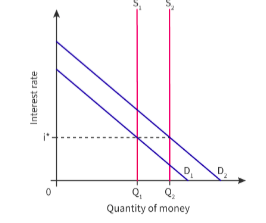
Supply of money is always fixed (perfectly inelastic)
Example of demand and supply for money graph
For example, if CB intervenes to increase money supply from Sm1 to Sm2 → results in increase of Qmoney, driving down interest rate
Example
Y1 is lower than full employment level (Yfe) → central banks can choose to lower interest rates
By lowering interest rates → increase I + C → increases AD (and PL and GDP)
2. Prints physical money and mints coins
Function: increase money supply to align with increases in GDP, replace old/torn bank notes
Also use security features to reduce counterfeit money
3. Lender of last resort for commercial banks
In financial crisis → consumers withdraw money (run on the bank)
Banks will not have the funds
4. Issues bonds and other financial instruments
To raise funds to finance projects (ex. War, infrastructure)
Citizens buy a bond to lend money to the government → repay with interest
5. Regulates the banking system
Ensure commercial banks don’t take too much risk
Function: set reserve requirements (= proportion of deposits that a commercial bank must keep in its vaults in reserve)
4 goals of monetary policy (demand side)
Low and stable rate of inflation
Operates monetary policy to influence AD
Rising prices reduce purchasing power of individuals – uncertainty for firms
a)Inflation targeting
CB maintains it to 2%
Creates greater certainty
Preferable to waiting until inflation is out of control
b) low unemployment
Keeps unemployment low
Unemployment leads to slower economic growth (makes up ⅔ AD)
c) reducing business cycle fluctuations
Long term growth (stable economic environment)
Through managing money supply and interest rates:
Can control inflation and real GDP
External balance
Achieved when imports = exports
How to do this
By raising interest rates, CB discourages spending
If this includes imports, it moves economy to balance
How is money created by commercial banks
Can create money through credit (Credit creation)
Individuals put money into a bank account → bank only keeps a small amount as cash (reserve requirement)
They lend the other amount
This process creates credit
Central bank requires commercial banks to hold some deposits in reserve → ensure banks don’t take too much risk
What are the 4 ways monetary policy is made/tools
Open market operations
Definition: the central bank buying and selling bonds to regulate money supply
Bonds = used by governments to finance infrastructure projects
The central bank buys and sells bonds on the OM to regulate money supply
Ex. when selling a bond for $500, the money supply is reduced by $500
Example: graph shows the supply moving left (when selling a bond)
Interest rate is driven up
Therefore, it can influence interest rate
Minimum reserve requirements
The proportion of bank deposits that a bank must hold in cash
A fall in reserve requirements is expansionary → increased supply (more money can be lent)
An increase in reserve requirements is contractionary → decreases money supply
Example: CB can stimulate economy by lowering reserve requirement
Changes in central bank minimum lending rate
CB can determine interest rates offered by commercial banks
Minimum lending rate = rate which central bank charges commercial banks to borrow money
Example: if CB cutting minimum lending rate, decreases cost of borrowing for commercial banks
Commercial banks also compete to cut mortgage/lending rates
Quantitative easing
Definition: A way for the CB to inject money directly into economy
Definition: where the central bank creates more digital money
CB uses new money to buy bonds
Boosts spending and investment
Example: CB buys assets from banks → banks get more money therefore lending increases → results in lower interest rate for borrowers → boosts investment
*quantitative tightening is the opposite = CB roll back expansion in money supply
Describe/draw the demand and supply of money graph
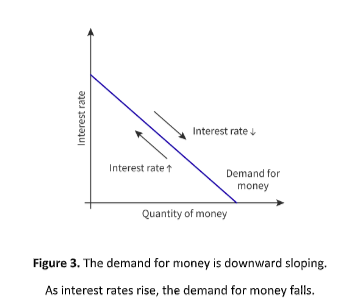
Describe the curve for demand of money and why. What are the 3 reasons to use money
Definition = the willingness and ability for economic agents to use money at a given interest rate and point in time
3 reasons to use money:
1. Transactions motive (buy goods)
2. Precautionary motive (precaution against unexpected events like medical bill)
3. Speculative motive (individuals hold money receive no rate of return and lose purchasing power due to inflation)
Opportunity cost = interest rate lost
Beneficial in stock market crash
Downward sloping (higher interest rate, less likely people hold money)
Define the supply of money
Definition: total amount of money in circulation (coins, banks, notes)
What determines the interest rate
Refers to the price and cost of borrowing money
Determined by forces of supply and demand
How can economy be stabilized by changing money supply
If central bank can increase supply of money at same rate as increase in Dm, can maintain interest rates at i* to maintain stability
What is nominal vs real interest rate, how to calculate
Nominal = the interest rate quoted by commercial bank
Not adjusted for inflation
Real = interest rate with inflation taken into account
True cost of borrowing
When negative = savers lose, borrowers benefit
How to calculate real interest rate
(1+nominal interest rate)/(1+inflation rate) = 1 + real interest rate
When is expansionary monetary policy used? how does it work?
to close recessionary gap
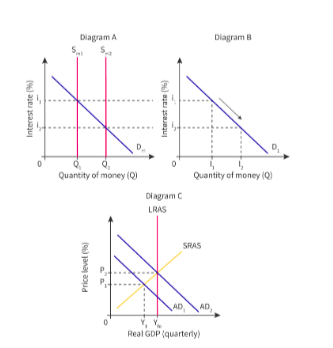
CB can intervene and increase money supply (Sm1 → Sm2)
Increases money in circulation from Q1 to Q2 → drive down interest rate from i1 to i2
Lowering interest rates = more investment = increase AD = closing recessionary gap
Keynesian vs monetarist view of monetary policy in solving deflationary gap
Keynesian
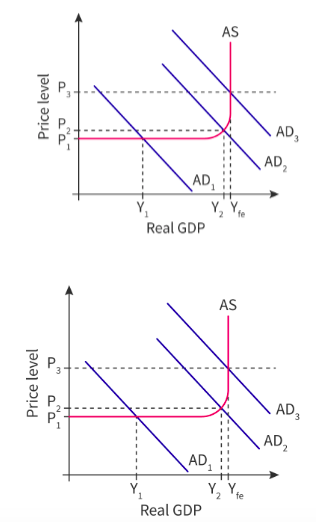
1. Assume economy at Y1 → economy produces at a level of output lower than full capacity
Any stimulus to increase AD will increase real GDP without pressure on PL
Possible to operate this policy without driving up PL
2. Assume economy at Y2 → at upward sloping section
Supply side bottlenecks
Firms compete with other firms for FOP
This case, the policy will drive up price level
How is contractionary monetary policy used? describe
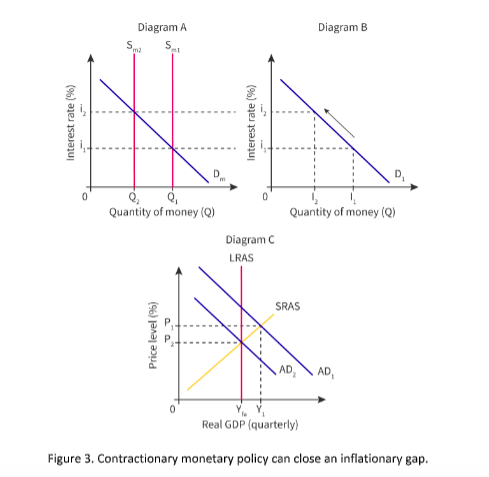
closing inflationary gap
Definition: an inflationary gap is where the economy overheats and creates upward pressure on PL
Difficult to plan for future
CB will decrease money supply
Reduce money in circulation
Drive up interest rates
Discourage investment, lower AD
what are 2 cons of monetary policy effectivity
Factor | Explanation |
Limited scope for reducing interest rates when close to zero |
|
Low consumer and business confidence |
|
What are 2 pros of monetary policy effectiveness
Factor | Explanation |
Incremental, flexible, easily reversible |
|
Short time lag |
|
How is conflict amongst macroeconomic objectives created using monetary policy
Example: government wants growth = CB uses expansionary monetary policy by lowering interest rates = puts upward pressure on PL = does not meet goals
However, this is possible in LR → if its used to encourage firms to improve LRAS, it will work
What is fiscal policy
Government adjusts government expenditure or taxation to stimulate the economy
What are 4 sources of revenue
Direct taxation
On income
Can be used to redistribute income → progressive taxation
Indirect tax
On expenditure
To discourage consumption of undesirable goods
Sale of goods and services from state-owned entreprises
State owned enterprise = a firm where the government has a significant financial stake and control (ex. Post office)
Resource curse = government difficult to benefit from selling natural resources
Sale of government assets
Selling state-owned entreprises
Privatization = transferring ownership from public to private sector → revenue is 1 time payment
Why: private firms improve efficiency, decrease costs, etc → creates greater revenue for government
What are 3 types of government expenditure
Current expenditure
Involves financing daily expenditure (ex. salaries)
Capital expenditure
Includes building infrastructure financed by government (roads, hospitals)
Long term projects
Transfer payments
Used to redistribute income (ex. Child support)
What are 5 goals of fiscal policy
Low and stable inflation
Beneficial as it gives greater certainty for firms
Low unemployment
Can use expansionary fiscal policy
Can stimulate AD to the level of full employment
Promoting a stable economic environment for long term growth
Through expansionary fiscal policy → build infrastructure like roads
Transport routes increase trade, hospitals for healthy workforce
Reducing business cycle fluctuations
Can increase injections for boost
Can slow economy in boom
Equitable distribution of income
Indirect taxes:
Can lower taxes on essential goods, increase on luxury
Direct taxes:
Progressive system
Transfer payments
External balance:
Through contractionary fiscal policy, can discourage consumption of domestic and imported goods
Can move towards balance
What are 2 ways to do expansionary and contractionary fiscal policy
tax revenue or government expenditure
How can expansionary fiscal policy be used
close recessionary gap
Government can intervene to help recover from recession
Can either increase G or reduce taxation
Both will increase AD → shifts towards full employment → increases price level → increases real GDP
Therefore, gap is closed
Monetarist vs. keynesian view of deflationary gap
Monetarist | Keynesian |
Economy is self correcting, will move to full employment level of equilibrium If in recession → as workers compete for jobs, wages will fall
| Economy not self correcting If in recession → unemployment will rise
|
Deflationary gap is only in short run | Deflationary gap can be in short run and long run |
How is contractionary fiscal policy used
closing inflationary gap
When economy overheats (when AD grows too fast, creating demand-pull inflation)
Causes reduction in confidence
Contractionary policy → increase taxes (direct or indirect) OR reduce G
Reduce disposable income for households
G: unpopular
Wages to workers are cut (current), or hospital doesn’t get built (capital), or unemployment benefits decreased (Transfer)
Both will shift AD back to full employment level
Monetarist vs. keynesian for inflationary gap
Monetarist | Keynesian |
Inflationary gap only in short run
| Any attempt to move output beyond Yfe only results in inflation Need government |
What is keynesian multiplier and formula
The overall increase in GDP is larger than original stimulus due to multiplier effect
Size of effect depends on how much additional income was used for purchases
1/1-MPC OR 1/(MPS+MPT+MPM)
Always greater or equal to 1
When government spends $120M, the firms they hire for projects will notice lack in inventory → increase their output by $120M to hire workers
Households can spend (marginal propensity to consume) or save additional income
By spending $48M on g/s → firms, noticing stock is falling, expand output, which then increases household income by $48M
Give 3 constraints of fiscal policy
Factor | Explain |
Political pressure | Depends on each party’s beliefs |
Time lags | Once a new policy is made, it may take months |
Sustainable debt | Government must operate a budget deficit (borrowing money by selling bonds) if it wants to stimulate the economy Governments respond to high debt by using austerity
|
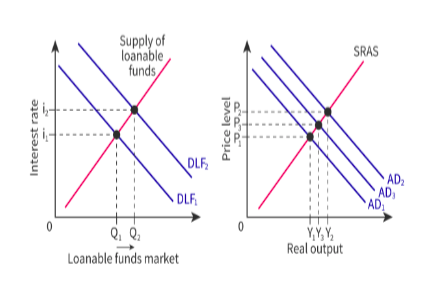
What is crowding out? describe the 2 steps
Definition: when public sector replaces private sector spending
1. Government spends on a road (shift AD right)
Can sell bonds and compete directly with private sector in loanable funds market
2. Competition will drive out interest rates to discourage private firms from investing → AD shifts left
Depends on interest rate change
What are 2 strengths of fiscal policy
ability to target sectors of economy
effective in deep recession
What are automatic stabilizers? give 2
Definition: ongoing government policies that automatically adjust tax rates and transfer payments
2 examples: progressive taxes and unemployment benefits
define supply side policies
long-term government strategies used to increase the potential productive capacity of the economy by increasing the quality/quantity of FOP
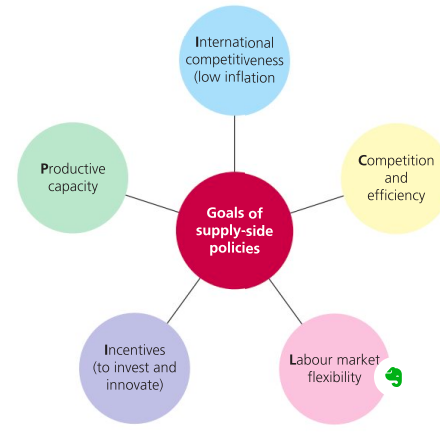
list goals of supply side policies
improving competition and efficiency (Trade liberalisation)
reducing labour costs and unemployment through labour market flexibility
reducing inflation to improve international competitiveness
increasing firms’ incentives to invest in innovation by reducing costs (ex. subsidies)
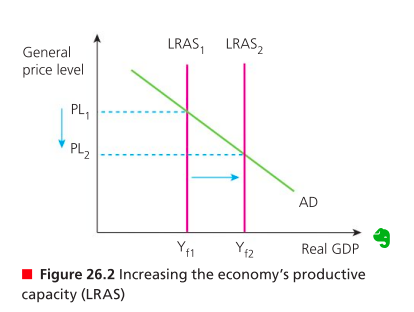
supply-side policies increase…
PPC or LRAS outwards through improving institutional framework and potential productive capacity
what are 2 categories of supply side policies? how to demonstrate it graphically
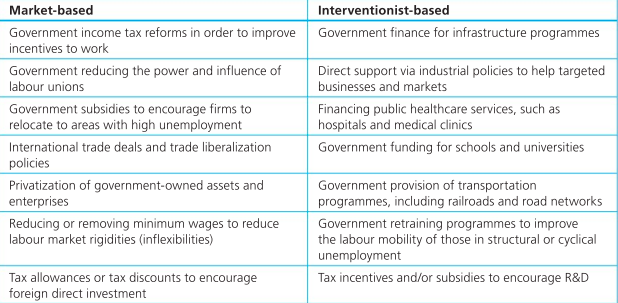
market-based (markets work more efficiently, allowing private firms more autonomy in allocation of resources)
interventionist (directly involving)
use AD-AS and LRAS curve
what are market-based supply-side policies? list goals/steps
focuses on freeing up industries and improving market incentives to increase AS
policies to encourage competition
deregulation
pros: increased comp leads to lower prices and create choice, reduce costs to enforce regulation
privitisation
pros: private sector needs to improve efficiency. tostay competitive, reduce government debt, reduce cost to taxpayers
cons: can create monopolist, still needs government intervention, social benefits?
trade liberalisation
anti-monopoly regulation (ex. price ceiling)
labour market policies
create greater flexibility and efficiency in labour market
reduce power of labour unions
reducing unemployment benefits
abolishing minimum wages
incentive-related policies
personal income tax cuts
cuts in business and capital gains tax
what are some interventionist policies
education and training
enhance human capital
improving quality, quantity, access to healthcare
research and development
provision of infrastructure
industrial policies
briefly summarize market and interventionist based supply side policies
supply-side policies can also impact…
demand-side effects
the acronym EPIC can be used to memorize the effects of supply-side policies…
efficiency
producitvity
incentives
competitiveness
4 constraints of market-based supply side policies
equity issues
time lags
vested interest (depends on what the govenrment is interested in)
environmental impact
4 constraints on interventionist supply-side policies
cost
time lag
list strengths of market based supply-side policies and interventionist ones
improve resource allocation
no burden on govenrment budget
directly supporting sectors important for growth