Human Anatomy & Physiology Chapter 9: Muscles & Muscle Tissue
 Call Kai
 Learn
Learn Practice Test
 Spaced Repetition
 Match
Match Flashcards
 Knowt Play
1/48

There's no tags or description
Looks like no tags are added yet.
Name | Mastery | Learn | Test | Matching | Spaced | Call with Kai |
|---|
No analytics yet
Send a link to your students to track their progress
49 Terms
Match the following description with the correct type of muscle: Striated and involuntary
Cardiac muscle
Match the following description with the appropriate type of muscle: Subject to conscious control
Skeletal muscle
Match the following skeletal muscle structure with the correct description: Perimysium
Surrounds each muscle bundle (fascicle)
Match the following description to the muscle type: Visceral, one nucleus per cell, and nonstriated
Smooth muscle
Match the following description with the correct type of muscle: Striated and voluntary
Skeletal muscle
Match the following skeletal muscle structure with the correct description: Epimysium
Surrounds an entire muscle
Match the following description with the correct type of muscle: Nonstriated, involuntary, found in the walls of hollow visceral organs
Smooth muscle
Which of the following muscles is voluntary
The muscle that extends the arm at the elbow
Which of the following characteristics is unique to smooth muscle?
Absence of striations
Which of the following muscle types is both voluntary and striated?
Skeletal muscle only
Select the characteristic of muscle tissue that sets it apart from all other tissue types
Contractility
Match the following description to the appropriate type of muscle: Not subject to voluntary control, is nonstriated, and contractions are slow and sustained
Smooth muscle
The layer of dense irregular connective tissue that surrounds the entire skeletal muscle is the __________.
epimysium
Match the following skeletal muscle structure with the correct description: Endomysium
Surrounds each muscle fiber
Match the following cellular component of a skeletal muscle fiber with its description: Cytoplasm of a skeletal muscle fiber
Sarcoplasm
Match the following cellular component of a skeletal muscle fiber with its description: Plasma membrane of skeletal muscle fiber
Sarcolemma
Myofibrils are composed of repeating contractile elements called __________.
sarcomeres
The linking of thick and thin filaments together is called __________.
Forming a cross bridge
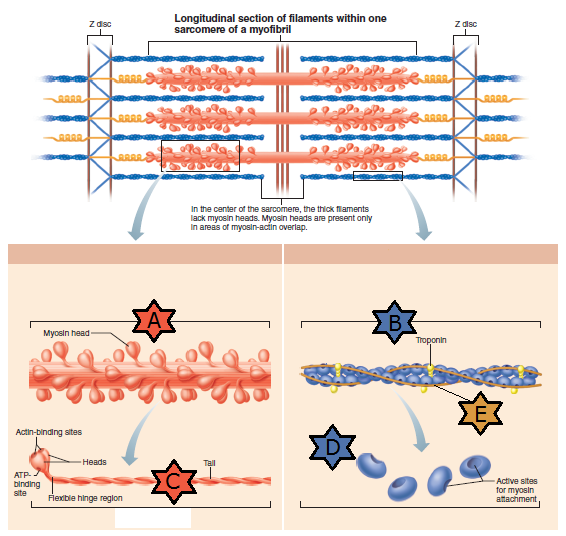
Identify the part of thick or thin filaments in skeletal muscle indicated by “A”
Por
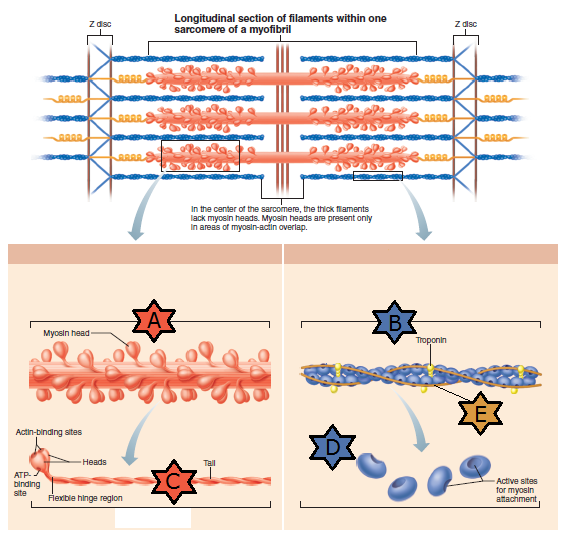
Identify the part of thick or thin filaments in skeletal muscle indicated by “D”
Actin subunits
The functional unit of contraction in a skeletal muscle fiber is the __________.
sarcomere
In the sliding filament model of contraction, which of the following does not occur when the muscle cell shortens?
H zones appear
Match the following muscle chemical with the correct name: Oxygen storage molecule in skeletal muscle
myoglobin
Which of the following provides the final “go signal” for contraction?
Calcium ions
Match the following cellular component of a skeletal muscle fiber with its description: Rodlike contractile element within a muscle fiber containing myofilaments
myofibril
Match the following component of a muscle fiber with its description: Area of the sarcomere with overlapping thick and thin filaments
A band
A sarcomere is part of a(n) __________.
Myofibril
Which of the following are inward invaginations of the sarcolemma that run deep into the cell between the terminal cisterns?
T tubules
In the sliding filament model of muscle contraction, the myofilaments slide over each other, resulting in the overlapping of actin and __________.
Myosin
"Cross bridges" that link between the thick and thin filaments directly involve __________.
Myosin
Which of the following is a special adaptation present in skeletal muscle cells but absent in most other cells?
Muscle ceels have myoglobin; most other cells do not
In the sliding filament model of contraction, which of the following occurs when the muscle cell shortens?
The distance between successive Z discs shortens
Match the following component of a muscle fiber with its description: Area of a sarcomere containing only thin filaments
I band
Match the following component of a muscle fiber with its description: Area in the center of the A band containing only thick filaments
H zone
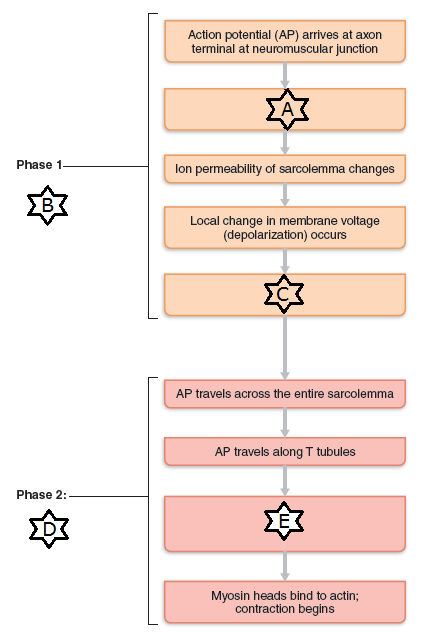
Identify the step in the phases leading to muscle fiber contraction indicated by “C”
Local depolarization (end plate potential) ignites AP in sarcolemma
Which of the following occurs when calcium binds to troponin?
Tropomyosin shifts, exposing the binding sites on actin
Match the following chemical with its function: Ca2+
Released by terminal cisternae into the sarcoplasm to bind with troponin
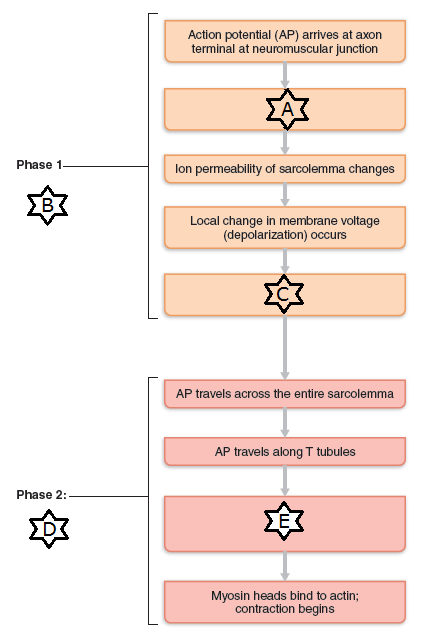
Identify the step in the phases leading to muscle fiber contraction indicated by “A”
ACh released; binds to receptors on sarcolemma
Match the following term with the correct description: End plate potential
Depolarization occuring only at the neuromuscular junction
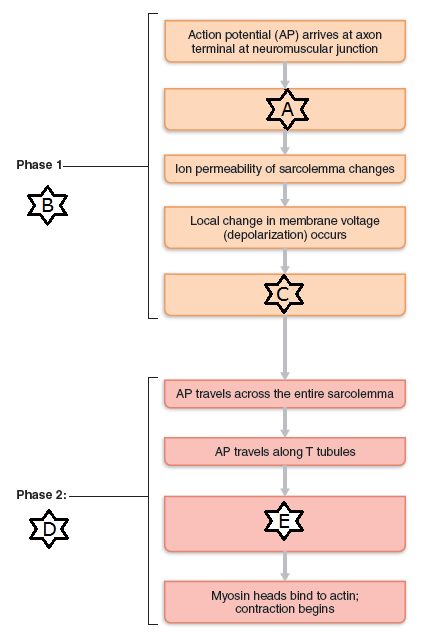
Identify the step in the phases leading to muscle fiber contraction indicated by “E”
SR releases Ca2+; Ca2+ binds to troponin; myosin-binding sites (active sites) on actin exposed
The space between the axon terminal of the motor neuron and the muscle fiber is called the __________.
Synaptic cleft
Acetylcholinesterase __________.
Breaks down acetylcholine
Match the following term with the correct description: Refractory period
The time when a fiber cannot be stimulated until repolarization is complete
Match the following term with the correct description: Repolarization
Restoration of the membrane potential to resting potential
Match the following area with the correct term: Contains vesicles filled with acetylcholine
Axon terminal
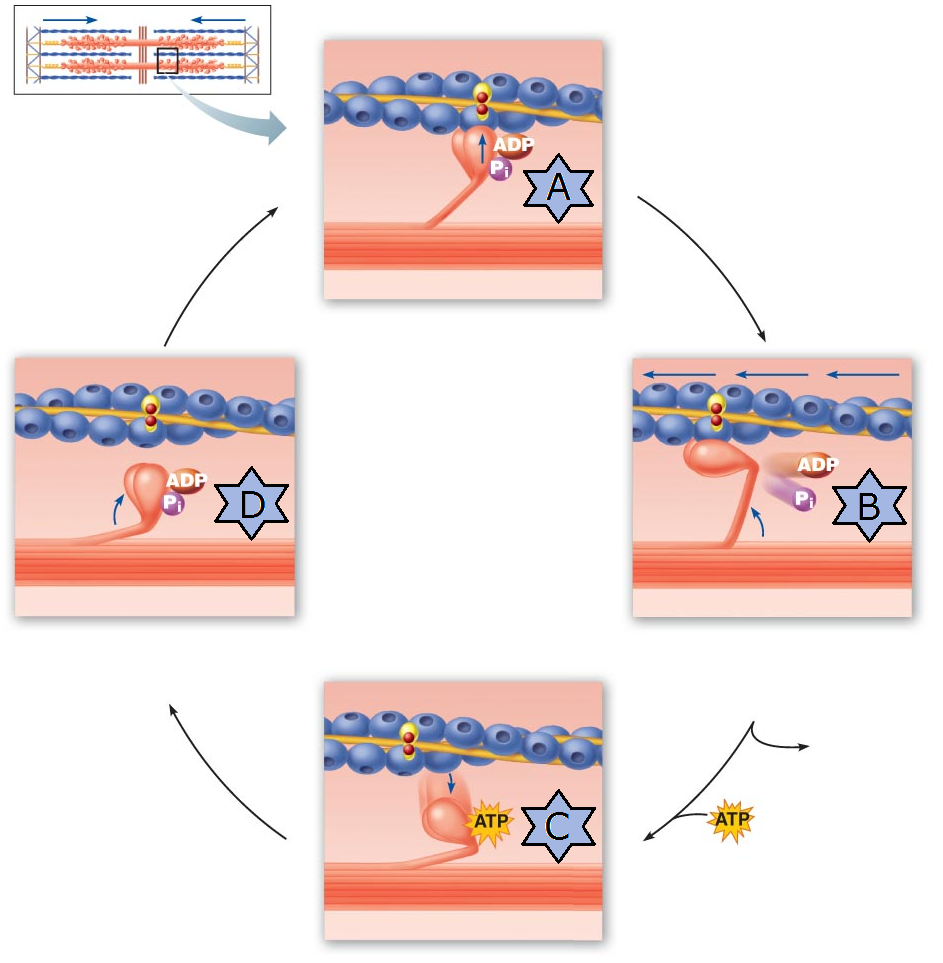
Identify the step of the cross-bridge cycle in skeletal muscle indicated by “A”
Cross bridge formation
Which of the following is an autoimmune disease that destroys acetylcholine receptors?
Myasthenia gravis
What term is used to describe the region where a somatic motor neuron meets with a skeletal muscle fiber?
Neuromuscular junction

