Interference
 Call Kai
 Learn
Learn Practice Test
 Spaced Repetition
 Match
Match Flashcards
 Knowt Play
1/11

There's no tags or description
Looks like no tags are added yet.
Name | Mastery | Learn | Test | Matching | Spaced | Call with Kai | Chat |
|---|
No analytics yet
Send a link to your students to track their progress
12 Terms
Interference
Forgetting because one memory blocks another, causing one or both memories to be distorted or forgotten
Proactive interference
Forgetting occurs when older memories, already stored, disrupt the recall of newer memories.
The degree of forgetting is greater when the memories are similar
E.g. Giving your old phone number to someone after changing to a new one.
Retroactive interference
Forgetting occurs when newer memories disrupt the recall of older memories already stored.
The degree of forgetting is greater when memories are similar.
E.g. A teacher learning the student names of a new class may have trouble remembering the student names of an older class
McGeoch + McDonald
PROCEDURE
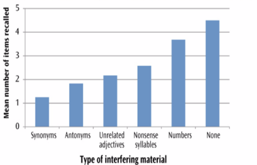
Studied retroactive interference by changing the amount of similarity between 2 sets of materials.
Participants had to learn a list of 10 words until they could remember them 100% accuracy.
There were 6 groups of participants who had to learn different types of new lists:
Synonyms
Antonyms
Words unrelated to original list
Consonant syllables
3-digit syllables
No new list (control condition)
McGeoch + McDonald
FINDINGS
When participants were asked to recall the original lists of words, the group with synonyms had the worst recall. Shows that interference is strongest when the memories are similar.
Supports both types of interference.
Explanation of effects of similarity
2 possible reasons why similarity affects recall.
Could be due to PI - previously stored information makes new similar information more difficult to store.
Or it could be due to RI - new information overwrites previous similar memories because of similarity
PI Keepel + Underwood
Same study as Peterson and Peterson
Gave participants a trigram to remember. Asked them to count backwards in threes. The length of time doing this gradually increased.
Number of trigrams recalled decreased with the increased time spent on the task
Proactive interference could explain this as earlier trigrams entered LTM and this interfered with the newer trigrams.
RI Schmidt
Investigated ability to remember street names learnt in childhood.
200+ participants 11-79 years old, former students of Dutch primary school
Sent a questionnaire about how many times they moved, where they lived and how long for.
Sent a map of the neighbourhood where they lived, street names replaced with numbers.
Interference measured by number of times they moved to other neighbourhoods
Positive association between number of moves and number of street names they forgot.
Retroactive interference had occurred, the new learnt street names interfered with the ability to recall the old ones.
W Experimental methods
Research was done in laboratories.
Subjects had to learn numbers, syllables and word lists in the McDonald study. Not fully representative of how memory operates.
Artificial environment. Low in ecological validity and hard to generalise.
S Baddeley + Hitch
Real-world application.
Rugby players recalling the names of teams they played against in a rugby season.
All had the same amount of time played, some missed matches so interference was different for everyone.
Players who played the most games had the most interference and had the worst recall.
Increases validity
W Vogel
People are more resistant to interference than others
Gave participants tasks to test their working memory capacity.
Highest and lowest scorers were given more tasks to create proactive interference.
High WMC = less likely to be affected by PI.
High WMC associated with enhanced filtering ability, helps prevent irrelevant information from disrupting working memory.
They can focus on relevant information more.
Limited explanation as it doesn’t apply to everyone.
W Tulving and Psotka
Interference is temporary and can be recovered using cues.
Gave participants lists of words with categories.
Recall ≈ 70% for the first list. Got worse for each additional list.
Given a cued recall test after the procedure with the names of the categories given. Rose to 70% again.
Shows that interference causes a temporarily loss of material that is still in LTM.