Chapter 3: Principles of Biomechanics
 Studied by 0 people
 Call with Kai
 Learn
Learn Practice Test
 Spaced Repetition
 Match
Match Flashcards
 Knowt Play
1/16

There's no tags or description
Looks like no tags are added yet.
Name | Mastery | Learn | Test | Matching | Spaced | Call with Kai |
|---|
No study sessions yet.
17 Terms
What are the two components of Newton’s 1st law: law of inertia
Linear and rotational
Law of inertia (linear)
A body remains at rest or in constant linear velocity except when compelled by an external force
Law of inertia (rotational)
A body remains at rest or in constant angular velocity around an axis except when compelled by an external torque
Static equilibrium
Linear and rotational velocities are zero and accelerations are zero
Dynamic equilibrium
Linear and rotational velocities are constant and not zero and accelerations are zero
Inertia
An object’s resistance to a change in its state of motion (due to mass/momentum)
Center of mass
Point about which mass is most evenly distributed in all directions (within the object)
Slightly anterior to S2 in the human body (when in anatomical position)
Center of gravity
Point about which the effects of gravity are most completely balanced
Mass moment of inertia
A body’s resistant to change in angular velocity
Depends on mass and distribution of mass with respect to an axis of rotation
Units of kg*m²
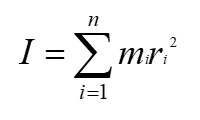
Equation for mass moment of inertia
n indicates the number of parts in the body
mi is the mass of each part
ri is the distance of each part to the axis of rotation
Mass moment of Inertia and “Conservation of Angular Momentum”
By reducing the mass moment of inertia, trunk position increases angular velocity
Fully extended positions increase the mass moment of inertia, thereby decreasing angular velocity
Newton’s 2nd Law: Acceleration
The linear acceleration of a body is directly proportional to the force causing it, takes place in the same direction in which force acts, and is inversely proportional to the mass of the body
Impulse-Momentum Relationship
Derived from Newton’s 2nd law
Momentum: quantity of motion possessed by a body
Mass of moment of inertia * angular velocity
Linear impulse: product of force and time, measure of what is required to change the momentum of a body
Mechanical work
Occurs when force or torque operates over some linear or angular displacement
No movement = no mechanical work done
Does not take into account the time force or torque is applied
Mechanical work units are joules (J)
Power
Power is the rate of performing work over time
Average power = work/time
Instantaneous linear power = force * linear velocity
Instantaneous angular power = torque * angular velocity
Newton’s 3rd Law: Action-Reaction
For every reaction there is an equal and opposite reaction
Implies every effect one body segment exerts on another is simultaneously counteracted by the second body segment exerts on the first
Consequences is based on F=ma
Free body diagrams
Assume rigid segments that are rigidly connected in static equilibrium
 Note
Note  Flashcards (124)