Topic 5
 Studied by 2 people
 Call Kai
 Learn
Learn Practice Test
 Spaced Repetition
 Match
Match Flashcards
 Knowt Play
1/33

There's no tags or description
Looks like no tags are added yet.
Name | Mastery | Learn | Test | Matching | Spaced | Call with Kai |
|---|
No analytics yet
Send a link to your students to track their progress
34 Terms
what is intelligence → Gottfredson (2000)
general ability to reason, plan, solve problems, think abstractly, learn quickly and learn from experience
what is IQ
intelligence Quotient - originally a measure of deviation of mental age from chronological age (ment age/ chron age) x 100
Wechsler (1975) redefined as a standardised score showing deviation from average score of 100 (sd. 15)
what are some examples of intelligence test items
digit span → repeating numbers in an order
letter number sequencing → repeating in alph order
trail-making → e.g. joining information
comprehension
pattern recognition
what is G (general) intelligence
common mental energy underlying performance on all tests, indifference of the indicator
so shouldnt matter which test to use
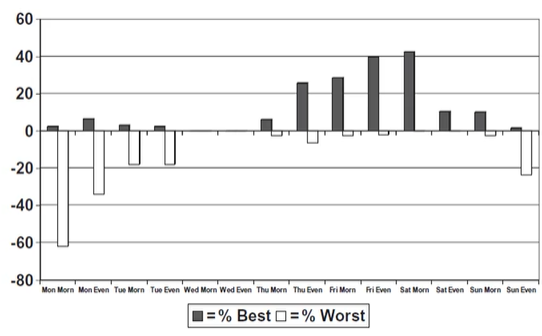
how does IQ influence health and longevity (cognitive epidemiology) and issues with measurement
Chamorro-premuzic (2013): IQ correlates with academic achievement, job performance and longevity
Cognitive epidemiology: examination of cognition/IQ as a correlate of health and morality (Deary and Batty (2007)
Reverse causation - i.e. poor health can influence IQ (e.g. stroke or brain condition)
Confounding effects e.g. of socio-economic status (SES) - e.g. childhood SES influences health and IQ
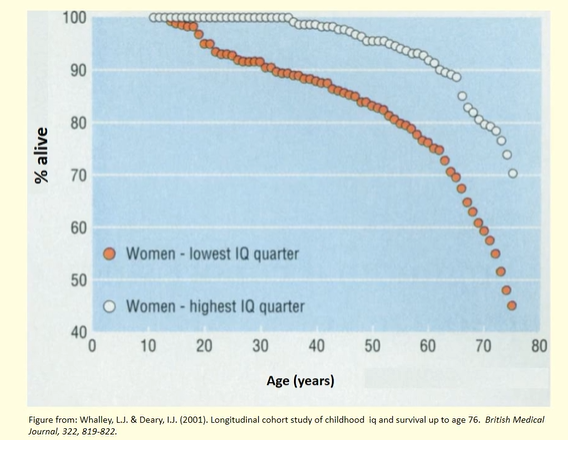
longitudinal study of cognitive epidemiology
the scottish mental survey → Whalley and Deary (2001) traced 80% of the Aberdeen birth cohorts and compared childhood IQ scores with survivors vs non-survivors (76 years) with SES controlled for
more intelligent survived for longer
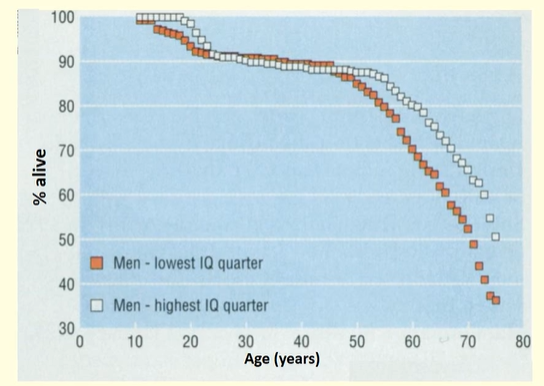
why was there a slight difference in scores for men?
In middle years trend seems to reverse - BUT this correlates with the years of the second world war - those with lower IQ were more likely to be rejected from service - one of the few exceptions
What (4) iq-health causal mechanisms does deary (2008) propose?
IQ → education → employment prospects → adult SES status
IQ → Health literacy and health behaviours → medication adherence, healthy eating physical activity etc.
suboptimal neural development → IQ and Psychiatric burden
Body system integrity → IQ and Health problems ( bodily symmetry associated with IQ)
How does IQ interact with happiness>
Ali et al. (2013); High IQ predicted likelihood of being happy → this relationship was mediated by:
dependency in activities of daily living
income
neurotic symptoms
self-reported health
marital status
social participation
define motivation (Chamorro-premuzic, 2013)
an internal state that: drives people into action, energizes directs and perpetuates behaviour, is directed towards the satisfaction of needs/drives, if unsatisfied, will generate a state of psychological or physiological arousal, dynamic rather than static
is motivation an individual difference or personality trait
an individual difference (state and trait differences) → linked with important life outcomes but relationship with personality is unclear and debated.
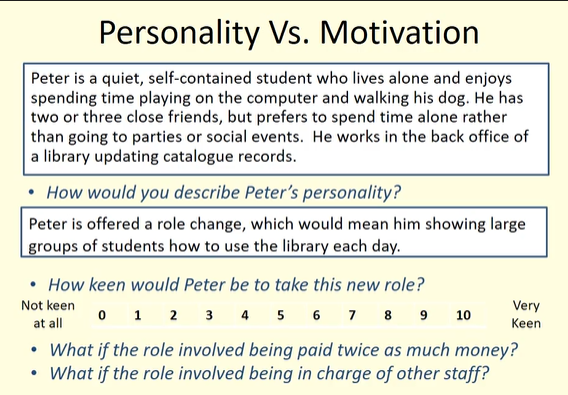
how do personality and motivation interact?
motivation may hold power over personality → e.g. someone may not like a specific job, but they could be motivated by money
Outline Murray’s (1938) model of motivation?
Press (situational conditions/events) & Need (primary and secondary needs) → bahviour
outline the primary and secondary needs in Murray’s model of motivation
primary needs: biological in nature e.g. air, food pain avoidance, sex
secondary/psychogenic needs: derived from biology and/or psychological e.g. nurturance and achievement
How does Chamorro-Premuzic (2013) suggest recent models have changed from Murray’s initial motivation model
More recent models include goals → especially to distinguish motivation from mood
What are the secondary needs that Murray suggets?
achievement
affiliation
aggression
autonomy
dominance
exhibition
nurturance
order
play
sentience
sex
understanding
but these are now seen as too many to focus on
what do Scheffer & Heckhausen (2018) note to be the 3 most focused on secondary needs in modern research?
Need for achievement, need for affiliation, need for power → these are partially linked to personality
Outline McClelland’s Aquired Needs Theory (1950s)
Three basic (secondary) needs:
Need for achievement → the desire to master skills, do things well, and accomplish goals etc.
Need for affiliation → the desire to form relationships and spend time with others.
Need for power → the desire to influence and control others
Measured with Thematic Apperception Test (TAT)
Outline the Thematic apperception test (TAT)
Tell stories about ambiguous stimuli → projective tests considered appropriate for motivation research due to implicit nature of motives
Outline the Subcomponents Schultheiss (2008) suggested for need for achievement and need for power
hope and fear components of motives:
need for achievement: hope for success vs fear of failure
need for power: hope for power vs fear of weakness
Outline the subtypes of need for affiliation that Hill (1987) suggested
need for: emotional support, positive stimulation, attention from others, social comparison
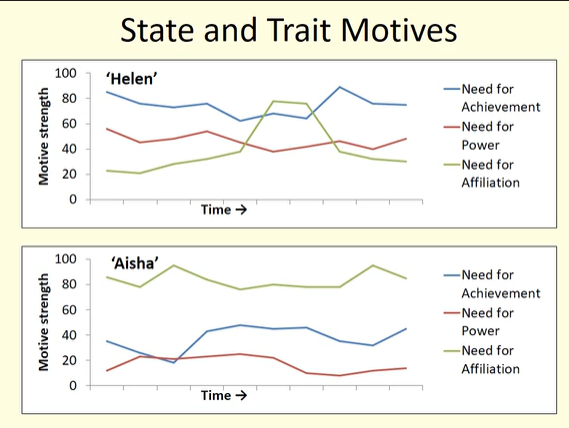
state/trait facets of motivation
motivation can be relatively stable, but also has state-like variation depending on circumstances
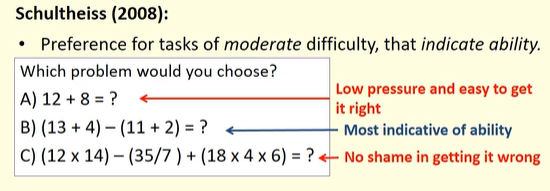
what kind of task does Schultheiss (2008) suggest that those with need for achievement would pick?
preference for tasks with moderate difficulty that indicate ability (not too east/too hard)
preference for work settings with frequent feedback on current vs previous performance
what does Schultheiss (2008) suggest are correlates of high need for achievement in individual-level/societal levels
individual level:
entrepreneurial success and innovation
poor leadership and managerial skills
Societal level:
economic growth and innovation
civil war and ineffective leadership
What did Bradburn & Berlew (1961) find in their historical study of need for achievement and economic growth
found that average level of need for achievement imagery from English literature plotted against gain in London coal imports were correlated (coal imports shortly following need for achievement ) suggesting economic growth
what dies Schultheiss (2008) say about need for power in individual and societal levels?
can reflect desire to influence and have impact, not necessarily just dominate and control
individual level:
higher testosterone levels
higher sexual activity and aggression
managerial, leadership and career success
societal level:
increase in war and arms
effective leadership
how do Winter (1973) and Peterson and Stuart (1996) suggest need for power can be presented?
can also be expressed through generativity:
Winter (1973); individuals high in need for power more attracted by jobs involving teaching
Peterson and Stuart (1996); High need for power in females correlated with larger families and greater involvement in parenting
How does need for power link to effective leadership? (Spangler and House, 1991)
motives estimated from previous coding of US presidents inagural speeches
presidential performance indicators measured by e.g. war entry, war avoidance, percieved ‘greatness’
Indicators of ‘presidential performance’ predicted by high need for power (lower needs for achievement and affiliation)
Outline Schultheiss (2008) individual and societal correlates of high need for affiliation
Individual level:
like similar others, but dislike dissimilar others
Societal level:
peace and disarmament
political scandal
what did Langer and Winter (2001) find regarding decision making and need for affiliation/power
importance of concessions to avoid/resolve conflicts - letters of students coded for concessions and needs
need for affiliation positively related to concessions
need for power negatively related to concessions
How does schultheiss (2008) suggest that need for power affects health?
High need for power correlated with high testosterone → engagement in power-challenge situations → activation of sympathetic nervous system stress response → chronic high blood pressure, lower immune function, increased susceptibility to illness
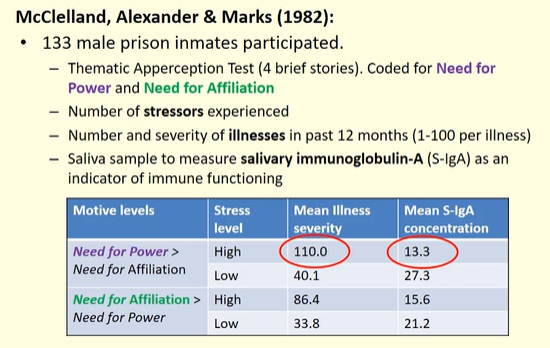
What did McClelland, alexander and marks find about need for power/affiliation and immunity (measured through salivary immunoglobulin-A, S-IgA)
took the TAT, stress level and number of illness experienced, and S-IgA count
those with need for power and high stress had a higher mean illness severity and lower mean S-IgA
How does need for power impact health?
need for power → dominate and control others → enagagement in power-challenge situations → more stress & acivation of sympathetic nervous system stress response
Schultheiss (2008): high need for power is not a vulnerability for health but NfP causes more stress which does implicate health
what does Schultheiss (2008) suggest is the link between need for affiliation and health
associated with parasympathetic activity and increased immune functioning, generally positive effects on health
made students watch doc on wither war or mother theresa, needs measured with TAT before and after, protective effects of need for affliliation from illness
 Note
Note  Flashcards (39)