A8 HAEMOGLOBIN
 Studied by 0 people
 Call Kai
 Learn
Learn Practice Test
 Spaced Repetition
 Match
Match Flashcards
 Knowt Play
1/37

There's no tags or description
Looks like no tags are added yet.
Name | Mastery | Learn | Test | Matching | Spaced | Call with Kai |
|---|
No analytics yet
Send a link to your students to track their progress
38 Terms
What is haemoglobin?
complex protein with a quaternary structure
composed of 4 polypeptide chains
each chain has a haem group, a globin chain and an iron core
How many oxygen molecules can the haem group bind to?
combines reversibly with one oxygen molecule, so haemoglobin can carry 4 oxygen molecules
What’s formed when oxygen combines with haemoglobin?
oxyhaemoglobin
What is the percentage saturation of haemoglobin?
the amount of oxygen combined with the haemoglobin
What does loading or association of haemoglobin mean?
the binding of oxygen to haemoglobin to form oxyhaemoglobin
Where does the loading of oxygen occur?
in the lungs
theres a high partial pressure of oxygen
What does partial pressure mean?
the amount of a particular gas in a mixture of gases or a solution
What happens at higher partial pressures of oxygen?
more oxygen will bind to the haemoglobin so there is a higher percentage saturation of haemoglobin
What does the oxygen dissociation curve look like?6
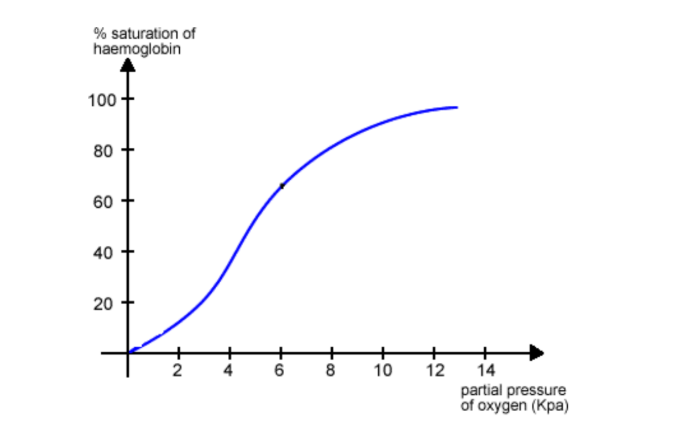
What is the shape of the oxygen dissociation curve?
sigmoidal
Describe the oxygen dissociation curve
at low partial pressures of oxygen the % saturation is low
at high partial pressures of oxygen the % saturation is high
What is dissociation?
when oxyhaemoglobin unloads oxygen
Where does dissociation occur?
at respiring tissues around the body
What does affinity mean?
the degree to which a substance tends to combine with another
What affects haemoglobin’s affinity for oxygen?
the partial pressure of oxygen
the partial pressure of carbon dioxide
What happens at high partial pressure’s of oxygen?
haemoglobin has a higher affinity for oxygen, so it will readily associate with oxygen and will dissociate less easily
What happens at low partial pressures of oxygen?
haemoglobin has a lower affinity for oxygen, meaning it will readily dissociate with oxygen and associate with it less easily
How is haemoglobin efficient at transporting oxygen?
as it changes affinities where necessary
oxygen is readily associated at the gas exchange surface
oxygen is readily dissociated at the tissues which need it
What causes the changes in affinity for oxygen?
due to changes in the shape of haemoglobin
What is cooperative binding?
binding of the first oxygen molecule causes a conformational change in the shape of the protein
this exposes the oxygen binding sites, making it easier for subsequent oxygen molecules to bind
How does the partial pressure of carbon dioxide affect the affinity of haemoglobin for oxygen
the higher the partial pressure, the lower the affinity of haemoglobin for oxygen
Why does carbon dioxide affect haemoglobin’s affinity for oxygen?
carbon dioxide dissolves in blood plasma to form carbonic acid
this decreases the pH
hydrogen ions disrupt ionic bonds in the tertiary structure causing a conformational change which lowers haemoglobin’s affinity for oxygen
What does it show if the sigmoidal curve is shifted to the right?
there is a higher partial pressure of carbon dioxide as the percentage saturation of haemoglobin is lower at higher partial pressures of carbon dioxide
Why is the Bohr shift beneficial when exercising?
as our respiratory rate increases, so more carbon dioxide is produced and the partial pressure of carbon dioxide increases
the conformational change in the haemoglobin leads to increased dissociation so more oxygen is available for the tissue so it can respire aerobically
How have different species adapted their haemoglobin?
in mutations
the structure of haem is identical however globin chains can differ
What do differences in globin chain cause?
variation in their oxygen-binding properties
they bind to and release oxygen in different conditions so the position of their dissociation curve is different
What does PAL stand for when answering a dissociation curve question?
P- partial pressure of oxygen
A- affinity of haemoglobin for oxygen
L- whether oxygen is loading or unloading more readily
What does it show if the dissociation curve has shifted to the right?
the species has a high metabolic rate
What surface area to volume ratio do species with a dissociation curve shifted to the right have?
a large surface area to volume ratio so lose heat readily and need to generate more heat via respiration to maintain a constant body temperature
How would a question for a mouse with the dissociation curve shifted to the right be answered?
P- at the same partial pressure of oxygen
A- the mouse haemoglobin has a lower affinity for oxygen
L- so unloads more readily
so more oxygen is available to cells for more aerobic respiration, which is exothermic to maintain a constant body temperature
What type of animals have a dissociation curve shifted to the right?
active species which need to contract their muscles more frequently, meaning they need to respire more for ATP for muscle contraction
How would a question for a hummingbird with the dissociation curve shifted to the right be answered?
P- at the same partial pressure of oxygen
A- hummingbird haemoglobin has a lower affinity for oxygen
L- unloads oxygen more readily
more oxygen is available for more respiration to supply ATP for muscle contraction
When would a dissociation curve be shifted to the left?
for species that live in low oxygen environments
How would a question for a llama with the dissociation curve shifted to the left be answered?
P- partial pressures of oxygen are low in the lungs. at low partial pressures of oxygen
A- llama haemoglobin has a higher affinity for oxygen
L- so loads oxygen more readily
meaning that haemoglobin becomes saturated at lower partial pressures allowing sufficient oxygen to be loaded to supply tissues with enough oxygen for aerobic respiration
How is foetal haemoglobin different to adult haemoglobin?
has a different shape due to containing different chains
foetal haemoglobin has a higher affinity for oxygen so the dissociation curve is shifted to the left
How does foetal haemoglobin aid the foetus?
by the time oxygen reaches the placenta the partial pressure of oxygen has decreases
foetal haemoglobin must have a higher affinity for oxygen in order for the foetus to get sufficient oxygen
What’s myoglobin?
stores oxygen in the muscles
What is myoglobins affinity for oxygen at low partial pressures?
has a higher affinity for oxygen
 Note
Note  Flashcards (53)