Chemical Senses
 Call Kai
 Learn
Learn Practice Test
 Spaced Repetition
 Match
Match Flashcards
 Knowt Play
1/35

There's no tags or description
Looks like no tags are added yet.
Name | Mastery | Learn | Test | Matching | Spaced | Call with Kai |
|---|
No analytics yet
Send a link to your students to track their progress
36 Terms
Function of olfaction and gustation
complementary senses that let us know whether a substance should be savored or avoided
Chemoreceptors
are used by olfaction and gustation
Chemicals must be dissolved in aqueous solution to be picked up by chemoreceptors
Smell receptors are excited by chemicals dissolved in nasal fluids
Taste receptors respond to chemicals dissolved in saliva
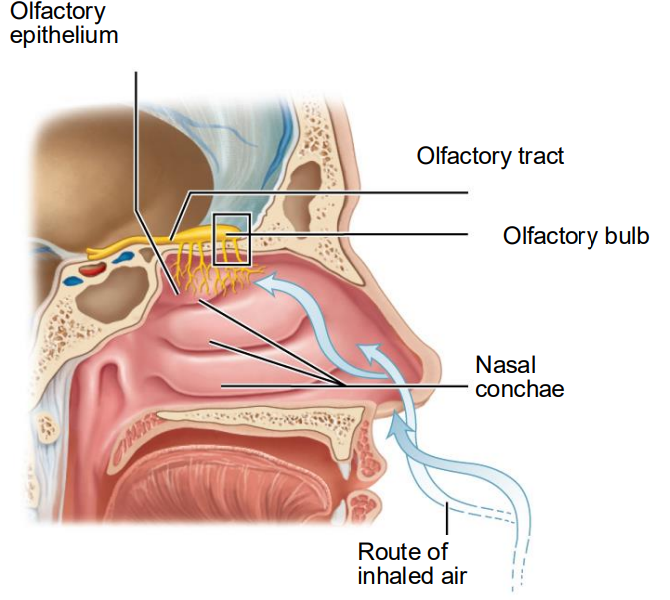
Olfactory epithelium of olfactory receptors
where olfactory receptors are located
organ of smell
Located in in roof of nasal cavity
Covers superior nasal conchae
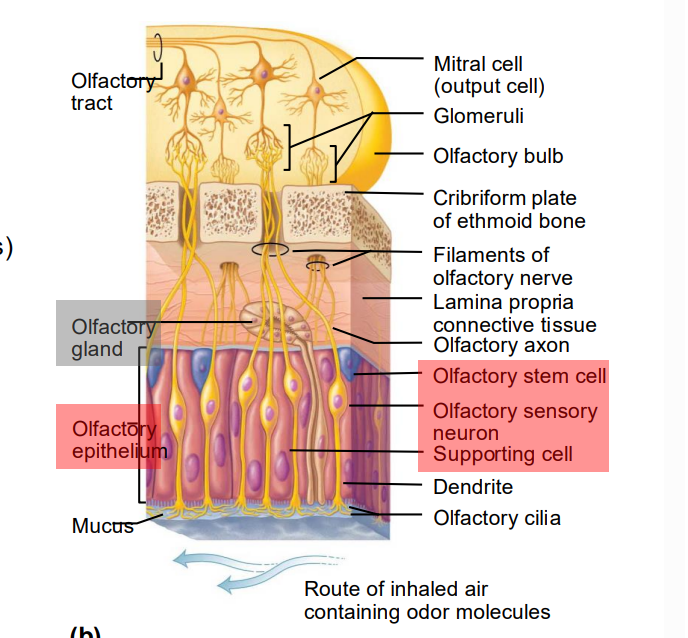
Contains olfactory sensory neurons
Bipolar neurons with radiating olfactory cilia
Has supporting cells to surround and cushion olfactory receptor cells
Has olfactory stem cells that lie at base of epithelium
Olfactory neurons of olfactory receptors
Olfactory neurons are unusual bipolar neurons
Thin apical dendrites terminate in knob
Long, largely nonmotile cilia, olfactory cilia, radiate from knob
Covered by mucus (solvent for odorants)
Bundles of nonmyelinated axons of olfactory receptor cells gather in fascicles that make up filaments of olfactory nerve (cranial nerve I)
unlike other neurons, have stem cells that give rise to new neurons every 30–60 days
CN I is the filaments of olfactory nerve
2 receptors olfactory epithelium
olfactory nerve
mitral cell (output cell)
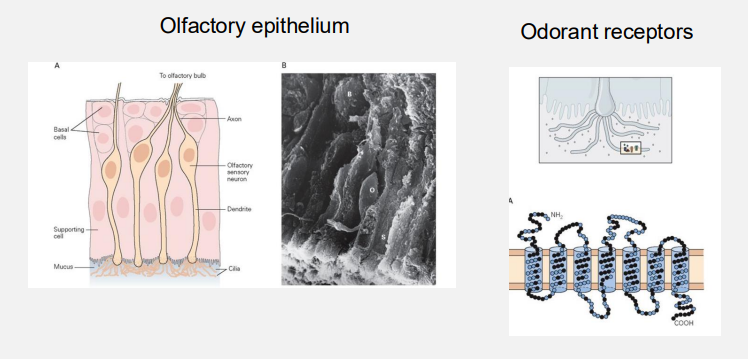
Olfactory epithelium and odorant receptors
How many ‘smell’ genes are active in the nose
400
Function of ‘smell’ genes in human nose
Each encodes a unique receptor protein
Protein responds to one or more odors
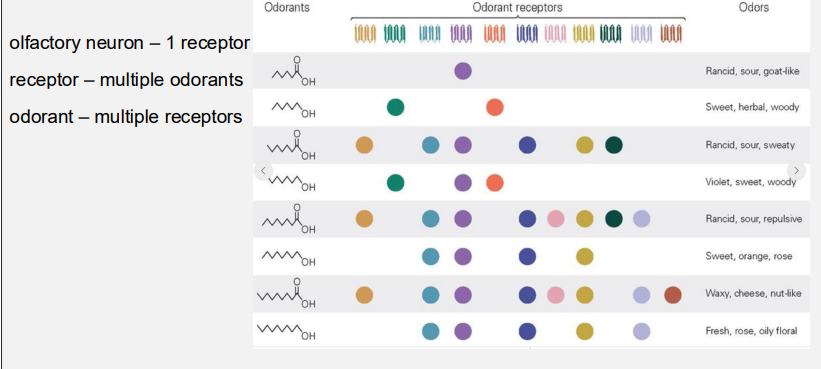
Each odor binds to several different receptors
Each receptor cell has one type of receptor protein
Odor coding
1 olfactory neuron can express only 1 receptor
1 receptor can detect many different molecule(odorant)
1 molecule can be detected by multiple receptors
How are olfactory neurons grouped
neurons with same receptor are confined to 1 zone but are scattered in that zone
Neurons with different receptors are interspersed
not completely true in all cases
How are we able sense smell
Axons of sensory neurons with the same odorant receptor type converge in 2 glomeruli
Single odorant activates multiple glomeruli with input from different receptors
Each glomerulus is dedicated to one type of receptor signaling
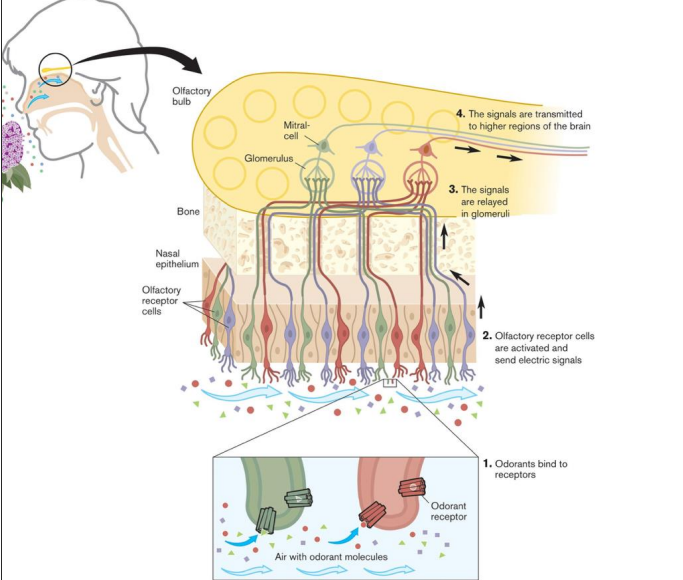
How are we able to smell
In order to smell substance, it must be volatile
Must be in gaseous state
Odorant must also be able to dissolve in olfactory epithelium fluid
Activation of olfactory sensory neurons
Dissolved odorants bind to receptor proteins in olfactory cilium membranes
Open cation channels, generating receptor potential
At threshold, AP is conducted
Olfactory transduction(translation into neuronal signal) process
recall 5 steps of G-protein coupling
Olfactory pathway
Filaments of olfactory nerves synapse with mitral cells located in overlying olfactory bulb
Mitral cells are second-order neurons that form olfactory tract
Synapse occurs in structures called glomeruli
Axons from neurons with same receptor type converge on given type of glomerulus
Mitral cells amplify, refine, and relay signals
Impulses from activated mitral cells travel via olfactory tracts to piriform lobe of olfactory cortex
Some information sent to hypothalamus, amygdala, and other regions of limbic system
Emotional responses to odor are elicited
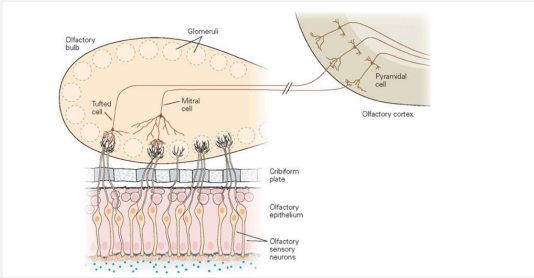
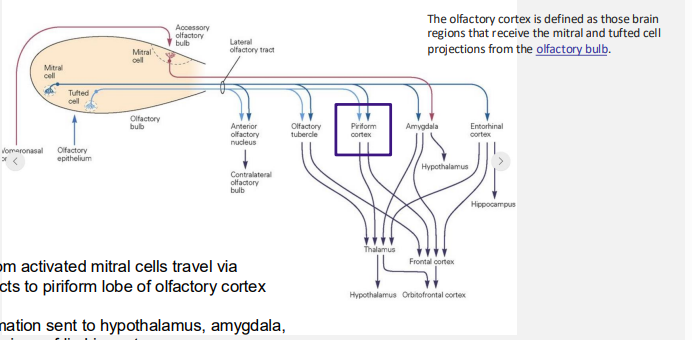
Piriform cortex
Responsible for conscious perception of olfactory information
Olfactory information can either go to the piriform cortex and synapse at thalamus or just synapse only at this area
Anosmias
olfactory defect; most result from
Head injuries that tear olfactory nerves
Aftereffects of nasal cavity inflammation
Neurological disorders, such as Parkinson’s disease
usually an early sign of Parkinson’s
irreversible
reversible one can come from a cold
Phantosmia
olfactory hallucination
smelling something that is absent
Usually caused by temporal lobe epilepsy that involves olfactory cortex
Some people have olfactory auras prior to epileptic seizures
misfiring of the neurons causes faulty signaling to olfactory cortex when it did not actually come from the olfactory epithelium
Where and how taste sensed
Chemoreceptors in taste buds detect gustatory signals
Taste buds
sensory organs for taste
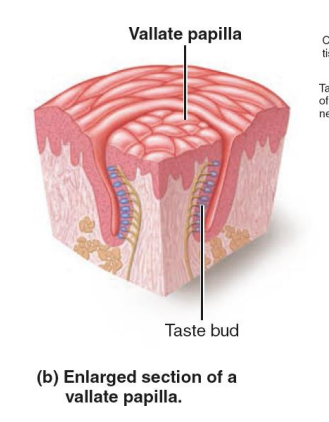
Most of 10,000 taste buds are located on tongue in papillae, peglike projections of tongue mucosa
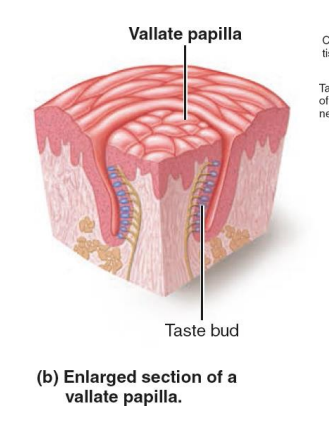
3 papillae that have tastebuds
Fungiform papillae: tops of these mushroom-shaped structures house most taste buds; scattered across tongue
Foliate papillae: on side walls of tongue
Vallate papillae: largest taste buds with 8–12 forming “V” at back of tongue
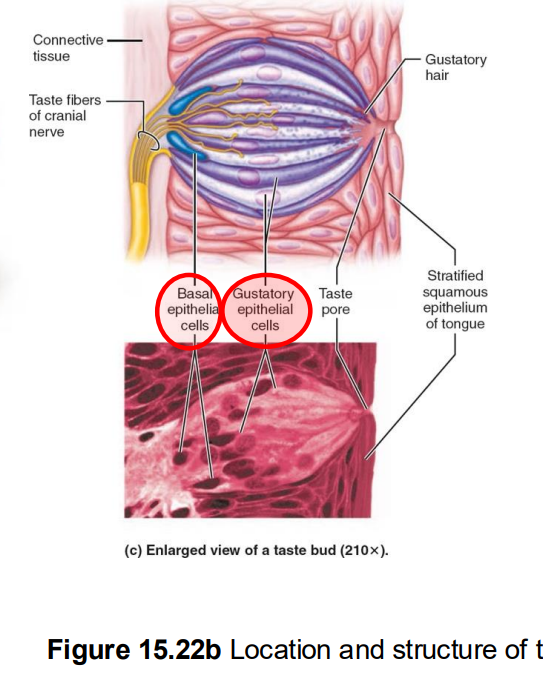
Parts of a taste bud
Gustatory epithelial cells
Basal epithelium cells
Gustatory epithelial cells
taste receptor cells have microvilli called gustatory hairs that project into taste pores, bathed in saliva
Sensory dendrites coiled around gustatory epithelial cells send taste signals to brain
not neuronal tissue unlike olfactory, photorecption,
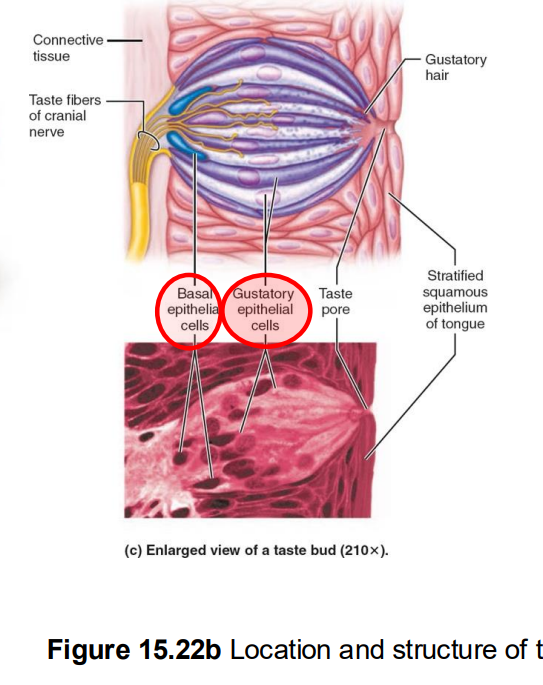
Basal epithelial cells
dynamic stem cells that divide every 7–10 days
constantly renews (blue region
5 basic taste sensations
Sweet: sugars, saccharin, alcohol, some amino acids, some lead salts
Sour: hydrogen ions in solution
Salty: metal ions (inorganic salts); sodium chloride tastes saltiest
Bitter: alkaloids such as quinine and nicotine, caffeine, and nonalkaloids such as aspirin
Umami: amino acids glutamate and aspartate; example: beef (meat) or cheese taste, and monosodium glutamate
all detected by different receptors
Purpose of taste ‘likes’ and ‘dislikes’
Guide intake of beneficial and potentially harmful substances
Dislike for sourness and bitterness is a protective way of warning us if something is spoiled or poisonous
How are we able to taste
To be able to taste a chemical, it must:
Be dissolved in saliva
Diffuse into taste pore
Contact gustatory hairs
Then requires taste receptors
Activation of taste receptors
Binding of food chemical (tastant) depolarizes cell membrane of gustatory epithelial cell membrane, causing release of neurotransmitter
Neurotransmitter binds to dendrite of sensory neuron and initiates a generator potential that leads to action potentials
Different gustatory cells have different thresholds for activation
Bitter receptors are most sensitive
All adapt in 3–5 seconds, with complete adaptation in 1–5 minutes
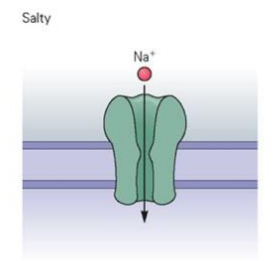
How is salty taste transduced
Salty taste is due to Na+ influx that directly causes depolarization
How is sour taste transduced
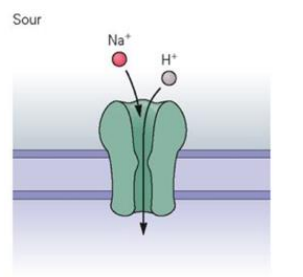
Sour taste is due to H+ acting intracellularly by opening channels that allow other cations to enter
How are sweet, bitter, and umami transduced
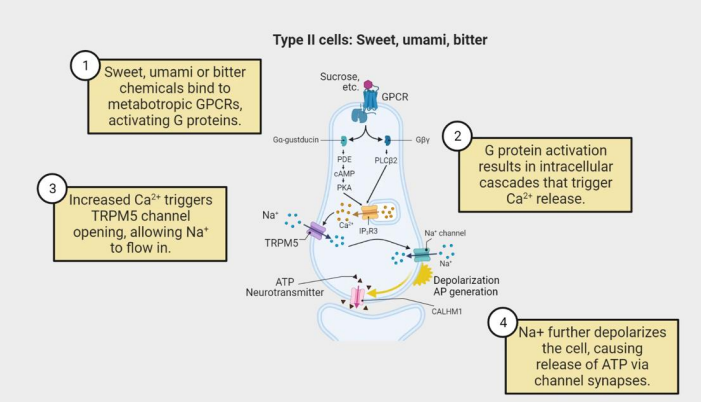
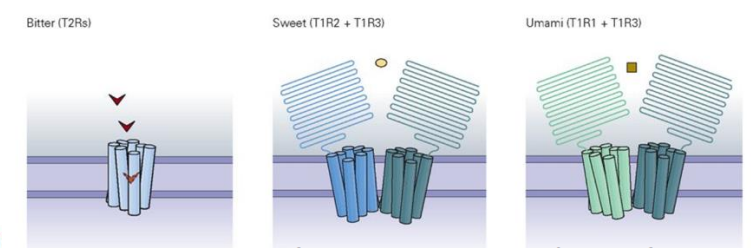
Unique receptors for sweet, bitter, and umami, but all are coupled to G protein gustducin
Activation causes release of stored Ca2+ that opens cation channels, causing depolarization and release of neurotransmitter ATP
salivary glands
3 main pairs
Saliva acts as a solvent
Facilitates clearance of taste particles
no saliva= no ability to taste
What other senses are involved in taste perception?
Taste is 80% smell
If nose is blocked, foods taste bland
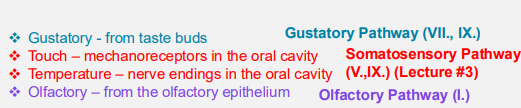
Mouth also contains thermoreceptors, mechanoreceptors, and nociceptors
Temperature and texture enhance or detract from taste
Spicy hot foods can excite pain receptors in mouth, which some people experience as pleasure
Example: hot chili peppers
How are gustatory signals transmitted to the brain?
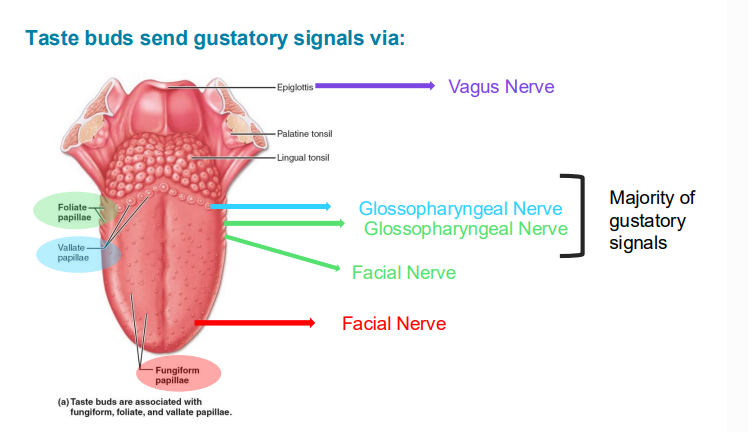
3 main cranial nerve pairs that carry taste impulses from tongue to brain
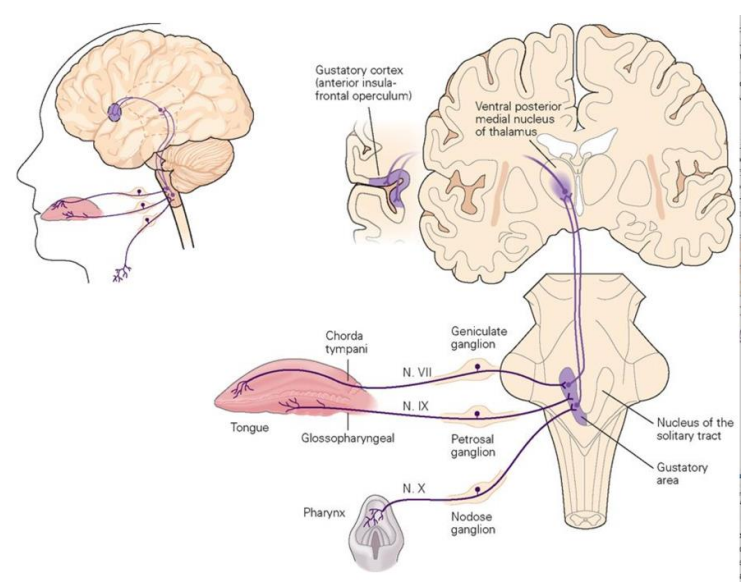
Facial nerve (VII) carries impulses from anterior two-thirds of tongue
Glossopharyngeal (IX) carries impulses from posterior one-third and pharynx
Vagus nerve transmits (X) from epiglottis and lower pharynx
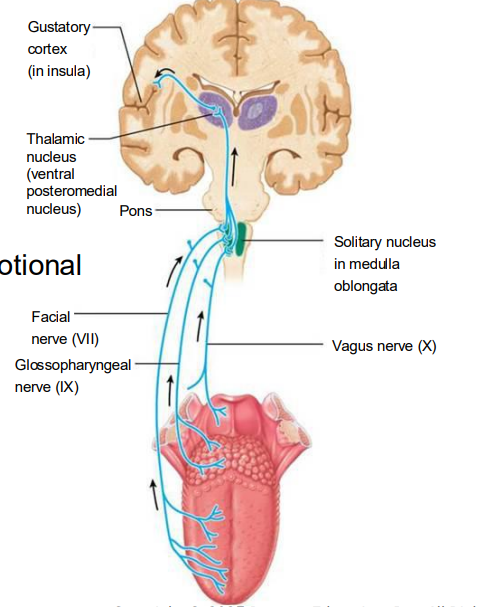
Fibers synapse in the solitary nucleus of the medulla, then travel to thalamus, and then to gustatory cortex in the insula
Hypothalamus and limbic system are involved; allow us to determine appreciation of taste
Cortex: detect taste
Hypothalamus, limbic system: trigger emotional valance
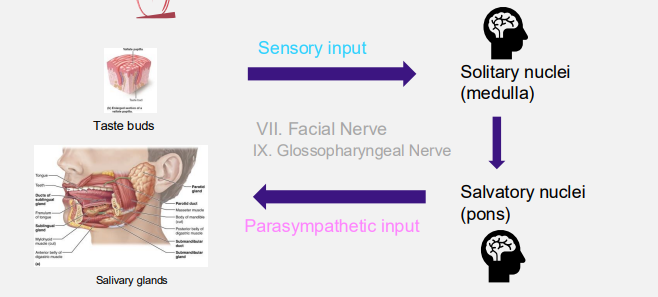
Solitary nucleus: trigger Visceral reflexes
Gustatory reflex
Explore top notes

