Intro to Contemporary Art Exam 3
 Call Kai
 Learn
Learn Practice Test
 Spaced Repetition
 Match
Match Flashcards
 Knowt Play
1/21

There's no tags or description
Looks like no tags are added yet.
Name | Mastery | Learn | Test | Matching | Spaced | Call with Kai |
|---|
No analytics yet
Send a link to your students to track their progress
22 Terms
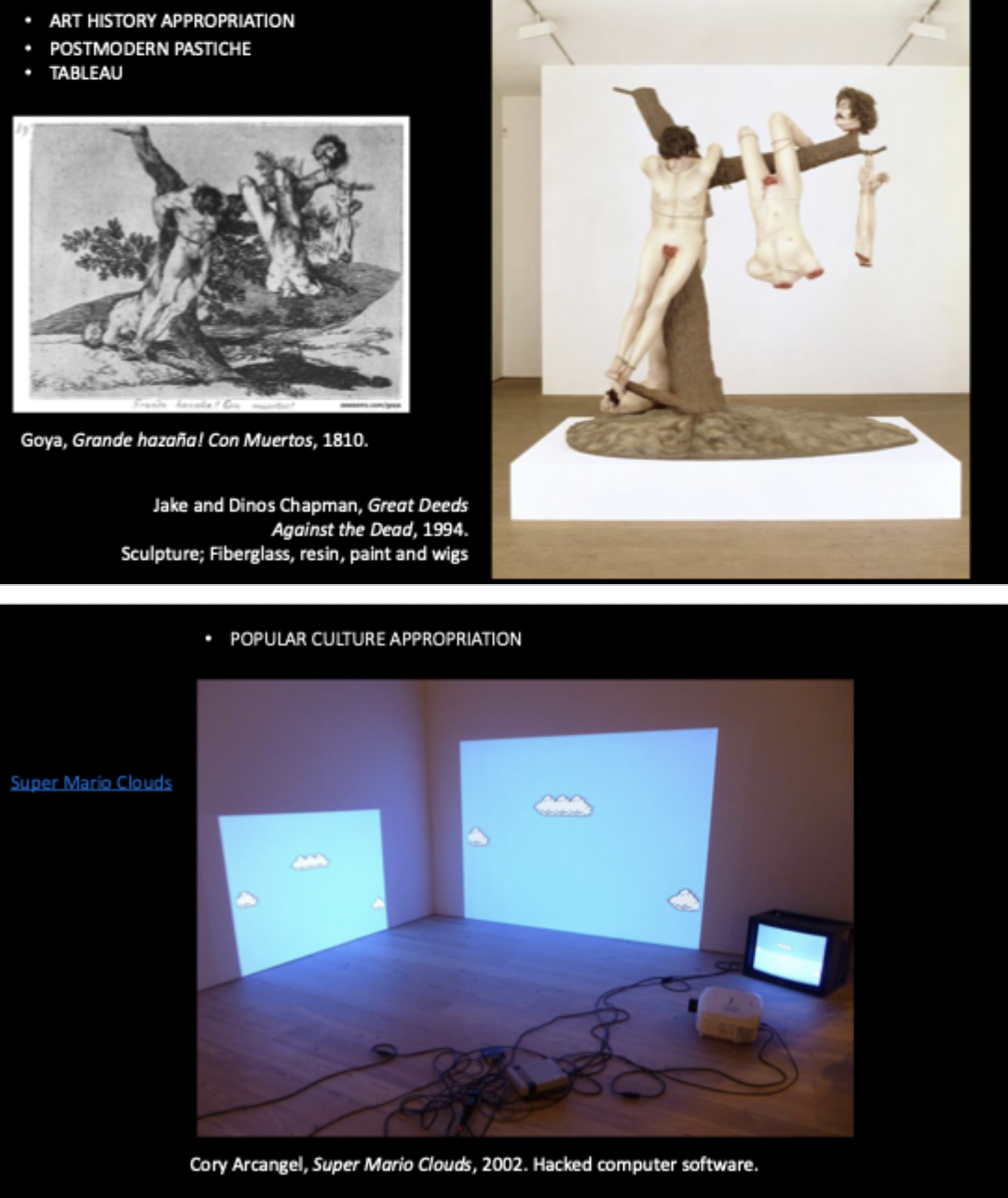
Appropriation
When an artist takes existing images, objects, or artworks and reuses them in a new context to create a new meaning.
Jake and Dinos Chapman, Great Deeds Against the Dead, 1994 - takes Goya’s prints and changes the imagery in their sculpture, therefore changing the meaning. The original was a documentation of war trauma, but with exaggerated and surreal elements, the sculpture confronts repeated violence and makes people aware of the normalization of violence.
Cory Arcangel, Super Mario Clouds, 2002 - example of popular culture appropriation through digital art. Artist takes original Super Mario Bros and takes all the elements so it is just the background. This makes the classic interactive game now an iconic setting that represents nostalgia and childhood memory.
Artist as archivist
Artist as archivist is when an artist collects, organizes, and presents documents, images, or records to construct a version of history. they often interrogate how history is recorded.
Tracey Emin, Everyone I Have Slept With 1963-1995, 1995. - tent-like installation that shows the names of all the people she slept with during that time, sexual and non-sexual. Emin is the archivist, preserving personal memories and relationships through her installation, turning lived experience into a structured record.
Walid Raad, “The Atlas Group Archive,” 1986-2006 (Notebook Volume 38. Already Been in a Lake of Fire, 1991; Notebook Volume 72. Missing Lebanese Wars, 1989; and My Neck is Thinner Than a Hair: Engines. A History of Car Bombs in the Lebanese Wars (1975-991). Volume 1-245, 200 - presenting historical archives but it is unclear what is real or crafted by the artist. This blurs the line between fact and fiction, critiquing the way history is recorded. It also represents trauma and missing history.
Nan Goldin, The Ballad of Sexual Dependency, 1979-1986 - artist creates photographic archive of her life/community. it is a multi-sensory experience as she also uses sound in the experience. it tells a story of her life and the specific culture she was a part of.
Artist as collector
when an artist gathers, selects, and organizes objects—often everyday or found items—and presents the collection itself as the artwork.
Susan Hiller, From the Freud Museum, 1991–6 - taking collected objects and giving them meaning through groupings, often ones that juxtapose each other. this creates memory and association with the objects, cultural and personal.
Artist as curator
when an artist selects, organizes, and displays objects (often existing ones) to create meaning—like a curator—but as an artistic act.
Fred Wilson, Metalwork 1793-1880, Modes of Transport 1770-1910, and Cabinetmaking 1820-1860; in “Mining the Museum”, The Contemporary and Maryland Historical Society, Baltimore, 1992-1993 - all different sections he did which use objects already in the museums collection but reframing their meaning through juxtaposition. He pairs the historical objects with things that contradict each other to show. This challenges and critics the way museums present history and how it shapes historical narratives.
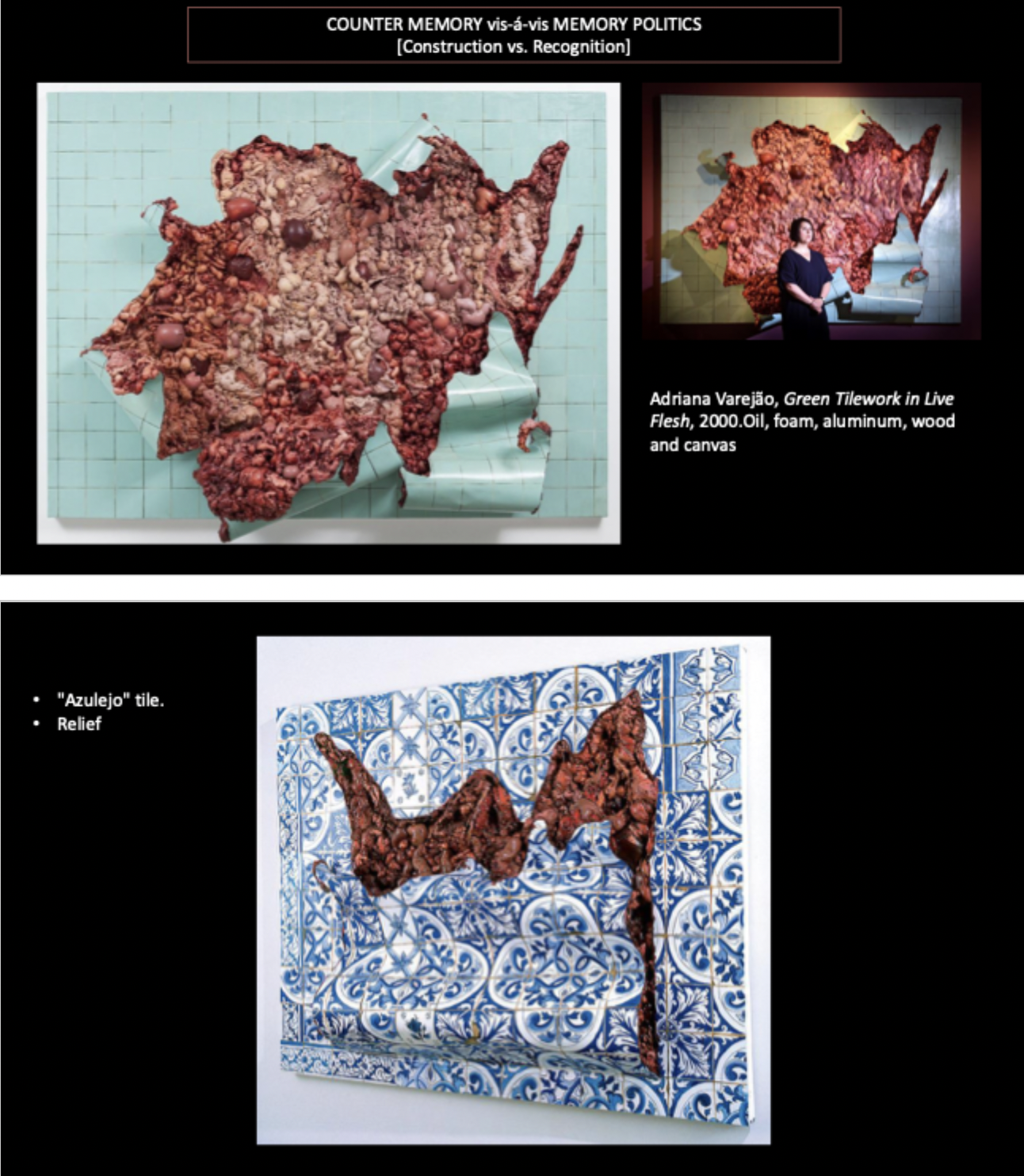
Counter Memory
artists create an alternative version of memory that does not simply add marginalized voices into official history, but instead builds a completely different way of remembering the past.
Adriana Varejão, Green Tilework in Live Flesh, 2000 - beautiful tile work revealing hidden violence beneath the surface. The artist is creating an alternative memory of Brazil’s colonial past
Critical Race Theory
a way of making and interpreting art that examines how race, power, and systemic inequality are built into society, institutions, and cultural representation
Kerry James Marshall, Many Mansions, 1994 - it critiques the historical exclusion of Black figures in Western art history by centering Black domestic life and reasserting their visibility within canonical painting traditions.
Frieze
a long, continuous visual composition that tells a story in a horizontal sequence
how is Kara Walker, Camptown Ladies, 1998 - narrates the story going across the mural. it shows the brutality of racism
Memorial
an artwork or structure created to commemorate people, events, or histories of loss, trauma, or significance.
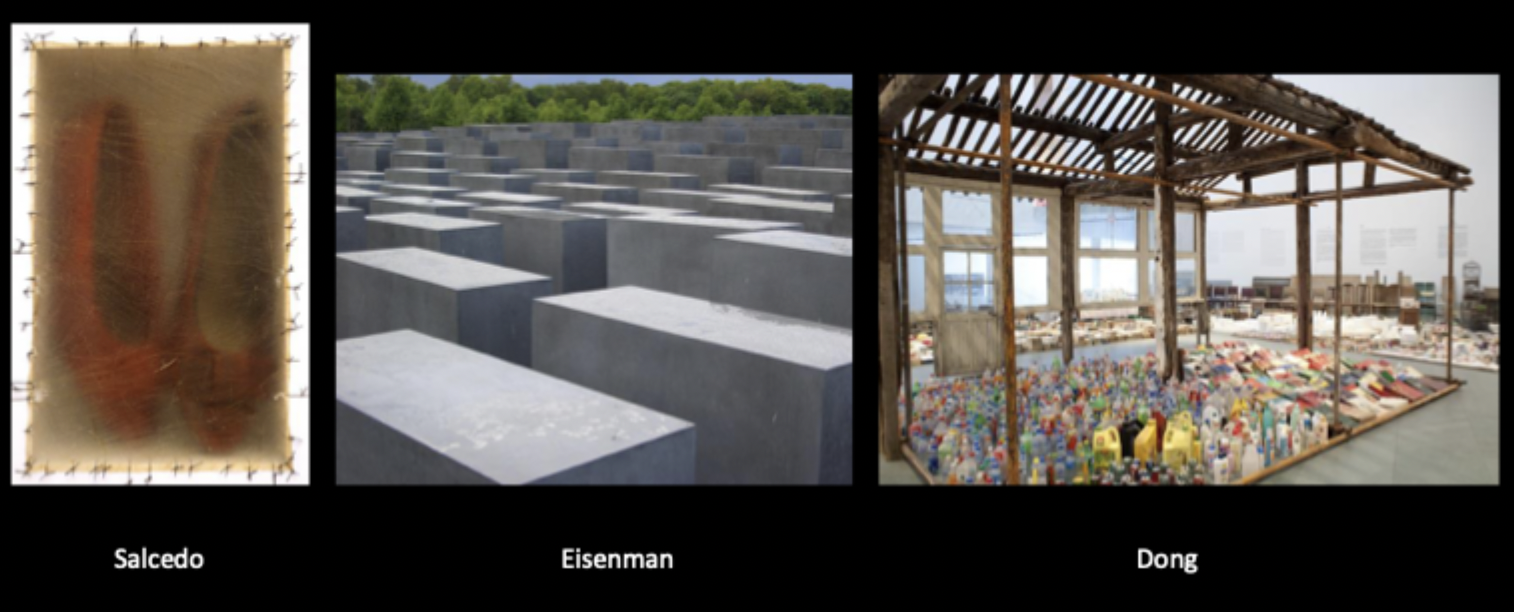
Memory Politics
the government's attempt to shape people's memories through art (which stories/perspectives are told and how they are framed)
Doris Salcedo, Atrabibliarios, 1999-2004 - the Columbian government framed this violent time often erasing narratives of those who disappeared, but this artist brings attention to the victims who went missing by showing evidence of their absence, their shoes. She advocates for the victims and shifts people’s memory of this time in history with the power of their absence.
Peter Eisenman, Memorial to the Murdered Jews in Europe, 1998-2005
Song Dong, Projects 90: Song Dong, Waste Not, 2009. - this installation is of thousands of objects from his Chinese mother, which serve as preserving memory of her and this time of scarcity/economic hardship in China. This installation contrasts official history with personal memory.
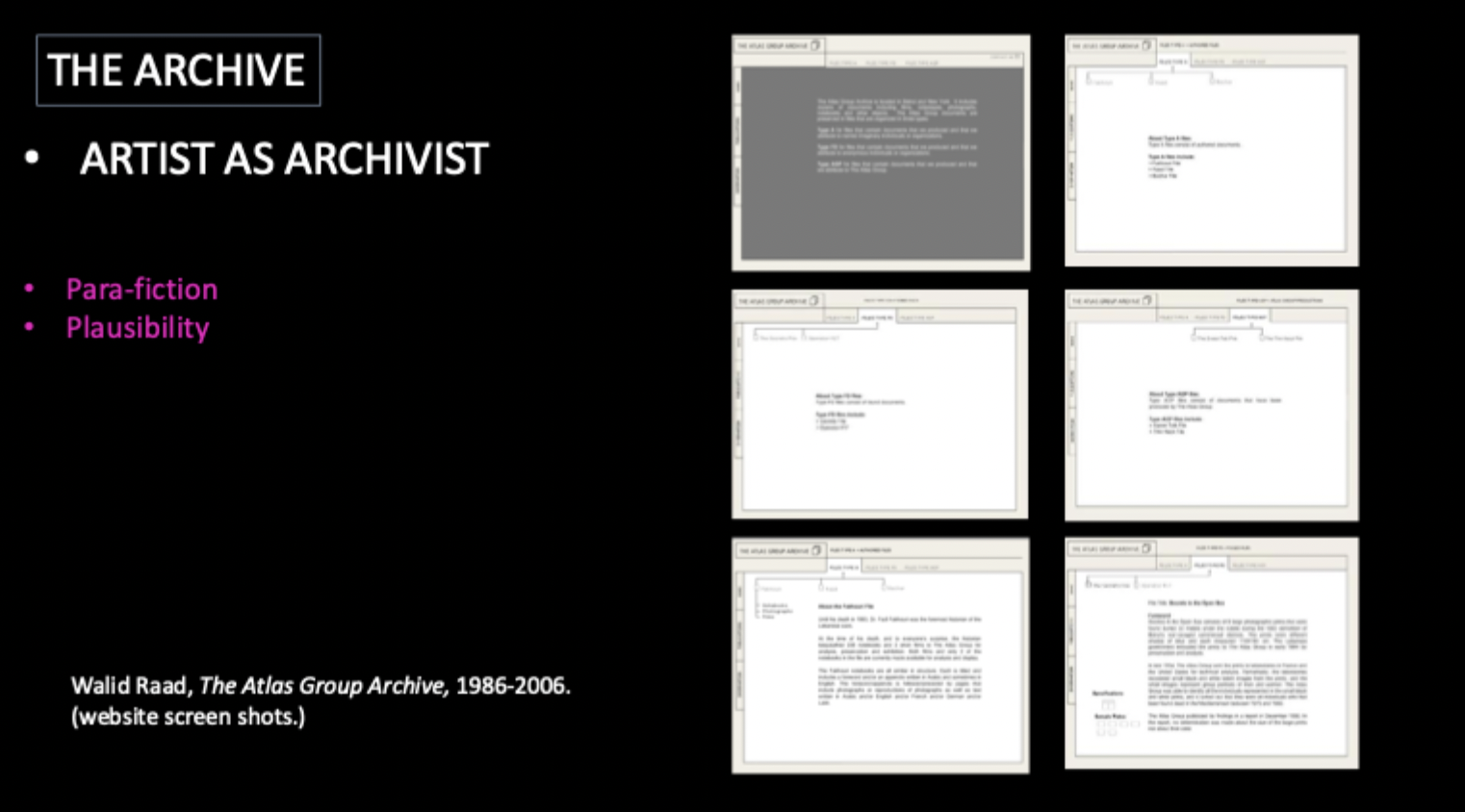
Para-fiction
when artists create fictional stories, documents, or archives that are presented as if they are real—blurring the line between truth and invention.
Walid Raad, “The Atlas Group Archive,” 1986-2006 (Notebook Volume 38. Already Been in a Lake of Fire, 1991; Notebook Volume 72. Missing Lebanese Wars, 1989; and My Neck is Thinner Than a Hair: Engines. A History of Car Bombs in the Lebanese Wars (1975-991). Volume 1-245, 200 - in this fiction is presented as an archive, appearing as real historical records. blurring the line between fiction and truth challenges/critiques the way historical information is recorded
Process art or system art
the artwork is defined by change over time rather than a permanent object
Félix Gonzáles-Torres, Untitled (Perfect Lovers), 1987-90. - this piece is often linked to memory politics and memorial practices, it also relates to process art because its meaning unfolds over time through the gradual desynchronization and decay of the clocks.
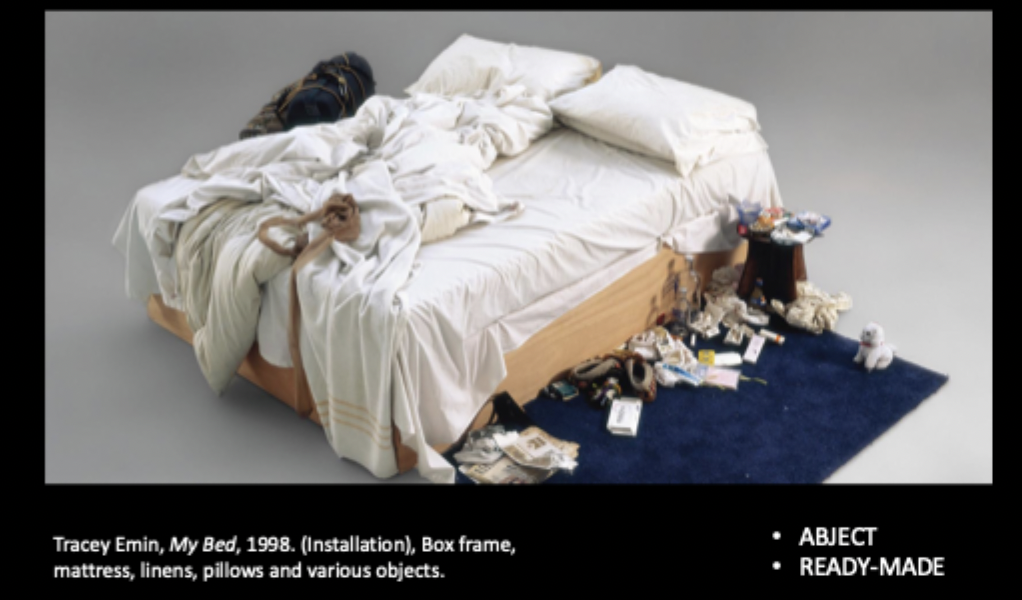
Readymade
A readymade is an everyday object that an artist selects and presents as art with little or no alteration.
Tracey Emin, My Bed, 1998 - this is an installation where the artist took her bed after she had a breakdown and preserved it as art to show the memory of it. the artist presents her actual bed, an everyday object, exactly as she left it in this moment and made it art.
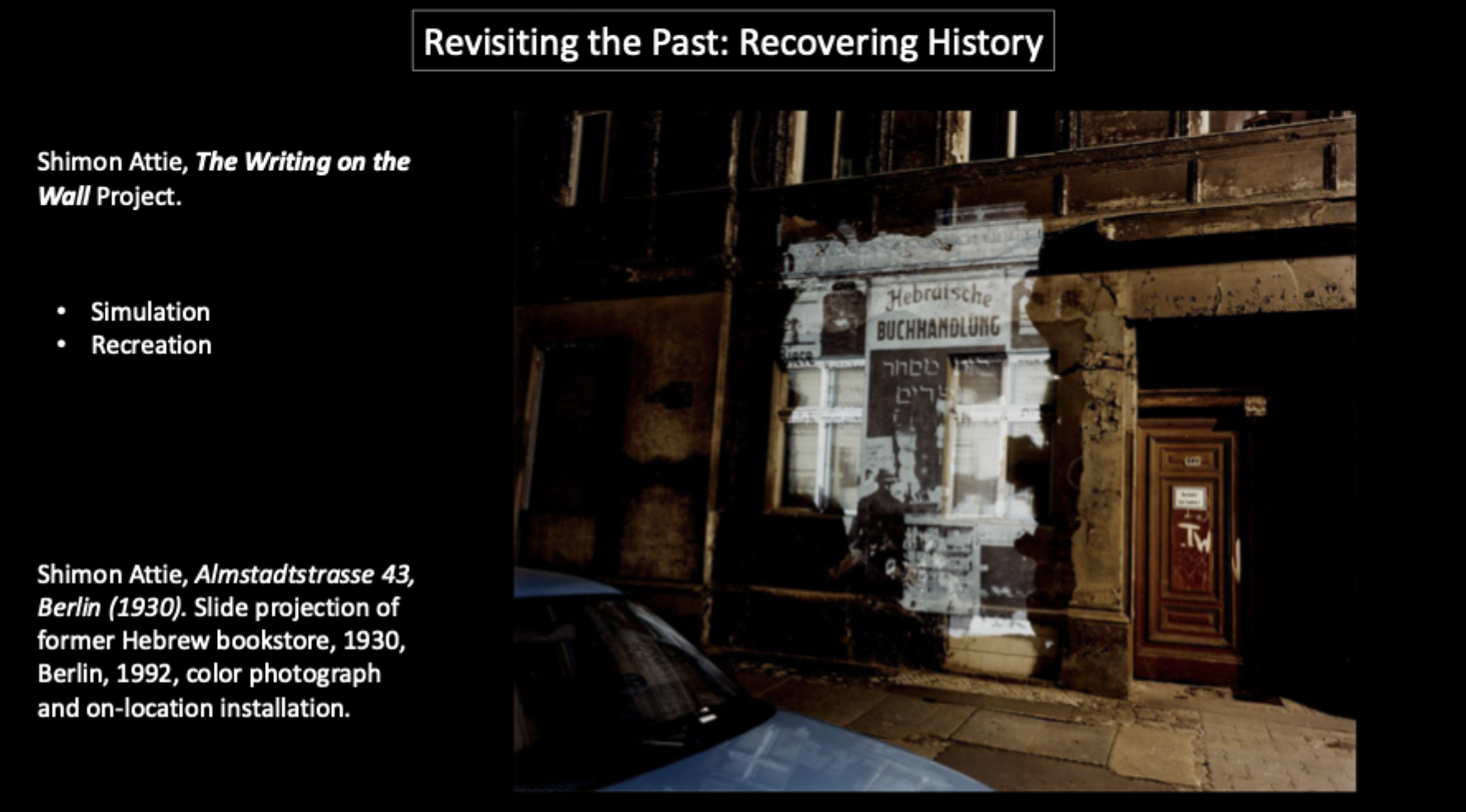
Recreation
when an artist reconstructs or reimagines a historical place, event, or environment that no longer exists (or is no longer visible).
Shimon Attie, The Writing on the Wall Project, 1992 - projection of former Hebrew bookstore. overlaying the past onto present space.
Reenacting the past
when artists recreate, restage, or perform past events—often using actors, video, or staged scenes—to explore how history is remembered and told
Omer Fast, Godville, 2005 - used actors to reenact interviews of soldiers who served in Iraq. the artist blurs the line between fiction and history through the interviews, which shows how memory changes and critiques past war narratives.
Pierre Huyghe, The Third Memory, 1999 - reenacting Brooklyn bank robbery. mixing real memory with film memory, creating a “third memory” showing how reenacting media shapes memory.
Krzysztof Wodiczko, Lenin Monument, Leninplatz, Berlin, 1990. - it intervenes in a Soviet-era monument during a moment of political change, reactivating its historical meaning to critically question how ideology is remembered in public space. also site-specifc
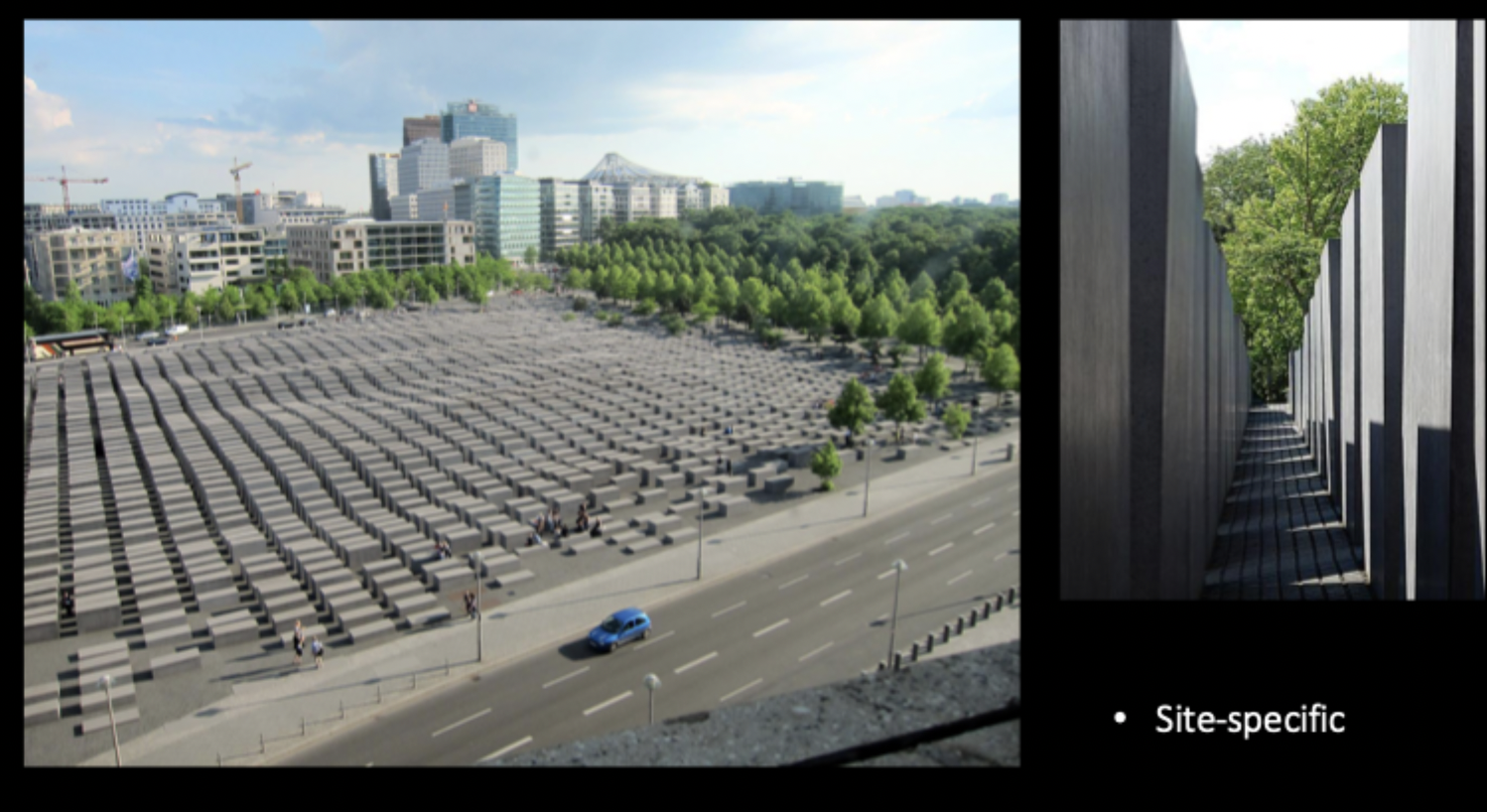
Shoah
Refers to killing of the Jews during the Holocaust
Peter Eisenman, Memorial to the Murdered Jews in Europe, 1998-2005. - form of memory politics, remembering those who died in the Holocaust. This is a site-specific installation of one concrete slabs for each victim. The slabs are varying heights arranged in a grid (representing isolation and unease) and each have no names (representing the people’s identity being stripped from them). With this piece Germany acknowledges the tragedy and shapes this idea into one of remembering the victims.
Silhouette cutouts
figures reduced to outlines that emphasize form, narrative, and symbolism over identity
Kara Walker, Camptown Ladies, 1998 - uses black silhouettes of the figures to tell the story. the silhouette is a story telling device
Simulation
when an artwork creates or replaces reality through representation, media, or technological systems, so that what we experience is not the “original” thing itself but a constructed version of it.
Bill Fontana, Sound Island, Arc de Triomphe, Paris, 1994. - it replaces the natural sound environment of a real site with transmitted, constructed sound, creating a mediated experience of place that feels real but is artificially produced.
Site-specific
artwork that is created for, shaped by, and inseparable from a particular location.
Brian Tolle, Irish Hunger Memorial, 2002 - this memorial uses environmental elements and was made specifically for the location it is in. it would not make sense or be the same experience if it were located somewhere else because of the Irish history with migrating to New York
Kara Walker, A Subtlety…, 2014 - it was created for the Domino Sugar Factory and uses the history of sugar production and enslaved labor embedded in that location to shape its meaning, while also engaging memory politics and Critical Race Theory.
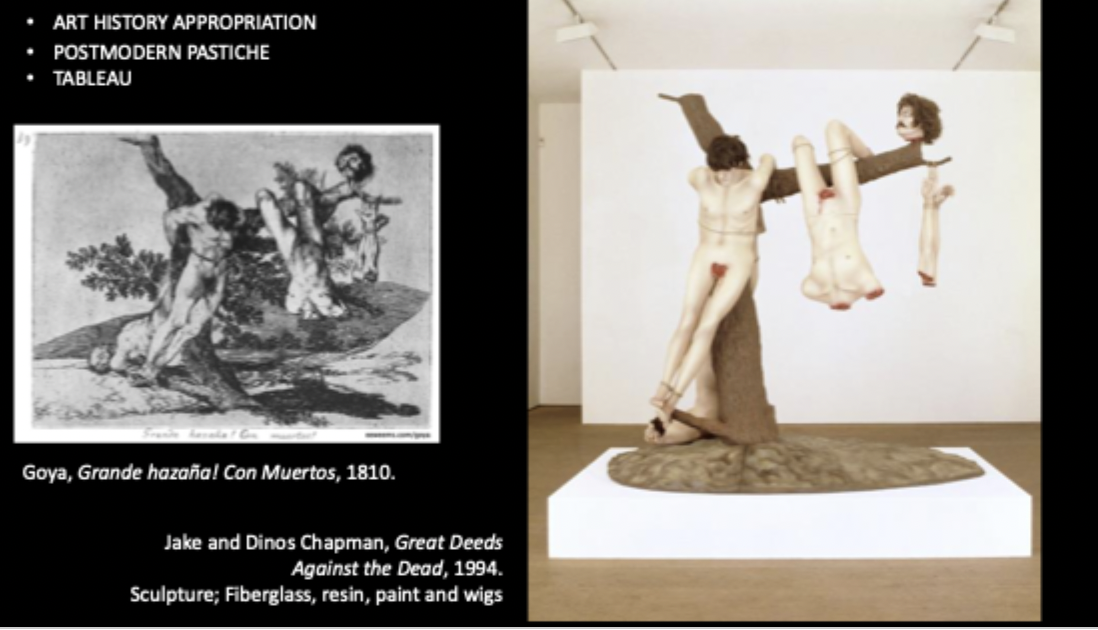
Tableau
still, staged arrangement of people or objects that looks like a scene or picture, often representing a scene from a story or from history
Jake and Dinos Chapman, Great Deeds Against the Dead, 1994 - an example of a tableau because it presents a staged, motionless scene that viewers “read” visually, but it pushes the idea further by turning historical imagery into a 3D, immersive installation of violence and aftermath.
Whitfield Lovell, Grace, 2003 - frozen moment in time, carefully staged, implies a story, and evokes historical memory without movement.
The Glitch
a visual or technical error
David Szauder, Failed Memories (series), 2013 - this piece shows the combination of glitch and memory. Memory is not always straightforward and in this piece the computer tries to fill in the gap in memory with data but the data is not correct and appears as the glitch.
Turbine Hall Tate Modern
The Turbine Hall is a massive, central exhibition space inside the Tate Modern in London. It holds many large pieces of art installations that are all site-specific.
Anish Kapoor, Marsyas, 2002. - a site-specific installation in the Tate Modern’s Turbine Hall that uses enormous red stretched membrane and steel rings to create an immersive environment evoking the body, interior space, and vulnerability. It turns the entire hall into an experience of the body in an immersive experience
Wunderkammer
a cabinet of curiosities that collects diverse objects to represent the wonders of the world, and in contemporary art it often appears as a curated, archival-style installation that blends art, science, and history.

