Nervous system / receptors / eye
 Call Kai
 Learn
Learn Practice Test
 Spaced Repetition
 Match
Match Flashcards
 Knowt Play
1/45

Earn XP
Description and Tags
Name | Mastery | Learn | Test | Matching | Spaced | Call with Kai |
|---|
No analytics yet
Send a link to your students to track their progress
46 Terms
Explain resting potential (7)
Na+/K+ pump actively transports 3Na+ out of axon and 2 K+ in, which requires ATP
Concentration gradient across membrane is established
Membrane is partially permeable to K+ so they move out of axon by facilitated diffusion
Membrane is relatively impermeable to N+, so they can’t move into the axon
Uneven distraction of ions causes pd to be established across membrane
Membrane is polarised
Inside of axon has pd -70mV
Explain action potential (4)
when the nerve is stimulated, the Na+ gated channels open
Na+ rapidly move into area by facilitated diffusion
If threshold is reached, the membrane becomes depolarised
Inside of axon has pd +40mV
Explain repolarisation (6)
Na+ gated channel closes
Na+/K+ pump actively transports Na+ back out of axon
K+ gated channel opens
Permeability of membrane to K+ increases, allowing them to diffuse out at a faster rate
Membrane becomes hyper polarised
Inside of axon has pd of -40mV
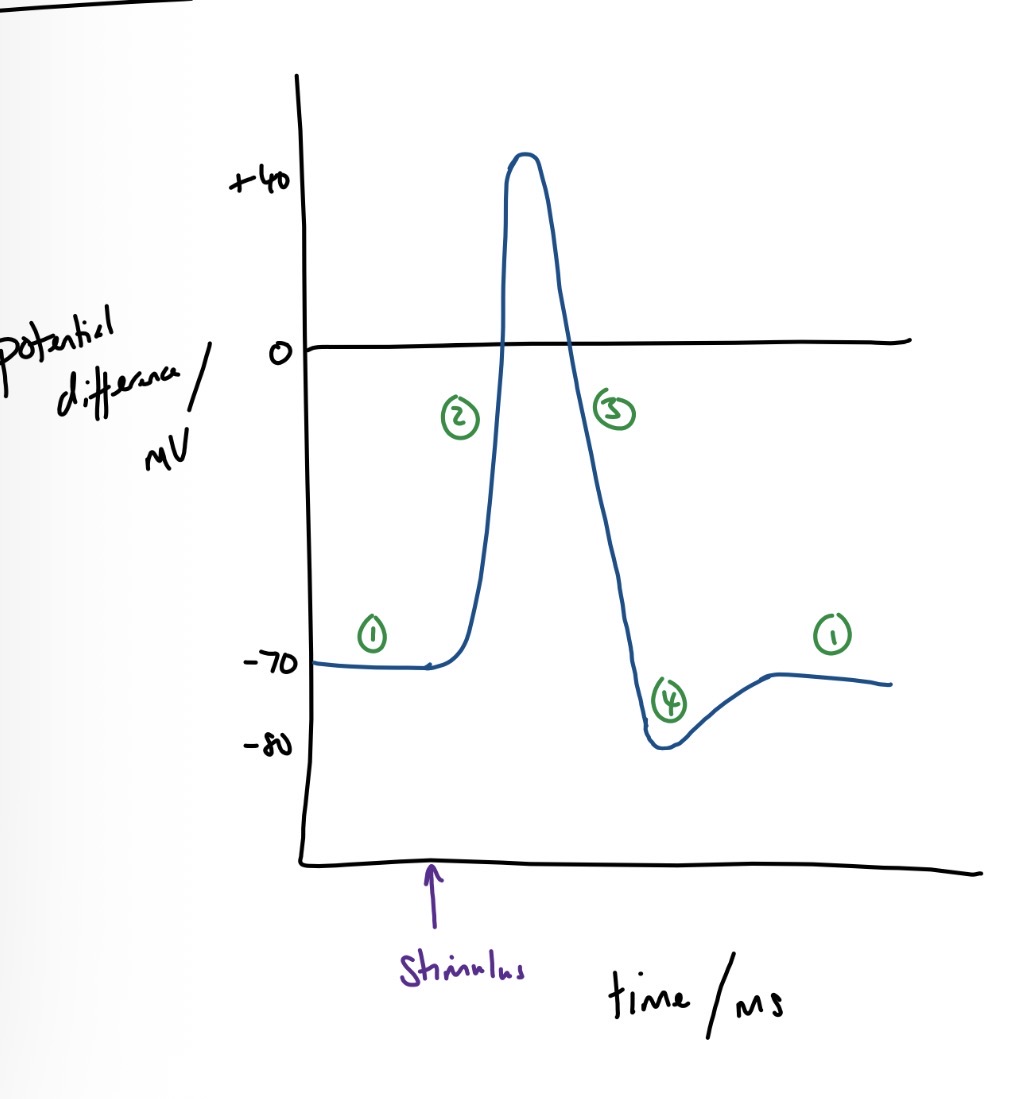
Oscilloscope trace of action potential
1) Resting potential
2) Action potential
3) Repolarisation
4) Hyperpolarisation
Sub threshold stimuli
Do not cause enough Na+ gated channels to open to reach threshold
No action potential is generated
Threshold stimulus
causes all Na+ gated channels to open
Reaches threshold
Action potential is generated
All or nothing law
Action potential is only reaches when threshold is reached
threshold is only reached when enough Na+ diffuses into neurone
Intensity of stimulus above threshold is conveyed by…
Frequency of action potentials
Refractory period
Na+ gated channels can’t be opened
No action potential
Occurs when membrane is hyperpolarised
Importance of refractory period (3)
prevents actions potentials from mergijg into eachother
Limits frequency of action potentials
Ensures that nerve impulse travels in one direction only
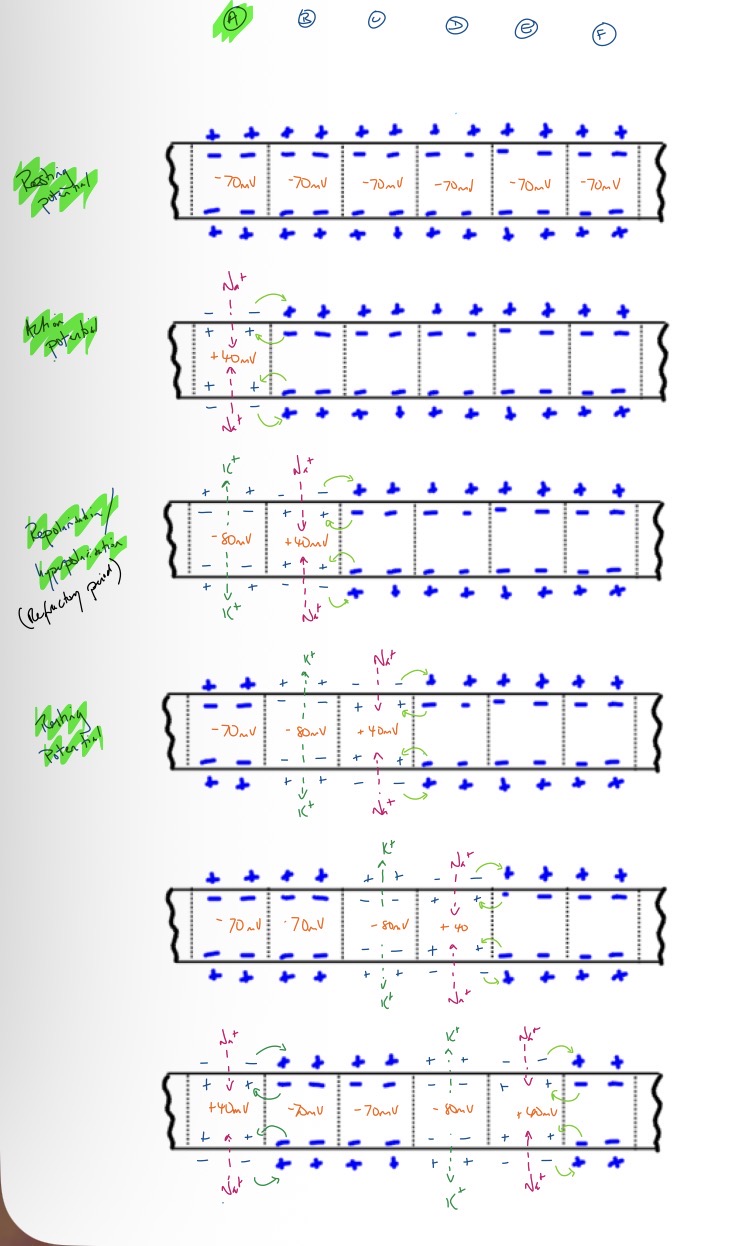
Propogation of a nerve impulse (5)
when nerve is stimulated an action potential is established in one section of the axon
Inside of axon becomes positively charged
Localised electrical circuit is set up along axon membrane, causing Na+ gated channels to open in next section of axon
Na+ diffuses into axon, establishing action potential
Process repeats so each section of neurone is depolarised in sequence
3 factors affecting speed of propagation of a nerve impulse
temperature
Diameter of axon
Mylination
How does temperature affect speed of propagation (5)
increase of temperature increases speed
Provides more KE
ions diffuse faster
Rate of respiration increases so more ATP for Na+ / K+ pump
How does diameter of axon increase speed of propagation of nerve impulse (5)
increase in diameter increases speed
More cytoplasm, so more ions
Increase in diameter, decrease longitudinal resistance along axon
Localised circuits are longer
LESS LEAKAGE OF IONS
Saltatory Propagation
Action potentials jump from node to node
Nodes of Ranvier
Unmyelinated gaps in myelinated neurones where action potentials can be established
How myelination increases speed of propagation of nerve impulses (4)
Schwann cells insulate axon
Preventing movement of Na+ / K+
Action potentials can only be established at nodes of renvier
Action potential jumps from node to node (saltatory propagation)
Schwann cell
Myelinated cell of neurone
synapse
Junction / gap between neurones
Communication between two neurones is via
Chemicals called neurotransmitters
Transmitters we need to know
Noradrenaline
Acetylcholine (Ach)
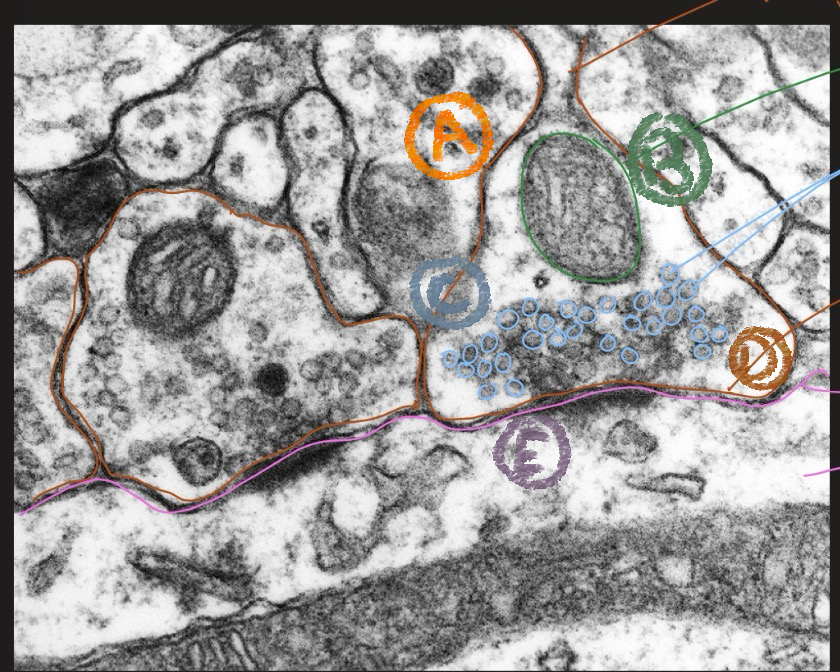
A) presynaptic neurone
B) mitochondrian
C) vesicles containing neurotransmitter
D) pre synaptic membrane
E) post synaptic membrane
Space between post and pre synaptic neurone
Synaptic cleft
Describe synaptic transmission (8)
Action potential arrives at synaptic knob
This causes Ca2+ gated channels to open, Ca2+ rapidly enters the synaptic knob by facilitated diffusion
Synaptic vesicles move to and fuse with pre synaptic membrane
Ach is released into synaptic cleft by exocytosis
Ach diffuses across synapse to post synaptic membrane
Ach binds to complimentary shaped receptors on the post synaptic membrane
the receptors are linked to Na+ gated channels, binding causes them to open
Na+ rapidly move into post synaptic neurone by facilitated diffusion
If the threshold is met, an action potential is established in the post synaptic neurone
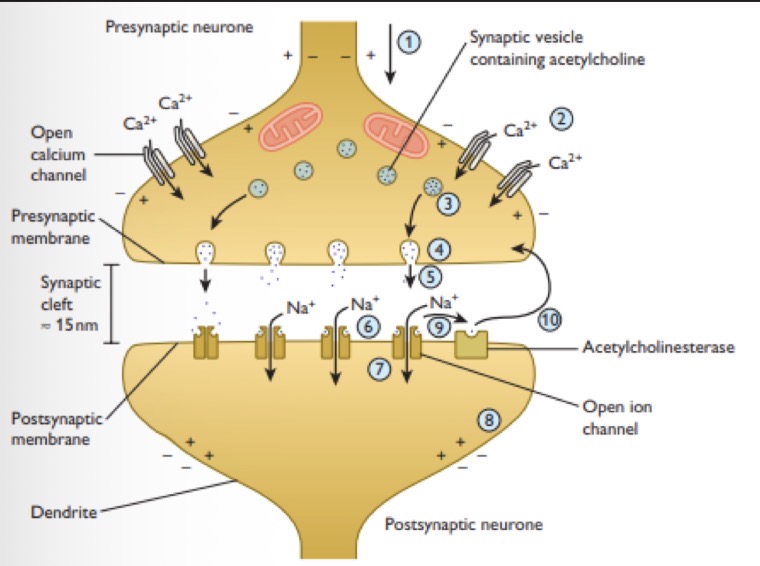
Describe what happens in synaptic transmission once an action potential has been generated (5)
Ach binds to active sire of Achase
This hydrolyses the Ach into its components (choline and acetate)
Components diffuse back towards pre synaptic membrane
Products are taken back into pre synaptic neurone by endocytosis, and Ach is reformed inside vesicle
Energy, from the hydrolysis of ATP is required.
Functions of synapse (4)
They are junctions
They ensure that the nerve impulse travels in one direction only (pre synaptic neurones have neurotransmitter vesicles, post synaptic neurones have receptors)
Prevents generation of actions potential in the post synaptic neurone
Allows summation
How can synapses stop the generation of an action potential in the post synaptic membrane?
inhibitory synapses: binding of the neurotransmitter results in opening of ion channels
that result in post synaptic membrane becoming hyperpolarised,
Less likely that threshold is reached
No action potential occurs
Summation definition and types
definition: additive effects of several nerve impulses arriving at synapse
Single nerve impulse only opens some Na+ gated ion channels, so no action potential
Spatial summation: several pre synaptic neurones at one synapse, so several impulses arrive at synapse at the same time
Temporal summation: one pre synaptic neurone. If high intensity stimulus, several impulses arrive at the synapse one after the other
2 types of drugs
Stimulants / agonists
Depressants / inhibitory / antagonists
Stimulants function and example of functions (6)
cause repeated stimulation of post synaptic neurone
Increasing frequency of action potentials
Neurotransmitter remains in synaptic cleft: inhibits Achase or prevents uptake of neurotransmitter
Mimics neurotransmitter, binding to receptors and opening Na+ channels
Decreasing threshold of post synaptic neurone
Depressants function (6)
Prevent stimulation of post synaptic neurone
decreasing or preventing action potentials
Prevent entry of calcium 2+
Prevent release of neurotransmitters
Block neurotransmitter receptors
hyperpolarise the post synaptic membrane
Receptors and transducers (3)
detect stimuli (change in external or internal environment)
Are specific to particular stimulus
Transducers convert one form of energy into electrochemical energy in the form of a generator potential
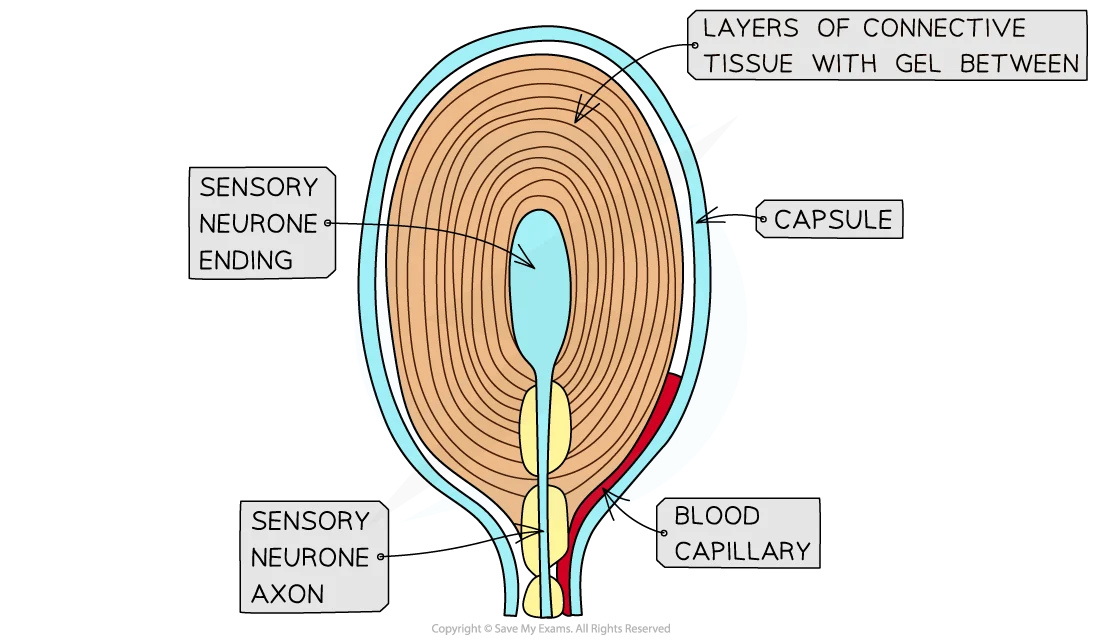
Pacinian corpuscles (4)
found in skin
Sensitive to pressure
Umyelinated end of sensory neurone, surrounded by concentric rings of connective tissue
Axon membrane has stretch-mediated Na+ gated channels
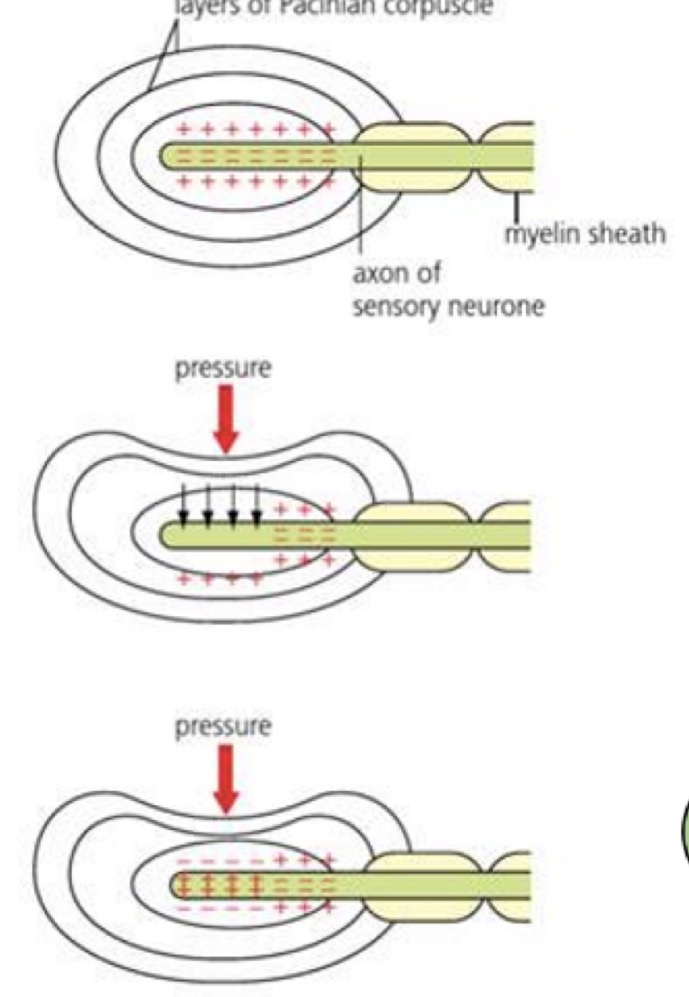
Generator potential of pacinian corpuscles (5)
there are stretch mediated sodium ion channels in membrane
increased pressure deforms / changes shape of membrane
sodium ion channels open
sodium ions diffuse into axon
depolarisation, leading to generator potential
Retina contains..
Photoreceptors;
Rods and cones
Rods (8)
more rods than cones
Distributed evenly throughout retina but absent from fovea
Contains light sensitive pigment rhodopsin
Provides monochromatic vision
Very sensitive, requires 1 photon of light to produce generator potential
Functions at low light intensity
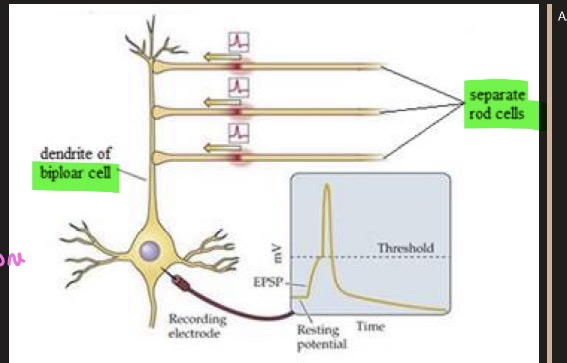
Group of rod cells synapse with one bipolar neurone (retinal convergence)
Low visual acuity / poorly resolved images
Cones (8)
less cones than rods
Present mainly in the fovea but absent from periphery
Contains 3 types of iodipsin (photosensitive pigment); sensitive to red, blue, and green wavelengths of life
Provides colour vision
Less sensitive. Requires approx 100 photons of light to produce generator potential
functions at high light intensity
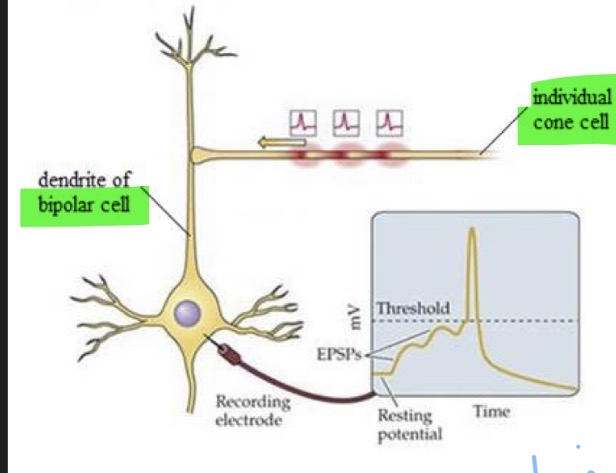
Each cone cell synapses individually with a single bipolar neurone
Produces highly resolved images
Compare cones and rods (8)
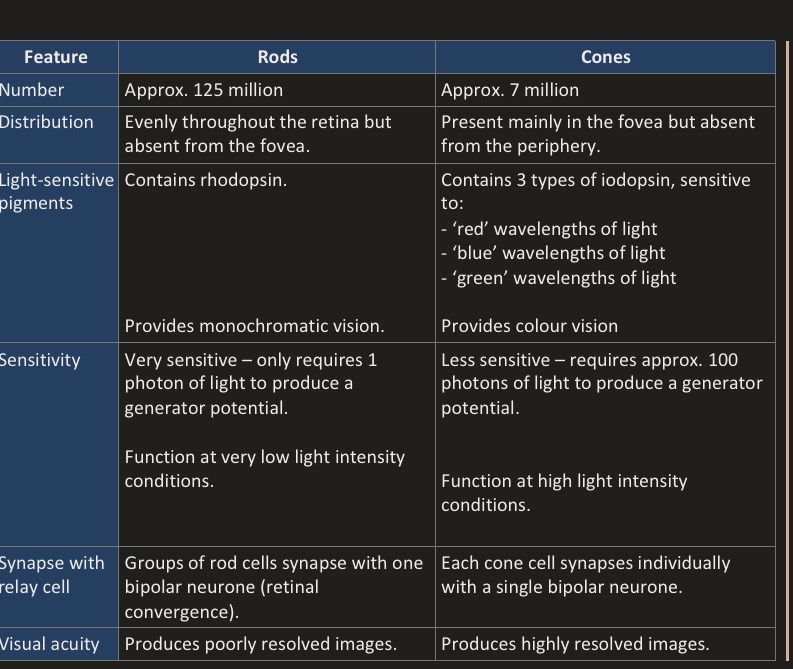
Bipolar cell
Relay neurone
Fovea
Central pit of retinal muscle
Why are rods high sensitivity
spatial summation / retinal convergence
low light intensity stimulus:
several rod cells depolarise
Due to spatial summation, it will cause the bipolar cell to depolarise
Why are cones low sensitivity
Temporal summation
low intensity light will not generate action potential in the bipolar cells
Requires high light intensity to bring about temporal summation to generate an action potential in bipolar cells, and ganglion cell to send impulse into the brain
Draw and label a pacinian corpuscle
in the ruler and reaction time experiment, how can very low values (anomalies) occur? (4)
student starts to move / close hand before ruler has been released
ruler did not fall vertically
ruler was stuck to skin
student held ruler too high
during the reaction time ruler experiment, the estimated speed of impulse transmission was less than what it is in other experiments. Why? (3)
synaptic transmission
time for muscle contraction
time taken for stretch mediated sodium ion channels to open in pacinian corpuscle
student may be distracted / not concentrating
time taken for coordinaton by brain