Bio Unit 7
 Call Kai
 Learn
Learn Practice Test
 Spaced Repetition
 Match
Match Flashcards
 Knowt Play
1/65

Earn XP
Description and Tags
Plants: Reproduction, Transport, Gas Exchange, and Water Potential
Name | Mastery | Learn | Test | Matching | Spaced | Call with Kai |
|---|
No analytics yet
Send a link to your students to track their progress
66 Terms
Dicotyledonous
Flowering plants that have a pair of leaves (cotyledons) in the embryo of the seed.
Adaptations of Dicotyledonous leaves for exchange
Large leaf surface area for gas diffusion and the absorption of sunlight
Hydrophobic waxy cuticle covering the cells of the epidermis→water proof barrier that prevents water loss and dehydration
Presence of Stomata on the Epidermis
The spongy mesophyll layer provides many air spaces to allow gases to diffuse from one part of the leaf to another.
Veins (vascular bundles) transport water from the roots to the leaves, which will diffuse out of the leaf in transpiraiton
Stomata
Small openings on the underside of a leaf that allow diffusion of gases in and out of the leaf.
most are located on the lower epithelium to prevent excess water loss and are more protected against physical factors such as rain and physical contact
When the stomata are open the rate of gas exchange increases, and when they are closed the rate of gas exchange decreases
Guard Cells
Regulate the opening and closing of the Stomata
Veins/Vascular bundles
Veins provide support for the leaf and are made of xylem and phloem tissue:
Xylem tissue transports water and dissolved minerals
Phloem tissue transports sugars and amino acids
Transpiration
Transpiration is the loss of water vapour from plant leaves. Water vapour is lost by evaporation at the surface of the mesophyll cells; this water vapour then diffuses through the stomata and out of the plant.
Because there is a greater concentration of water vapour in the leaf than the surrounding air, water vapour diffuses out from the leaf, through the stomata.
Capillary Action
The diffusion of water out into the atmosphere through the stomata results in a negative pressure, which pulls on water molecules in the xylem, occurs due to the cohesive and adhesive properties of water
Potometer
A simple laboratory apparatus used to measure the rate of water uptake in a plant, which will be approximately equal to the volume of water lost from the plant in the process of transpiration during that time.
Factors affecting rate of transpiration
Temperature -
Water molecules have more kinetic energy at higher temps → evaporate and diffuse out of the stomata faster
High temps increase the saturation point of the air outside the leaf → the air is able to hold more water vapor molecules
Humidity - air outside the leaf is holding more water vapor molecules→ lower concentration gradient between the leaf and the surrounding air, slowing the rate of diffusion of water vapor
Wind intensity - the higher the wind speed, the faster water molecules are moved away from the leaf once transpiration has occurred → increased concentration gradient between the stomata and the air outside the leaf, increasing the rate of diffusion of water molecules
Light intensity- When light intensity is higher, guard cells cause the stomata to open wider to allow more carbon dioxide to diffuse into the leaf for photosynthesis→more water evaporates from the plant
Stomatal Density
The number of stomata in a particular unit of area of a leaf or other plant organ.
Reasons for knowing the Stomatal Density
Plants with more stomata tend to have a higher rate of transpiration →stomatal density can indicate how efficiently a plant uses water
Changes in stomatal density in different environments can help us to understand the effect of climates and climate change on plant physiology
Similarities and differences in stomatal density can indicate phylogenetic (evolutionary) relationships between plants.
Stomatal density of plant fossils can be used as an indicator of past environmental conditions
Calculating Stomata Density
Stomatal Density = Average number of Stomata counted / Area of microscopic field view
Rate of photosynthesis is higher than respiration
Carbon dioxide will diffuse into the stomata and oxygen will diffuse out
Rate of respiration is higher than photosynthesis
Oxygen will diffuse into the stomata and carbon dioxide will diffuse out.
Waxy cuticle
provides a waterproof barrier that prevents water loss from the upperside of the leaf
Upper epidermis
Protective outermost layer across which water and mineral ions are absorbed
Palisade layer
Contains many palisade cells which are packed full of chloroplasts, the organelles that carry out photosynthesis.
Xylem
Transports water and dissolved minerals
Phloem
Transports sugar and amino acids
Lower epidermis
functions as a protective layer and also helps to regulate gas exchange
Stoma
Small pore that allows the exchange of gases between the leaf and the air outside
Spongy mesophyll
Contains many air spaces to allow gases to diffuse from one part of the leaf to another
Cohesion
Attraction between dipolar molecules of the same type.
Adhesion
The attraction between charged molecules and a charged surface.
Lignin
A complex polysaccharide that strengthens and waterproofs the wall of the xylem.
Pits
Regions on the xylem where there is no lignin, allow water and other molecules to move between adjacent cells, allowing the lateral movement of water into and out of xylem.
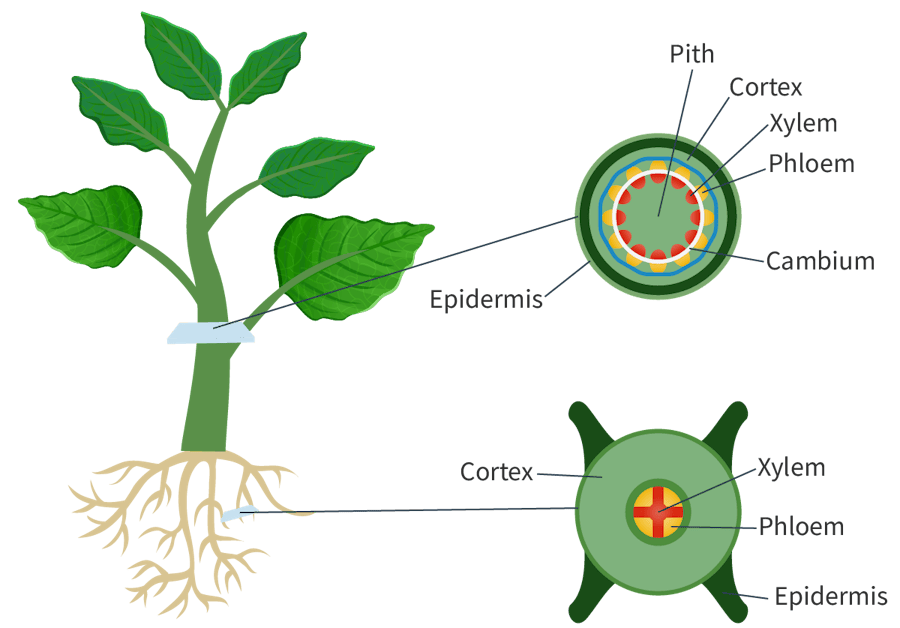
Cambium
A thin layer of actively dividing cells that can differentiate into xylem and phloem cell, located between the Xylem and Phloem
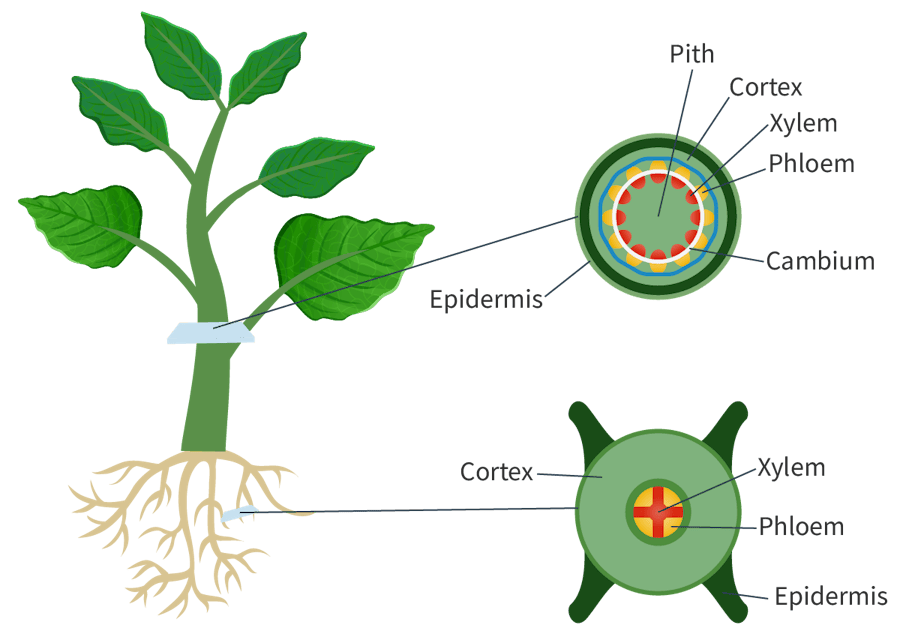
Cortex
Located between vascular bundles and epidermis→provides structural support to the stem and roots, involved in storage of nutrients and may contain chloroplasts, allowing them to carry out photosynthesis.
Aphids
Small insects that feed on the nutrient-rich phloem sap of plants using specialized mouth pieces called stylets
Scientists use Aphids to study the rate of flow of the phloem by removing the aphid from the plant and measuring the rate at which sap continues flowing out of the phloem vessel
Scientists alsp analyse the substances excreted by the aphid after they have fed
Root pressure
A hydrostatic pressure generated when mineral ions are actively transported into the root hair cell of a plant, which increases the solute concentration in the roots and in turns draws water in by osmosis, creating a pressure which pushes water up the xylem.
Sources
An area of a plant that is producing or releasing carbon compounds.
Leaves: produce carbon compounds through photosynthesis
Roots or tubers: store carbon compounds that can later be transported to the rest of the plant.
Sinks
An area of a plant that is consuming or storing carbon compounds.
Translocation
Movement of sap through the phloem from a source to a sink, bidirectional and requires active transport
Active transport of carbon compounds into the phloem at the source→increases solute concentration in the phloem→water is drawn into the phloem from the xylem by osmosis→ increasing hydrostatic pressure at the source→pushing effect, moving sap along the phloem towards the sink
Sieve tube elements
Specialised cells that form the sieve tube of the phloem
Sieve plates
Perforated structures that separate sieve tube elements, through which sap can flow.
Companion cells
Specialised cells found within the phloem that load sugars and amino acids into the phloem, contain many mitochondria to provide the ATP necessary to actively transport nutrients into and out of the phloem
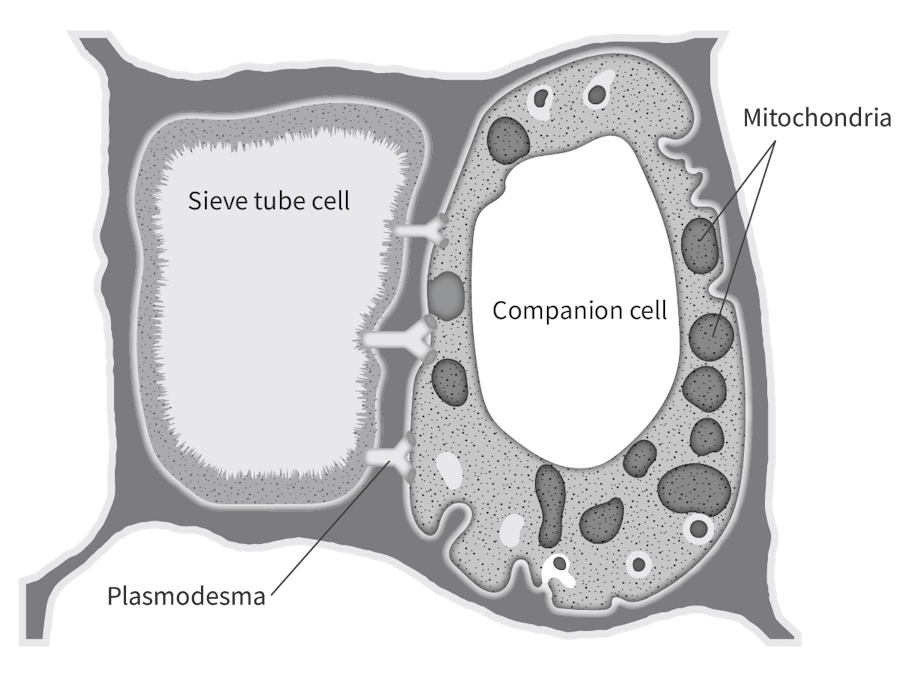
Plasmodesmata
Pores that connect companion cells and sieve tube elements, important for transporting nutrients and facilitating communication between cells.
Stamens
The male structures of a flower, consisting of the anther and the filament.
Pistil
The female reproductive part of a flower. The pistil, centrally located, typically consists of a swollen base.
Perfect flower
A flower that contains both male and female reproductive structures.
Imperfect flower
A flower that only contains one sexual reproductive organ – either male or female reproductive organs.
Pollination
The transfer of pollen from the anther to the stigma.
Synergids
Two cells present on either side of the egg cell in the embryo sac of flowering plants which guides the pollen tube to help the pollen reach the egg cell.
Triple fusion
The fusion of a single male gamete with the two polar nuclei present in the central cell, gives rise to the endosperm, which surrounds and nourishes the developing embryo
Double fertillisation
The two fertilisation events that occur: fusion of the first male gamete with the nucleus of the egg cell, and the fusion of the second male gamete with the two polar nuclei present in the central cell.
Adaptations of flowers to attract insects
Produce nectar. As the insect drinks the nectar, the anther brushes against its legs, transferring pollen. When the insect visits another flower, some pollen gets transferred to the stigma, resulting in pollination.
Some flowers like Magnolia or lilies (Lilium) have developed strong scents to attract insects.
White or brightly coloured to attract insects.
Pollen produced by insect-pollinated flowers is heavy and sticky to ensure that the pollen gets stuck to the body of the insect.
*flowers and insects have evolved leading to symbiotic relationships.
Cross-pollination
The transfer of pollen grains from one flower on one plant to the stigma of another flower on another plant.
Adaptations of wind-pollinated plants
Light, small, and produced in large numbers
Anthers exposed to wind and dangle loosely from the filament
Feathery stigma to catch the pollen
Small petals
Self-pollination
The transfer of pollen grains to the stigma of the same flower or to the stigma of another flower on the same plant
Adaptations that facilitate cross-pollination
male and female flowers are located on different plants
In plants where the male and female flowers are located on the same plant, the maturation time of the male and female flowers differs
time at which the anthers and pistils mature varies
The anatomical structure of bisexual flowers: produces two different forms of flowers
Self-incompatibility
The inability of hermaphroditic plants to produce zygotes after self-pollination (In plants with hermaphroditic flowers, self-incompatibility mechanisms prevent self-fertilisation)
Changes after fertilization
Inside the ovule: zygote divides mitotically to form the embryo while the triploid cell develops into the endosperm
Wall of the ovule becomes the seat coat, which encloses the embryo and endosperm
Ovary forms the fruit
Seed dispersal
Wind: light seeds with adaptations like wings or hair
Water: bouyant, aril covering
Animals: fleshy fruits that animals feed on and undigested seeds are thrown out in the feces, collected and hoarded by animals, hooks and spines to attach to skin and fur
Germination
The process that begins with the uptake of water by the seed and ends with the emergence of the radicle.
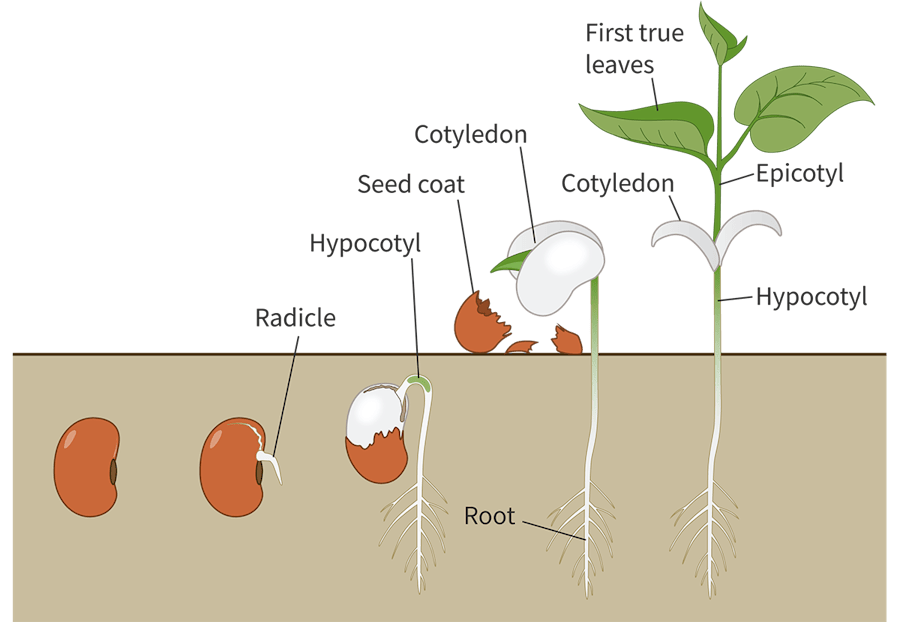
Germination and the post-germination changes
imbibition of water: seed swells up and seed coat ruptures
mobilizing food reserves: embryo depends on the food reserves present in the endosperm, embryo produces gibberellins (hormones that cause the release of enzymes that break down the stored food reserves)
emergence of the primary root or radicle
when the plumule (shoot) emerges it is bent over to protect the delicate growing tip. The straightening of the plumule occurs on exposure to light.
Cotyledons
Part of the embryo that provides nutrients to the developing plant embryo.
Tropic movements
The movements of plants in response to environmental stimuli such as light, chemical stimuli and gravity.
positive tropism: movement towards stimulus
negative tropism: movement away from the stimulus
Phototropism
The movement of plants in response to light, either towards or away from light.
Geotropic movements
Movements in response to gravity
The roots of plants normally display positive geotropism as they grow downwards while the stems display negative geotropism.
Phytohormones
Plant hormones. Chemical compounds secreted by plants which regulate their physiological processes including growth and development.
Transported via vascular tissues (xylem and phloem)
Cytokinin
Cell growth, promote cell division and are abundant in growing tissues, cell differentiation,
stimulate differentiation of the meristem
delay senescence or ageing.
Auxin
Cell growth and elongation, promotes the growth of terminal buds, fruit formation, apical dominance
Gibberellin
Hormones that are synthesised in the apical meristems of roots and shoots, young leaves and embryos. Main role in seed germination where they breakdown of stored food to facilitate germination
Abscisic acid
Abscission means to cut off. One of the key effects of abscisic acid (ABA) is the dropping or abscission of leaves. levels of ABA increase during stressful environmental conditions like intense cold or reduced water levels and inhibits elongation of the stem and induces dormancy in the seeds.
Ethylene
Ethylene is a gas and is produced by ageing tissues with its major role being the ripening of leaves and fruits.
Inhibitor phytohormones versus promotors
Auxins, cytokinins and gibberellins promote plant growth, while ABA and ethylene act as growth inhibitors.

