ECON Midterm 3 Joe Price
 Call Kai
 Learn
Learn Practice Test
 Spaced Repetition
 Match
Match Flashcards
 Knowt Play
1/54

There's no tags or description
Looks like no tags are added yet.
Name | Mastery | Learn | Test | Matching | Spaced | Call with Kai |
|---|
No analytics yet
Send a link to your students to track their progress
55 Terms
Screening
Done by the less-informed party to learn about the other side. Example: An employer uses tests or interviews to identify productive workers.
Signaling
Done by the more-informed party to reveal their type. Example: A worker gets a degree to show they are competent.
Adverse Selection
Occurs BEFORE the transaction. ○ Problem: one side is hiding information (HIDDEN INFORMATION) about themselves in order to get a better price. ○ Ex: The market for insurance → Insurance companies cannot tell who has issues and who doesn’t (those with issues are probably HIDING the fact that they have issues in order to get a better insurance price). As a result, they raise the prices of insurance for everyone, not just for the people with issues. ○ You don’t know who you are dealing with!
Moral Hazard
Occurs AFTER the transaction. ○ Problem: one side takes less precaution (HIDDEN ACTION) because the consequence won’t fall on them. ○ Ex: The market for insurance → After getting insurance, people take fewer health precautions because insurance pays if they get hurt. ○ You can’t monitor behavior!
Coase Bargaining
If property rights are well-defined and transaction costs are low, private parties can negotiate to resolve externalities efficiently on their own, regardless of who initially has the rights. Example: A factory pollutes a river. If affected fishermen can negotiate with the factory, they can reach a deal that maximizes total welfare.
Private Good
Excludable & Rivalrous
Ex. Food, Clothing, Smartphones
Club Good
Excludable but not rivalrous
Ex. Subscriptions, private parks, gyms
Common Good
Not excludable but rivalrous
Ex. fish in the ocean, timber in a forest
Public Good
Not excludable and not rivalrous
Ex. national defense, public fireworks
Positive externality
The market will produce less than the optimal quantity because the social benefits are larger than the private benefits. You can fix this with a subsidy or mandate.
Negative Externality
The market will produce more than the optimal quantity because the social costs are larger than the private costs. You can fix this with a tax or permit.
DWL with Externalities
Your DWL triangle points towards the socially optimal point!
Government Failures: Restriction on choice
Limits on what people can buy, sell, or do, reducing freedom and efficiency.
Government failures: Rent-seeking
Using resources to gain wealth through political or legal favors rather than creating value.
Government failures: Bereaucracy
Complex administrative procedures that can slow decision-making and reduce efficiency.
Government failures: Limited information
Decisions are constrained because people don’t have full knowledge about prices, quality, or outcomes.
Perfect competition
Many firms
Homogenous products
No barriers to entry
Monopolistic Competition
Many firms
Differentiated goods
No barriers to entry
Oligopoly
A few firms
Homogeneous or differentiated products
Yes barriers to entry
Monopoly
One firm
Unique product
Yes barriers to entry
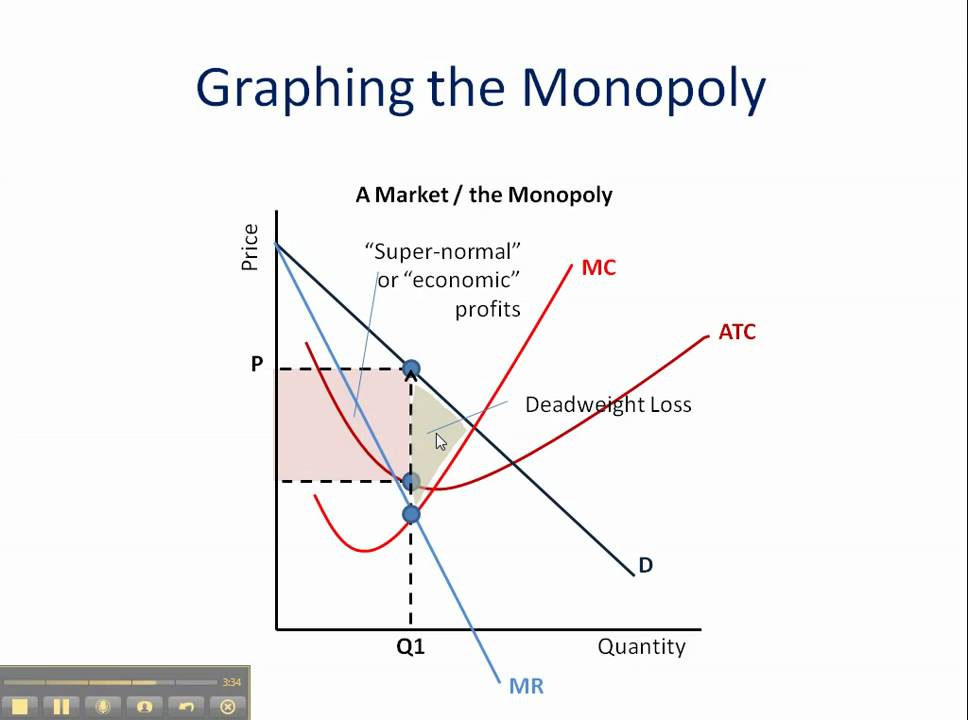
Monopoly Graph
Profit Maximizing Monopolist
A monopolist profit maximizes by choosing to produce at the largest quantity for which MR >= MC ○ A profit-maximizing monopolist will always want their price to be greater than the MR (price is at Demand line)
Natural Monopoly
Has very high fixed costs and very low marginal costs. These high fixed costs are a barrier to entry. This means that one firm can supply output at a lower cost than two firms. Competitors are excluded using cost structure rather than legal rules. Does NOT necessarily mean that a firm has exclusive ownership of a natural resource (a good example is a sewer company).
Oligopoly
Multiple firms aim to mimic monopoly behavior as a group. They collude (which is illegal) to do this.
Price Discrimination
Increases a firm's profits by attracting price-sensitive customers without lowering the price for others (student discounts, for example).
GDP
Y = C + I + G + NX
CPI
= (cost current year/cost base year) * 100
GDP Deflator (price level)
= (nominal GDP/real GDP) * 100
Real GDP per capita
= Real GDP/Population
Nominal GDP
= ∑Current Price * Current Quantity
GDP
The total value of all goods and services a country produces in a year. It shows how big the economy is.
Nominal GDP
The total value of everything the country makes, using the prices that actually exist right now. It goes up if prices go up, even if we don’t make
Real GDP
The total value of everything the country makes, but using constant prices from a base year. This shows how much the country actually produced, ignoring price changes.
GDP Deflator
A measure of how much prices for all goods and services in the economy have changed compared to a base year. It’s like a big-picture inflation number.
CPI (Consumer Price Index)
A measure of how prices for everyday items that people buy (food, clothes, rent, etc.) have changed. It shows how much the cost of living is going up.
Inflation Rate
= [CPI(x) - CPI(y) / CPI(y)] ×100
CPI (year x)
= [Cost-of-basket(year x) / Cost-of-basket(base year)] x 100
Real Interest Rate (purchasing power)
= Nominal Interest Rate - Inflation Rate
Real Value in Year X dollars
= Nominal Value in Year Y dollars x (CPI-Year-X / CPI-Year-Y).
Real Value (higher real value = higher purchasing power)
= (Nominal / CPI)*100
Finding the value of a dollar in the past:
Dollar past = Dollar today * (CPI past/CPI today)
CPI Biases: Introduction of new goods
Bias arises if new products aren’t in the basket
CPI Biases: Income bias
Changes in consumer behavior due to changes in real income.
CPI Biases: Unmeasured Quality Change
Bias from improvements in quality.
CPI Biases: Substitution Bias
CPI fails to account for consumers switching to cheaper alternatives.
Catch-up Effect
Poor countries sometimes grow faster than wealthy countries because additional capital will increase production more when the capital stock is smaller.
Savings Mechanisms
Other things the same, a country that increases its savings rate will decrease current consumption, increase future capital, and increase future consumption.
Policies that Discourage Growth
High income tax rates
A lack of property rights
Discouraging trade (tariffs)
A lack of investment
Taxing investment
Corruption in legal systems
Declines in school attendance
Forbidding foreigners from owning property
Unemployment Rate
U/(U+E)
Labor Force Participation Rate
(U+E)/(U+E+N)
Unions and Minimum Wage Laws
Force wages above market value against the firm’s will.
Firms choose to set an efficiency wage above market value to attract better workers. Any wage above market value causes unemployment (quantity supplied exceeds quantity demanded of labor).
Structural Unemployment
Occurs because wages are higher than the competitive wage.
Any reduction in unemployment must come through lower wages.
Frictional Unemployment
Comes from the difficulty in matching skills or switching between sectors.
Unionization
An increase in ______ in the US would tend to increase the unemployment rate and increase the labor-force participation rate (More unionization would decrease e, increase u, and decrease n).
Efficiency Wages
Higher-than-market wages that employers pay to motivate workers to be more productive, reduce turnover, and discourage shirking.

