Supporting Connective Tissue + Bones
 Studied by 0 people
 Call with Kai
 Learn
Learn Practice Test
 Spaced Repetition
 Match
Match Flashcards
 Knowt Play
1/19

There's no tags or description
Looks like no tags are added yet.
Name | Mastery | Learn | Test | Matching | Spaced | Call with Kai |
|---|
No study sessions yet.
20 Terms
Cartilage
flexible connective tissue

Chondrocytes Cartilage
Produces and maintains the cartilaginous matrix which contains collagen and other fibers
Lacunae Cartilage
Small paces or cavities within the matrix where chondrocytes (cartilage cells) reside. They protect and support these cells.
Perichondrium Cartilage
a dense layer of connective tissue that surrounds most types of cartilage (except at joints).
contains blood vessels and nerves
supplies nutrients to cartilage (which itself has no blood vessels)
helps in growth and repair.
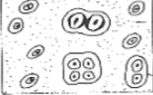
Hyaline Cartilage
One of the basic and most common types - type 2 collagen - it’s smooth, glassy, found in joints, nose, trachea and provides support with some flexibility (NO THICK bundles)
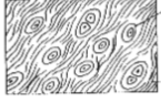
Elastic Cartilage
One of the basic types - it contains more elastic fibers, found in ear and epiglottis and is very flexible
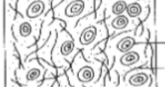
Fibrocartilage
One of the basic types - it has lots of collagen (type 1) fibers, very tough/ and found in the intervertebral disc and menisci - forms thick and parallel bundles
Bones- Osteocytes
Mature bone cells found in small spaces (lacunae) within bone tissue. They help maintain bone structure and mineral content by exchanging nutrients and waste with the blood.
are also found in compact bone & spongy (cancellous) bone - also contains lacunae
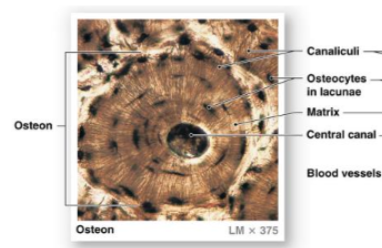
Lacunae
small spaces within the hard bone matrix where osteocytes (bone cells) live and are protected. Lacunae connect to each other and to blood supply through tiny canals called canaliculi.
Lamellae
thin layers or rings of bone matrix found in bone tissue, important structural part of bone - helping to give it strength and support.
The basic types and properties of lamellae: concentric, interstitial, and circumferential
Concentric (lamellae)
Forms circular layers around a central canal in compact bone
Circumferential (lamellae)
Form outer and inner layers around the whole bone
Insterstitial (lamellae)
Fill spaces between osteons in compact bone
Canaliculi
tiny, microscopic channels found in bone tissue. They connect the osteocytes (bone cells) housed in lacunae to each other and to blood vessels.
lets nutrients, oxygen, and waste products move between blood and bone cells.
Periosteum
Tough, thin layer of connective tissue that covers the outer surface of bones (except at joints).
contains blood vessels, nerves, and cells important for bone growth and repair
Trabecular
thin, branching plates or rods of bone that form a lattice-like network in spongy (cancellous) bone & helps give spongy bone its strength while staying lightweight.
Found mainly in areas like the ends of long bones, pelvis, ribs, and vertebrae.
Spaces between trabeculae usually contain bone marrow.
They align along lines of stress, providing structural support where it’s needed most.
Cortical
Hard, dense outer layer of bones, gives bones their strength, structure, and ability to support weight. aka compact bone
Forms the outer shell of all bones.
Made up of tightly packed osteons (cylindrical units with concentric lamellae).
Very strong and resistant to bending or breaking.
Contains small channels for blood vessels and nerves
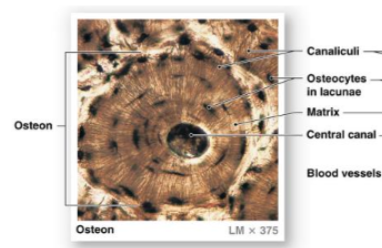
Haversian system (osteon)
The fundamental structural unit of compact (cortical) bone & is a cylindrical structure that runs lengthwise through the bone.
Made of concentric rings (lamellae) of bone matrix around a central (Haversian) canal.
The central canal contains blood vessels and nerves.
Osteocytes (bone cells) in lacunae are arranged in rings around the canal and connected by tiny canals called canaliculi
Haversian (central) canal
a channel in the center of each osteon (Haversian system) in compact bone
Runs lengthwise through the bone.
Contains blood vessels and nerves.
Supplies nutrients and removes waste from bone cells deep in the bone.
Volkman’s (perforating) canal
a channel in compact bone that runs perpendicular (at right angles) to the Haversian (central) canals.
Connects neighboring Haversian canals.
Carries blood vessels and nerves from the outer periosteum into the bone and between osteons.
Helps provide a network for nutrients and waste exchange throughout the dense bone.
 Note
Note  Flashcards (81)