Freshwater ecology - Biotics
 Studied by 0 people
 Call Kai
 Learn
Learn Practice Test
 Spaced Repetition
 Match
Match Flashcards
 Knowt Play
1/86

There's no tags or description
Looks like no tags are added yet.
Name | Mastery | Learn | Test | Matching | Spaced | Call with Kai |
|---|
No analytics yet
Send a link to your students to track their progress
87 Terms
debate on density dependance and population regulation
those that emphasized the relative constancy of populations and the
need to look for stabilizing forces (e.g., competition) to explain why populations are boundedthose that emphasized population fluctuations and the importance of
external forces (e.g., weather) in explaining changes
+/-/0 interactions : competition, predator and prey, amensalism/commensalism, mutualism
competition: -/-
predator and prey: +/-
amensalism: -/0
commensalism: +/0
mutualism: +/+
niche
The total range of environmental variables where an organism can survive,
grow, and reproducean abiotic frame
fundamental niche
Describes the range of environmental conditions that a species can
occupy in the absence of biotic interactions
realized niche
Describes the range of environmental conditions that a species can
occupy in the presence of biotic interactionscoexisting species often have overlapping niches = competition
competition
the negative effect which one organism has upon another by consuming, or controlling access to, a resource that is limited in availability
what is a resource
Substances or factors that result in increased growth as the availability is increased
nutrients, light, food, mates, spawning grounds, and space
two types of competition
exploitation competition
interference competition
exploitation competition
one organism exploits a resource more efficiently (indirect)
ex: one fish filters water more efficiently than another
interference competition
direct interference of one organism with a competitor
ex: aggressive behavior
interspecific competition
Niche overlap between species (white spotted charr vs dolly varden)
the more different organisms are the less competition there is between them (ex: phytoplankton rarely compete with fish)
intraspecific competition
Niche overlap within species (big dolly varden vs small dolly varden)
competitive exclusion principle
Organisms that overlap completely in use of a limiting resource are
not able to coexistIf the overlap can be reduced (i.e., resource partitioning) coexistence can be possible
character displacement
Strong competitive interactions among coexisting organisms can
result in evolution of phenotypic differences in traits that are related
to the exploitation of the limiting resource
2 ways organisms can adapt to tolerate low amounts of a limiting resource
size
luxury uptake
relation between size and tolerating low amounts of resources
remaining small means you can get by with fewer resources, so in a
limiting situation can out compete a larger individual or species
relation between luxury uptake and tolerating low amounts of resources
storing a limit resource when it is prevalent to use later (e.g.,
many primary producers store phosphorous as a large polyphosphate
molecule)
Lotka-Volterra Model
predicts potential outcome when two species are in competition for the same resources
alpha is what in the Lotka-Volterra model
α is the effect of species 2 on species 1’s growth rate (and
vice versa)
α 12 < 1 means…
the effect of species 2 on species 1 is less than the effect of species 1 on it’s own members (intraspecific more important)
α 12 > 1 means…
the effect of species 2 on species 1 is greater than the effect of species 1 on its own members (interspecific more important)
two species two resources model
called Resource-Ratio Hypothesis (R* rule)
A graphical model based on the supply rate of two resources
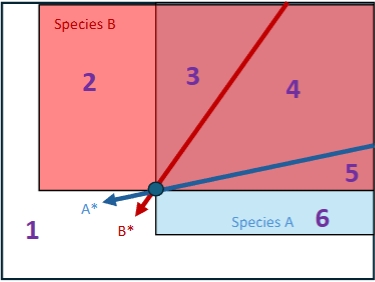
what does 1 indicate
Supply rate of resources is not sufficient for any of the species
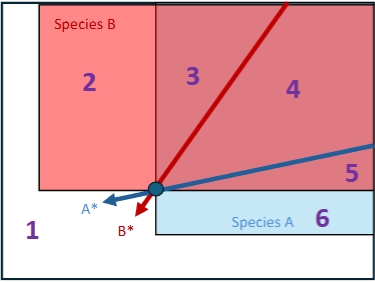
what does 2 indicate
species B can survive but not species A
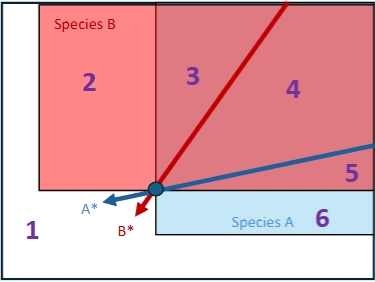
what does 6 indicate
Species A can survive but not species B
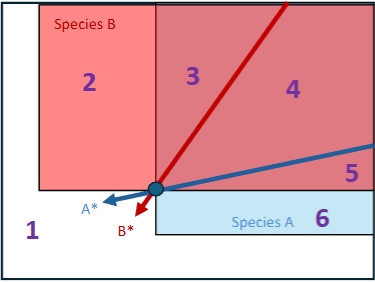
what does 3 indicate
Species B competitively displace Species A because B will make resource x
limiting for A
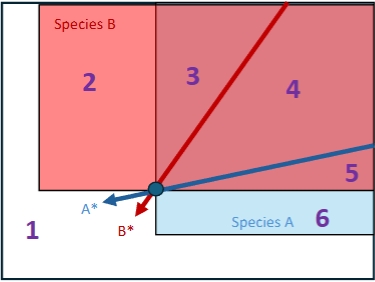
what does 4 indicate
Two species will coexist because an individual of one species will have a
greater effect on its own relatives than on members of the other species
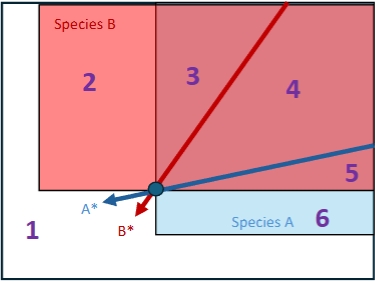
what does 5 indicate
Species A displaces Species B because A will make resource y limiting for B
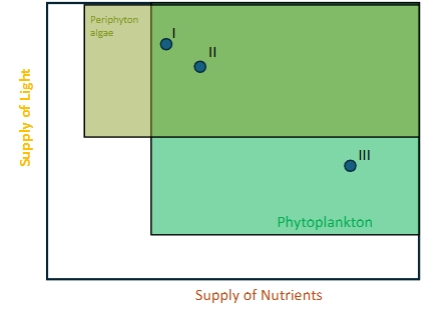
periphyton vs phytoplankton example
Periphyton have dibs on nutrients (biomineralization is higher at sediment)
Phytoplankton have dibs on light (they can move up in the water column)
crucian carp example
the only fish in shallow ponds b/c they can survive periods of low oxygen (intraspecific effects)
low body condition, low recruitment of young into mating, low glycogen in high density populations
do better in low density populations
carnivory, herbivory, and parasitism are…
consumption of living organisms
4 principles of predation and herbivory
Consumption is a major source of mortality in many freshwater organisms
and thus is an important structuring force in lakes and pondsDirect lethal effects can cause local extinction
Predators can change behaviour of prey including changes in habitat-use,
activity patterns, and foraging...thus, there can be indirect effects on prey
growth and reproduction rates.Can be a strong selective force over evolutionary time
predation cycle
search
encounter
attack
capture
ingestion
adaptions that impact the predation cycle
Defence adaptations have evolved in prey species (goal is to interrupt predation at any stage)
Counter adaptations in predators (goal is to go from search to ingestion quickly)
lake victoria example of predator adaptations
invasive nile perch indroduced
the nile perch adapted big mouths and bellies to be better predators
decrease in prey fish = change ecosystem
2 basic foraging strategies
ambush/ sit and wait
searching
ambush/ sit and wait strategy
Predator remains inactive
Often within complex microhabitat
Prey passes by and is detected
Can involve fast starts and attacks (uses energy)
Capture success is high
searching strategy
Move around in search of a prey item
Uses energy for moving around
Capture success can be low
choosing between basic foraging strategies
depends on environment - if there is refuge from predators
depends on organisms place in food chain - if at top they don’t need refuge to sit and wait
adaptions to help detect prey
Visual, Mechanical and/or Chemical cues
Size, shape, colour, contrast against background and movement can affect
the distance at which prey is sightedBeing able to react in a manner that optimizes encounter rate
Environmental effects like turbidity and brownification
selective feeding
Predator feeding on a prey organism more than is expected from its relative availability in the environment
because prey is optimal diet choice - aim of a forager should be to consume prey types that achieve maximum net energy gain to maximize lifetime reproductive success
changes prey community
defence
Adaptations that reduce the risk of being a victim of predation
primary defences
operate before a predator has detected the prey and decreases the probability of an encounter with a potential predator
secondary defences
come into action after the prey has been encountered by a predator
Increases the probability of surviving after being detected by a predator
2 types of primary defences
avoiding encounters
crypsis
avoiding encounters
2 types: spatial and temporal refugia
Many prey organisms are poor at escaping predation so they aim to reduce encounters
often leave systems with predators or breed in systems without predators
spatial refugia
requires habitat complexity
Provides space to be hidden and to escape to
decreases interactions between predator and prey
3 types of temporal refugia
diel migration
seasonal migration
diapaus
temporal refugia
Reducing activity when prey detected reduces likelihood of being detected
diel migration
diurnal vertical migration
cost energy (less energy for growth and reproduction) but also protects from predation and UV damage
in shallow lakes movement is horizontal instead of vertical
daphnia response to water flea predation
when predator is not around daphnia are closer to surface where more nutrients and warmth is (increase growth)
when predator is present daphnia stay closer to sediment and only go to surface at night
diapause
a transient interruption in growth or development
ex: produce resting eggs that only hatch when predators are absent or at low activity
rely on predators periods of low activity
crypsis
dull, colorless appearance that allows prey to blend into their environment
examples of secondary defences
Erratic movements
Hide in burrow/shell/tubes
Spines
chemical defense (extremely distasteful or anaesthetic effect)
prey chemical cues
disturbance cues
alarm cues
predator confusion
future vigilance
predator chemical cues
attractant signal
predator interference
dietary attractant signal
kairomones
dietary alarm cues
constitutive defences
ex: spines on sticklebacks, shells of snails
They are present whether a predator is or isn’t there
inducible defences
defences that are phenotypically induced when predators are present
4 ways inducible defenses are promoted
There is a variability in predation pressure (if a predator is always present, a
constitutive defense would be more advantageous)The prey organisms have reliable cues of detecting the presence of the predator in the habitat
The prey benefits by having the induced morphology (it should increase the
probability of surviving an encounter)The inducible defence structure incurs a cost to the prey organisms
predator offence
Predators may have inducible offence adaptations that increase foraging efficiency
ex: salamanders will develop a wider gape to facilitate swallowing of tadpoles
HSS hypothesis
argued that herbivore populations are limited by predators and thus cannot expand to densities where they can limit plants
predators and plants in turn are limited by competition for resources
evidence of HSS hypothesis
decrease fish = increase large zooplankton = decrease algae biomass = increase water clarity
abundant fish = less zooplankton = increase algae biomass
size-efficiency hypothesis
large zooplankton are dominant when fish density is low
small zooplankton are dominant when fish density is high (fish don’t eat them)
predicts when algal biomass will be high/low based on the presence of fish
what 2 hypotheses were used to develop the Cascading trophic interaction concept
HSS hypothesis
size-efficiency hypothesis
cascading trophic interaction concept
a way to explain variation in lake productivity not explained by phosphorous levels
A trophic cascade is an indirect interaction characteristic of linear food chains where a predator species A has an indirect positive effect on a plant species C by reducing the abundance of the herbivore species B
wolves as stream animals example of cascading trophic interactions: without wolves
elk browse woody species causing decrease in woody plants near streams
decreases beaver abundance
decreases riparian ecosystem functions
loss of food web support
loss of wetlands
channel widening and incisions
loss of hydrologic conductivity between streams and floodplains
wolves as stream animals example of cascading trophic interactions: with wolves
elk under higher predation risk = adjust foraging and movement patterns
increased abundance of woody species
riparian functions recover
beaver recolonizes the area
recovery of food web
channels stabilize
wetlands recover
hydrologic conductivity recovers
Bottom-up :Top-down theory
Combines influence of predators from the top and resource availability from the bottom
Trophic levels near the base of the food chain will be primarily affected by bottom- up processes, these effects weaken as trophic level increases
Top-down effects only important for upper trophic levels
Fish will have no influence when there is high nutrient concentrations, so fish only have an impact on biomass in oligotrophic systems
Fretwell-Oksanen model
Predicts that systems with low nutrient loads can only support primary producers
The more primary producers that can be supported, the more trophic levels will be found in the system
Control of abundance at the levels flips between resource competition and predation
trait-mediated indirect effects
strong cascading effects often focus on the lethal effects of predators but indirect effects are also important
ex: sunfish prefer the pelagic zone for foraging when large mouth bass are not present, but when they are present sunfish feed in the littoral zone because there is vegetation and they can eat benthic macroinvertebrates
microbial loop
Bacteria retrieve carbon from phytoplankton, zooplankton and
fish wastes and decaying particles (DOC/DOM)Bacteria then eaten by ciliates and heterotrophic flagellates,
which feed zooplankton, rotifers, small fish, (releases nutrients back into ecosystem)
consumer release of nutrients effects
Higher Organisms excrete DOC AND other nutrients like N and P
when planktivorous fish become abundant they not only reduce the
grazing pressure from zooplankton by predation (top-down)they also promote phytoplankton growth by increasing nutrient abundances
(indirect bottom up effect)
criticism of trophic cascades
strong trophic cascades only seem to be present in species poor systems where keystone species are present ... they also seem to be stronger in aquatic systems
possible issue with trophic cascades
do trophic levels exist
predator identity and multiple predators
omnivory
ontogenetic niche shifts and size-structured populations
subsidized consumers and food chain coupling
do trophic levels exist
food webs are not linear : species feed at different levels, species linked to multiple resources
species grouped into guilds using isotopes
species may be in a different level depending on resources and competition
issue of multiple predators
predators interfere with other predators (eat the same prey)
prey may increase with multiple predators because of strong competition
prey may decrease with multiple predators because they have an additive impact
issue of omnivory
organism feeds at more than one trophic level
may feed on both animal and plant matter
may feed on both carnivores and herbivores
may feed on a different resource than the consumer
may be cannabalistic
3 reasons omnivory is advantageous
Flexibility to feed at a lower trophic level where there are higher
resource levels (protects against periods of low food availability)Flexibility to feed higher in the trophic spectrum to obtain higher
quality food and limiting resourcesOmnivores are more likely to be in higher trophic levels (larger –
better able to exploit wider range of prey sizes and species)
why is omnivory more common in the tropics
more diversity and abundance of fish
issue of ontogenetic niche shifts
not all individuals in a population use the same trophic level
as an organism ages they eat different food
issue with subsidized consumers and food chain coupling
ponds, lakes, and streams are not closed systems
open transport of resources across habitat boarders (nutrients, detritus, prey, and consumers)
additions and deletions
allochthonous sources of energy
Energy in the form of leaves, plants, pollen, twigs, branches, trunks get blown and washed into streams
Smaller and softer items provide energy for food web
Larger and harder items help retain smaller items
why are leaves not nutritional
In the autumn, nutrients in leaves are translocated back to stems and trunks
of treesShed leaves are mostly cellulose and lignin, and toxic phenolic compounds
(e.g., tannins)Insects do not like to graze on shed leaves
how do fungi make leaves nutritional
Spores latch on to leaves and have enzymes that digest lignin and cellulose
Leaf becomes a partly digested carbohydrate with protein from the fungi
creation of fine particulate organic matter
once leaves are conditioned by fungi, shredders tear the leaf apart to get to the mycelium
then the leaf is recolonized by bacteria and fungi for further conditioning
what happens to fine particulate organic matter after further conditioning
filter feeders create more
or, deposit feeders consumer it
final destination of leaf matter
Eventually all leaf matter is converted to animal tissue and CO2
The greater the diversity present in the stream, the more efficiently
leaves are processed (each species has its own specializations)
 Note
Note  Flashcards (22)