Biogeography Ch 1-7
 Studied by 0 people
 Call Kai
 Learn
Learn Practice Test
 Spaced Repetition
 Match
Match Flashcards
 Knowt Play
1/52

Earn XP
Description and Tags
Content for 1st test
Name | Mastery | Learn | Test | Matching | Spaced | Call with Kai |
|---|
No analytics yet
Send a link to your students to track their progress
53 Terms
What is biogeography?
A science that seeks to understand spacial patterns of biological diversity
What is an “allied science?”
A combination of multiple scientific disciplines
Describe the concept of immutable earth
The idea that the earth, and everything on it, is unchangeable
What was Carolus Linnaeus’ hypothesis of species dispersion?
All lifeforms were placed along the slope of a mountain near the equator
Species dispersed as the mountain grew broader
What was Buffon’s hypothesis of species dispersion?
That all life originated in a region of Europe in a time when the earth’s climate was more homogenous, and migrated southwards as temperatures cooled
What is Buffon’s law?
Environmentally similar, but geographically isolated regions, have distinct assemblages of mammals and birds
What characterized the Age of Enlightenment in the late 18th century?
The globalization of biogeography and the sharing of knowledge
What did Alexander Von Humboldt study?
Climatic associations of plant communities, expanded upon the theory of floristic zonation to be applied along elevational gradients
Who was it that proposed that the earth was mutable?
Charles Lyell
What are the three major advancements in biogeography of the 19th century
A better estimate of earth’s age
A better understanding of ocean and continent dynamics
Better understanding of the mechanisms by which species disperse and become different species
Define uniformitarianism
The idea that the processes working on the Earth today have always existed
What is considered the father of zoogeography?
Alfred Wallace
What is the Linnean shortfall?
It is hard to group and classify species when we don't know all the species that exist
What is the Wallacean shortfall?
If you see a species, you can say it was there. But if you don't see it, you cannot guarantee it wasn't actually there— leads to biases in species observation
What are the two types of inferences in science?
Induction and deduction
What is inductive reasoning?
Inferring a larger conclusion based on information from particular instances
Ex. The sun has risen every morning, and there will be morning tomorrow → the sun will rise tomorrow
Why is inductive reasoning sometimes flawed?
Because it may lead to false conclusions (Ex. The more firefighters at a burning house, the bigger the damage bill → firefighters cause damage)
What is deductive reasoning?
The conclusions follow necessarily from their premises, if the premises is true then so must be the conclusion
(f the hypothesis is true, your predictions should occur)
Ex. If all bats can fly, and Myotis lucifugus is a species of bat → Myotis lucifugus are able to fly
Why is deductive reasoning sometimes flawed?
Can lead to confirmation bias, as one instance does not confirm a theory
Your hypothesis needs to be true for your predictions to be correct
What is the fundamental unit of biogeography?
Ranges
Define: Niche
The range in which a species can persist, and fulfill its role
What are the two components of the Hutchensonian Niche
The fundamental and realized niche
What is the fundamental niche?
A set of abiotic conditions in which a species can persist in the absence of interactions with other species
The “ideal scenario” for a species
Only considers abiotic components
What does the width of a species’ niche say about their tolerance?
A wider niche implies a more tolerant species that can inhabit a larger area
A narrow niche is the opposite, implying a narrow range of suitable conditions
What is the realized niche?
The set of conditions in which a species can persist given interactions with other species
More realistic model of what really happens in nature
Takes into account competition & other biotic components
Why might a species not fill their niche?
Encroachment of predation or invasive species
Habitat fragmentation
Newly introduced species that hasn’t had time to expand
What is dispersal?
An active or passive attempt to move from a natal/breeding site, to another breeding site
How is dispersal different from migration?
Animals will return after migrating, while dispersal is a permanent relocation
What is the difference between natal and breeding dispersal/
Natal dispersal: A young individual moves away from where they were born
Breeding dispersal: Adults moving to a new breeding site
What are the three types of passive dispersal?
Hydrochory: Dispersal through water
Anemochory: Dispersal by wind
Zoochory: Dispersal by animals
What is ballochory?
A form of active dispersal used by plants that are able to shoot their seeds
What is a species?
A group of related organisms that share common characteristics, and are capable of interbreeding
What are the two types of cohesion that individuals within a species share?
Spatial cohesion: Individuals will stay close together
Temporal cohesion: Maintains consistent interaction patterns over time (Ex. coordinated movements, resource sharing, hierarchies)
What is speciation?
The process by which two or more species evolve from an ancestral population
What is a reticulate species?
A hybrid species with its own evolutionary history and trajectory, niche, and geographic structure
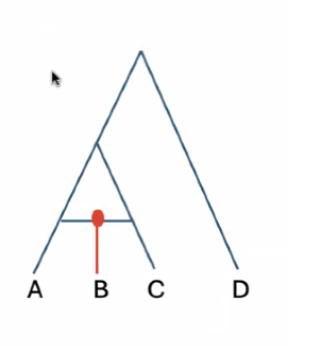
What type of species is indicated in red here?
A reticulate species
What are the four processes that drive microevolution
Mutation
Genetic drift
Natural selection
Gene flow
Define: Mutation
A permanent change in a DNA sequence
What are the four types of mutation?
Substitution of a single nucleotide
Deletion of a single/multiple nucleotides
Insertion of a single/multiple nucleotides
Inversion of a single/multiple nucleotides
What is genetic drift?
Occurrence of random changes in allele frequencies between generations
Why is genetic drift less effective in larger populations?
Because changes tend to even themselves out over time
What is gene flow?
Movement of alleles within/between populations due to dispersal of offspring
Why does gene flow counter genetic drift & natural selection?
Because it has a homogenizing influence
What are the three main modes of speciation?
Allopatric
Sympatric
Parapatric
What is allopatric speciation?
Speciation that occurs due to a physical barrier isolating a population
What is parapatric speciation?
Speciation that occurs in adjacent populations across a larger area
What is sympatric speciation?
Speciation that occurs within the same area between overlapping species
What is disruptive selection?
Selective pressures that cause a population to adapt to different niches (ex. Evolving towards the extremes)
What are the two types of species distribution modelling
Correlative (empirical) and mechanistic (biophysical)
What does correlative modelling compare?
Involve predicting a species’ potential distribution using statistical analysis of correlations between where a species randomly occurs, and the known environmental conditions at said locations
What does mechanistic modelling compare?
Involves predictions for species location by understanding their needs
What type of modelling is MaxEnt?
Presence only, correlative/empirical modelling
What does SDM stand for?
Species distribution modelling
 Note
Note  Flashcards (24)