Midterm 2: Motivation and Emotion
0.0(0)
 Studied by 1 person
 Call Kai
 Learn
Learn Practice Test
 Spaced Repetition
 Match
Match Flashcards
 Knowt Play
Card Sorting
1/128

Earn XP
Description and Tags
Last updated 3:22 PM on 1/18/25
Name | Mastery | Learn | Test | Matching | Spaced | Call with Kai |
|---|
No analytics yet
Send a link to your students to track their progress
129 Terms
1
New cards
What is self esteem? High self esteem? Low self esteem?
* Self esteem: how positive one’s overall/global evaluation of oneself is
* Low self esteem: person thinks there is nothing good about them
* High: person thinks everything is great about themselves
* Low self esteem: person thinks there is nothing good about them
* High: person thinks everything is great about themselves
2
New cards
Describe the self esteem differences present in independent versus interdependent self construal individuals
* Independent self construal
* Strong emphasis on having and maintaining high self esteem
* Self enhancement: tendency to view selves positively and socially desirably
* Motivated by desire to bolster self image, demonstrate unique attributes
* You are this amazing person that deserves to stand out
* Interdependent self construal
* Self effacement: tendency to view selves in critical/disparaging manner
* As a way to find out how to best fit yourself into a certain context
* Motivated by desire to fit in with others, self improve
* Generally:
* Independent: more emphasis on positive traits
* Interdependent: more attention paid to negative traits
* Strong emphasis on having and maintaining high self esteem
* Self enhancement: tendency to view selves positively and socially desirably
* Motivated by desire to bolster self image, demonstrate unique attributes
* You are this amazing person that deserves to stand out
* Interdependent self construal
* Self effacement: tendency to view selves in critical/disparaging manner
* As a way to find out how to best fit yourself into a certain context
* Motivated by desire to fit in with others, self improve
* Generally:
* Independent: more emphasis on positive traits
* Interdependent: more attention paid to negative traits
3
New cards
What are the compensatory strategies individuals engage in to protect their own self esteem from being attacked?
* Downward social comparison: compare ourselves to those who are worse off than us
* Discounting: downplaying importance of the attribute/result, downplaying the attack that is coming
* External attributions: attribute failures to others rather than ourselves
* E.g., got a 67% on your paper, respond by saying the TA or instructor are unclear
* Discounting: downplaying importance of the attribute/result, downplaying the attack that is coming
* External attributions: attribute failures to others rather than ourselves
* E.g., got a 67% on your paper, respond by saying the TA or instructor are unclear
4
New cards
Why would an individual engage in compensatory strategies?
* Why engage in these? A: it can be beneficial
* More ambition: low chances of success doesn't phase them
* Ignore adversity: you do not think that obstacles apply to you, more likely to try to engage in endeavours with lower chances of success
* Better physical health: less anxiety
* More ambition: low chances of success doesn't phase them
* Ignore adversity: you do not think that obstacles apply to you, more likely to try to engage in endeavours with lower chances of success
* Better physical health: less anxiety
5
New cards
How is self esteem often studied?
Self esteem is often studied/measured using the Rosenberg self esteem scale
6
New cards
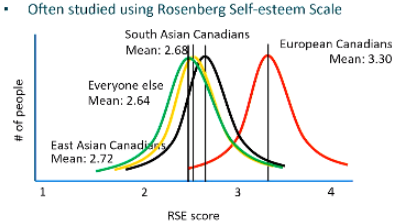
Describe visually and verbally the self esteem distribution of south asian canadians, east asian canadians, european canadians, and everyone else
* Most people should be around average, most people are about as good as other people
* If people were to be accurate, you would more have a distribution centering around 2.5
* So when we see people not in the middle there must be some compensatory strategies occurring in that population
* The european canadian distribution is clearly the outlier, and thus must be engaging in some compensatory strategies
* If people were to be accurate, you would more have a distribution centering around 2.5
* So when we see people not in the middle there must be some compensatory strategies occurring in that population
* The european canadian distribution is clearly the outlier, and thus must be engaging in some compensatory strategies
7
New cards
Evaluate “self enhancement versus group enhancement” as an explanation for why European canadians engage in more self enhancing strategies
* some researchers tried to argue that when looking at self construal, independent self construal contrasts the self versus everything else, then it make sense that people would be more likely to self enhance
* Interdependence self construals main division is the ingroup and outgroup, so the main distinction should be enhancing the ingroup rather than the individual
* This did not explain enough of the variability- people with more of an independent self construal enhance everything about themselves, including the groups they are apart of (more likely to self enhance and group enhance)
* Interdependence self construals main division is the ingroup and outgroup, so the main distinction should be enhancing the ingroup rather than the individual
* This did not explain enough of the variability- people with more of an independent self construal enhance everything about themselves, including the groups they are apart of (more likely to self enhance and group enhance)
8
New cards
Evaluate “matter of importance” as an explanation for why European canadians engage in more self enhancing strategies
* Matter of importance: maybe people with more interdependent would self enhance when it has to do with things that are more important to them
* But we still see the difference not enhancing as much for other topics more important to them
* But we still see the difference not enhancing as much for other topics more important to them
9
New cards
Evaluate “modesty norms” as an explanation for why European canadians engage in more self enhancing strategies
* Modesty norms: argues that other cultural groups also self enhance but they do not honestly reflect that pattern because they have cultural patterns of modesty. They feel uncomfortable rating themselves more highly on these measures.
* as explored in other cards, this is a promising explanation!
* as explored in other cards, this is a promising explanation!
10
New cards
Briefly outline the explanations for why European canadians engage in more self enhancing strategies. Also briefly note their validity
1. Self enhancement versus group enhancement
1. not promising
2. matter of importance
1. not promising
3. modesty norms
1. promising!
11
New cards
What is overconfidence? How does it differ from self enhancement? What are its 3 components?
* Overconfidence: having an unjustifiably positive belief in one’s characteristics or performance
* Difference between self enhancement: more specific to task, self enhancement is a global evaluation of character
* Broken up into 3 components
* Overestimation: e.g., what is your expected performance versus actual performance
* Overplacement: requires some level of social awareness, a person has been overconfident in how well they did in relation to other people. Over Placing yourself in relation to other people
* Overprecision: how certain your judgement is in your performance
* Difference between self enhancement: more specific to task, self enhancement is a global evaluation of character
* Broken up into 3 components
* Overestimation: e.g., what is your expected performance versus actual performance
* Overplacement: requires some level of social awareness, a person has been overconfident in how well they did in relation to other people. Over Placing yourself in relation to other people
* Overprecision: how certain your judgement is in your performance
12
New cards
Describe the methods of the investigating the cultural variability of overconfidence
* task: test of empathy, ambiguous task (people should have no idea on how they are doing) where individuals are asked to rate the emotion of someone by just looking at their eyes. No feedback is given.
* procedure: Canadian, Japanese, and Hong Kong participants are given 10 tokens (no real value), others given 10 coins (equivalent to local currency). Given a number line, place bets on how well you did. If you guess correctly how you did in a certain range you get to keep the currency (tokens it doesn't matter to the person because they are worthless but coins do matter)
* They thought that the token condition is the unincentivized condition, where the cultural modesty norms would come up
* Hoping that the desire for capital was overriding the desire for modesty, allowing this to be controlled in the real coin condition
* variables:
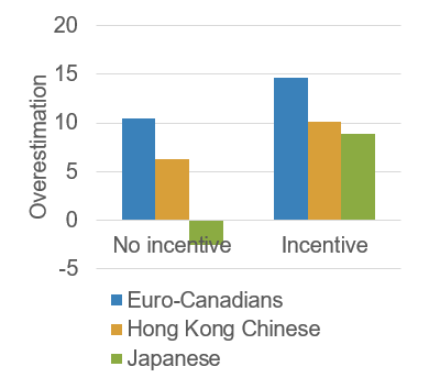
* Overestimate calculated by your predicted mean score minus actual performance
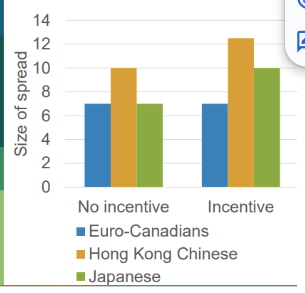
* Overprecision calculated by the spread of the distribution of bets along the numberline
* Larger the spread the less overprecision you have, overprecision is about certainty remember !
* procedure: Canadian, Japanese, and Hong Kong participants are given 10 tokens (no real value), others given 10 coins (equivalent to local currency). Given a number line, place bets on how well you did. If you guess correctly how you did in a certain range you get to keep the currency (tokens it doesn't matter to the person because they are worthless but coins do matter)
* They thought that the token condition is the unincentivized condition, where the cultural modesty norms would come up
* Hoping that the desire for capital was overriding the desire for modesty, allowing this to be controlled in the real coin condition
* variables:
* Overestimate calculated by your predicted mean score minus actual performance
* Overprecision calculated by the spread of the distribution of bets along the numberline
* Larger the spread the less overprecision you have, overprecision is about certainty remember !
13
New cards
Describe the results of the investigating the cultural variability of overconfidence and the conclusions to draw from them
\
* token condition, no incentives (default responses with modesty bias)
* euro-canadians were more confident than Japanese or Hong Kong participants
* JP participants even showed defacement, less confidence
* coin condition: incentives (responses with modesty bias overridden)
* overconfidence is shown for everyone, but is still greatest in the european canadian group
* thus modesty norms appear to explain away at least some of the cultural variability
* results for overprecision (spread of the estimation)
* no incentivization: Everyone’s spread was about the same when no incentivization
* incentive condition: HK and JP participants got less certain
* So they overestimated their performance, but were also less certain in their estimations
* So modesty norms do not really explain uncertainty (there seems to be something genuine in their hesitation to overestimate)
* token condition, no incentives (default responses with modesty bias)
* euro-canadians were more confident than Japanese or Hong Kong participants
* JP participants even showed defacement, less confidence
* coin condition: incentives (responses with modesty bias overridden)
* overconfidence is shown for everyone, but is still greatest in the european canadian group
* thus modesty norms appear to explain away at least some of the cultural variability
* results for overprecision (spread of the estimation)
* no incentivization: Everyone’s spread was about the same when no incentivization
* incentive condition: HK and JP participants got less certain
* So they overestimated their performance, but were also less certain in their estimations
* So modesty norms do not really explain uncertainty (there seems to be something genuine in their hesitation to overestimate)
14
New cards
What are the 2 important points taken from the study investigating the cultural variability of overconfidence?
1. There is less cultural variability when you control for modest norms
2. But there is more cultural variability when examining over precision
This means: we cannot make these blanket statements saying that this group is more overconfident or self enhances more, it really depends what you are talking about: overprecision? Overestimation? Replacement (we did not talk about this but theoretically it could change)?
15
New cards
How does culturally variability manifest in agency and control? What question distinguishes between the 2 theories?
Different cultural environments foster different ways of exercising control
\
Question is: can I change?
* Yes: incremental theory of self
* No: entity theory of the self
\
Can do the same for the world: can the world change?
* Yes: incremental theory of the world
* No: entity theory of the world
\
Question is: can I change?
* Yes: incremental theory of self
* No: entity theory of the self
\
Can do the same for the world: can the world change?
* Yes: incremental theory of the world
* No: entity theory of the world
16
New cards
Describe the incremental and entity theory of the self. How about the incremental and entity theory of the world?
* Incremental theory of self: we believe that abilities are malleable, as long as we put in enough effort we can change
* Lots of things in daily life is based on this view: e.g., workout routines
* Incremental theory of the world: world is flexible and responsive to our efforts to change it
* Entity theory of self: abilities are fixed and reflect whatever innate abilities we have
* Entity theory of the world: associated with the perception that the world is not really responsive, that it is fixed and is beyond your ability to change it
* Lots of things in daily life is based on this view: e.g., workout routines
* Incremental theory of the world: world is flexible and responsive to our efforts to change it
* Entity theory of self: abilities are fixed and reflect whatever innate abilities we have
* Entity theory of the world: associated with the perception that the world is not really responsive, that it is fixed and is beyond your ability to change it
17
New cards
How does the self construal of an individual interact with their theories of the self and world?
* More independent self construal: associated with more incremental theory of the world and entity theory of the self
* Referred to as primary control: idea is that you as an individual cannot be changed so the world must change to fit you, or you have to change the world to fit you.
* People with a more interdependent self construal: more likely to have an entity theory of the world and incremental theory of the self
* The world is fixed and there is nothing you can do about it so you have to change yourself
* This is referred to secondary control
* Referred to as primary control: idea is that you as an individual cannot be changed so the world must change to fit you, or you have to change the world to fit you.
* People with a more interdependent self construal: more likely to have an entity theory of the world and incremental theory of the self
* The world is fixed and there is nothing you can do about it so you have to change yourself
* This is referred to secondary control
18
New cards
What do primary and secondary control represent? Define them.
* Researchers think that this is 2 different ways people can exercise agency
* Primary control: exercise agency by making changes in their environment in a way that suits them
* Internal locus of control, seat of power rests within
* Secondary control: exercise agency by adjusting goals and desires to play a more direct role in the psychological impact of reality
* Assumes an external locus of control, that change is being compelled from the outside
* Primary control: exercise agency by making changes in their environment in a way that suits them
* Internal locus of control, seat of power rests within
* Secondary control: exercise agency by adjusting goals and desires to play a more direct role in the psychological impact of reality
* Assumes an external locus of control, that change is being compelled from the outside
19
New cards
How do independent versus interdependent self construal (and their associated differences in agency) affect choice making?
* Independent self construal: more likely to value making important decisions by themselves
* Interdependent self construal: more likely to consult others
* Interdependent self construal: more likely to consult others
20
New cards
What is the paradox of choice?
* Paradox of choice: we do not like too many, but we also do not like too little
* We do not like too many choices, overwhelming amount of choices deplete our mental resources
* Not good at dealing with a large number
* Too little choices leads us to have more learned helplessness
* Sometimes this is seen in political elections
* “Why vote anyway it's only 2 parties”
* We do not like too many choices, overwhelming amount of choices deplete our mental resources
* Not good at dealing with a large number
* Too little choices leads us to have more learned helplessness
* Sometimes this is seen in political elections
* “Why vote anyway it's only 2 parties”
21
New cards
What is an emotion?
* What is an emotion: psychological and physiological state in response to some kind of stimulus
* Psychological: has some subjective component
* Also has a cognitive component, having thoughts about certain thoughts about emotions we have or emotions about thoughts
* Physiological: our bodies reactions to some kind of stimulus
* Emotions are a combination of these states
* Psychological: has some subjective component
* Also has a cognitive component, having thoughts about certain thoughts about emotions we have or emotions about thoughts
* Physiological: our bodies reactions to some kind of stimulus
* Emotions are a combination of these states
22
New cards
What are the 2 primary theories of emotion?
* James Lang theory: start with some event, experience physiological responses, recognise those responses (this means I am feeling this), then label it as an emotion
* Event → physiological change → perceiving physiological change results in emotion
* 2 factor theory of emotion: also need to consider interpretation. In our heads are thoughts that are important to consider. Argues that emotions are a function of both physiological as well as cognitive appraisals
* Experience physiological changes, have some cognitive appraisal, then emotion
* Allows us to misattribute where our arousal is coming from
* Misattribution of arousal
* Event → physiological change → perceiving physiological change results in emotion
* 2 factor theory of emotion: also need to consider interpretation. In our heads are thoughts that are important to consider. Argues that emotions are a function of both physiological as well as cognitive appraisals
* Experience physiological changes, have some cognitive appraisal, then emotion
* Allows us to misattribute where our arousal is coming from
* Misattribution of arousal
23
New cards
What is the facial feedback hypothesis and how does it related to the James Lange theory of emotion?
* J-L theory leads to this facial feedback hypothesis: if you manipulate physiological changes (e.g., facial expressions) you can produce different or distinct kinds of emotions
* Classic study: take a pen and get people to hold between teeth or lips (teeth produces smiling behaviour)
* Classic study: take a pen and get people to hold between teeth or lips (teeth produces smiling behaviour)
24
New cards
What is the problem with the JL theory in general?
Assumes that there is a physiological response for each emotion, but we know that there are many emotions for one physiological response
25
New cards
Briefly contrast the JP and 2 factor theory of emotion in relation to their thoughts on cultural variability
* JL: emotion should be universal
* 2 factor: emotions should vary because different cultural environments should lead to different experiences and thus different interpretations of their physiological responses
* 2 factor: emotions should vary because different cultural environments should lead to different experiences and thus different interpretations of their physiological responses
26
New cards
What are the 4 lines of evidence showing emotional universality (just list them do not describe)
1. Emotional antecedents
2. Physiological responses
3. Emotional appraisal
27
New cards
Describe how emotional antecedents provide evidence for emotional universality
* Events leading up to certain emotion
* There seems to be substantial overlap cross culturally in terms of what antecedents lead to what kinds of emotions
* E.g., loss of loved one leads to grief, injustice leads to anger, potential harm leads to fear
* There seems to be substantial overlap cross culturally in terms of what antecedents lead to what kinds of emotions
* E.g., loss of loved one leads to grief, injustice leads to anger, potential harm leads to fear
28
New cards
Describe the different types of relevant physiological responses and how they provide evidence for emotional universality
* Ergotropic: physiological response affiliated with the sympathetic NS
* Fight or flight mechanism, responses preparing you to expend energy
* Higher cardiovascular activity, muscular reactivity (muscles primed to engage in some behaviour), high levels of perspiration
* All gets us ready to do something
* Trophotropic: reflect the actions of the parasympathetic NS
* Responses all about relaxing and calming
* E.g., gastric disturbance, crying and sobbing (release tension in your body)
* Felt temperature: subjective feeling of temperature
* What it feels like to have that kind of emotion
* No change in actual core body temperature, subjective evaluations of hot, cold, somewhere in between
* E.g., anger tends to be associated with higher ergotropic responses, lower trophotropic responses, and higher levels of heat
* E.g., sadness associated with lower ergotropic, higher trophotropic, and a feeling of cold
* Fight or flight mechanism, responses preparing you to expend energy
* Higher cardiovascular activity, muscular reactivity (muscles primed to engage in some behaviour), high levels of perspiration
* All gets us ready to do something
* Trophotropic: reflect the actions of the parasympathetic NS
* Responses all about relaxing and calming
* E.g., gastric disturbance, crying and sobbing (release tension in your body)
* Felt temperature: subjective feeling of temperature
* What it feels like to have that kind of emotion
* No change in actual core body temperature, subjective evaluations of hot, cold, somewhere in between
* E.g., anger tends to be associated with higher ergotropic responses, lower trophotropic responses, and higher levels of heat
* E.g., sadness associated with lower ergotropic, higher trophotropic, and a feeling of cold
29
New cards
Describe how emotional appraisals provide evidence for emotional universality
* When people encounter an antecedent people will undergo a stimulus evaluation check appraising antecedents along several dimensions
* Appraising whether the antecedent is expected, pleasant, and fair
* Different emotions are associated with different combinations of pleasantness, expectation, and fairness
* Appraising whether the antecedent is expected, pleasant, and fair
* Different emotions are associated with different combinations of pleasantness, expectation, and fairness
30
New cards
Discuss the history of the expression “the pursuit of happiness”
Expression “pursuit of happiness” is dated back to the enlightenment in the 18th century. Time when science was arising, as they did that the world seemed like a more rational and predictable place. A place that you could control if you willed it enough.
* Used by thomas Jefferson in the US declaration of independence
* “Pursuit of happiness is an inalienable right”
* Historical beginning to starting about happiness, so maybe culture does shape this
* Used by thomas Jefferson in the US declaration of independence
* “Pursuit of happiness is an inalienable right”
* Historical beginning to starting about happiness, so maybe culture does shape this
31
New cards
Contrast characteristics of happier versus less happier countries
* Happier countries
* Northern european or latin american countries
* Wealthier
* Respect human rights
* More income equality
* Less corruption
* Less happier countries
* Former soviet bloc, south asian, or african
* Less wealthy
* Fewer human rights
* Less income equality
* More corruption
* Northern european or latin american countries
* Wealthier
* Respect human rights
* More income equality
* Less corruption
* Less happier countries
* Former soviet bloc, south asian, or african
* Less wealthy
* Fewer human rights
* Less income equality
* More corruption
32
New cards
Does money make you happy?
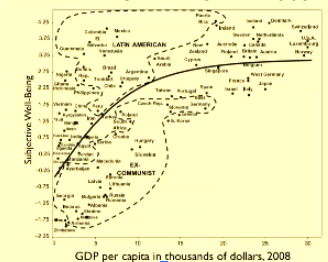
* You see this curve everywhere
* On the low end people do not have their basic needs met, but after you get to a certain point it largely flattens out
* Money matters on the low end of the scale, not so much on the high end
* On the low end people do not have their basic needs met, but after you get to a certain point it largely flattens out
* Money matters on the low end of the scale, not so much on the high end
33
New cards
What are the 2 kinds of happiness? How are they related?
* Hedonism: concerned with satisfaction, happiness, and subjective well being
* Most research studies this aspect
* Eudaimonia: from aristotle, means living a good life
* Often measured by “meaning of life”
* These overlap a lot
* Happier, more likely to see meaning, and vice versa
* Most research studies this aspect
* Eudaimonia: from aristotle, means living a good life
* Often measured by “meaning of life”
* These overlap a lot
* Happier, more likely to see meaning, and vice versa
34
New cards
What is a key difference between happiness and eudaimonia?
* With more money you get happier
* But there is a negative relationship between wealth and meaning in life (more wealth, less meaning in life)
* One big reason for this is religion, and this same curve describes differences in country’s religiosity
* But there is a negative relationship between wealth and meaning in life (more wealth, less meaning in life)
* One big reason for this is religion, and this same curve describes differences in country’s religiosity
35
New cards
Contrast differences between a happy life and a meaningful life
* Happiness:
* Happy life
* Focus on present
* Fun times with friends
* Getting basic needs satisfied
* Sufficient money
* Positive feelings
* Eudaimonia
* Meaningful life
* Focus on past and future
* Time with family
* Religiosity and spirituality
* Expressing self
* Difficult struggles
* Happy life
* Focus on present
* Fun times with friends
* Getting basic needs satisfied
* Sufficient money
* Positive feelings
* Eudaimonia
* Meaningful life
* Focus on past and future
* Time with family
* Religiosity and spirituality
* Expressing self
* Difficult struggles
36
New cards
What does happiness mean literally in english? Other languages?
* Definitions have changed
* early english definitions of happiness emphasis that it was the result of good luck
* hap=happenstance, result of good fortune
* Analysis of dictionaries from 30 different countries found that definitions of happiness include a definition involved luck in 24 of them (but no longer in english)
* Happiness as good fortune rather than something that you pursue
* early english definitions of happiness emphasis that it was the result of good luck
* hap=happenstance, result of good fortune
* Analysis of dictionaries from 30 different countries found that definitions of happiness include a definition involved luck in 24 of them (but no longer in english)
* Happiness as good fortune rather than something that you pursue
37
New cards
Discuss how happiness has changed on the independence to dependence scale
* Graph (not shown here): frequency of words over time
* Happy person occurrence versus happy nation
* Expression happy person has become more common over time and happy nation has become less common in published american books
* Happiness has become more of an individual concept
* Happy person occurrence versus happy nation
* Expression happy person has become more common over time and happy nation has become less common in published american books
* Happiness has become more of an individual concept
38
New cards
Describe the relationship between culture and the amount of value you place on happiness in the context of decision making
* Cultures differ in how much they are making decisions based on whether they think it will make them happier
* Study: UBC students choose between a fun task with no benefit, but another game that is boring but improves thinking skills
* European canadian decent: showed an overwhelming preference for the fun game
* Asian canadians the decision was much closer, most chose the most fun game but almost an equal amount chose useful game
* Similar findings emerged for studies where people chose hypothetical university courses
* Study: UBC students choose between a fun task with no benefit, but another game that is boring but improves thinking skills
* European canadian decent: showed an overwhelming preference for the fun game
* Asian canadians the decision was much closer, most chose the most fun game but almost an equal amount chose useful game
* Similar findings emerged for studies where people chose hypothetical university courses
39
New cards
Describe the relationship between culture and attitudes towards negative feelings (and the outcomes associated with them)
* Some cultures strive to enhance positive feelings and avoid any negative feelings
* In north america you see this especially
* In NA the more positive feelings they experience and the fewer negative experiences, the less depression and health problems they face
* Reliably found in NA
* But in much of the rest of the world you do not see this
* East asia: amount of positive feelings of risk for depression and health problems is uncorrelated
* Russians are famous for apparently wanting to wallow in their despair
* National stereotype
* In north america you see this especially
* In NA the more positive feelings they experience and the fewer negative experiences, the less depression and health problems they face
* Reliably found in NA
* But in much of the rest of the world you do not see this
* East asia: amount of positive feelings of risk for depression and health problems is uncorrelated
* Russians are famous for apparently wanting to wallow in their despair
* National stereotype
40
New cards
Describe a study investigating culture and the outcomes of negative emotions
* Study: russians and americans were compared in terms of how much they tend to brood (dwell on suffering in life), how much they identified with a ruminating target in vignettes, and how depressed they were
* Read vignettes with one character ruminating in suffering and the other happy
* Russians reported brooding more than americans and identified more with ruminating target
* Americans who ruminate were more depressed than those who did not
* No difference in depression levels between ruminating and non-ruminating russians
* So the psychological narrative exported to the world from NA is that rumination is bad, but this is not replicated here in Russia
* Read vignettes with one character ruminating in suffering and the other happy
* Russians reported brooding more than americans and identified more with ruminating target
* Americans who ruminate were more depressed than those who did not
* No difference in depression levels between ruminating and non-ruminating russians
* So the psychological narrative exported to the world from NA is that rumination is bad, but this is not replicated here in Russia
41
New cards
What variables are associated with life satisfaction across different cultures?
* Study: measures individualist, life satisfaction, overall positive affect, and extent to which people felt they were living up to cultural norms of different countries
* In the most individualistic countries, life satisfaction was strongly correlated by positive affect
* In the least individualistic countries, life satisfaction was more strongly predicted by the extent to which people felt they were living up to cultural norms
* In the most individualistic countries, life satisfaction was strongly correlated by positive affect
* In the least individualistic countries, life satisfaction was more strongly predicted by the extent to which people felt they were living up to cultural norms
42
New cards
What are the 2 different ways we can operationalise happiness?
1. Sum total of all happy feelings that you have experienced
2. How you retrospectively evaluate your happiness
Much research finds that it is people’s retrospective evaluations of their happiness that guide their decisions in life
43
New cards
Outline 2 studies higlighting why we need to distinguish between happiness as operationalised as the sum total of all feelings and how retrospectively we evaluate our happiness
* Study: colonoscopy patients either had the colonoscopy removed quickly at the end, quickly ending their pain, or had a colonoscopy removed slowly, thus increasing the total duration of the pain, but making sure that the pain slowly diminished towards the end of the procedure
* They had a gauge to measure pain
* Slow removal group had overall more pain
* Patients who had the slow removal (with more total pain) viewing the procedure as overall less painful than those who had the quick removal
* Remembering self does not account for all experiences we have
* Study: AA (asian americans) and european americans ratings of their satisfaction to disentangle people’s experienced satisfaction and their retrospective satisfaction
* There were no cultural differences in actual daily reports of satisfaction
* There were pronounced cultural differences in people’s retrospective reports
* Retrospective accounts are influenced largely by people’s theories of what they think their life is like
* euro-americans are more likely than AA to possess a theory that they are happy, even when their daily reports might not be
* They had a gauge to measure pain
* Slow removal group had overall more pain
* Patients who had the slow removal (with more total pain) viewing the procedure as overall less painful than those who had the quick removal
* Remembering self does not account for all experiences we have
* Study: AA (asian americans) and european americans ratings of their satisfaction to disentangle people’s experienced satisfaction and their retrospective satisfaction
* There were no cultural differences in actual daily reports of satisfaction
* There were pronounced cultural differences in people’s retrospective reports
* Retrospective accounts are influenced largely by people’s theories of what they think their life is like
* euro-americans are more likely than AA to possess a theory that they are happy, even when their daily reports might not be
44
New cards
Discuss cultural differences in ideal affect
* Cultural variation is more pronounced for the kinds of affect that people want to have than for their actual affect
* East asians (EA) prefer low arousal positive states (e.g., calm, relaxed, peaceful) compared with north americans (NA), who tend to prefer high arousal positive states
* evidence:
* 1. EA prefer music with slower tempos than Westerners
* 2. EA say they prefer more passive leisure activities and westerners prefer more active ones
* 3. EA uses more drugs that elicit calm states (e.g., heroin and opium), whereas westerners use more that elicit excited states (e.g., cocaine and amphetamines)
* 4. Kids book in the US include bigger and more excited smiles than those in Taiwan
* When reading these books, kids get more excited when reading western books and more calm when reading Taiwanese books
* 5. Western self help books and religious texts are more likely to encourage more high arousal positive states than EA self help books, where calmness is emphasised more
* Christian religion texts encourage more energetic states than do buddhist religious texts, which encourage calmer states
* 6. Bigger smiles in american ads, smaller smiles in EA ads
* East asians (EA) prefer low arousal positive states (e.g., calm, relaxed, peaceful) compared with north americans (NA), who tend to prefer high arousal positive states
* evidence:
* 1. EA prefer music with slower tempos than Westerners
* 2. EA say they prefer more passive leisure activities and westerners prefer more active ones
* 3. EA uses more drugs that elicit calm states (e.g., heroin and opium), whereas westerners use more that elicit excited states (e.g., cocaine and amphetamines)
* 4. Kids book in the US include bigger and more excited smiles than those in Taiwan
* When reading these books, kids get more excited when reading western books and more calm when reading Taiwanese books
* 5. Western self help books and religious texts are more likely to encourage more high arousal positive states than EA self help books, where calmness is emphasised more
* Christian religion texts encourage more energetic states than do buddhist religious texts, which encourage calmer states
* 6. Bigger smiles in american ads, smaller smiles in EA ads
45
New cards
What emotions display especially high levels of universality?
* High levels of anger
* Associated with low levels of expectedness, pleasantness, fairness
* High levels of happiness
* Associated with high and low expectedness
* Can be happy about something expected and unexpected, depends
* Associated with high levels of fairness and pleasantness
* Associated with low levels of expectedness, pleasantness, fairness
* High levels of happiness
* Associated with high and low expectedness
* Can be happy about something expected and unexpected, depends
* Associated with high levels of fairness and pleasantness
46
New cards
What are the 6 basic emotions? Why are they called basic? What lines of evidence support their existance?
* 6 basic emotions
* Anger
* Happy
* Sadness
* Surprise
* Disgust
* Fear
* Called basic because they are experienced by every culture that has been studied
* Despite this universality, there is a good level of cultural variability
* 2 lines of evidence:
* Variability of emotional expression
* Variability of emotional lexicon
* Anger
* Happy
* Sadness
* Surprise
* Disgust
* Fear
* Called basic because they are experienced by every culture that has been studied
* Despite this universality, there is a good level of cultural variability
* 2 lines of evidence:
* Variability of emotional expression
* Variability of emotional lexicon
47
New cards
Discuss whether nationality or ethnicity make a bigger difference in emotional expression
* When people share one ethnicity, differing on nationality makes a difference
* E.g., east asians in east asia shown asian americans/canadians and asians in east asia expressing emotion, they are able to tell above chance level which one is in the west or east
* E.g., east asians in east asia shown asian americans/canadians and asians in east asia expressing emotion, they are able to tell above chance level which one is in the west or east
48
New cards
What are display rules? When do we develop them?
Display rules: culturally specific rules governing how appropriate and intense facial expressions are supposed to be, and sometimes can be so specific that you see ritualised displays (emotional expressions only existing in specific cultural environments)
* Learned early in life, but become automatic by adulthood
* Learned early in life, but become automatic by adulthood
49
New cards
Describe the display rules of amplification versus deamplifcation
* Ampliciation: cultural display rule where you are supposed to express the emotion that you are experiencing more intensely then what you are actually experiencing
* Deamplification: display rule where whatever emotional experience you are having, your expression needs to be less intense
* Just needs to be less intense
* Deamplification: display rule where whatever emotional experience you are having, your expression needs to be less intense
* Just needs to be less intense
50
New cards
Describe the display rules of neutralisation versus simulation
* Neutralisation: emotional expression should be blank when you have an emotional experience
* simulation: no emotional experience, but you pretend that you are
* simulation: no emotional experience, but you pretend that you are
51
New cards
Describe the display rules of masking versus qualification
* Masking: emotional expression is disconnected from your emotional experience
* E.g., happens in depression, where outwardly they can appear happy
* Qualification: emotional expression that is a combination of an actual emotional experience and something else
* 2 emotional expressions simultaneously leak out onto someone’s face
* Generally characterised by this lateral asymmetry in your face and facial expression
* Not symmetry in terms of left side is doing the same as the right side, but rather if one side is expressing the same emotion as the other side
* E.g., Nigawarai
* Mixed emotional expression where top half is distressed, but the bottom half is a positive emotion
* Occurs when you are experiencing an negative experience but it is not appropriate to express it during that time
* E.g., happens in depression, where outwardly they can appear happy
* Qualification: emotional expression that is a combination of an actual emotional experience and something else
* 2 emotional expressions simultaneously leak out onto someone’s face
* Generally characterised by this lateral asymmetry in your face and facial expression
* Not symmetry in terms of left side is doing the same as the right side, but rather if one side is expressing the same emotion as the other side
* E.g., Nigawarai
* Mixed emotional expression where top half is distressed, but the bottom half is a positive emotion
* Occurs when you are experiencing an negative experience but it is not appropriate to express it during that time
52
New cards
List (but do not describe) notable display rules
1. Amplification versus deamplification
2. Neutralisation versus simulation
3. Masking versus qualification
53
New cards
Contrast the level of display rules in individualistic versus collectivistic countries
highly collectivist: e.g., east asian countries
* More control oriented display rules
* Deamplification
* Masking
* Neutralisation
* Qualification
South american countries high in collectivism and western individualistic countries
* both are high on amplification
* This highlights that collectivism and individualism does not look the same everywhere
* South american:
* Cultural script is that if you are experiencing an emotion it needs to be expressed strongly, otherwise it is not really genuine
* More control oriented display rules
* Deamplification
* Masking
* Neutralisation
* Qualification
South american countries high in collectivism and western individualistic countries
* both are high on amplification
* This highlights that collectivism and individualism does not look the same everywhere
* South american:
* Cultural script is that if you are experiencing an emotion it needs to be expressed strongly, otherwise it is not really genuine
54
New cards
Discuss the variability of emotional lexicon
* Some languages have unique words for unique emotions
* Some debate as to whether such differences are meaningful with important consequences for emotional experience
* Does not having a word for an emotion affect our emotional experience?
* Some debate as to whether such differences are meaningful with important consequences for emotional experience
* Does not having a word for an emotion affect our emotional experience?
55
New cards
Describe the hard and soft versions of the Sapir-Whorf hypothesis of linguistic relativity
* Hard version: language determines how we think, and our experience
* If we are not able to have those words we cannot have those experiences
* Psychologists and linguistics reject this claim
* Soft version: language affects how we think, but is not deterministic
* Language does help us think about/articular ideas, experience
* Without words, it hinders ability to remember/discuss experience
* If we are not able to have those words we cannot have those experiences
* Psychologists and linguistics reject this claim
* Soft version: language affects how we think, but is not deterministic
* Language does help us think about/articular ideas, experience
* Without words, it hinders ability to remember/discuss experience
56
New cards
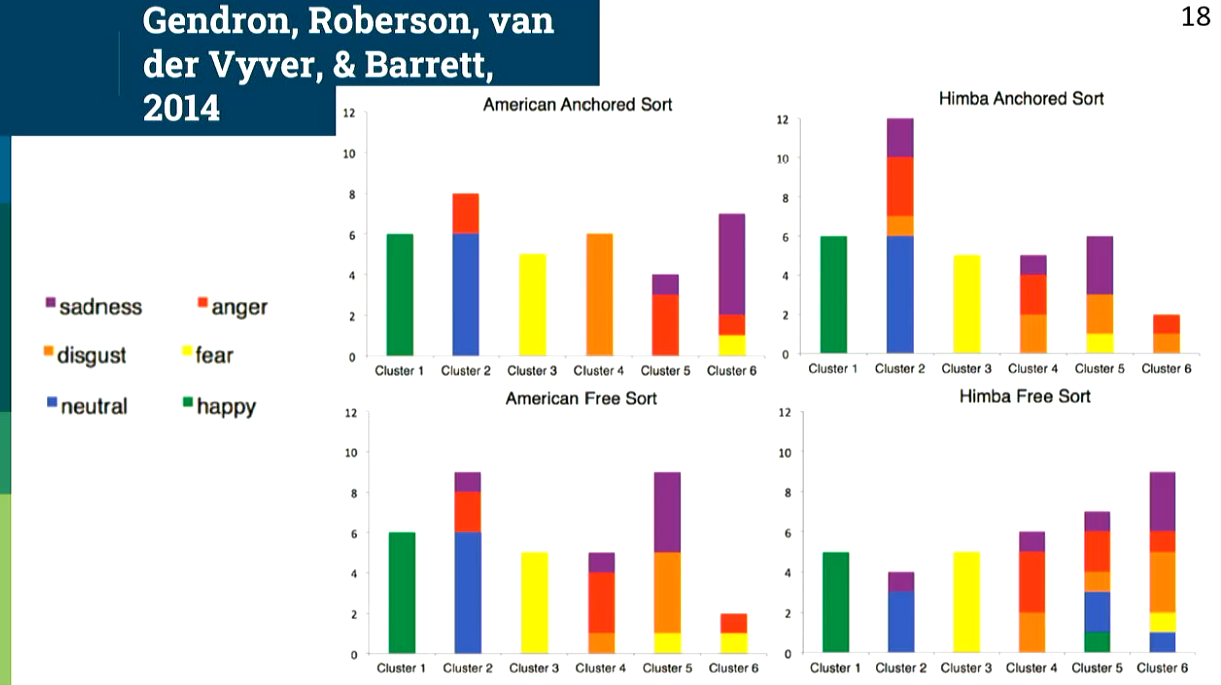
Describe Gendron, Roberson, van der Vyber, and Barrett’s study. What did they investigate? Describe their study and its results.
* What if the basic emotions fall into the same trap as the 5 factor personality model
* What if we see this universality because we tell people what emotions to expect and then they see what they are expecting
Study: compared Himba in Africa to students in US
* Participants did one of 2 tasks: anchored sort task and free sort task
* Anchored sort: participants get a bunch of emotional expression pictures and they correspond to 6 different emotional expressions
* Participants have to take these pictures and sort them into the 6 basic categories
* Free sort:
* Participants asked to sort into 6 categories, but no names are given to the 6 categories
* Kinda similar to the lexical method used to derive the big 5
* US results:
* Anchored sort: there are some general consistencies with how they are sorting them, happy goes with happy, neutral with neutral, with some variability
* Should be the one meriting the most universality
* Free sort: there are still consistencies, but it is a bit messier
* Himba results:
* Anchored sort
* Very similar to the american free sort results
* All happy and fear faces get sorted in easily, neutral faces were likely to be in the neutral category, but other categories were messier
* Free sort:
* More messy, but happy and fear tend to come out on top as the most reliably recognised emotion
* Conclusions: there may be such thing as basic emotions, and maybe all cultures express these emotions, but there are cultural nuances to how we express these emotions that might impact how recognisable they are
* What if we see this universality because we tell people what emotions to expect and then they see what they are expecting
Study: compared Himba in Africa to students in US
* Participants did one of 2 tasks: anchored sort task and free sort task
* Anchored sort: participants get a bunch of emotional expression pictures and they correspond to 6 different emotional expressions
* Participants have to take these pictures and sort them into the 6 basic categories
* Free sort:
* Participants asked to sort into 6 categories, but no names are given to the 6 categories
* Kinda similar to the lexical method used to derive the big 5
* US results:
* Anchored sort: there are some general consistencies with how they are sorting them, happy goes with happy, neutral with neutral, with some variability
* Should be the one meriting the most universality
* Free sort: there are still consistencies, but it is a bit messier
* Himba results:
* Anchored sort
* Very similar to the american free sort results
* All happy and fear faces get sorted in easily, neutral faces were likely to be in the neutral category, but other categories were messier
* Free sort:
* More messy, but happy and fear tend to come out on top as the most reliably recognised emotion
* Conclusions: there may be such thing as basic emotions, and maybe all cultures express these emotions, but there are cultural nuances to how we express these emotions that might impact how recognisable they are
57
New cards
Contrast evolutionary versus appraisal theories of emotion
* Evolutionary theories: argues that there are a good level of universality across cultures and species
* Focus on universality: emotions are hardwired, automatic responses tied to nervous system, culture plays minimal role in emotions
* Physiological changes are generally seen as antecedent to emotions or indicators of emotions and not so much consequences of emotions
* J-L theory follows this
* Appraisal theories
* Approaches allowing for the universality in biological features, but also for the cultural variability of evaluative process
* Also allows for individual variability in appraisals
* Culture plays important role in emotional experience due to influence on appraisals and interpretations
* Focus on universality: emotions are hardwired, automatic responses tied to nervous system, culture plays minimal role in emotions
* Physiological changes are generally seen as antecedent to emotions or indicators of emotions and not so much consequences of emotions
* J-L theory follows this
* Appraisal theories
* Approaches allowing for the universality in biological features, but also for the cultural variability of evaluative process
* Also allows for individual variability in appraisals
* Culture plays important role in emotional experience due to influence on appraisals and interpretations
58
New cards
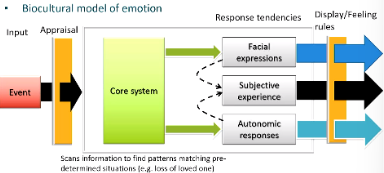
Visually and verbally describe the biocultural model of emotion
* Everything in white border box are theorised to happen inside the brain and outside of conscious awareness
\
* 1. Event input has to go through this appraisal filter
* This is where culture first comes in
* If this information is appraised in a way recognised by the core system certain response tendencies are triggered
* 2. We have this theoretical core system in our brains scanning from information from outside to see whether that information hits predetermined preprogrammed relationships or patterns
* Patterns or situations will match certain stimuli to certain emotional outputs
* E.g., loved one dies, leads to grief
* 3. Once the core system gets activated it leads to response tendencies
* Because they are in the white box they are supposed to be preconscious, just out of conscious awareness
* Preparing you to do something, preparing your facial muscles to express something, preparing your autonomic system to respond to this stimulus
\
* both facial expressions and autonomic responses contribute to a subjective experience
* 4. Response tendencies are then expressed based on display/feeling rules
* Second place culture comes in
\
* 1. Event input has to go through this appraisal filter
* This is where culture first comes in
* If this information is appraised in a way recognised by the core system certain response tendencies are triggered
* 2. We have this theoretical core system in our brains scanning from information from outside to see whether that information hits predetermined preprogrammed relationships or patterns
* Patterns or situations will match certain stimuli to certain emotional outputs
* E.g., loved one dies, leads to grief
* 3. Once the core system gets activated it leads to response tendencies
* Because they are in the white box they are supposed to be preconscious, just out of conscious awareness
* Preparing you to do something, preparing your facial muscles to express something, preparing your autonomic system to respond to this stimulus
\
* both facial expressions and autonomic responses contribute to a subjective experience
* 4. Response tendencies are then expressed based on display/feeling rules
* Second place culture comes in
59
New cards
In the biocultural model, which of the response tendency is the most subject to culture?
* Subjective experience response tendency is more subject to the impact of culture
* Autonomic not really, very difficult to control your autonomic responses
* Facial expressions are possible to control, but this depends on the type of emotion
* Autonomic not really, very difficult to control your autonomic responses
* Facial expressions are possible to control, but this depends on the type of emotion
60
New cards
What are the 4 components of emotion?
* Aspects of emotion
* Type of emotion
* Emotional context
* The individual experiencing the emotion
* Type of emotion
* Emotional context
* The individual experiencing the emotion
61
New cards
How does culturally variability interact with emotional intensity?
* When an imposition is highly intense, it floods the system, everything happens very quickly and automatically and it is hard to control
* So when emotions are really intense, it does not seem to be as susceptible to culture
* So when emotions are really intense, it does not seem to be as susceptible to culture
62
New cards
What is liget?
emotional term used in an indigenous hunter gather tribe in the Philippines (Ilongot)
\
Emotional response to insult, disappointment, irritation, and especially envy
Aroused by all-night song-fests, pride of accomplishments, or the death of a loved one
* Stimulation of liget results in mass amounts of energy, you can do a lot of things
\
Emotional response to insult, disappointment, irritation, and especially envy
Aroused by all-night song-fests, pride of accomplishments, or the death of a loved one
* Stimulation of liget results in mass amounts of energy, you can do a lot of things
63
New cards
Describe the interpretation study evaluating the 2 factor theory of emotions
method: participants autonomic nervous system is stimulated with epinephrine, then put in a room with either a euphoric or angered confederate
* they were also either informed about the epinephrine symptoms (fast heart rate, sweaty palms, etc), or uninformed
* Strongest emotions were experienced by those in the epinephrine uninformed condition
* Euphoria condition explained their arousal as a feeling of euphoria, whereas those in the anger condition explained their arousal as the feeling of anger
* they were also either informed about the epinephrine symptoms (fast heart rate, sweaty palms, etc), or uninformed
* Strongest emotions were experienced by those in the epinephrine uninformed condition
* Euphoria condition explained their arousal as a feeling of euphoria, whereas those in the anger condition explained their arousal as the feeling of anger
64
New cards
Are facial expressions consious/deliberate?
Facial expressions are often reflexive, same faces adults make are made by very young infants (including those who have been blind their whole lives)
65
New cards
Describe Ekman and Friesen’s studies investigating the universality of facial expressions. What the criticism of this work? How did they address this?
* Ekman and Friesen: took 1000s of photos of people making different emotional expressions: happiness, disgust, surprise, sadness, anger, and fear, and reduced their set of photos most easily recognisable by Americans
* Showed this set to individuals in other cultures, and asked them to select which of a set of 6 emotion terms best matched the feeling a person was showing in a photo
* Result: identified the emotion correctly in 80-90% of the photos
* Criticism: the 5 cultures used were not all that different to begin with
* All:
* Industrialised
* Literate
* Exposed to a lot of the same media images (e.g., butch cassidy and the sundance kid was shown in all 5 countries at the time)
* Ekman addressed this by going to a culture with minimal Western exposure, a tribe in Papua New Guinea (the fore)
* Created stories appropriate for each of the 6 emotions, asking them how they would feel, and make a corresponding facial expression in response to each situation
* Showed the same emotional expressions
* Ekman as a result proposed 6 basic emotions that are universally recognised around the world: happiness, surprise, sadness, anger, disgust, and fear
* Showed this set to individuals in other cultures, and asked them to select which of a set of 6 emotion terms best matched the feeling a person was showing in a photo
* Result: identified the emotion correctly in 80-90% of the photos
* Criticism: the 5 cultures used were not all that different to begin with
* All:
* Industrialised
* Literate
* Exposed to a lot of the same media images (e.g., butch cassidy and the sundance kid was shown in all 5 countries at the time)
* Ekman addressed this by going to a culture with minimal Western exposure, a tribe in Papua New Guinea (the fore)
* Created stories appropriate for each of the 6 emotions, asking them how they would feel, and make a corresponding facial expression in response to each situation
* Showed the same emotional expressions
* Ekman as a result proposed 6 basic emotions that are universally recognised around the world: happiness, surprise, sadness, anger, disgust, and fear
66
New cards
Did follow up research on Ekman’s work prove that his list was exhaustive?
there is still controversy whether other emotions, like pride (which has also been universally shown) should be added
* Pride involves whole body movements however
* Pride involves whole body movements however
67
New cards
Discuss cultural variability in recognition of emotional expressions
In general, people are best at recognising the emotional expression of those who they have had the most exposure to
1. people are about 9% more accurate in judging the facial expressions of people from their own culture than from another culture
2. Brain imaging: stronger fear response when people look at fearful facial expressions on people in their own culture
3. People can predict the electability of political candidates in their own culture just by looking at pictures of their faces, but they are not as accurate in their predictions from photos of candidates in unfamiliar cultures
4. People can also reliably guess the nationality of those expression emotions, but cannot when there are just neutral faces
5. People with a lower SES are more accurate at identifying emotions in facial expressions
1. people are about 9% more accurate in judging the facial expressions of people from their own culture than from another culture
2. Brain imaging: stronger fear response when people look at fearful facial expressions on people in their own culture
3. People can predict the electability of political candidates in their own culture just by looking at pictures of their faces, but they are not as accurate in their predictions from photos of candidates in unfamiliar cultures
4. People can also reliably guess the nationality of those expression emotions, but cannot when there are just neutral faces
5. People with a lower SES are more accurate at identifying emotions in facial expressions
68
New cards
Discuss how the cultural variability involved in interpreting facial expressions interacts with the parts of the face being observed
rationale behind a difference existing:
* Japanese people are more likely than US to conceal emotions they feel are potentially disruptive by presenting a more neutral or pleasant face
* It is harder to control muscles around the eyes than the mouth, so if you want to discern the feelings of someone disguising those feelings, it's better to focus on their eyes
* Study 1: JP are more influenced by the top half of the photos, looking at the eyes, than those of Americans whose judgement was more influenced by looking at the mouths
* Generally the finding in other studies: Europeans recognise facial expressions by observing both the eyes and mouths, whereas EAs primary focus on an area near the eyes
* Study 2: different patterns of brain activation when EAs look at faces compared with Westerners, consistent with the differences in the facial regions people from different cultures look at
* another example in culture: anime characters have bigger eyes than mouths
* Japanese people are more likely than US to conceal emotions they feel are potentially disruptive by presenting a more neutral or pleasant face
* It is harder to control muscles around the eyes than the mouth, so if you want to discern the feelings of someone disguising those feelings, it's better to focus on their eyes
* Study 1: JP are more influenced by the top half of the photos, looking at the eyes, than those of Americans whose judgement was more influenced by looking at the mouths
* Generally the finding in other studies: Europeans recognise facial expressions by observing both the eyes and mouths, whereas EAs primary focus on an area near the eyes
* Study 2: different patterns of brain activation when EAs look at faces compared with Westerners, consistent with the differences in the facial regions people from different cultures look at
* another example in culture: anime characters have bigger eyes than mouths
69
New cards
Why do some cultures have display rules allowing for more expressivity?
* Some countries consist of many cultures, others are very homogeneous in their culture
* Homogenous societies share much accumulated knowledge, and are thus good at inferring meaning from one another without need for explicit communication
* In contrast heterogeneous cultures do not share much knowledge, so they need to be more open and precise for their communication to be understood
* More heterogeneous, more emotional expression
* Homogenous societies share much accumulated knowledge, and are thus good at inferring meaning from one another without need for explicit communication
* In contrast heterogeneous cultures do not share much knowledge, so they need to be more open and precise for their communication to be understood
* More heterogeneous, more emotional expression
70
New cards
What are ritualised displays? How are these different from Ekman’s emotional categories?
facial expressions that are only recognised by certain cultural groups
\
* Ritualised displays expressions voluntarily produced rather than reflexively displayed
* E.g., tongue bite showing embarrassment in indian cultures
* Different from Ekman’s universally produced facial expressions in
\
* Ritualised displays expressions voluntarily produced rather than reflexively displayed
* E.g., tongue bite showing embarrassment in indian cultures
* Different from Ekman’s universally produced facial expressions in
71
New cards
What effect do the heavy deamplification and masking display rules present in east asian have on emotional experience?
* the cultural display rules governing the deamplifying and masking of emotions in EA (east asia) are also associated with experiencing fewer and less intense emotions than NAs
* They report feeling emotions less frequently and intensely
* They report feeling emotions less frequently and intensely
72
New cards
In the West, what is associated with characteristic hostile tendencies? Is this the same in other cultures? Bring up 2 studies investigating this.
* Western research: people with hostile tendencies are at increased risk for cardiovascular disease
* Many maintain that the reason is that these hostile people need to inhibit their anger, i.e., it is the suppression of the anger response accelerating the heart rate
* Study: how different cultures respond to an anger provoking situation, participants selected how they would respond based on a number of preset options
* EC (european canadians) felt more anger and expressed it more openly, while CC (chinese canadians) adopted strategies to minimise their anger response, and felt less angry
* Study: participants interacting with a rude confederate
* Both cultural groups responded with a similar degree of anger (measure by blood pressure and self report)
* CC blood pressure returned to normal much more quickly than EC
* None of the groups openly expressed their anger, and this inhibition led to a slower decrease in blood pressure levels for EC than for CC
* Suggests that CC experience their anger less intensely, and were more comfortable with strategies reducing the anger experience
* Many maintain that the reason is that these hostile people need to inhibit their anger, i.e., it is the suppression of the anger response accelerating the heart rate
* Study: how different cultures respond to an anger provoking situation, participants selected how they would respond based on a number of preset options
* EC (european canadians) felt more anger and expressed it more openly, while CC (chinese canadians) adopted strategies to minimise their anger response, and felt less angry
* Study: participants interacting with a rude confederate
* Both cultural groups responded with a similar degree of anger (measure by blood pressure and self report)
* CC blood pressure returned to normal much more quickly than EC
* None of the groups openly expressed their anger, and this inhibition led to a slower decrease in blood pressure levels for EC than for CC
* Suggests that CC experience their anger less intensely, and were more comfortable with strategies reducing the anger experience
73
New cards
Generally, discuss the cultural variability of health outcomes for intense positive and negative emotions
* Compared with NA, intense emotions in EA (east asian) are associated with fewer negative health outcomes
* Less of a neurological response in EA when suppressing their emotions indicates that it is not hard for them to do so
* On the flip side the regular experience of positive emotions has been associated with numerous health benefits in studies with Western participants
* EA do not show the same associations between positive emotions and healthy outcomes
* Less of a neurological response in EA when suppressing their emotions indicates that it is not hard for them to do so
* On the flip side the regular experience of positive emotions has been associated with numerous health benefits in studies with Western participants
* EA do not show the same associations between positive emotions and healthy outcomes
74
New cards
Describe the relationship between cultural concerns and the kinds of common emotions felt
* Cultural concerns as associated with the kinds of emotions related to those concerns
* E.g., defending honour is important to Turks, while maintaining face is important for JP
* Anger and shame are arise when people are concerned with defending honour, and arise more frequently in Turkey
* Shame, but not anger, is associated with maintaining face, and people in JP are far more likely to experience shame than anger
* E.g., defending honour is important to Turks, while maintaining face is important for JP
* Anger and shame are arise when people are concerned with defending honour, and arise more frequently in Turkey
* Shame, but not anger, is associated with maintaining face, and people in JP are far more likely to experience shame than anger
75
New cards
Describe cultural differences in how athletes respond to winning. What does this show?
* Study: reactions of US versus JP athletes emotional reactions to winning
* Research participants who read athlete’s self descriptions were asked to infer what kinds of emotions they were feeling: JP inferred more emotions when the athlete mentioned relationships, whereas US participants inferred more emotions when the athlete focused on themselves
* Conclusion: for JP, emotions are experienced more as interpersonal states connecting people to each other, whereas for US, emotions are experienced more as personal states within individuals
* Research participants who read athlete’s self descriptions were asked to infer what kinds of emotions they were feeling: JP inferred more emotions when the athlete mentioned relationships, whereas US participants inferred more emotions when the athlete focused on themselves
* Conclusion: for JP, emotions are experienced more as interpersonal states connecting people to each other, whereas for US, emotions are experienced more as personal states within individuals
76
New cards
Contrast the daily reported emotional experience of Japanese and American people. What can we conclude from this?
* JP reporting feeling a great deal of positive interpersonally engaged emotions also had more positive feelings in general
* US felt a lot of positive interpersonal disengaged emotions had much more positive feelings overall
* In sum:
* JP feel especially good when they are focusing on how their emotional experiences enable them to connect with others, whereas Americans feel good when dwelling on emotions experiences distinguishing them from others
* US felt a lot of positive interpersonal disengaged emotions had much more positive feelings overall
* In sum:
* JP feel especially good when they are focusing on how their emotional experiences enable them to connect with others, whereas Americans feel good when dwelling on emotions experiences distinguishing them from others
77
New cards
Describe Wierzbicka’s critic of Ekman’s basic emotions
* Wierzbicka: english has clear labels for all the basic emotions, yet many other languages do not
* E.g., the Natyashatra, Indian treatise on many subjects including emotions
* Identify 8 basic emotions: disgust, sadness, anger, and fear (no happiness or surprise)
* Love, amusement, enthusiasm, and wonder
* Clearly cross-cultural disagreement about what could be considered a basic emotion
* E.g., the Natyashatra, Indian treatise on many subjects including emotions
* Identify 8 basic emotions: disgust, sadness, anger, and fear (no happiness or surprise)
* Love, amusement, enthusiasm, and wonder
* Clearly cross-cultural disagreement about what could be considered a basic emotion
78
New cards
Describe the cultural variability involved in emotional language
1. Differences in how emotional experiences are described
* English is an extreme, having more than 2,000 different emotion words
* Language is particularly well equipped to describe subtle variations in how they feel
* Other extreme is the Chewong of Malaysia, who have exactly 8 emotional words
* Only 2 correspond to Ekman, anger and fear
2. People also categorise emotions differently
* Luganda speakers in Uganda: do not make a distinction between sorrow and anger
3. Lots of emotional words in other languages with no equivalent in english
* E.g., schadenfreude: german word describing the feelings of pleasure one gets when witnessing the hard times that befall another
* liget
* Japanese term: iklas, referring to the somewhat pleasant feeling of frustration
* Amae: captures the feeling one experiences when allowing to claim their dependence on another
79
New cards
In north america was is happiness associated with?
Happiness is associated with career success and increased longevity
80
New cards
What are the factors contributing to people’s overall sense of satisfaction (their subjective well being)?
1. Income level: people living in countries providing incoming opportunities to meet basic daily needs are considerably more satisfied than those that do not -
* Association between income and happiness is not the same magnitude everywhere, correlation is strongest at very low income levels. Correlation weaker in developed nations but still positive
* Once a country has an average GDP of at least 40% there is no longer any pronounced relationship between income level and subjective well being
2. Human rights protection: countries promoting human rights the most generally have the happiest citizens
3. Overall equality of people in a country has been associated with greater subjective well being
4. Rule of law: as this increases corruption decreases and citizens tend to be happier
81
New cards
Define subjective well being
Subjective well being: the feeling of being satisfied with one’s life
82
New cards
Do all countries follow the previously described factors important associated with high subjective well being? What does this suggest?
no!
\
* Many nations have average subjective well being scores departing from the predictable patterns these studies indicate
* E.g., Latin american countries show average scores much higher than would be predicted by their variables of income level, human rights, and equality
* And there are countries in EA showing lower scores than would be predicted by those same factors
* So there are some other influences on well being that have not yet been reliably identified
\
* Many nations have average subjective well being scores departing from the predictable patterns these studies indicate
* E.g., Latin american countries show average scores much higher than would be predicted by their variables of income level, human rights, and equality
* And there are countries in EA showing lower scores than would be predicted by those same factors
* So there are some other influences on well being that have not yet been reliably identified
83
New cards
Discuss the cultural variability involved in an individual’s view that life satisfaction can be attained by doing what one loves, versus what a person thinks they should do.
* More independent view of the self: satisfaction with life should be based on whether they feel they are acting in ways consistent with their inner desires
* Study: people in individualistic societies are far more likely than those in collectivist ones to base their life satisfaction on how many positive emotions they were experiencing
* More interdependent self views: feel good about their lives if they were living up to others’ standards for being a good person
* Findings: people in collectivist cultures show a higher correlation between their life satisfaction scores and being respected by others for living up to cultural norms when compared to people from individualistic cultures
* Also more likely to pursue happiness by means of social engagement than the individualistic societies
* Study: people in individualistic societies are far more likely than those in collectivist ones to base their life satisfaction on how many positive emotions they were experiencing
* More interdependent self views: feel good about their lives if they were living up to others’ standards for being a good person
* Findings: people in collectivist cultures show a higher correlation between their life satisfaction scores and being respected by others for living up to cultural norms when compared to people from individualistic cultures
* Also more likely to pursue happiness by means of social engagement than the individualistic societies
84
New cards
Discuss cultural variability in the personal theories on a satisfying life (i.e. what they think constitutes a satisfying life)
Some think that life should be full of happy experiences, whereas others believe it should be balanced, consisting of both happy and sad times
\
* Oishi Study: when participants recalled the previous week (their retrospective ratings), the EA (european americans) remembered having a much better week than the AA did (asian americans)
* This may first indicate that EA had a better week, but if you look at how positively the participants rated their satisfaction each day of the week, there was no difference, but the EA recall their weeks as being better than they really were
* AA recall their week as being about as good as it was
* The longer the period people consider they were happy in, the more their answer will reflect theories they have
* EA are operating under an implicit theory that they should be happy, whereas AA operate under the theory that emotional experience should be balanced, and not necessarily upbeat all the time
* Other findings
* WE are more likely than EA to say their ideal life would be dominated by happiness
* EA view dictates they can simultaneously experience both positive and negative emotions
* EA are less likely than WE to emphasise positive emotions
* More generally people from interdependent cultures tend to experience mixed emotions more readily than people from independent cultures
\
* Oishi Study: when participants recalled the previous week (their retrospective ratings), the EA (european americans) remembered having a much better week than the AA did (asian americans)
* This may first indicate that EA had a better week, but if you look at how positively the participants rated their satisfaction each day of the week, there was no difference, but the EA recall their weeks as being better than they really were
* AA recall their week as being about as good as it was
* The longer the period people consider they were happy in, the more their answer will reflect theories they have
* EA are operating under an implicit theory that they should be happy, whereas AA operate under the theory that emotional experience should be balanced, and not necessarily upbeat all the time
* Other findings
* WE are more likely than EA to say their ideal life would be dominated by happiness
* EA view dictates they can simultaneously experience both positive and negative emotions
* EA are less likely than WE to emphasise positive emotions
* More generally people from interdependent cultures tend to experience mixed emotions more readily than people from independent cultures
85
New cards
When do personal theories on what a satisfying life constitutes come into play in individual’s evaluation of their life satisfaction?
* When people from different cultures think about over their lives, they interpret their feelings with respect to culturally divergent theories, but when they consider their feelings at a specific time, those theories do not come into play as much
86
New cards
Discuss cultural variability in choosing happiness when making decisions. What is one reason for this difference?
* Study: role of happiness when making decisions
* EC (euro-canadians) tended to choose fun game, AC tended to choose the useful game (asian canadians)
* Similar findings with selection of university courses
* For people in Asian cultures pursuing happiness is less important in making decisions than it is for WE
* One reason for this: for EA (east asians), feeling good might have fewer benefits than WE (westerners)
* Positive feelings do not carry the same protection against depression in EA
* EA and HA (hispanic americans) who reported having many positive emotions also report less depression
* But EA reporting high positive emotions are just as susceptible to depression as EA reporting having very few positive emotions
* This may be because happiness boosting activities do not seem to be as effected among EA
* EC (euro-canadians) tended to choose fun game, AC tended to choose the useful game (asian canadians)
* Similar findings with selection of university courses
* For people in Asian cultures pursuing happiness is less important in making decisions than it is for WE
* One reason for this: for EA (east asians), feeling good might have fewer benefits than WE (westerners)
* Positive feelings do not carry the same protection against depression in EA
* EA and HA (hispanic americans) who reported having many positive emotions also report less depression
* But EA reporting high positive emotions are just as susceptible to depression as EA reporting having very few positive emotions
* This may be because happiness boosting activities do not seem to be as effected among EA
87
New cards
Discuss cultural variability in the consequences of experiencing negative emotions
* There is a stereotype that russians like to suffer, like negative emotions
* This is partially due to culturally display rules
* Study: russians more likely than Americans to identify with the subject reflecting on their feelings, corresponding to this stereotype
* Americans who identified with the self reflective subject were more depressed than those not identifying with them, but for russians the trend was the opposite
* Self reflective americans were considerably more depressed than self reflective russians
* Thus: wallowing in one’s negativity does not have the same consequences across cultures
* This is partially due to culturally display rules
* Study: russians more likely than Americans to identify with the subject reflecting on their feelings, corresponding to this stereotype
* Americans who identified with the self reflective subject were more depressed than those not identifying with them, but for russians the trend was the opposite
* Self reflective americans were considerably more depressed than self reflective russians
* Thus: wallowing in one’s negativity does not have the same consequences across cultures
88
New cards
Discuss cultural variation in ideal affect
* The kinds of positive emotions people desire also vary considerably across cultures
* Positive emotions vary in the amount of physical arousal they involve (some involve a great deal but others are more peaceful)
* Tsai study:
* Propose the notion of ideal affect: the kinds of feelings people desire, or emotions they want to have, so they structure their lives in order to maximise the opportunities for experiencing them
* People are more likely to donate money to someone if their photo matches the giver’s preferred ideal affect
* For most Americans, ideal affect includes positive emotions that are high in arousal
* EA: ideal affect contains positive feelings low in arousal
* This is shown in children's books, religion, and popular activities
* Positive emotions vary in the amount of physical arousal they involve (some involve a great deal but others are more peaceful)
* Tsai study:
* Propose the notion of ideal affect: the kinds of feelings people desire, or emotions they want to have, so they structure their lives in order to maximise the opportunities for experiencing them
* People are more likely to donate money to someone if their photo matches the giver’s preferred ideal affect
* For most Americans, ideal affect includes positive emotions that are high in arousal
* EA: ideal affect contains positive feelings low in arousal
* This is shown in children's books, religion, and popular activities
89
New cards
Broadly contrast views on happiness and positive emotion between Westerners and East Asians
* Westerners
* Interpersonally disengaging emotions feel especially good
* Subjective well being is associated with positive feelings
* People operate under the implicit theory that opportunities for happiness should be maximised
* Positive emotions protect against depression
* High arousal positive emotions are preferred
* EAs
* Interpersonally engaging emotions feel especially good
* Subjective well being is associated with appropriate role behaviours
* People operate under the implicit theory that a balance between positive and negative emotions and experiences is natural
* Positive emotions do not necessarily protect against depression
* Low arousal positive emotions are preferred
* Interpersonally disengaging emotions feel especially good
* Subjective well being is associated with positive feelings
* People operate under the implicit theory that opportunities for happiness should be maximised
* Positive emotions protect against depression
* High arousal positive emotions are preferred
* EAs
* Interpersonally engaging emotions feel especially good
* Subjective well being is associated with appropriate role behaviours
* People operate under the implicit theory that a balance between positive and negative emotions and experiences is natural
* Positive emotions do not necessarily protect against depression
* Low arousal positive emotions are preferred
90
New cards
What differentiates the pride expression from the six basic emotional facial expressions?
* a) It involves more than the arrangement and movement of facial muscles.
* b) It is not universally recognized, whereas the basic emotional expressions are.
* c) It is more influenced by display rules.
* d) It is learned, whereas the basic emotional expressions are innate.
* e) It is more commonly recognized.
* a) It involves more than the arrangement and movement of facial muscles.
* b) It is not universally recognized, whereas the basic emotional expressions are.
* c) It is more influenced by display rules.
* d) It is learned, whereas the basic emotional expressions are innate.
* e) It is more commonly recognized.
a
91
New cards
When making a choice between an activity that is useful and an activity that is enjoyable:
* a) people everywhere tend to prefer useful tasks over enjoyable ones.
* b) Asian Canadians are less likely than European Canadians to choose enjoyable tasks.
* c) Asian Canadians choose useful tasks as long as they are also enjoyable.
* d) Asian Canadians choose tasks their parents approve of more than European Canadians do.
* e) people rely on the autonomy heuristic
* a) people everywhere tend to prefer useful tasks over enjoyable ones.
* b) Asian Canadians are less likely than European Canadians to choose enjoyable tasks.
* c) Asian Canadians choose useful tasks as long as they are also enjoyable.
* d) Asian Canadians choose tasks their parents approve of more than European Canadians do.
* e) people rely on the autonomy heuristic
b
92
New cards
Research on facial expressions across cultures indicates that the expressions Americans make for the basic emotions
* a) are largely unrecognizable by people from other cultures.
* b) are recognized by people from cultures with much contact with Americans, but not by those from cultures with little contact with Americans.
* c) are recognized in other cultures for happiness and sadness, but not for anger and disgust.
* d) are recognized much above chance in all cultures studied.
* e) None of the above.
* a) are largely unrecognizable by people from other cultures.
* b) are recognized by people from cultures with much contact with Americans, but not by those from cultures with little contact with Americans.
* c) are recognized in other cultures for happiness and sadness, but not for anger and disgust.
* d) are recognized much above chance in all cultures studied.
* e) None of the above.
d
93
New cards
Which statement is true about languages around the world? ,
* a) They all have words that correspond to the basic emotions, but often not for other emotions.
* b) Some do not have emotion words that correspond with each of the basic emotions
* c) They may have words for the same emotions as in English, but non-English speakers do not necessarily experience those emotions the same way as English speakers
* d) All of them have hundreds of words to express different emotions.
* e) They all have a word for disgust
* a) They all have words that correspond to the basic emotions, but often not for other emotions.
* b) Some do not have emotion words that correspond with each of the basic emotions
* c) They may have words for the same emotions as in English, but non-English speakers do not necessarily experience those emotions the same way as English speakers
* d) All of them have hundreds of words to express different emotions.
* e) They all have a word for disgust
b
94
New cards
What is self enhancement? In what context has it been seen?
* Self enhancement: motivation to view oneself positively
* NA research: people have a strong need to view themselves positively
* NA research: people have a strong need to view themselves positively
95
New cards
What is self esteem?
Self esteem: positivity of your overall evaluation of yourself
96
New cards
Describe the following terms related to protecting self esteem:
* self serving bias
* downward social comparison
* upwards social comparison
* compensatory self enhancement
* discounting
* external attribution
* internal attribution
* self serving bias
* downward social comparison
* upwards social comparison
* compensatory self enhancement
* discounting
* external attribution
* internal attribution
* Self serving bias: tendency for people to exaggerate their positive characteristics
* Downward social comparison: comparing your performance with that of someone who is doing worse
* Upward social comparison: comparing performance with someone who is doing better than you
* Compensatory self enhancement: focusing on something you're good at unrelated to your setback to compensate for the pain of your failure
* Discounting: reducing the perceived importance of your poor performance
* External attribution: interpreting the reason for your low grade as being caused by something outside yourself
* Internal attribution: interpreting the reason as being caused by factors within yourself
* Downward social comparison: comparing your performance with that of someone who is doing worse
* Upward social comparison: comparing performance with someone who is doing better than you
* Compensatory self enhancement: focusing on something you're good at unrelated to your setback to compensate for the pain of your failure
* Discounting: reducing the perceived importance of your poor performance
* External attribution: interpreting the reason for your low grade as being caused by something outside yourself
* Internal attribution: interpreting the reason as being caused by factors within yourself
97
New cards
Discuss cultural variability in self enhancement between interdependent versus independent cultures
* More interdependent Mexican American children showed less self enhancement than European American chindre
* There are exceptions to this: some collectivistic cultures have shown levels of self enhancement comparable to those found in more individualistic settings
* Cultural variation in self enhancement motivation is more striking when we compare NA to EAs (east asians)
* NA (north american):
* Higher self esteem
* Greater tendency for self serving bias
* There are exceptions to this: some collectivistic cultures have shown levels of self enhancement comparable to those found in more individualistic settings
* Cultural variation in self enhancement motivation is more striking when we compare NA to EAs (east asians)
* NA (north american):
* Higher self esteem
* Greater tendency for self serving bias
98
New cards
Discuss cultural differences in memories of successes/failures
* NA listed more success memories than failure memories, whereas EAs (east asian) listed fewer success and more failure ones
* Conclusion: NA find successes more memorable, giving evidence for greater tendency for self serving bias
* Conclusion: NA find successes more memorable, giving evidence for greater tendency for self serving bias
99
New cards
After failure, how do East Asians and Westerners differ in self esteem protecting behaviour?
* Asian Canadians look for upward social comparisons models after failure, while European Canadians look at as many upward as downward
* EA after failure show the opposite effect that NAs do
* NA discount importance of task, JP value the task even more highly
* NA make external attributions for their failures, JP often make more external attributions to their successes
* NAs reflect glory of sports teams, JP fans are likely to be more critical of their own teams than opposition
* EA after failure show the opposite effect that NAs do
* NA discount importance of task, JP value the task even more highly
* NA make external attributions for their failures, JP often make more external attributions to their successes
* NAs reflect glory of sports teams, JP fans are likely to be more critical of their own teams than opposition
100
New cards
Do East Asians really view themselves more critically than north americans? List some possibilities in what could be occuring here.
1. One possibility: EA are just as driven as NAs to evaluate themselves positively, but various Western biases in research methods prevent us from seeing these motivations
* E.g., EA could be more motivated to enhance their group selves rather than individual selves
* But many studies have found that NA are also more motivated than EAs in enhancing their group selves
* EAs self critical views appear to generalise from the individual to the group
2. Another possibility: EAs value a different set of traits from those that have been explored in research thus far, so if they were asked to evaluate themselves on these important traits the cultural differences would be reduced
* Evidence is not strong, little positive effect, more evidence reveals an opposite pattern
3. Another possibility: these studies are not measuring people’s true feelings, but tapping into differences in cultural norms for describing oneself
* I.e. EA are faking modesty, and perhaps WE faking bravado
* But… these studies are done often anonymously, and indirect measures show similar effects
 Note
Note  Flashcards (64)