humanistic approach
 Studied by 0 people
 Call Kai
 Learn
Learn Practice Test
 Spaced Repetition
 Match
Match Flashcards
 Knowt Play
1/20

There's no tags or description
Looks like no tags are added yet.
Name | Mastery | Learn | Test | Matching | Spaced | Call with Kai |
|---|
No analytics yet
Send a link to your students to track their progress
21 Terms
history of the approach
developed in 1950s America, became named the 3rd force as it aimed to replace psychoanalysis and behaviourism
less deterministic and artificial approach, its theories are connected with human experiences, uniqueness, meaning, freedom and choice
free will
the notion that humans can make choices and are not determined by biological or external forces
approach claims humans are self determining and have free will, doesn't mean people aren't affected by external or internal influences, we are active agents with the ability to determine our own development
what does the approach believe?
psychology should concern itself with subjective experience not general laws as we are all unique, a person centred approach
what does Abraham Maslow believe?
humans are motivated by needs beyond basic survival, desire is fundamental to grow, develop and achieve our full potential 'self actualisation'
his theory emphasises uniquely human motivation factors, higher level needs are a later evolutionary development to the human species
Maslow's hierarchy of needs
images from basic needs to higher level psychological and actualisation needs, all 4 levels must be met before you can work towards self actualisation
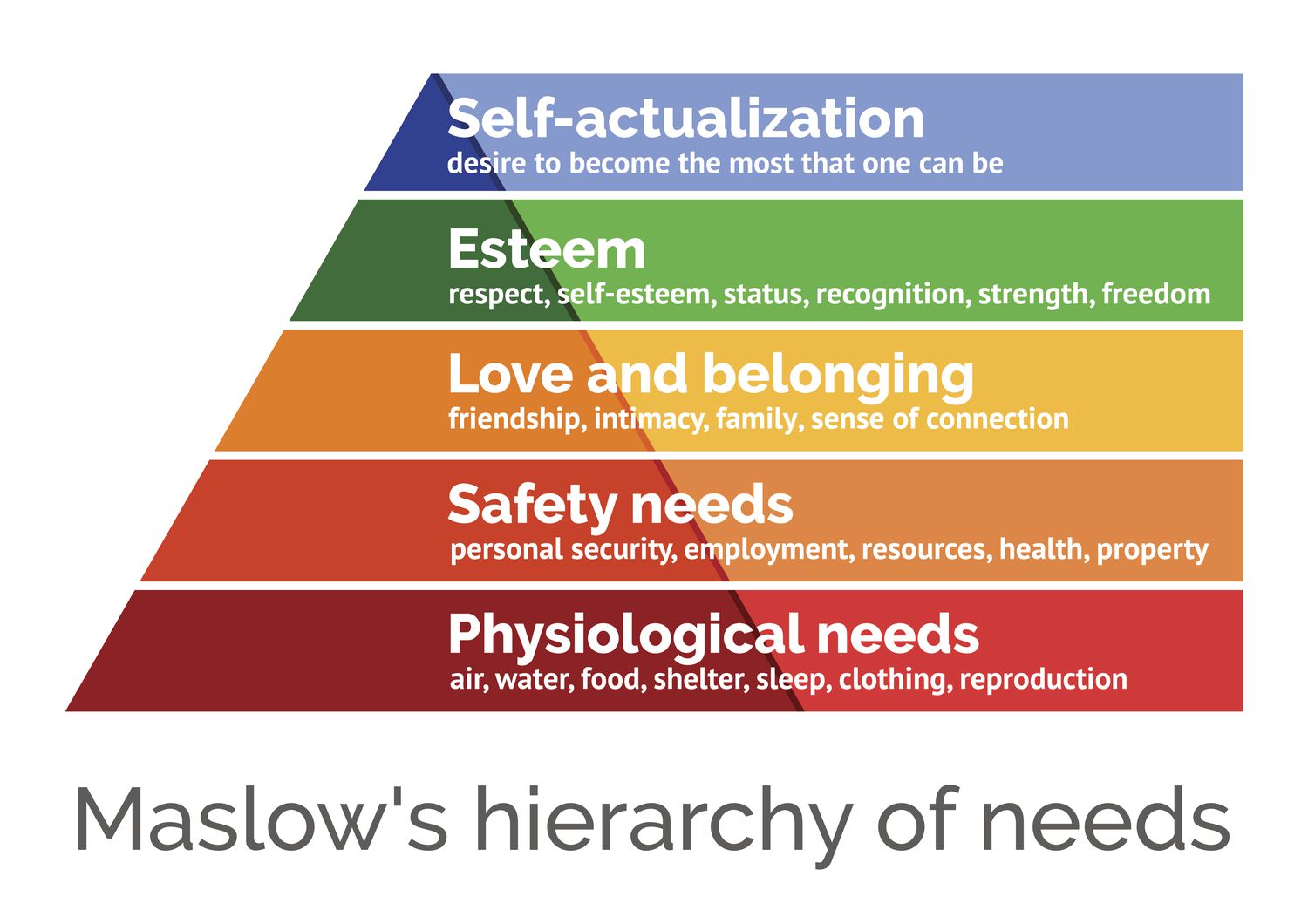
motivation
personal growth is concerned with developing and changing a person to become fulfilled, satisfied and goal orientated
not everyone will manage this and there are important psychological barriers that may prevent a person from reaching their potential
salient needs
at any time only a subset of needs is salient, as those needs are met we start to orient ourselves to those that come next
for various reasons, lower needs may take priority
periods of deprivation can result in a person becoming fixated on needs that are subsequently met, results in neurotic thinking and behaviour
self actualisation
innate tendency to want to achieve our full potential and become our best, people who fulfil their potential, their own needs are met so start looking outward to others
reality centred, problem orientated, non conformist, autonomous
rare people generally recognised as outstanding
what did Carl Rogers believe?
individuals strive to achieve their ideal selves as they are motivated towards self improvement
he felt Freud had dealt with the sick half of psychology so humanistic concerned itself with explanations of healthy growth in individuals, a positive image of the human condition
what were the assumptions of Carl Rogers?
• humans have a basic need to feel nurtured and valued by significant people in their life eg parents, if this is given freely without conditions (unconditional positive regard), people will develop a healthy sense of self worth, recognising their abilities and difficulties
• children who receive negative regard eg criticism and blame develop low self esteem so parents should blame the behaviour not the child
congruence
• a healthy sense of wellbeing is established if an individual maintains a reasonable consistency between ideal self and actual behaviour
• the greater the gap between ideal and actual, the greater the incongruence, can cause low self esteem and maladjustment
effect of defence mechanisms on incongruence
• defence mechanisms, distortion, denial, blocking, can stop the self from growing and changing and widen the gap between ideal and actual
• we defend ourselves from the effects of incongruity by denying or distorting aspects of reality
• fully functioning people will meet each situation with behaviour that's a unique and creative adaptation to the newness of that moment
conditions of worth
a parent who sets boundaries or limits on their love is storing up psychological problems for their child in the future
client centred therapy (CCT)
• developed by rogers to reduce the gap between ideal and actual
• an effective therapist is able to provide clients with the unconditional positive regard they didn't receive as chidlren
• the whole person should be studied in their environmental context and psychology should study the individual case (idiographic approach) not the average performance of groups (nomothetic)
contribution to society
humanistic's primary application has been to therapy:
• client centred therapy- the client is encouraged to develop positive self regard and overcome the mismatch between perceived, true and ideal self
• Gestalt therapy- helps the client become a 'whole' (Gestalt) person by getting them to accept every aspect of themselves eg by confrontation, dream analysis or role play
Q sort assessment
• developed by Stephenson (1953) and was adapted into CCT by Rogers
• the measurement of a persons congruence/ incongruence is measured by a Q sort, a series of cards each containing a personal statement eg 'is self defeating', 'needs recognition from others' etc, the person sorts them into 'to describe their ideal self' or 'to describe their actual self'
strength- anti reductionist
• humanistic psychologists reject any attempt to break up behaviour and experience into smaller componenets
• they advocate holism- the idea that subjective experience can only be understood by considering the whole person, their relationships, past, present, future etc
• this approach may have more validity than its alternatives by considering meaningful human behaviour within its real world context
counterpoint of anti reductionist
• however, humanistic unlike behaviourism has relatively few concepts that can be reduced to single variables and measured
• means humanistic in general is short on empirical evidence to support it's claims
strength- positive approach
• humanistic psychologists have been praised for promoting a positive image of the human condition, seeing people as in control of their lives and having freedom to change
• Freud saw humans as prisoners of their past and claimed all of us existed somewhere between 'common unhappiness and absolute despair'
• therefore, humanistic offers a refreshing optimistic alternative
limitation- may be guilty of cultural bias
• many humanistic ideas eg self-actualisation would be more associated with individualistic cultures eg the US
• collectivist cultures eg India, which emphasise the needs of the group, may not identify so easily with the ideals and values of humanistic psychology
• therefore, its possible the approach doesn't apply universally and is a product of the cultural context which it was developed
evaluation- limited approach
• critics argue, that compared to other approaches, humanistic psychology has had limited impact within psychology, or practical application in the real world
• however, CCT revolutionised counselling techniques and Maslow's hierarchy of needs has been used to explain motivation, especially in work
• suggests the approach does have value, despite the fact that unlike other approaches, its resolutely anti-scientific
 Note
Note  Flashcards (132)