Biomechanics & Muscles
 Call Kai
 Learn
Learn Practice Test
 Spaced Repetition
 Match
Match Flashcards
 Knowt Play
1/116

There's no tags or description
Looks like no tags are added yet.
Name | Mastery | Learn | Test | Matching | Spaced | Call with Kai |
|---|
No analytics yet
Send a link to your students to track their progress
117 Terms
Organisms in physical world deal with
external and internal loads
Organisms in water have what external loads?
fluid flow
What external loads to organisms on land have?
fluid flow, gravity, muscle force, predation
Force
interaction that alters object’s motion and/or shape
Force Equation
mass x acceleration
Force units
Newton (N) = kgm/s²
What way does structure respond to applied force?
depends on shape and material
Stress
how much force is applied over an area; amount of energy used to deform or move a volume
Stress Equation
Force/ Area
Stress Units
pascals (Pa) = Newtons/m2
How does a material respond to an applied force?
measured by stress
Structures fail (break) when ____ gets too high
stress
Higher the stress, _____ likely to break
more
Increase area, ______ stress
decrease
Types of Load
tension (pull), compression (squish), bending
Tension (Pull) Load
pulling apart molecules; failure likely; ex: Achilles Tendon
Compress (Squish) Load
only happens at very small scale; pushing molecules together; failure unlikely
Bending Load
tension & compression; on opposite sides with neutral axis in middle
What does resistance to bending depend on?
structure & material
How to make a structure better at resisting bending?
put material where stress is highest
Neutral Axis
region of a bending structure where there is no applied load; magnitude of load decreases
Material Properties
stress & strain
Strain
unit-less measure of deformation; %
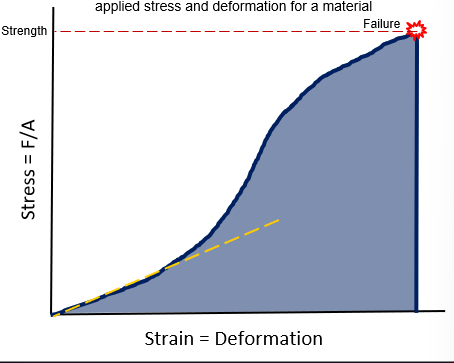
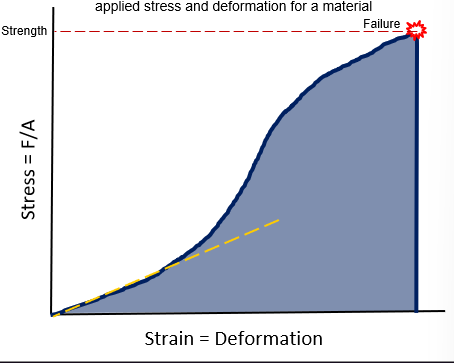
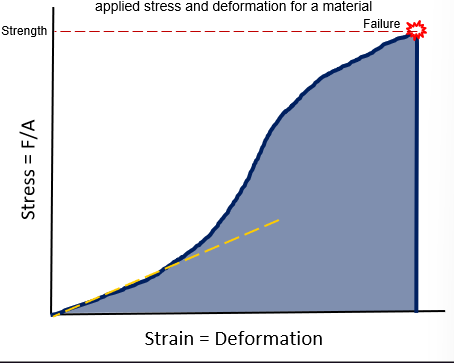
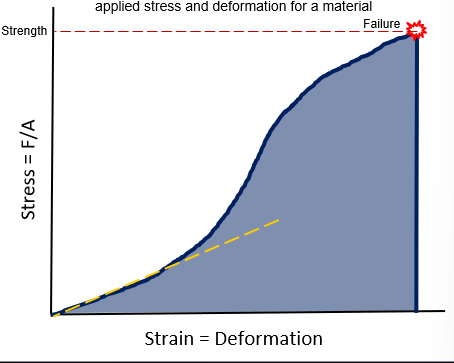
Stress- Strain Curve
show relationship between applied stress and deformation for a material; strain on x-axis and stress on y-axis; has stiffness, strength, and work
Stiffness
Pa; how deformable a material is; yellow dashes
High stiffness, _____ to deform
hard
Low stiffness, ____ to deform
easy
Compliance
inverse of stiffness
High compliance, _____ stiffness
low
Low compliance, ______ stiffness
high
Deformity
how much bending
Strength
Pa; maximum stress; where failure occurs; red dashed line
Work
Pa; area under the curve; work put into the system to deform the material/object; dark blue
External Forces/Loads
gravity, flow (water currents and wind), competitors and predators
Internal Forces
animals use muscles pulling on stiff structures to moveM
Muscle contractions generate
force
Biochemical precursors to muscles
used at cellular level in cell division, amoeboid movements, cytoskeleton
Myocytes
derived from mesoderm; 3 types (cardiomyocytes, gut myocytes, somatic myocytes)
Cardiomyocytes
muscles that power the heart
gut myocytes
smooth muscle that line the gut
somatic myocytes
skeletal muscles used to move the body
Contractile cells
organized into tissues where the cells tend to contract to various degrees together to magnify their individual effects
What groups have muscles?
cnidaria and bilateria
Ductile
deform before failure; not a lot of stress to break
Elastic Deformaiton
stores energy and release to return to original shape; beginning of graph
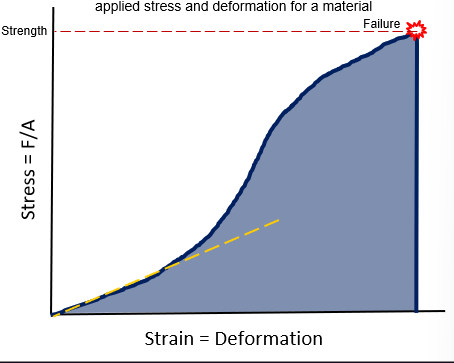
Plastic Deformation
uses energy to permanently change shape; does not return to original form (bent); between yellow and red
Vertebrate Skeletal Muscle
SkM; produces voluntary movments; controlled exogenously; roughly 36-42%of total body mass; modified force output; contains mechanoreceptors
Exogenously
external signals; sometimes nervous system
What does vertebrate skeletal muscle do when fully activated?
dominate metabolism
Vertebrate Skeletal Muscle Force Output
undergo elastic deformation; stores and releases energy
Vertebrate Skeletal Muscle mechanoreceptors
report movement and position
Do vertebrate skeletal muscles have intrinsic activity?
nope; only contracts when commanded by neurons
What is the only tissue in mammals that engages in significant anaerobic metabolism?
skeletal muscle
Origin
anchoring muscle attachment; typically proximal; on other side of a joint from the insertion; little motion
Insertion
mobile muscle attachment; typically distal; on other side of a join from the origin
proximal
closer to the center of the body
distal
further from the center of the body
Tendons
connect muscle to bone; connective tissue dominated by collage and elastin; undergoes elastic deformation
Belly of a muscle
generates force; muscle fibers (SkM cells), stem cells, blood vessels, sensory cells, neurons
Joint
where two bonds meet; some allow motion (hinge & ball-and-socket) and some do not (sutures)
Fascia
the sheet of connective tissue that covers a muscle
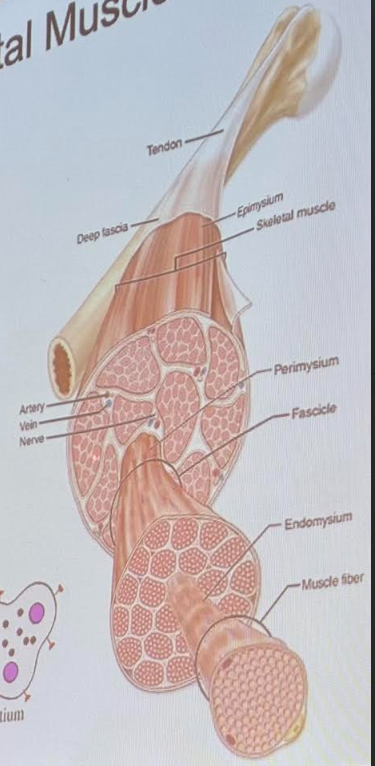
Fascicles
bundles of muscle fibers that make up the belly of a muscle
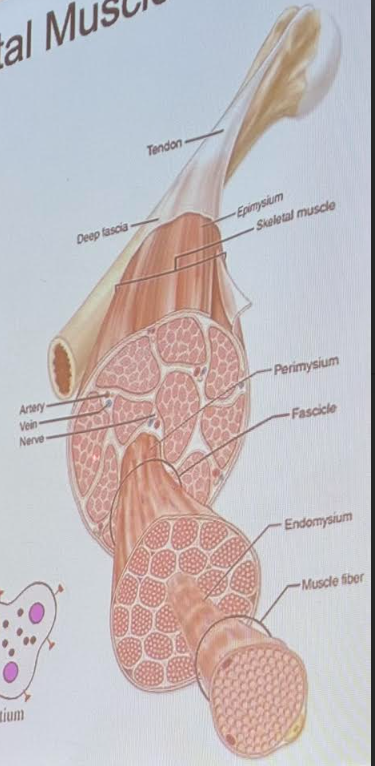
Muscle fibers
multiple myocytes fuse into a large syncytium; inside fascicles; a cell
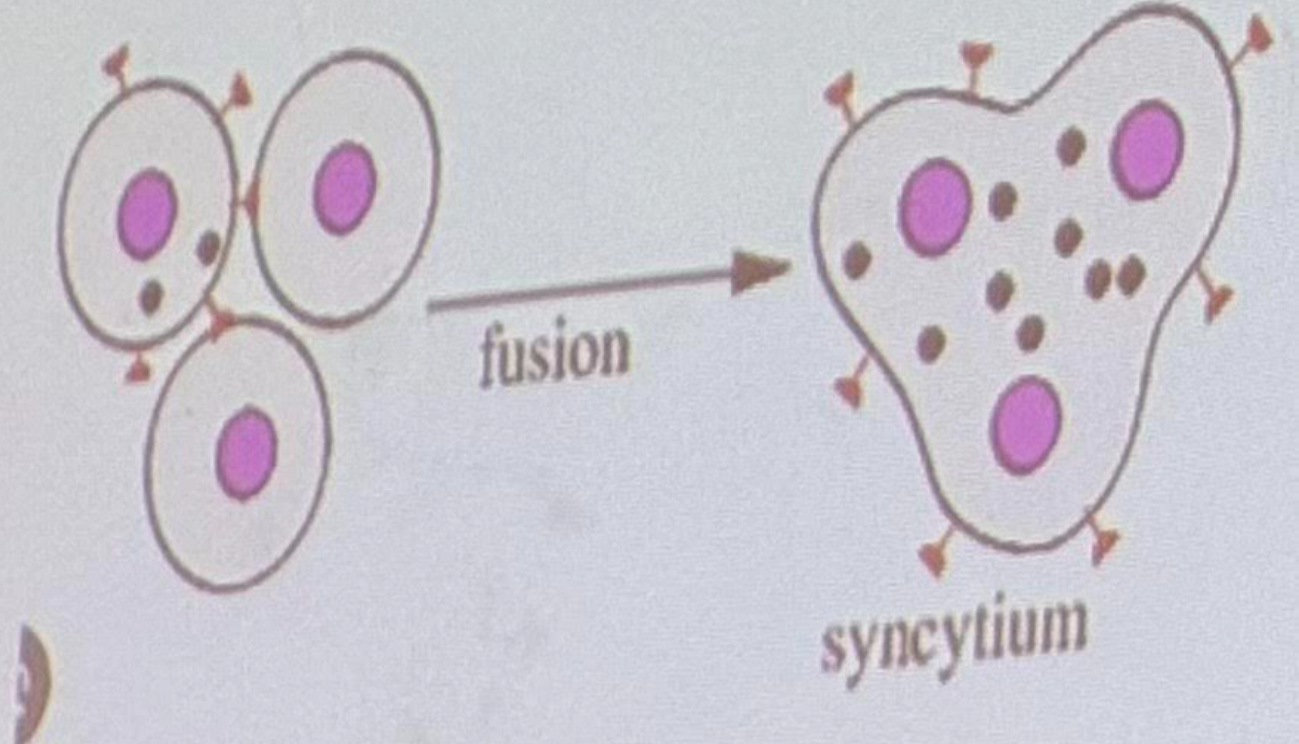
Myocytes
embryonic precursor cells that fused together to form one muscle fiber (single cell); used to be separate cells but fused during development
Muscle Fiber Cytoplasm
lots of mitochondria, extensive membrane system with t-tubules, sarcoplasmic reticulum, and myofibrils
T-Tubules
deep in-folding of plasma membrane; action potential goes down this (gets AP to whole muscle fiber)
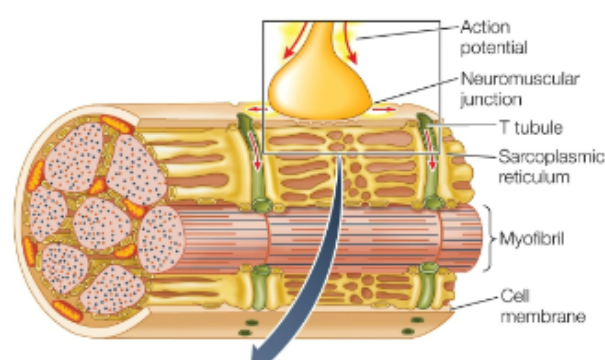
Sarcoplasmic reticulum
modified endoplasmic reticulum; uses ATP to pump Ca2+ in → stores Ca2+; Ca2+ gradient
Myofibrils
strands of sarcomeres
Largest to Smallest Skeletal Muscle Anatomy
muscle organ and tissue, fascicle, muscle fiber (cell), myofibrils, sarcomeres, actin + myosin filaments
Sarcomeres
repeating sections; actin filament and myosin filament
Actin Filaments
pulled by myosin; anchor on Z-disks; proteins that regulate the interactions between myosin and actin; thin; lighter color
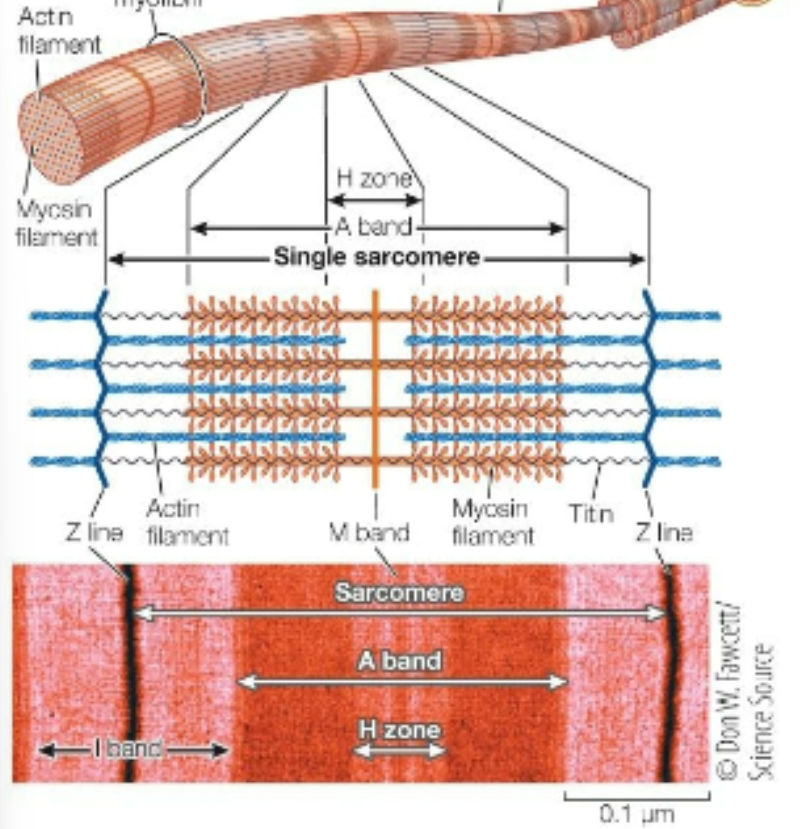
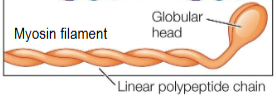
Myosin Filaments
pull actin; anchor on M-line; each has a “head” containing ATPase and actin binding site; bundle together → thick; darker
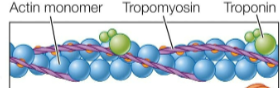
Actin monomers
myosin binding sites; blocked by tropomyosin, held in place by troponin; repeating spheres
Myosin heads
actin binding site; ATP binding site
How do skeletal muscles generate force?
Excitation Contraction Coupling
Excitation Contraction Coupling
receive signal (AP); AP excites cell → release of Ca2+; allows Actin-Myosin bond; cross-bridge cycle & contraction
Neuromuscular junctions
where skeletal muscle action potentials are generated
Receive Signal in Excitation Contraction Coupling
AP on pre-synaptic motor neuron → releases acetylcholine (Ach) across synaptic cleft
AP Excites cell → release of Ca2+ in Excitation Contraction Coupling
Ach binds to receptors on myofibril → Excitatory Post-Synaptic Potentials (EPSPs) → AP → AP travels down T-Tubule, close to sarcoplasmic reticulum → sarcoplasmic reticulum releases Ca2+ → floods cell with Ca2+ ions
Allows Actin-Myosin bond in Excitation Contraction Coupling
released Ca2+ binds to Troponin → changes its shape → moves Tropomyosin off myosin binding sites → clears myosin binding sites
Cross-Bridge Cycle & Contraction in Excitation Contraction Coupling
myosin binds to Actin → release of phosphate → myosin changes shape (bends back toward M-line) → release of ADP from myosin → bind to ATP → release Actin → hydrolysis of ATP → myosin changes shape, ready to bind
Proteins change in shape, depending on
binding partner
Change in affinity (likelihood of binding)
myosin head & ATP/ADP-Pi; Myosin head & Actin
What happens when there is no ATP?
myosin never lets go of actin
What happens when there is no Ca2+?
myosin can’t bind to actin; no contractions
What generates force?
muscle contractions
What happens when myosin heads form cross-bridges with actin filaments and pull?
shortens sarcomere
Small Force
myofibrils composed of thousands of sarcomeres in series → sarcomeres shorten and myofibrils shorten
Large Force
muscle fibers composed of thousands of myofibrils in parallel → myofibrils shorten and pull together
Maximum muscle force scales with
cross-sectional area of the muscle
How do muscles generate different amounts of force?
tetany, recruitment, muscle fiber type, resting fiber length, muscle usage
Tetany
summation of twitches generated by a series of closely spaced action potentials; all or nothing; lasts as long as AP signal
Twitch
single short contraction; single AP
Why do muscles experience fatigue?
muscle is used for too long or too often, using up ATP in the cell; cannot produce as much force
Recruitment
activation of additional motor units yields mroe force
Muscle force depends on the
number of actively contracting muscle fibers
Motor Unit
all the muscle fibers controlled by one neuron
Activation of any motor unit yields
certain amount of force
increase activation of motor units, _____ force
larger
maximum force
all motor units activated; proportional to muscle x-section area

