B2.2 - The Challenges of size (AI generated with instructions by me)
 Call Kai
 Learn
Learn Practice Test
 Spaced Repetition
 Match
Match Flashcards
 Knowt Play
1/53

There's no tags or description
Looks like no tags are added yet.
Name | Mastery | Learn | Test | Matching | Spaced | Call with Kai |
|---|
No analytics yet
Send a link to your students to track their progress
54 Terms
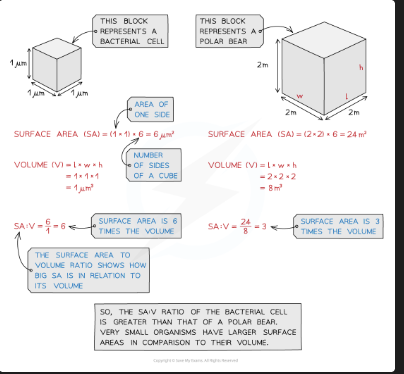
What happens to SA:V ratio as an organism gets larger?
As size increases, SA:V ratio DECREASES — less surface area relative to volume, so diffusion alone is insufficient
Why do single-celled organisms not need a transport system?
High SA:V ratio means diffusion distance to all areas is short — substances can exchange across the cell membrane fast enough
Why do multicellular organisms need transport systems?
Low SA:V ratio means diffusion alone is too slow — substances can't reach all cells quickly enough without a circulatory system
What are the three transport processes living organisms use?
Diffusion, osmosis and active transport
How do you calculate surface area to volume ratio for a cube?
SA = 6 × (side length)². Volume = (side length)³. SA:V = SA ÷ volume
What is Fick's Law?
Rate of diffusion = (surface area × concentration gradient) ÷ diffusion distance
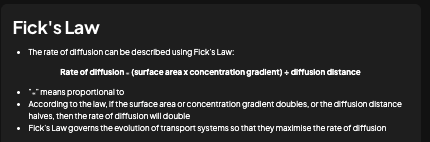
What are the four factors that affect rate of diffusion and how?
Surface area (bigger = faster). Concentration gradient (steeper = faster). Diffusion distance (shorter = faster). Temperature (higher = faster — more kinetic energy)
What are the properties of an efficient exchange surface?
Large surface area. Thin barrier (short diffusion distance). Well ventilated to maintain concentration gradient. Good blood supply to maintain concentration gradient
What substances must organisms take in?
Oxygen (respiration), water, dissolved food molecules, minerals
What waste substances must organisms remove?
Carbon dioxide and urea — if they build up they become toxic
What are examples of exchange surfaces in animals?
Lungs and alveoli (gas exchange). Small intestine and villi (absorption of digested food)
What are examples of exchange surfaces in plants?
Roots and root hair cells (mineral ions and water). Leaves (gas exchange via stomata)
What are the adaptations of alveoli as an exchange surface?
Millions of alveoli = huge surface area. Walls are one cell thick = short diffusion distance. Rich capillary network = maintains concentration gradient. Well ventilated = maintains concentration gradient
What are the adaptations of villi as an exchange surface?
Highly folded surface = large surface area. One cell thick walls = short diffusion distance. Rich blood supply = maintains concentration gradient
What is the double circulatory system?
Two circuits joined together: pulmonary circuit (heart → lungs → heart) and systemic circuit (heart → body → heart)
What are the advantages of a double circulatory system?
Blood loses pressure in lung capillaries — returning to the heart allows pressure to be raised again before sending to the body, so oxygenated blood reaches organs faster
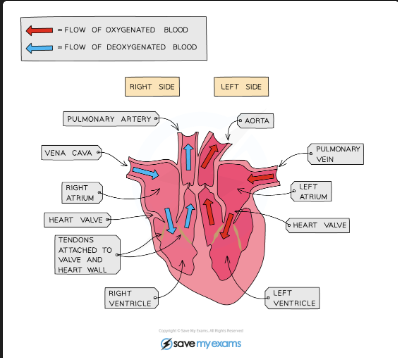
What are the four chambers of the heart?
Right atrium, left atrium, right ventricle, left ventricle — atria receive blood IN, ventricles pump blood OUT
Which side of the heart pumps deoxygenated blood and which pumps oxygenated?
Right side → pumps deoxygenated blood to lungs via pulmonary artery. Left side → pumps oxygenated blood to body via aorta
What is the role of valves in the heart?
Prevent the backflow of blood — ensure blood flows in one direction only
What is the pathway of blood through the heart?
Deoxygenated blood → vena cava → right atrium → right ventricle → pulmonary artery → lungs → oxygenated blood → pulmonary vein → left atrium → left ventricle → aorta → body
What is the role of the coronary arteries?
Supply the heart muscle itself with oxygenated blood — branch off the aorta
Why does cardiac muscle never get tired?
Contains far more mitochondria than skeletal muscle and has its own constant blood supply via the coronary arteries — never fatigues
What are the three types of blood vessel?
Arteries, veins and capillaries
What are the features and function of arteries?
Carry blood AWAY from heart at HIGH pressure. Thick muscular walls with elastic fibres to stretch and recoil. Narrow lumen. No valves
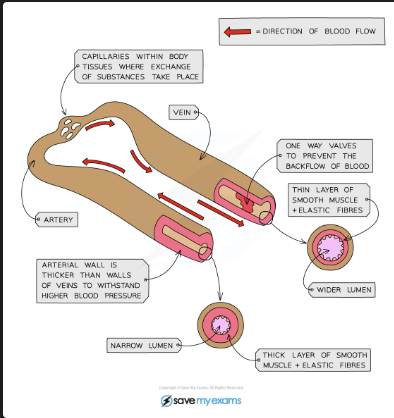
What are the features and function of veins?
Carry blood TOWARDS heart at LOW pressure. Thin walls. Wide lumen. Contain valves to prevent backflow
What are the features and function of capillaries?
Supply blood to tissues. One cell thick walls = short diffusion distance. Permeable walls — plasma leaks out to form tissue fluid. Very slow blood flow allowing time for exchange
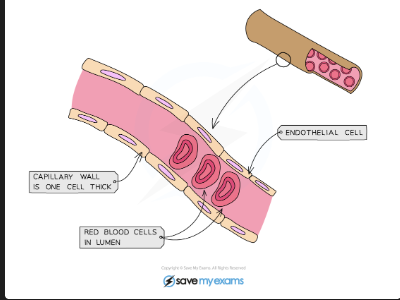
What is blood composed of?
~55% plasma. ~45% red blood cells. Small amounts of white blood cells and platelets
What is the function and structure of red blood cells?
Carry oxygen using haemoglobin. Biconcave disc shape = large SA:V for diffusion. No nucleus = more space for haemoglobin. Small and flexible to squeeze through capillaries
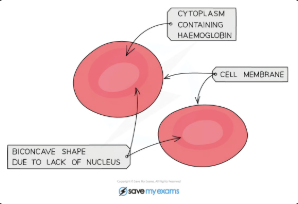
What is haemoglobin and what does it do?
A protein in red blood cells that binds to oxygen in the lungs to form oxyhaemoglobin, then releases oxygen at body tissues
What is the function of white blood cells?
Part of the immune system — defend the body against pathogens by engulfing them (phagocytosis) or producing antibodies
What is the function of platelets?
Small cell fragments that help blood clot at wounds — prevents blood loss and entry of pathogens
What is plasma and what does it transport?
Straw-coloured liquid that transports: red/white blood cells and platelets, water, carbon dioxide, digested food, urea, hormones, antibodies and heat
How do root hair cells absorb water?
By osmosis — soil water has a higher water potential than root hair cell cytoplasm so water moves in by osmosis
How do root hair cells absorb mineral ions?
By active transport — mineral ion concentration is lower in soil than in root hair cells so they move against the concentration gradient (requires energy from ATP)
Why are root hair cells well adapted for absorption?
Long thin extensions increase SA:V ratio significantly — maximises contact with soil particles and absorption surface
What is transpiration?
The loss of water vapour from leaves by evaporation from mesophyll cells and diffusion out through the stomata
What drives the transpiration stream?
Water evaporates from leaves → water is drawn up the xylem from roots to replace it → creates a continuous transpiration stream from roots to leaves
What are stomata and what controls them?
Tiny pores mainly on the underside of leaves that allow gas exchange. Controlled by guard cells
How do guard cells open and close stomata?
Water available → guard cells absorb water by osmosis → become turgid → stomata OPEN.
Water scarce → guard cells lose water → become flaccid → stomata CLOSE
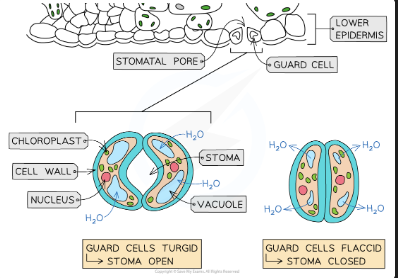
Why do stomata open in light and close in the dark?
In light, guard cells become turgid → stomata open for photosynthesis. In dark, stomata close to conserve water as no photosynthesis occurring
What is translocation?
The active transport of dissolved sugars (sucrose) and amino acids through the phloem — moves from source (leaves) to sink (roots/growing regions)
What is the direction of translocation?
Both up and down the stem — direction depends on season and plant requirements (e.g. early spring: root → leaves; summer: leaves → roots)
What is the structure of xylem vessels?
Dead cells joined end to end with no cell contents and no end walls — forms hollow tube. Walls strengthened with lignin making them waterproof and stiff
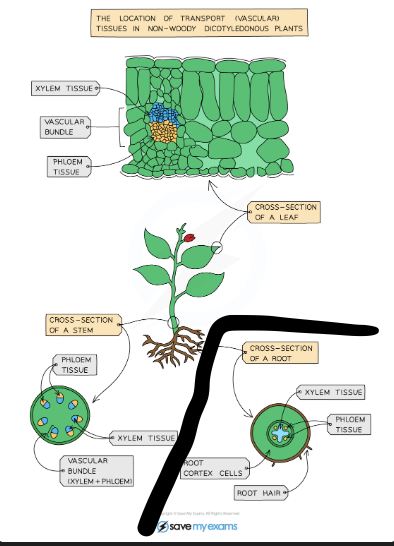
What does xylem transport and in which direction?
Water and mineral ions — ONE direction only from roots to leaves (transpiration stream)
What is the structure of phloem?
Living sieve tube elements joined end to end with sieve plates (holes). Supported by companion cells which carry out living functions for sieve tube cells (which have no nucleus)
What does phloem transport and in which direction?
Dissolved sugars (sucrose) and amino acids — in ALL directions both up and down the stem
Compare xylem and phloem
Xylem: water + minerals, transpiration, one-way roots→leaves, dead cells. Phloem: sucrose + amino acids, translocation, all directions, living cells
What are the four factors that affect the rate of transpiration?
Air movement, humidity, light intensity, temperature
How does each factor affect transpiration rate?
Air movement high → faster (removes water vapour, maintains gradient). Humidity high → slower (less concentration gradient). Light intensity high → faster (stomata open wider). Temperature high → faster (more kinetic energy, faster evaporation)
What is a potometer used for?
Measuring the rate of water uptake by a plant as an indicator of transpiration rate
What are the two types of potometer?
Mass potometer: measures change in mass of plant as water evaporates. Bubble potometer: measures movement of air bubble along capillary tube as water is taken up
What is the formula for rate of transpiration using a bubble potometer?
Rate of transpiration = distance moved by air bubble (m) ÷ time (min)
[PRACTICAL] Bubble potometer — write the full method
Cut shoot underwater to prevent air entering xylem.
Assemble potometer underwater to avoid air bubbles — seal all joints with Vaseline.
Dry the leaves of the shoot.
Remove capillary tube from water to allow one air bubble to form, place back in water.
Set up lamp 10cm from leaf.
Allow plant to adapt to new environment for 5 minutes.
Record starting position of air bubble.
Leave for 30 minutes.
Record end position and calculate distance travelled.
Calculate rate = distance ÷ time.
Repeat with changed variable (e.g. move lamp closer for higher light intensity). To investigate humidity: spray water in plastic bag around plant. To investigate airflow: set up fan/hairdryer
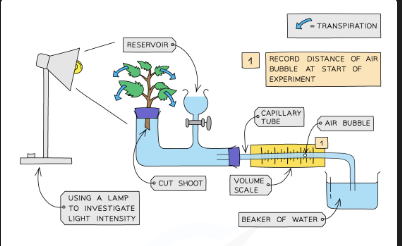
What are three limitations of the potometer experiment and solutions?
Equipment leaks → ensure all joints sealed tightly with Vaseline. Plant cutting has blockage → cut and assemble underwater. Transpiration slows if cuttings left too long → use fresh cuttings immediately and use as soon as cut

