Chainsaw VS Pampass Grass 🌾 - Simon Armitage
 Studied by 2 people
 Call Kai
 Learn
Learn Practice Test
 Spaced Repetition
 Match
Match Flashcards
 Knowt Play
1/9

There's no tags or description
Looks like no tags are added yet.
Name | Mastery | Learn | Test | Matching | Spaced | Call with Kai |
|---|
No analytics yet
Send a link to your students to track their progress
10 Terms
Summary of Chainsaw vs Pampass Grass
"Chainsaw vs. the Pampas Grass" is a poem by Mark Tredinnick that explores the conflict between human intervention (the chainsaw) and nature (the pampas grass). The chainsaw represents destructive human power, while the pampas grass symbolizes nature’s resilience. The poem reflects on the irony of trying to control nature, suggesting that nature often finds a way to persist, even in the face of human efforts to dominate it.
Structure of Chainsaw vs Pampass Grass
8 irregular stanzas and length lines, that finish with end-stopped lines.
May give sense of opposition, as if the two elements are in conflict.
Prevents fluidity of the poems which is perhaps the representative of how humans create and force unnatural barriers and structures, like the chainsaw attempted to do with the Pampas Grass.
Mimic the way a chainsaw functions, as the lack of regular scheme creates an unsteady reading experience
Free verse: freedom of the pampas grass
Vivid imagery and personification: The poem uses descriptive language and personification, giving the pampas grass human-like qualities to enhance the emotional weight of the battle.
Juxtaposition: The structure alternates between descriptions of the chainsaw and the pampas grass, emphasizing the conflict between human control and nature’s resistance.
Themes of Chainsaw Vs Pampass Grass
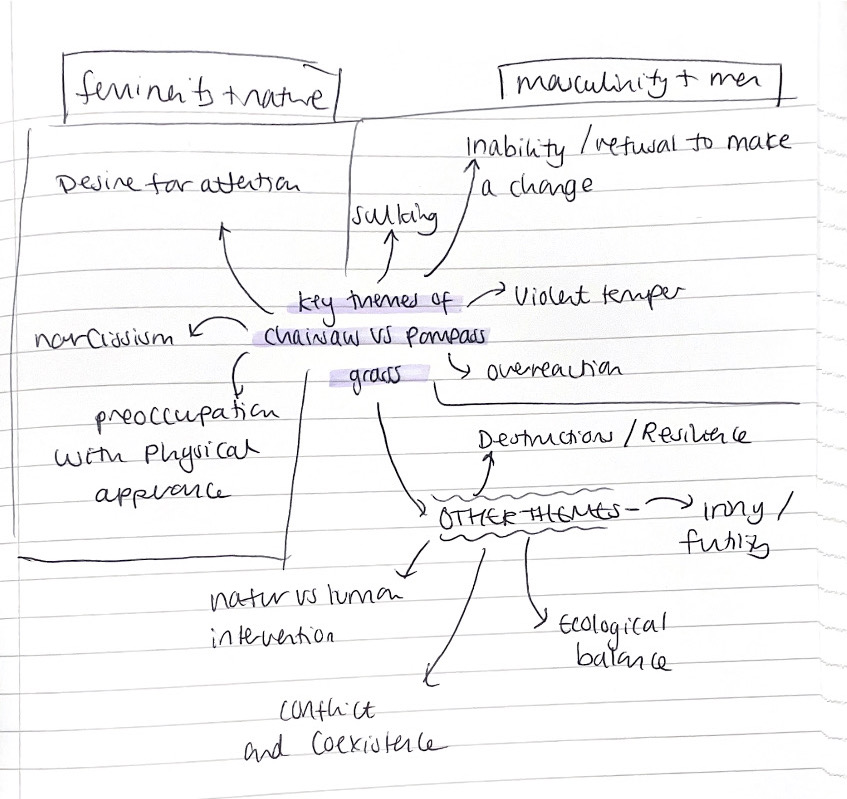
Title of Chainsaw vs Pampass grass-
directly reflects the central conflict of the poem: a struggle between human intervention (represented by the chainsaw) and nature (symbolized by the pampas grass). “Chainsaw” and “Pampass Grass” with is supported in the opening line “it seemed an unlikley match”
It sets up an immediate image of opposition, suggesting a battle or contest between these two forces.
The title’s use of "vs." emphasizes the antagonistic relationship and could also be read as a commentary on humanity's often combative approach to nature, framing the poem as a kind of confrontation or clash.
It also hints at the theme of futility, as both forces are locked in a conflict that doesn't necessarily have a clear victor.
Suggestive of a match or game - poem is describing a sporting match between chainsaw to the fragile grass: famously a symbol of fragility - therefore match would be nothing sportsmanlike about taking a powerful chainsaw to some fragile grass
Tone of Chainsaw Vs Pampass Grass-
Ironic:
struggle between the chainsaw and the pampas grass in a way that highlights the futility or absurdity of the conflict.
Even as the chainsaw seems to have the upper hand, the pampas grass persists, suggesting that nature has a resilience that human efforts can’t easily overcome.
Playful:
The personification of the pampas grass and the almost comical, exaggerated "battle" between the two forces give the poem a sense of playfulness, as though it is winking at the reader about the often ridiculous nature of human attempts to dominate the environment.
Title- suggests a sort of match or game (the ‘match’ idea is confirmed in the poem’s first line, and later we read that ‘this was a game’), as if the poem is describing a sporting match between the saw and the grass. In reality, there is nothing sportsmanlike about taking the powerful chainsaw to the fragile grass: famously, a symbol of frailty – ‘all flesh is grass’, as one Biblical phrase has it. This ‘match’ motif succeeds in downplaying the seriousness behind the poem but also the unevenness between the two ‘competitors’
Frustrated/Resigned:
Underneath the humour and irony, there’s a sense of frustration or resignation about the human inability to fully control nature.
The chainsaw, representing human agency, might have power, but nature (represented by the pampas grass) is not so easily defeated.
Violent/aggressive:
The use of violent imagery adds to the aggressive tone
“blood desire” and “gargle” - intense tone supported by the gruesome imagery
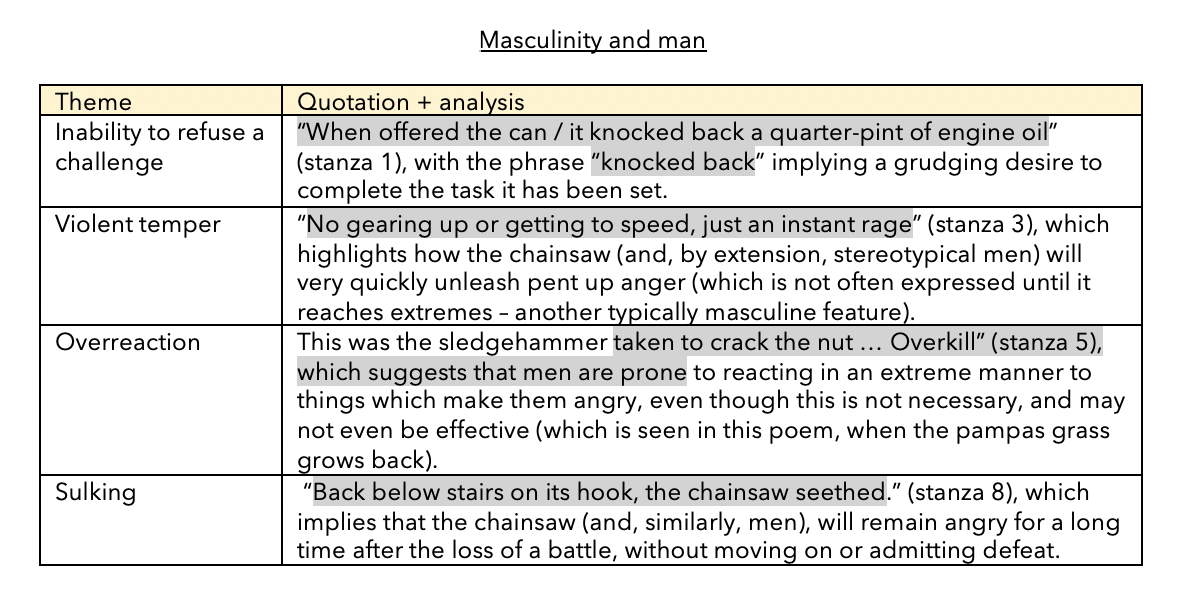
Quotes for Masculinity and Men within the poem-
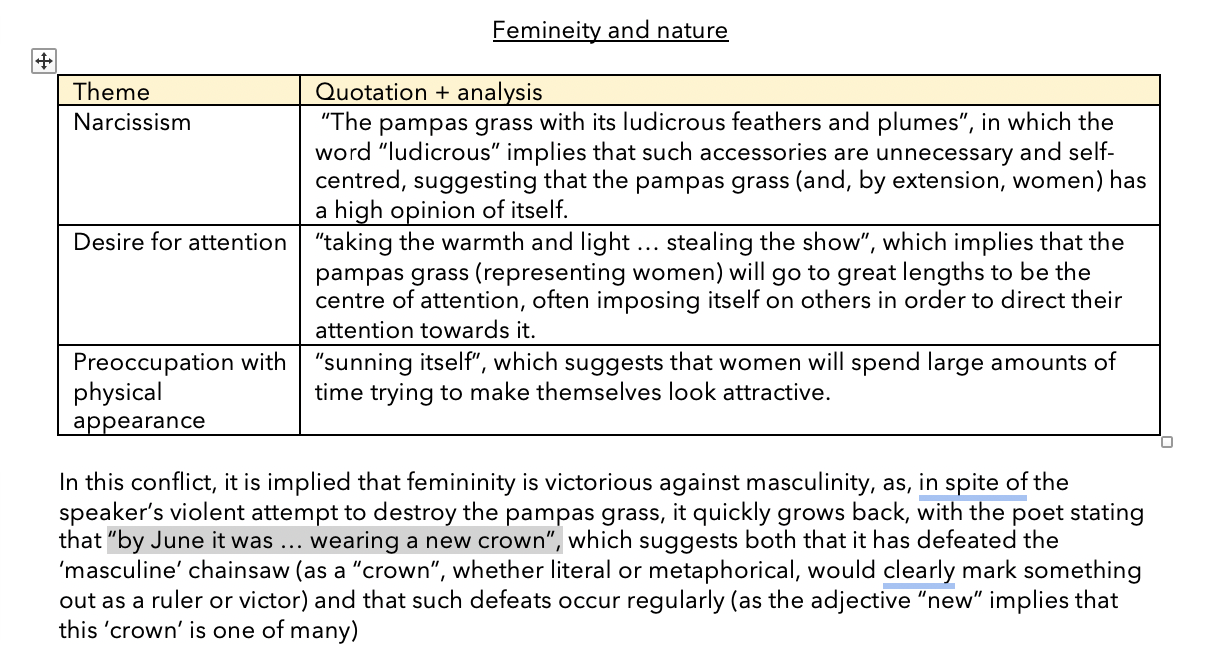
Quotes for Feminity and Nature within the poem-
Discuss the theme of destruction and power in "Chainsaw vs Pampas Grass". How does Simon Armitage use imagery and contrast to explore these themes?
the ‘Chainsaw’ as a symbol of destruction and power:
The chainsaw is a tool of destruction, associated with brute force and violence.
Right from the title, "Chainsaw vs Pampas Grass", the conflict is framed as a battle between human control and the natural world.
The chainsaw is given almost an animalistic or aggressive quality, “revving its engine,” like an uncontrollable beast.
The machine is personified, suggesting that it has a mind of its own.
This imagery of the chainsaw roaring and dominating sets up the human-driven destruction of nature.
"The chainsaw revs, its blade a long scar"—the chainsaw is depicted almost as a predator with a sharp, slicing weapon, emphasising its power to harm or alter its environment with no regard for the life that it cuts through.
use of graphic imagery “blood desire”
hard and plosive consonants create a sense of anger and aggression “back to the socket and flicked the switch”
This sets up the chainsaw’s destructive force, a metaphor for humanity’s ability to impose its will on the world.
the contrast between the ‘Chainsaw’ and the ‘Pampas Grass’ with the grass becoming a symbol of resistance:
In contrast to the chainsaw, the pampas grass represents nature’s beauty and resilience. At first, it might appear weak or passive, especially when the chainsaw is introduced.
Armitage also hints at the grass’s power in its resistance to destruction. The grass may be cut down, but it has a way of growing back or reclaiming space.
In the poem, the pampas grass is described almost with a sense of defiance and vitality. It "hurls" or "dances" in the wind, suggesting that it still holds a kind of natural power even as it is cut or controlled.
The blades of the grass, which are "sharp," also reflect a hidden strength in nature, suggesting that its destruction isn’t as simple as it might seem.
This juxtaposition between the chainsaw’s raw power and the seemingly delicate nature of the grass reflects the paradox of human control over nature—it’s never a one-sided victory.
How does Simon Armitage use personification in "Chainsaw vs Pampas Grass"? What effect does this have on the reader's interpretation of the poem?
In Simon Armitage's "Chainsaw vs Pampas Grass", personification plays a key role in creating vivid imagery and giving life to inanimate objects, which enhances the emotional weight of the poem.
Chainsaw being personified as being a toxically masculine man
Armitage uses personification to portray both the chainsaw and the pampas grass as characters with intentions, personalities, and desires.
QUOTES: “instant rage” + “overkill” - ironic bc the chainsaw is being used it does not feel these emotions itself
QUOTES: when offered the can/it knocked back a quarter-pint of engine oil”
QUOTES: “no gearing up or getting to speed, just an instant rage” - which highlights how the chainsaw (and by extension, stereotypical men” will very quickly unleash pent-up anger - which is not often expressed until it reaches extremes - another typically masculine feature)
Pampas Grass being a stereotypical woman or could symbolise nature on a wider basis
Armitage also uses personification for the portrayal of the pampas grass with the nacirissim created with “The pampas grass with its ludicrous feathers and plumes”, in which the word “ludicrous” implies that such accessories are unnecessary and self-centred, suggesting that the pampas grass (and, by extension, women) has a high opinion of itself.
show a desire for attention “taking the warmth and light … stealing the show”, which implies that the pampas grass (representing women) will go to great lengths to be the centre of attention, often imposing itself on others to direct their attention towards it.
shows a preoccupation with physical appearance with “sunning itself”, which suggests that women will spend large amounts of time trying to make themselves look attractive.
In this conflict, it is implied that femininity is victorious against masculinity, as, in spite of the speaker’s violent attempt to destroy the pampas grass, it quickly grows back, with the poet stating that “by June it was … wearing a new crown”, which suggests both that it has defeated the ‘masculine’ chainsaw (as a “crown”, whether literal or metaphorical, would clearly mark something out as a ruler or victor) and that such defeats occur regularly (as the adjective “new” implies that this ‘crown’ is one of many)
In "Chainsaw vs Pampas Grass", Armitage presents a conflict between nature and technology. How does the poet convey the violence of this struggle, and what might he be suggesting about human impact on the natural world?
the use of personification in the poem not only enhances the reader's engagement with the narrative, but also deepens the poem's exploration of human nature, the environment, and the consequences of our actions. The humanization of the chainsaw and the pampas grass forces the reader to reflect on how we assign meaning and value to both natural and man-made forces and the complexities that arise when these forces collide.
Imagery and Language of Violence:
Armitage uses harsh, violent imagery to convey the chainsaw's destructive force.
Descriptions like the chainsaw being a "hungry beast" evoke a sense of predatory aggression. T
he chainsaw is not simply cutting the grass; it is consuming it, attacking it with ferocity. This predatory language suggests that technology, in its unchecked power, does not just alter nature—it dominates and destroys it.
The image of the chainsaw “growl[ing]” and the way it is described as having a "roar" conveys a sense of primal, animalistic aggression, which contrasts sharply with the delicate, peaceful nature of the pampas grass. Armitage’s choice of such animalistic and violent verbs makes it clear that this isn’t a gentle pruning; it's a forceful act of violence.
The Conflict:
The pampas grass, in contrast, is portrayed almost as a victim. It's "huddling" and "surrendering," with its tall, feathery plumes symbolizing a fragile, peaceful part of nature that is being overpowered by a mechanical, human-made force. Armitage describes the plant as being defenseless, its beauty and tranquility starkly contrasted with the chainsaw’s brutality.
The personification of the chainsaw as a "beast" and the pampas grass as a "wounded" entity deepens the sense of violence, as if the chainsaw is an aggressor and the grass, a helpless victim.
The violence is not just physical but also symbolic of the way human technology intrudes upon the natural world. This struggle is not just about cutting grass—it's about the broader human tendency to exploit and manipulate nature for our own purposes, often without regard for the consequences.
Human Impact on Nature:
Armitage seems to be suggesting that technology, once in motion, acts with little regard for the balance of the natural world.
The chainsaw, as a tool of human construction, represents mankind’s dominance over nature. The violence of the struggle suggests that humanity’s impact on the environment is not subtle or gentle; it is forceful and destructive.
There is also a sense of inevitability in the poem. Despite the beauty and elegance of the pampas grass, it is "cut down" and "defeated" by the chainsaw.
This could be Armitage's comment on how, despite the beauty and resilience of nature, human interference often leads to its destruction, whether through industrialization, deforestation, or other forms of environmental exploitation.
In conclusion, Armitage uses the violent imagery of a chainsaw cutting through pampas grass to explore the destructive relationship between nature and technology. The personification of both the chainsaw and the grass amplifies this struggle, suggesting that humanity’s technological advancements often come at the expense of the natural world. The poem might be urging readers to recognize the brutality of our impact on the environment and to consider the cost of unchecked human progress.

