Wrong PPQs
 Call Kai
 Learn
Learn Practice Test
 Spaced Repetition
 Match
Match Flashcards
 Knowt Play
1/6

Earn XP
Name | Mastery | Learn | Test | Matching | Spaced | Call with Kai |
|---|
No analytics yet
Send a link to your students to track their progress
7 Terms
Describe 2 differences between DNA in prokaryotic cells and DNA in eukaryotic cells [2]
Any two from the following:
Prokaryotes have short DNA / eukaryotic DNA is long [1 mark]
Prokaryotes have circular DNA / eukaryotic DNA is linear [1 mark]
Prokaryotes have one molecule of DNA/ eukaryotes have more than one [1 mark]
Prokaryotic DNA is not associated with proteins / eukaryotic DNA are associated with proteins (histones) [1 mark]
Prokaryotic DNA does not have non-coding DNA/ eukaryotic DNA has introns (non-coding DNA within genes) and non-coding multiple repeats between genes [1 mark]
A gene is a small section of DNA. State what a gene codes for. [1]
Any one from:
The amino acid sequence of a protein/polypeptide; [1 mark]
A functional RNA product OR ribosomal RNA (rRNA) OR transfer RNA (tRNA); [1 mark]
Explain why the genetic code is described as being universal. [1]
In all organisms / DNA, the same triplet codes for the same amino acid [1 mark]
Name the two non-coding regions of eukaryotic nuclear DNA [2]
Introns [1 mark]
Multiple repeats [1 mark]
State why it is possible for a gene from one organism to be introduced into and function in a different organism [1]
The genetic code is universal [1 mark]
![<p>Name the structures labelled X, Y and Z in Figure 2 [3] </p>](https://assets.knowt.com/user-attachments/8a417f19-996b-49e5-bd96-cb4fb4d2cea5.png)
Name the structures labelled X, Y and Z in Figure 2 [3]
X = RNA polymerase; [1 mark]
Y = DNA; [1 mark]
Z= mRNA: [1 mark]
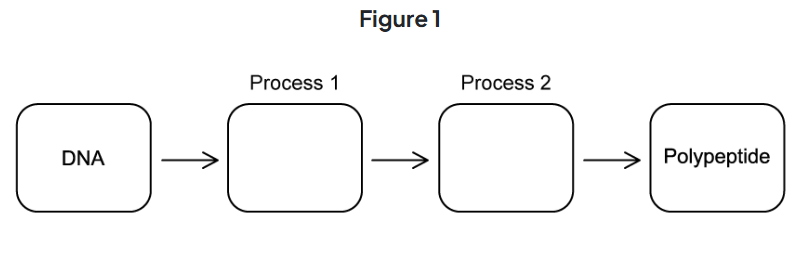
Figure 1 below represents a model for the production of a polypeptide.
Name and outline what occurs in:
i) Process 1
ii) Process 2
i) Transcription: [1 mark]
Any two of the following:
Production of a mRNA molecule that is complementary to a section of DNA; [1 mark]
It occurs in the nucleus; [1 mark]
Involves RNA polymerase: [1 mark]
ii) Translation: [1 mark]
Any two of the following:
Genetic code on the mRNA is converted into a polypeptide chain; [1 mark]
Occurs in the cytoplasm: [1 mark]
Requires a ribosome, tRNA and amino acids; [1 mark]
Explore top notes

Explore top flashcards
