Lecture 28 - Mercury and Venus
 Studied by 0 people
 Call Kai
 Learn
Learn Practice Test
 Spaced Repetition
 Match
Match Flashcards
 Knowt Play
1/18

Earn XP
Description and Tags
ASTR 1210 (Exam 3)
Name | Mastery | Learn | Test | Matching | Spaced | Call with Kai |
|---|
No analytics yet
Send a link to your students to track their progress
19 Terms
Where did the water on Mars go?
Light was able to destroy water molecules in the Martian atmosphere - IMPORTANT
Light and particles that passed into the Martian atmosphere - energy snacked into those particles to vibrate and rotate and destroy it - photo ionization or photo disassociation
Earth is surviving because we have a strong magnetic field that protects water from harmful chemicals and reacts entering Earth’s atmosphere
Some of it became trapped beneath the surface
Now frozen in the polar regions
See evidence of seasonal melt (stratification of rocks)
See some water erosion (beneath the surface)
Ice caps spectroscopically show a lot of ice water — there is water ice beneath the dry ice
Mercury
Densest of terrestrial worlds - denser than Earth!
Much smaller than Earth
Rotates incredibly slow
Distance from Sun 0.39 AU
Period 87.97 days
Can affect surface of Mercury and its characteristics
No source resupplying heat - geologically dead
Orbital inclination 7.0 degrees
Orbital eccentricity 0.206
Mass 0.055 M_Earth
Density 5.43 gm/cm³
Rotation period 58.6 days
What do we know about Mercury?
Two spacecrafts sent to Mercury — images require you to go to planets
Images we have 10s of years old
We have to observe from the Earth
Takes a lot of money to send spacecrafts to each planet
We see phases from Earth
Closer to us: crescent
Further from us: full
Always near the Sun - hard to see with own naked eye - only seen from greatest elongation from Sun (couple of degrees)
Need clear horizon to see Mercury
Transit of Mercury - passes in front of Sun
See it for a couple of times
Highlands and craters
What are some similarities and differences between the Moon and Mercury?
Maria on Moon - lava planes
Created flat dark regions
Mercury has less of those - less flat planes/less lava planes
Lava can’t seep out as easily
Mercury didn’t have thin side to make more lava planes
Moon forming near Earth made near side thinner, and far side thicker
Near side has more lava planes
Mercury didn’t have tectonic activity
No volcanoes, mountain ranges
Topography of Mercury’s Northern Hemisphere
Lowest crater to highest peak - height difference is 6 miles/10 km
Mount Everest is 5 miles
10 Km difference on MercuryMerc is less than height difference between lowest and highest place of Earth
Mt Everest reaches about 9 km off surface and Mariana Trench is about 11 km beneath surface for 20 km difference
Because less tectonically activity than Earth (Mercury)
Mercury
Has a very large iron core (about 65% of mass of the planet)
Besides Earth, it is the second most dense
Small magnetic field - smaller than Earth but not 0
Although Mercury has large iron core, geologically dead and the planet is small - should’ve cooled off
Because Mercury in inner solar system, it got chipped away or smacked against
Maybe planetesimals near Sun are made of Iron and Nickel?
Cratering of Mercury
Has heavily cratered and smooth regions like Moon
Smooth regions are likely ancient lava flows
Pretty big craters - entire crater is bigger than Cville
Large cliffs on Mercury
Tectonics on Mercury
Cliffs suggest tectonic activities
Mercury might’ve shrank to create steep cliffs
A little like tectonic activity
Should see stretch marks
Mercury
Closest planet to the Sun - Sun tries to tidally lock Mercury (one face always towards it)
Significantly slowed Mercury’s rotation
Takes 2 Mercury years for it to fully turn once with respect to Sun
Impacts temp on day side of Mercury vs night side
Spend Mercury year in darkness, Mercury year in day
Night: super cold
Day: super hot
No atmosphere - can’t bring energy from one side to other (like Earth with wind)
MESSENGER
10 years since we had spacecraft orbiting Mercury (MESSENGER)
Mariner 10 orbited Mercury 50 years ago
Closest to sun - hard to get stable orbit from Earth to interior of solar system
Easier to go to the farther side
Flow by Venus until it zipped by Mercury, creating some of the images
Venus
Next most traveled to planet behind Mars (not counting Earth and Moon)
Traveled to about 40 times
Distance from Sun 0,72 AU
Can only see atmosphere of Venus
Period 224.7 days
Orbital inclination 3.4 degrees
Close to density of Earth
Less massive
Orbital eccentricity 0.007
Year on Venus is shorter than day on Venus
Rotates wrong direction
Super slow rotation
Diameter 12,104 km =7,521.0769 mi 0.95 diameter of Earth
Mass 0.82 Mass of Earth
Density 5.24 gm/cm³
Rotation period = 243.0 days
What geological processes have shaped Venus?
Shadow volcanos
Volcanically active Earth
Stratovolcanoes
Has atmosphere
How can we study the surface features of Venus?
Cannot see thru atmosphere (thick) - much thicker than Earth
Send some light
Bounce radar off its surface to spacecraft
Create radio waves
Limited with resolution you see on Venus
Shoot infrared light and back - sees how long it takes to smack into different parts of planet and back
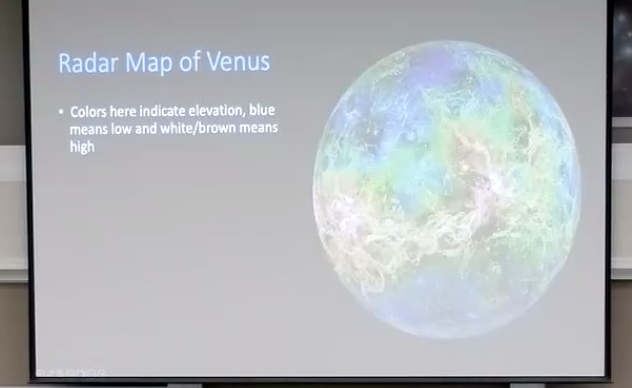
Topographic map of Venus - see a bunch of radio light or infrared light
Radar Map of Venus
Colors indicate elevation (blue means low, white/brown means high)
Depressions and elevations — higher density than continental plates
Continents on Venus
Two major continents
No liquid ocean
Aphrodite content (equatorial region and about size of Africa) and Ishtar (northern highland and about size of Australia)
No water
Lead to intense CO2-filled atmosphere
Cratering on Venus
Impact craters - fewer than Moon, Mercury, or Mars
As many volcanoes as Earth - shield and strato-
Not sure if they’re active
Tectonics on Venus
Seems to be tectonic activity on Venus - fractured and contorted surface indicates tectonic activity
Erosion on Venus
Photos of rocks taken by landers show little erosion (from the land) - only lasted a couple of hours
Can get to 900 degrees Fahrenheit - relying on small bits of energy to send signals back
Erosion
Wind erosion creates sand dunes on Earth - Venus doesn’t seem to have that
More flaky rocks
Limited in spacecrafts going to Venus, like Mercury
Two missions planned to launch to Venus to explore its atmosphere
Does Venus Have Plate Tectonics?
Has long been thought Venus doesn’t have plate tectonics
Not sure if volcanically active
Venus has evidence of lava flows and entire surface seems to have been repaved 750 million years - older than oceanic plates, younger than continental plates
 Note
Note  Flashcards (85)