✂️ Lecture 8: Post-transcriptional Gene Control

0.0(0)
studied byStudied by 0 people
0.0(0)
full-widthCall with Kai
learnLearn
examPractice Test
spaced repetitionSpaced Repetition
heart puzzleMatch
flashcardsFlashcards
GameKnowt Play
Card Sorting

1/22

encourage image

There's no tags or description

Looks like no tags are added yet.

Study Analytics
Name
Mastery
Learn
Test
Matching
Spaced
Call with Kai

No study sessions yet.

23 Terms

1
New cards

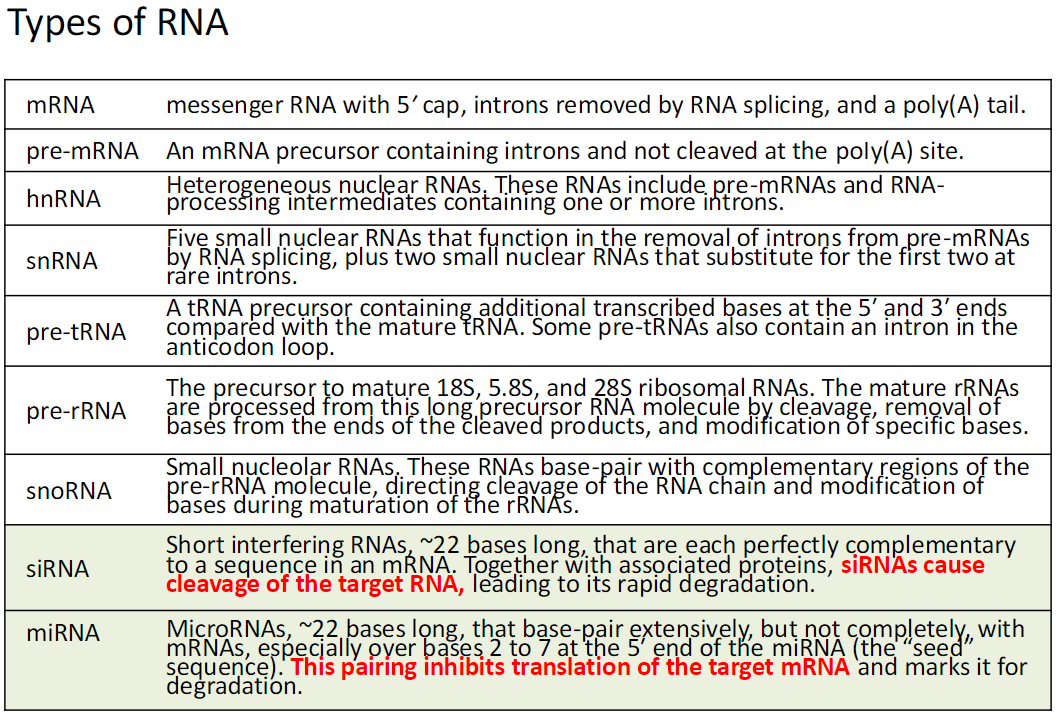
Types of RNA *Probably just know siRNA and miRNA

mRNA (Messenger RNA)
 Contains a 5′ cap, introns removed by RNA splicing, and a poly(A) tail

pre-mRNA
 Precursor mRNA containing introns
 Not yet cleaved at the poly(A) site

hnRNA (Heterogeneous Nuclear RNA)
 Includes pre-mRNAs and RNA-processing intermediates containing one or more introns

snRNA (Small Nuclear RNA)
 Five small nuclear RNAs that remove introns from pre-mRNAs by splicing
 Two additional snRNAs act at rare introns

pre-tRNA
 tRNA precursor with extra bases at the 5′ and 3′ ends
 Some contain an intron in the anticodon loop

pre-rRNA
 Precursor to mature 18S, 5.8S, and 28S rRNAs
 Processed by cleavage, trimming, and base modification

snoRNA (Small Nucleolar RNA)
 Base-pairs with pre-rRNA
 Directs cleavage and modification of rRNA during maturation

siRNA (Short Interfering RNA)
 ~22 bases long
 Perfectly complementary to an mRNA sequence
 Causes cleavage and rapid degradation of the target RNA

miRNA (MicroRNA)
 ~22 bases long
 Partially base-pairs with target mRNAs, especially bases 2–7 (“seed” sequence)
 Inhibits translation and marks mRNA for degradation
<p><strong>mRNA (Messenger RNA)</strong><br> Contains a 5′ cap, introns removed by RNA splicing, and a poly(A) tail</p><p><strong>pre-mRNA</strong><br> Precursor mRNA containing introns<br> Not yet cleaved at the poly(A) site</p><p><strong>hnRNA (Heterogeneous Nuclear RNA)</strong><br> Includes pre-mRNAs and RNA-processing intermediates containing one or more introns</p><p><strong>snRNA (Small Nuclear RNA)</strong><br> Five small nuclear RNAs that remove introns from pre-mRNAs by splicing<br> Two additional snRNAs act at rare introns</p><p><strong>pre-tRNA</strong><br> tRNA precursor with extra bases at the 5′ and 3′ ends<br> Some contain an intron in the anticodon loop</p><p><strong>pre-rRNA</strong><br> Precursor to mature 18S, 5.8S, and 28S rRNAs<br> Processed by cleavage, trimming, and base modification</p><p><strong>snoRNA (Small Nucleolar RNA)</strong><br> Base-pairs with pre-rRNA<br> Directs cleavage and modification of rRNA during maturation</p><p><strong>siRNA (Short Interfering RNA)</strong><br> ~22 bases long<br> Perfectly complementary to an mRNA sequence<br> Causes cleavage and rapid degradation of the target RNA</p><p><strong>miRNA (MicroRNA)</strong><br> ~22 bases long<br> Partially base-pairs with target mRNAs, especially bases 2–7 (“seed” sequence)<br> Inhibits translation and marks mRNA for degradation</p>
2
New cards

Pre-mRNA Processing and Splicing

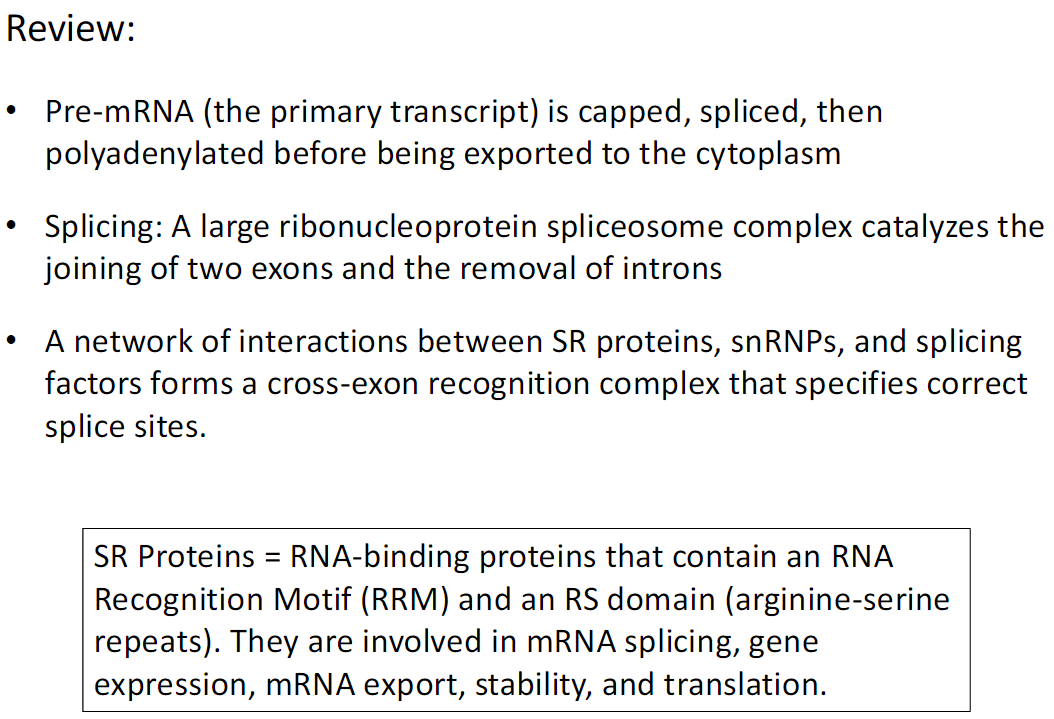
Pre-mRNA Processing
 The primary transcript is capped, spliced, and polyadenylated before export to the cytoplasm

Splicing
 A large ribonucleoprotein spliceosome joins two exons and removes introns

Exon Recognition
 SR proteins, snRNPs, and splicing factors form a cross-exon recognition complex
 Specifies correct splice sites

SR Proteins
 RNA-binding proteins with an RNA Recognition Motif (RRM) and an RS domain (arginine-serine repeats)
 Involved in mRNA splicing, gene expression, mRNA export, stability, and translation
<p><strong>Pre-mRNA Processing</strong><br> The primary transcript is capped, spliced, and polyadenylated before export to the cytoplasm</p><p><strong>Splicing</strong><br> A large ribonucleoprotein spliceosome joins two exons and removes introns</p><p><strong>Exon Recognition</strong><br> SR proteins, snRNPs, and splicing factors form a cross-exon recognition complex<br> Specifies correct splice sites</p><p><strong>SR Proteins</strong><br> RNA-binding proteins with an RNA Recognition Motif (RRM) and an RS domain (arginine-serine repeats)<br> Involved in mRNA splicing, gene expression, mRNA export, stability, and translation</p>
3
New cards

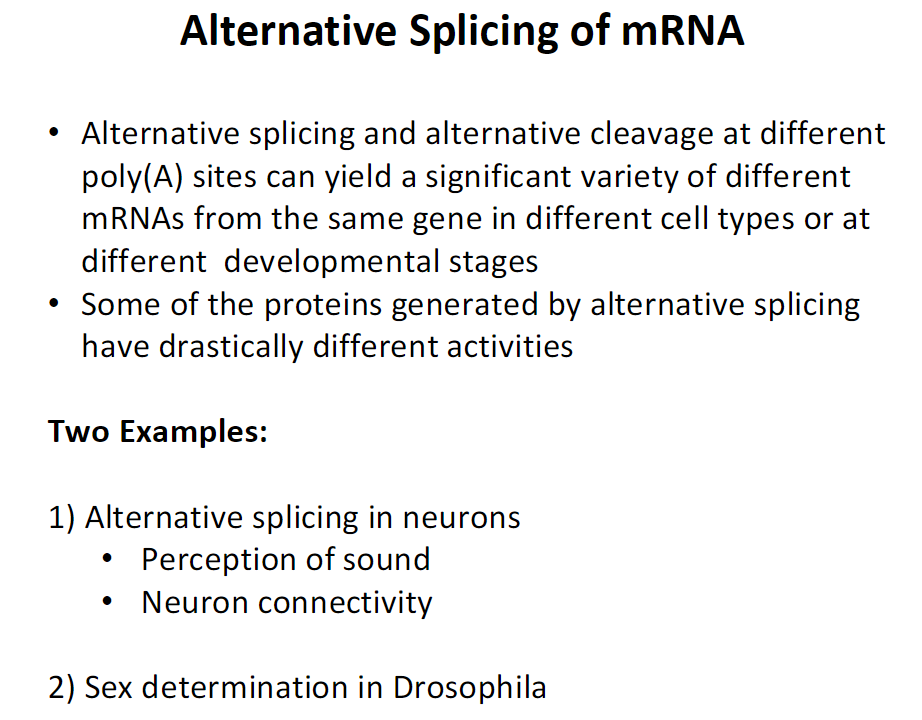
Alternative Splicing of mRNA

Function
 Alternative splicing and alternative cleavage at different poly(A) sites generate diverse mRNAs from the same gene
 Occurs in different cell types or developmental stages
 Some resulting proteins have drastically different activities

Examples
 1) Neurons – affects perception of sound and neuron connectivity
 2) Drosophila – controls sex determination
<p><strong>Function</strong><br> Alternative splicing and alternative cleavage at different poly(A) sites generate diverse mRNAs from the same gene<br> Occurs in different cell types or developmental stages<br> Some resulting proteins have drastically different activities</p><p><strong>Examples</strong><br> 1) Neurons – affects perception of sound and neuron connectivity<br> 2) Drosophila – controls sex determination</p>
4
New cards

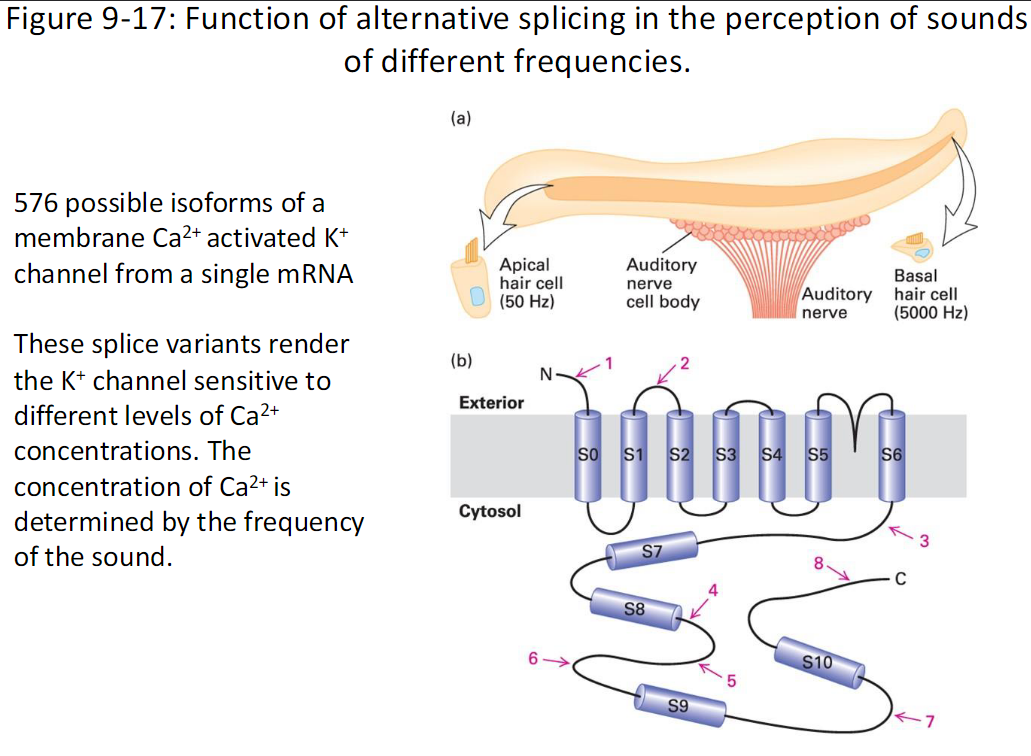
Alternative Splicing in Sound Perception *Don’t memorize specifics

Function
 A single mRNA can produce 576 possible isoforms of a membrane Ca²⁺-activated K⁺ channel

Effect
 Different splice variants make the K⁺ channel sensitive to varying Ca²⁺ concentrations
 Ca²⁺ levels are determined by the frequency of the sound

Figure Reference
 Fig. 9-17
<p><strong>Function</strong><br> A single mRNA can produce 576 possible isoforms of a membrane Ca²⁺-activated K⁺ channel</p><p><strong>Effect</strong><br> Different splice variants make the K⁺ channel sensitive to varying Ca²⁺ concentrations<br> Ca²⁺ levels are determined by the frequency of the sound</p><p><strong>Figure Reference</strong><br> Fig. 9-17</p>
5
New cards

Drosophila DSCAM Gene and Alternative Splicing *Just know that splicing is important

Gene Structure
 95 exons total
 Produces 38,016 possible isoforms

Variable Exons
 Ig2 – one of 12 exons included
 Ig3 – one of 48 exons included
 Ig7 – one of 33 exons included
 TM – one of 2 exons included
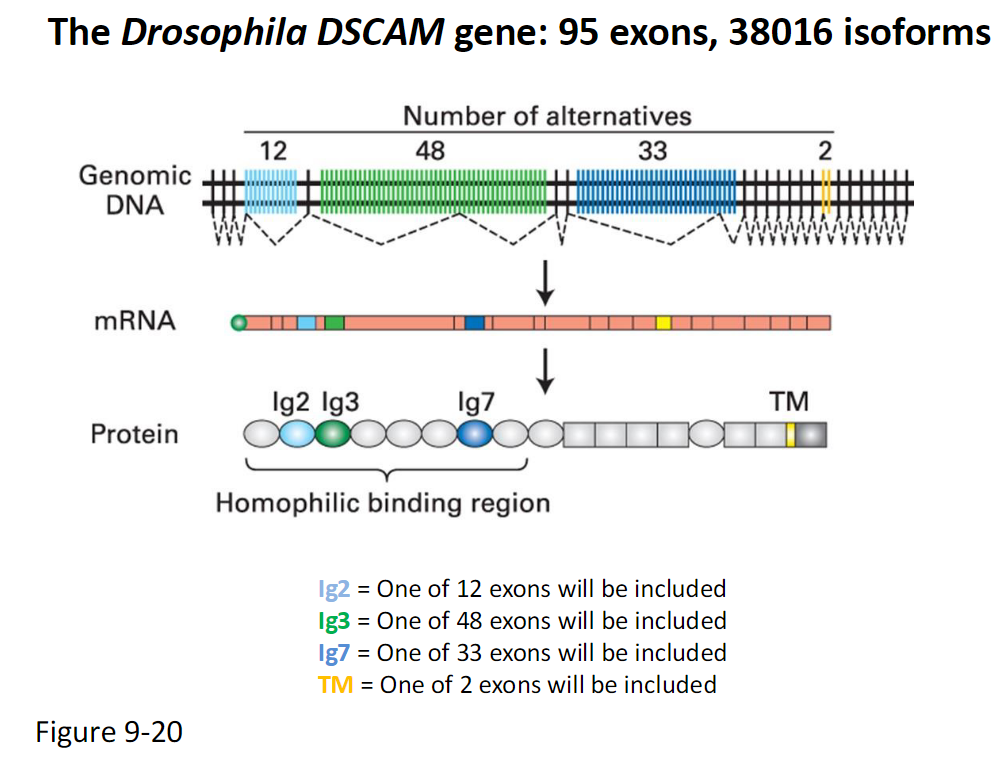
<p><strong>Gene Structure</strong><br> 95 exons total<br> Produces 38,016 possible isoforms</p><p><strong>Variable Exons</strong><br> Ig2 – one of 12 exons included<br> Ig3 – one of 48 exons included<br> Ig7 – one of 33 exons included<br> TM – one of 2 exons included</p>
6
New cards

Dendrite Self-Avoidance and Dscam

Function
 Dscam controls dendrite self-avoidance
 Ensures that branches from the same neuron do not overlap
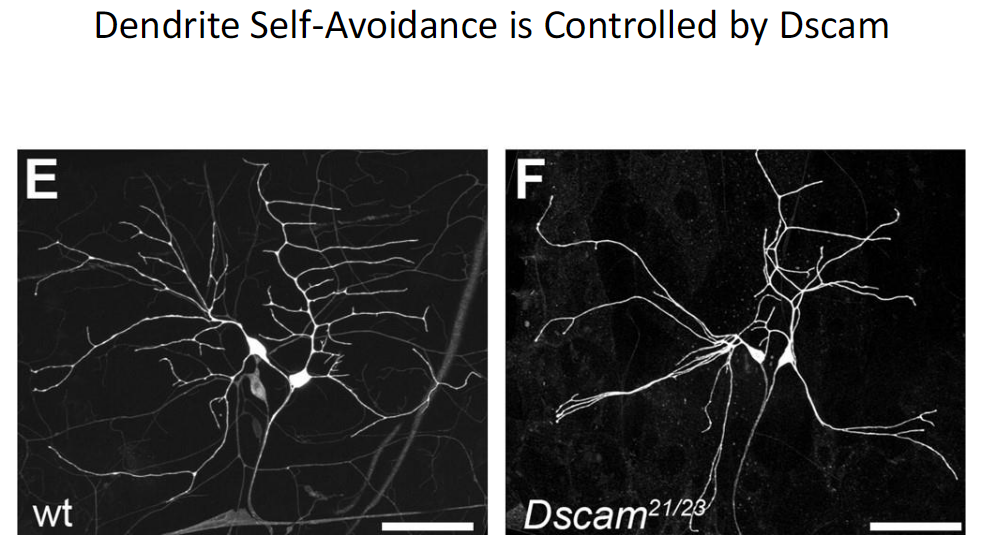
<p><strong>Function</strong><br> Dscam controls dendrite self-avoidance<br> Ensures that branches from the same neuron do not overlap</p>
7
New cards

Splicing Changes in Autism Spectrum Disorder (ASD)

Types of Splicing Changes
 Alternative cassette exons
 Microexons
 Alternative 5′ and 3′ splice sites
 Retained introns
 Complex splicing events

Observation
 These splicing changes differ between ASD patients and controls
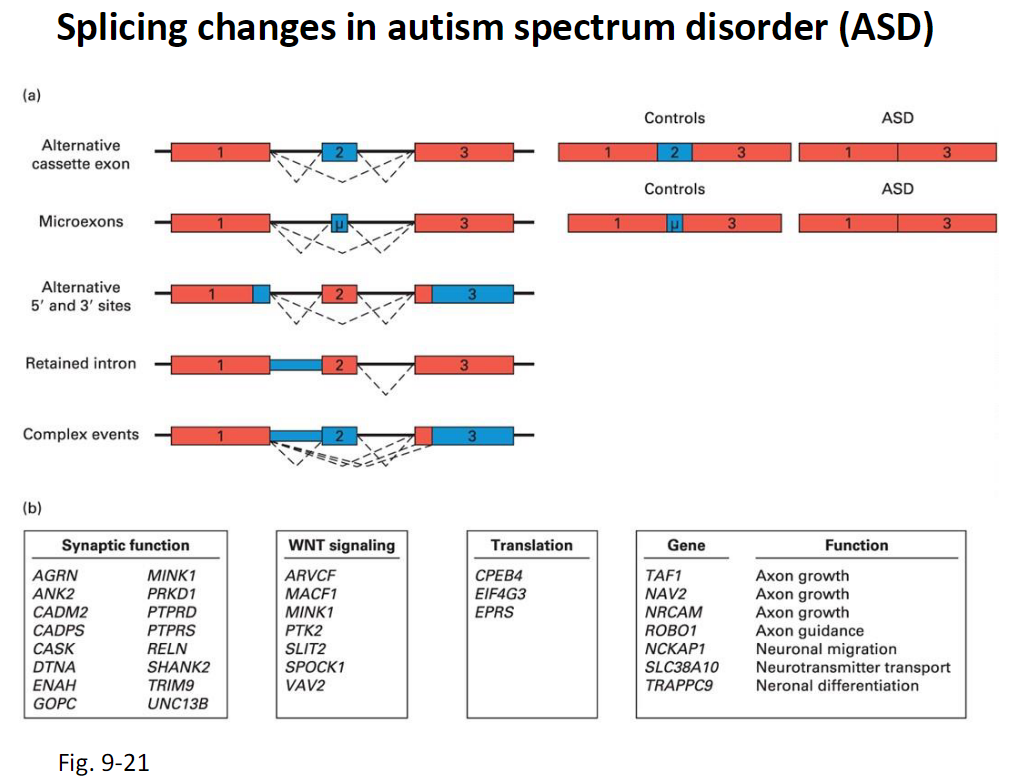
<p><strong>Types of Splicing Changes</strong><br> Alternative cassette exons<br> Microexons<br> Alternative 5′ and 3′ splice sites<br> Retained introns<br> Complex splicing events</p><p><strong>Observation</strong><br> These splicing changes differ between ASD patients and controls</p>
8
New cards

Neurological Disorders Linked to Abnormal Alternative RNA Splicing *Probably don’t need to know names

Diseases
 Ataxia telangiectasia
 Facioscapulohumeral dystrophy (FSHD)
 Fragile-X-associated tremor/ataxia syndrome (FXTAS)
 Frontotemporal dementia with Parkinsonism linked to chromosome 17 (FTDP-17)
 Duchenne muscular dystrophy; Becker's muscular dystrophy
 Myotonic dystrophy (DM1, DM2)
 Neurofibromatosis type 1 (NF1)
 Paraneoplastic neurologic disorders (PND)
  Paraneoplastic opsoclonus-myoclonus-ataxia (POMA)
  Hu syndrome (paraneoplastic encephalomyelitis/sensory neuronopathy)
 Prader-Willi syndrome
 Psychiatric disorders
 Retinitis pigmentosa
 Rett syndrome
 Spinal muscular atrophy
 Spinocerebellar ataxias (SCA2, SCA8, SCA10, SCA12)
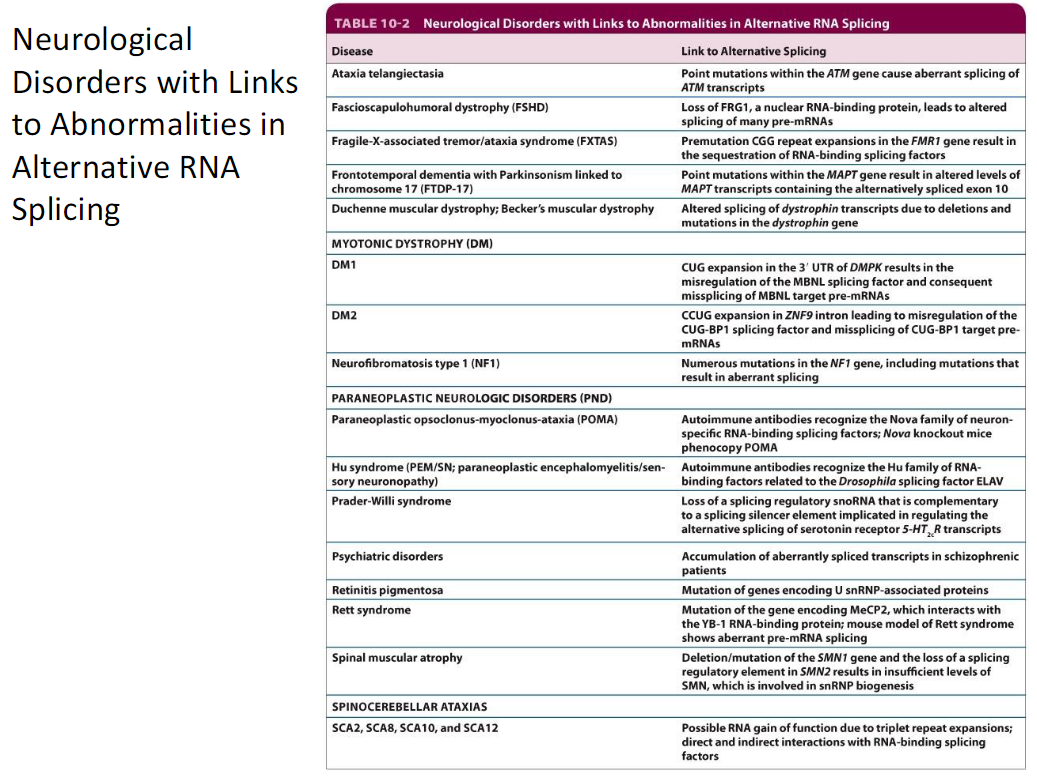
<p><strong>Diseases</strong><br> Ataxia telangiectasia<br> Facioscapulohumeral dystrophy (FSHD)<br> Fragile-X-associated tremor/ataxia syndrome (FXTAS)<br> Frontotemporal dementia with Parkinsonism linked to chromosome 17 (FTDP-17)<br> Duchenne muscular dystrophy; Becker's muscular dystrophy<br> Myotonic dystrophy (DM1, DM2)<br> Neurofibromatosis type 1 (NF1)<br> Paraneoplastic neurologic disorders (PND)<br>  Paraneoplastic opsoclonus-myoclonus-ataxia (POMA)<br>  Hu syndrome (paraneoplastic encephalomyelitis/sensory neuronopathy)<br> Prader-Willi syndrome<br> Psychiatric disorders<br> Retinitis pigmentosa<br> Rett syndrome<br> Spinal muscular atrophy<br> Spinocerebellar ataxias (SCA2, SCA8, SCA10, SCA12)</p>
9
New cards

Sex Determination in Drosophila

Sxl (Sex Lethal)
 Controls female development by regulating splicing of downstream genes

Tra (Transformer)
 Acts downstream of Sxl to control splicing of other genes

Dsx (Double Sex)
 Final gene in the pathway that determines sexual characteristics

Figure Reference
 Fig. 9-18
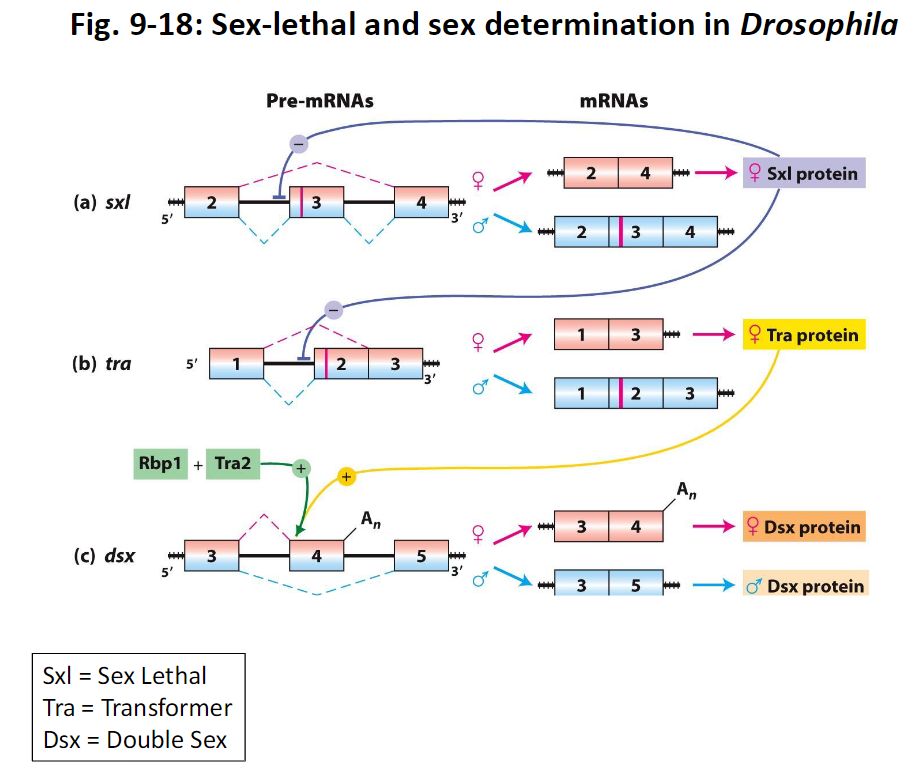
<p><strong>Sxl (Sex Lethal)</strong><br> Controls female development by regulating splicing of downstream genes</p><p><strong>Tra (Transformer)</strong><br> Acts downstream of Sxl to control splicing of other genes</p><p><strong>Dsx (Double Sex)</strong><br> Final gene in the pathway that determines sexual characteristics</p><p><strong>Figure Reference</strong><br> Fig. 9-18</p>
10
New cards

Alternative Splicing and Sex Determination in Drosophila

Key Regulators
 Sxl, Tra, and Dsx control sexual differentiation

Mechanism
 RNA-binding proteins recognize specific sequences near splice sites to regulate alternative splicing

Roles of Proteins
 Sxl – RNA-binding protein, acts as a suppressor of splicing
 Tra – RNA-binding protein, acts as an activator of splicing
 Dsx – transcription activator or repressor
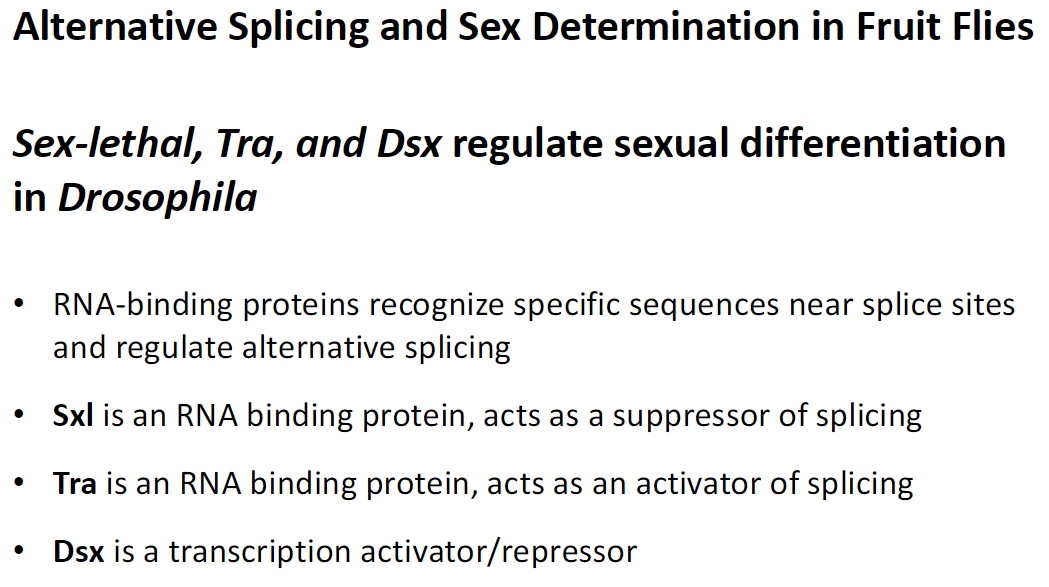
<p><strong>Key Regulators</strong><br> Sxl, Tra, and Dsx control sexual differentiation</p><p><strong>Mechanism</strong><br> RNA-binding proteins recognize specific sequences near splice sites to regulate alternative splicing</p><p><strong>Roles of Proteins</strong><br> Sxl – RNA-binding protein, acts as a suppressor of splicing<br> Tra – RNA-binding protein, acts as an activator of splicing<br> Dsx – transcription activator or repressor</p>
11
New cards

Sex-Lethal (Sxl) and Exon 3 Splicing

In Males
 Sxl is absent
 Exon 3 is included in the transcript
 Exon 3 contains a STOP codon
 Leads to a nonfunctional Sxl protein

In Females
 Sxl is expressed early in development
 Controls its own splicing to exclude exon 3
 This produces a functional Sxl protein
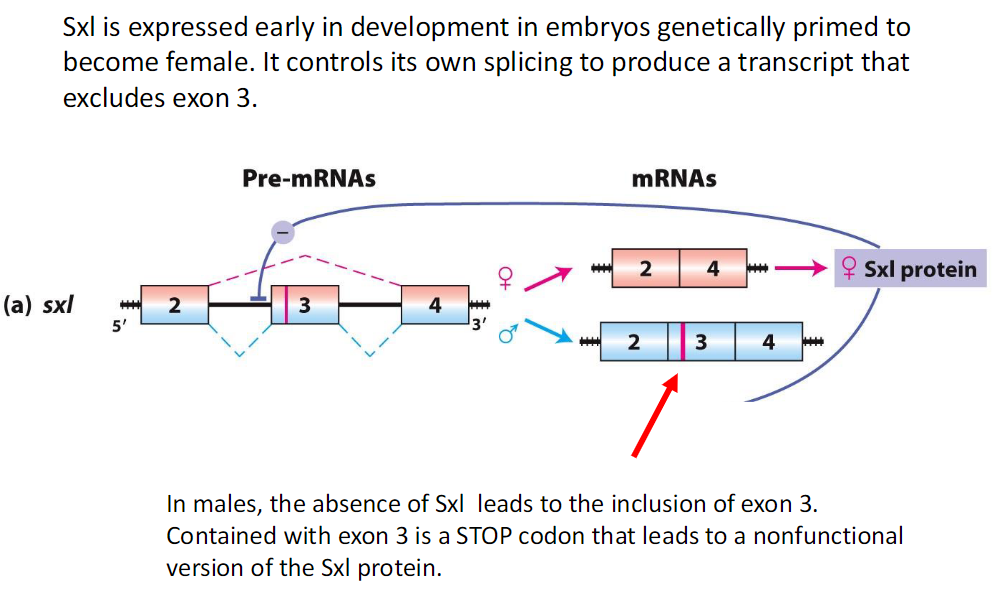
<p><strong>In Males</strong><br> Sxl is absent<br> Exon 3 is included in the transcript<br> Exon 3 contains a STOP codon<br> Leads to a nonfunctional Sxl protein</p><p><strong>In Females</strong><br> Sxl is expressed early in development<br> Controls its own splicing to exclude exon 3<br> This produces a functional Sxl protein</p>
12
New cards

Sxl Regulation of Tra Splicing

In Females
 High levels of Sxl protein
 Exon 2 of Tra is excluded
 Produces functional Tra protein

In Males
 Sxl is absent
 Exon 2 of Tra is included, containing a stop codon
 Generates a nonfunctional Tra protein
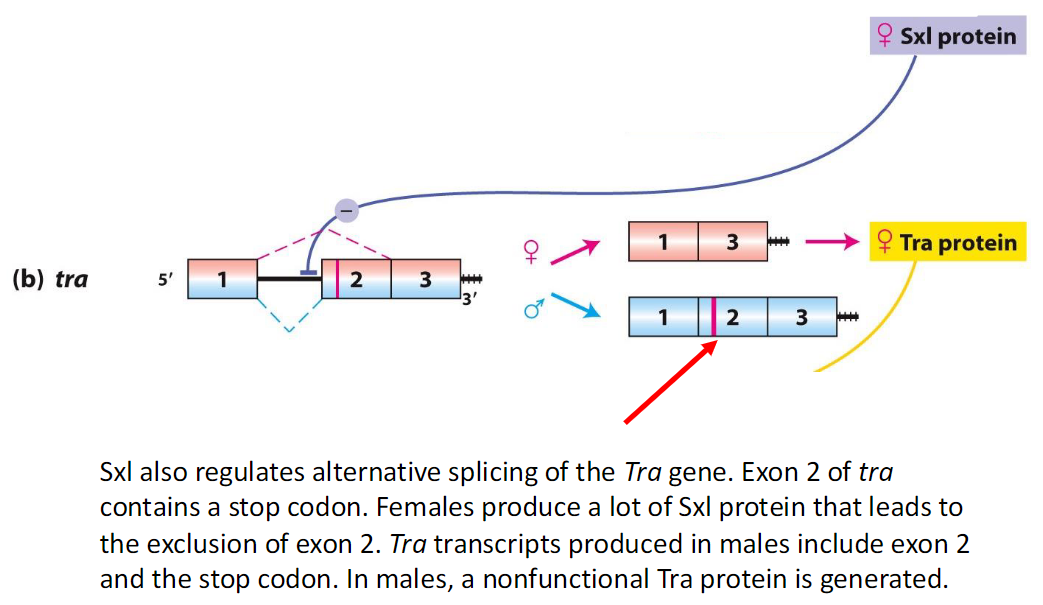
<p><strong>In Females</strong><br> High levels of Sxl protein<br> Exon 2 of Tra is excluded<br> Produces functional Tra protein</p><p><strong>In Males</strong><br> Sxl is absent<br> Exon 2 of Tra is included, containing a stop codon<br> Generates a nonfunctional Tra protein</p>
13
New cards

Tra Regulation of Dsx Splicing

In Females
 Tra protein, with Rbp1 and Tra2, binds sites in exon 4
 Promotes inclusion of exon 4 in the Dsx transcript
 Transcription stops at exon 4
 mRNA is polyadenylated
 Resulting Dsx transcript = exons 1 + 2 + 3 + 4

In Males
 Tra protein is absent
 Exon 4 is excluded
 Exons 5 and 6 are added instead
 Resulting Dsx transcript = exons 1 + 2 + 3 + 5 + 6
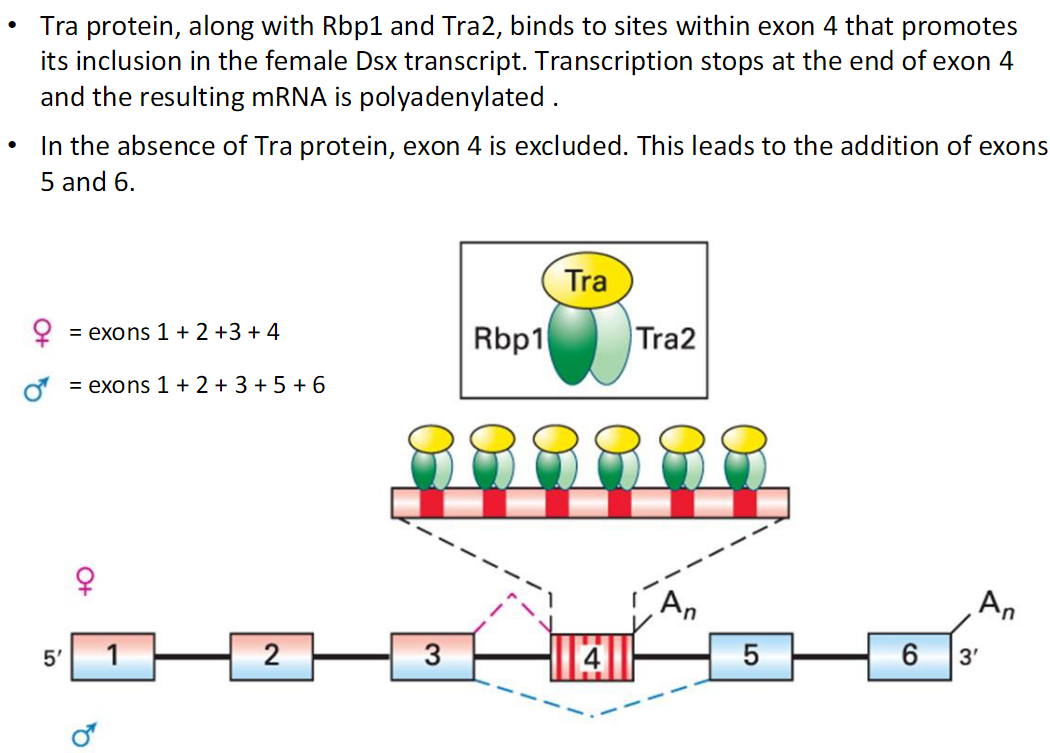
<p><strong>In Females</strong><br> Tra protein, with Rbp1 and Tra2, binds sites in exon 4<br> Promotes inclusion of exon 4 in the Dsx transcript<br> Transcription stops at exon 4<br> mRNA is polyadenylated<br> Resulting Dsx transcript = exons 1 + 2 + 3 + 4</p><p><strong>In Males</strong><br> Tra protein is absent<br> Exon 4 is excluded<br> Exons 5 and 6 are added instead<br> Resulting Dsx transcript = exons 1 + 2 + 3 + 5 + 6</p>
14
New cards

Tra and Dsx Isoforms

Function
 Tra regulates alternative splicing and cleavage of Dsx

Dsx Isoforms
 Male Dsx – acts as a transcriptional repressor
 Female Dsx – acts as a transcriptional activator
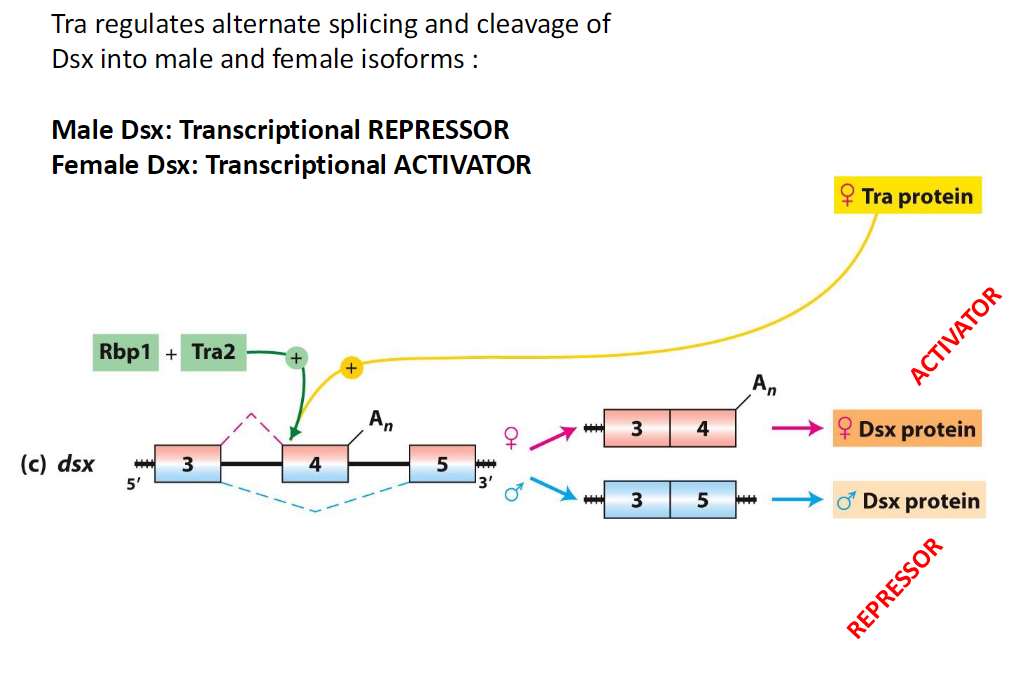
<p><strong>Function</strong><br> Tra regulates alternative splicing and cleavage of Dsx</p><p><strong>Dsx Isoforms</strong><br> Male Dsx – acts as a transcriptional repressor<br> Female Dsx – acts as a transcriptional activator</p>
15
New cards

miRNA and siRNA

Function
 Regulate mRNA stability and translation

miRNA (microRNA)
 Causes translational repression
 Effect is reversible

siRNA (small interfering RNA)
 Causes RNA degradation
 Effect is permanent
<p><strong>Function</strong><br> Regulate mRNA stability and translation</p><p><strong>miRNA (microRNA)</strong><br> Causes translational repression<br> Effect is reversible</p><p><strong>siRNA (small interfering RNA)</strong><br> Causes RNA degradation<br> Effect is permanent</p>
16
New cards

miRNA and siRNA: Small RNA Regulators

Size and Origin
 Both are small RNA molecules (21–28 base pairs)
 Generated from larger double-stranded RNAs that are processed into mature miRNA or siRNA

Diversity
 Humans have over 3000 different miRNAs
 Each miRNA can bind many different mRNA transcripts
 Each mRNA can be targeted by many different miRNAs or siRNAs

Binding and Function
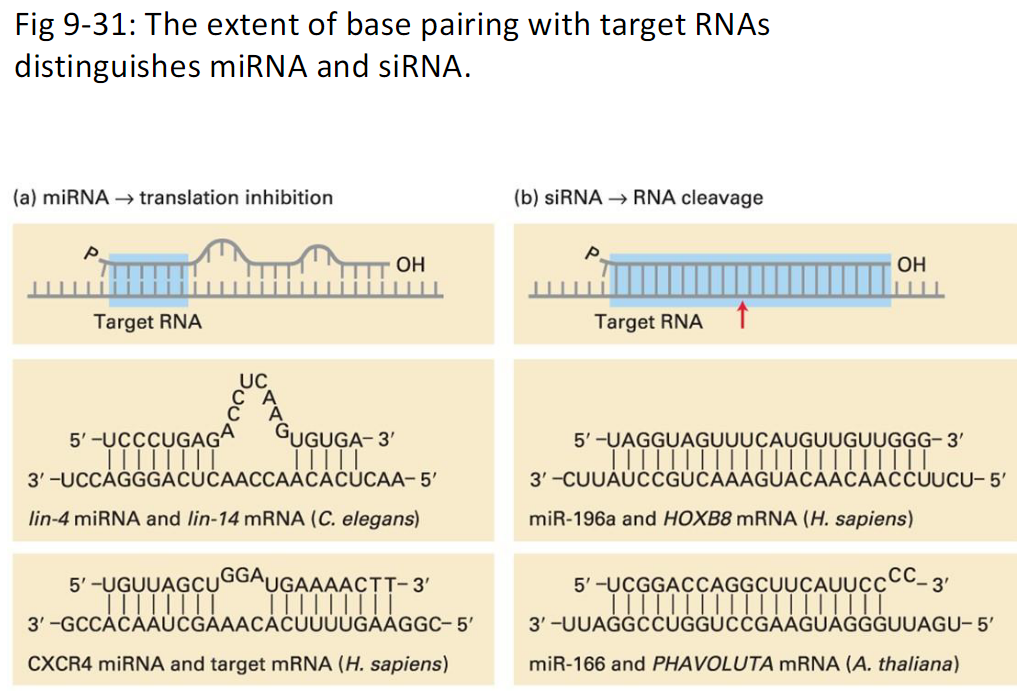
 miRNAs – bind imperfectly (with mismatches), usually at the 3′-UTR, leading to translational repression (reversible)
 siRNAs – bind perfectly (no mismatches), can bind anywhere on the transcript, cause rapid RNA degradation via RNA interference (permanent)
<p><strong>Size and Origin</strong><br> Both are small RNA molecules (21–28 base pairs)<br> Generated from larger double-stranded RNAs that are processed into mature miRNA or siRNA</p><p><strong>Diversity</strong><br> Humans have over 3000 different miRNAs<br> Each miRNA can bind many different mRNA transcripts<br> Each mRNA can be targeted by many different miRNAs or siRNAs</p><p><strong>Binding and Function</strong><br> miRNAs – bind imperfectly (with mismatches), usually at the 3′-UTR, leading to translational repression (reversible)<br> siRNAs – bind perfectly (no mismatches), can bind anywhere on the transcript, cause rapid RNA degradation via RNA interference (permanent)</p>
17
New cards

miRNA vs siRNA

Difference in Base Pairing and Effect
 miRNA – binds imperfectly to target RNA, usually at the 3′-UTR → blocks the ribosome from translating the mRNA, so protein is not made (reversible repression)
 siRNA – binds perfectly to target RNA anywhere in the transcript → recruits RNA cleavage machinery, causing the mRNA to be cut and degraded (permanent silencing)

Figure Reference
 Fig. 9-31
<p><strong>Difference in Base Pairing and Effect</strong><br> miRNA – binds imperfectly to target RNA, usually at the 3′-UTR → blocks the ribosome from translating the mRNA, so protein is not made (reversible repression)<br> siRNA – binds perfectly to target RNA anywhere in the transcript → recruits RNA cleavage machinery, causing the mRNA to be cut and degraded (permanent silencing)</p><p><strong>Figure Reference</strong><br> Fig. 9-31</p>
18
New cards

miRNA and siRNA in Biological Regulation

Function
 Regulate nearly every biological process

Example
 Animals lacking Dicer, the enzyme that processes miRNAs/siRNAs, fail to develop beyond gastrulation
 Knock-out strains are created by deleting or silencing a target gene

Disease Relevance
 Abnormal miRNA/siRNA levels contribute to many diseases, including cancer

Dicer
 An RNase that cleaves double-stranded RNA into miRNAs or siRNAs
<p><strong>Function</strong><br> Regulate nearly every biological process</p><p><strong>Example</strong><br> Animals lacking Dicer, the enzyme that processes miRNAs/siRNAs, fail to develop beyond gastrulation<br> Knock-out strains are created by deleting or silencing a target gene</p><p><strong>Disease Relevance</strong><br> Abnormal miRNA/siRNA levels contribute to many diseases, including cancer</p><p><strong>Dicer</strong><br> An RNase that cleaves double-stranded RNA into miRNAs or siRNAs</p>
19
New cards

miRNA Function in Limb Development

Observation
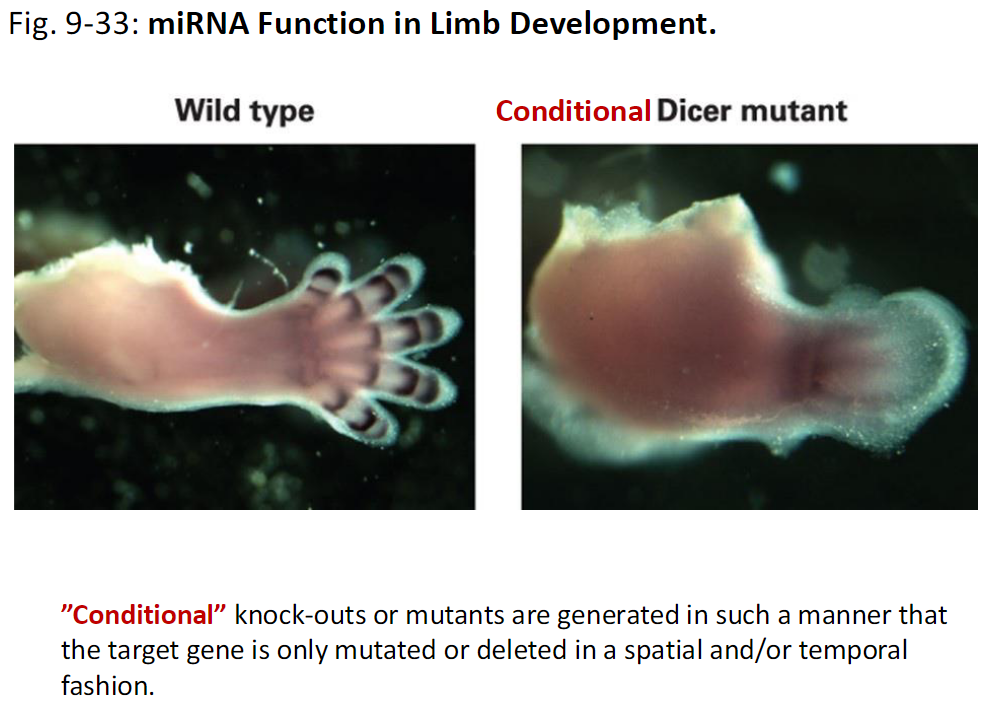
 Wild type – normal limb development
 Conditional Dicer mutant – limb development is disrupted

Conditional Knock-Outs
 Target gene is mutated only in specific tissues or at specific times, not throughout the whole organism

Figure Reference
 Fig. 9-33
<p><strong>Observation</strong><br> Wild type – normal limb development<br> Conditional Dicer mutant – limb development is disrupted</p><p><strong>Conditional Knock-Outs</strong><br> Target gene is mutated only in specific tissues or at specific times, not throughout the whole organism</p><p><strong>Figure Reference</strong><br> Fig. 9-33</p>
20
New cards

RISC and Small RNA Function

RISC (RNA-Induced Silencing Complex)
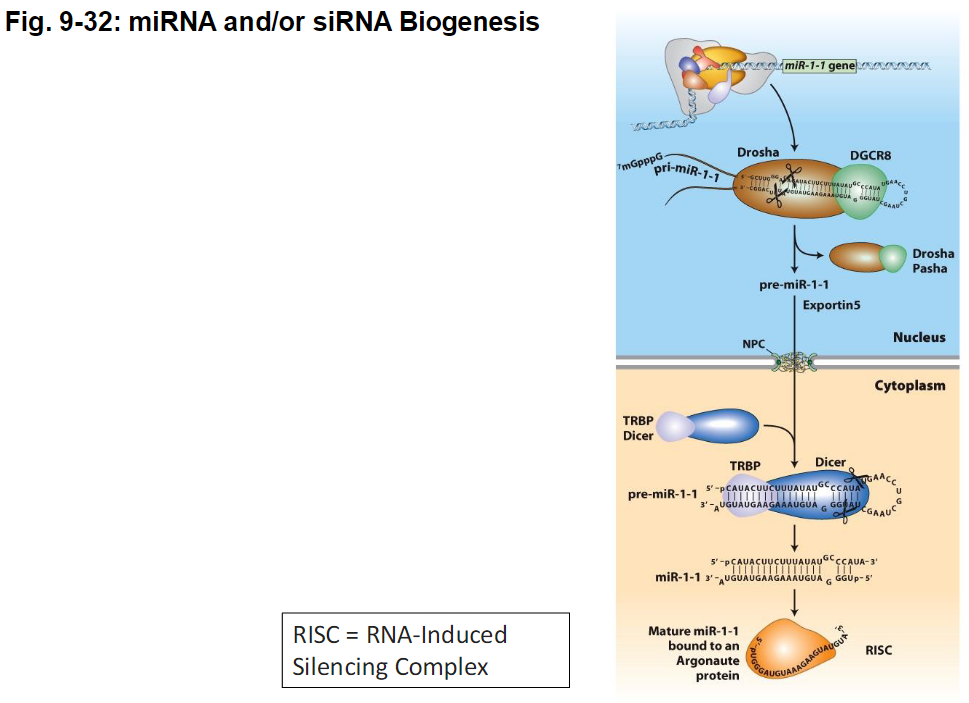
 A protein complex that incorporates miRNA or siRNA
 Guides the small RNA to its target mRNA

Function
 miRNA in RISC – binds imperfectly to mRNA → blocks translation
 siRNA in RISC – binds perfectly to mRNA → directs RNA cleavage

Figure Reference
 Fig. 9-32: miRNA and siRNA biogenesis
<p><strong>RISC (RNA-Induced Silencing Complex)</strong><br> A protein complex that incorporates miRNA or siRNA<br> Guides the small RNA to its target mRNA</p><p><strong>Function</strong><br> miRNA in RISC – binds imperfectly to mRNA → blocks translation<br> siRNA in RISC – binds perfectly to mRNA → directs RNA cleavage</p><p><strong>Figure Reference</strong><br> Fig. 9-32: miRNA and siRNA biogenesis</p>
21
New cards

miRNA Processing and Export

Drosha/DGCR8
 Removes hairpin structures from double-stranded RNA in the nucleus

Exportin
 Transports the processed miRNA from the nucleus to the cytoplasm
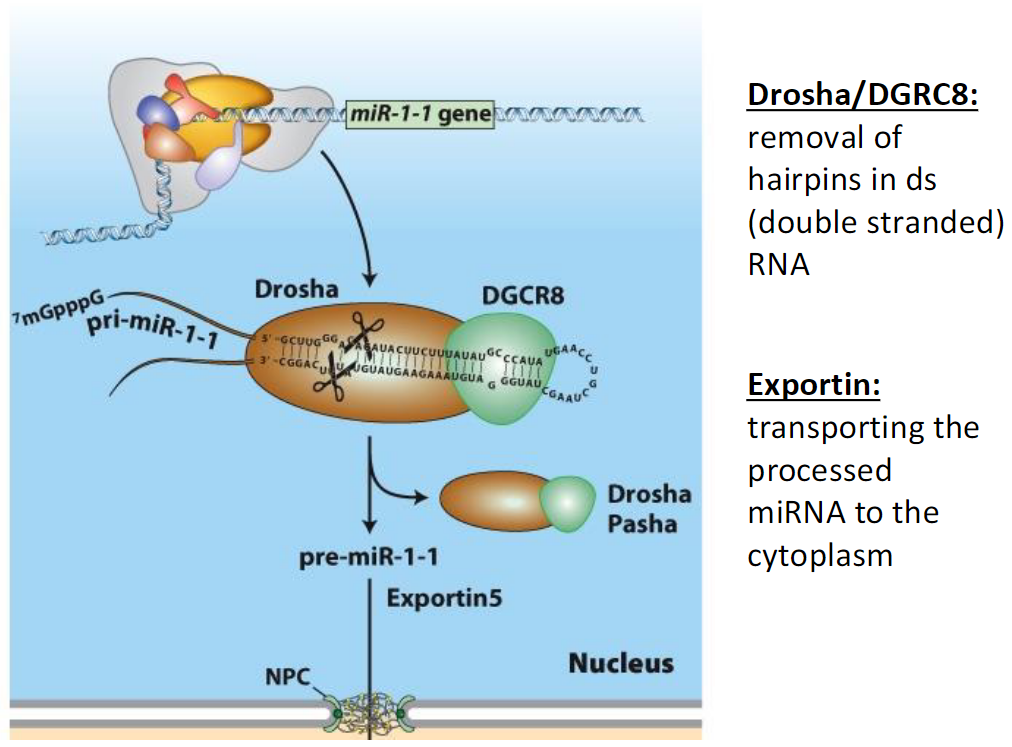
<p><strong>Drosha/DGCR8</strong><br> Removes hairpin structures from double-stranded RNA in the nucleus</p><p><strong>Exportin</strong><br> Transports the processed miRNA from the nucleus to the cytoplasm</p>
22
New cards

Dicer and RISC in miRNA/siRNA Processing

Dicer
 Cuts double-stranded RNA into small fragments (21–28 bp)

Argonaute (RISC)
 An RNA helicase
 Removes one strand of the double-stranded RNA
 Guides the remaining miRNA/siRNA to its target mRNA
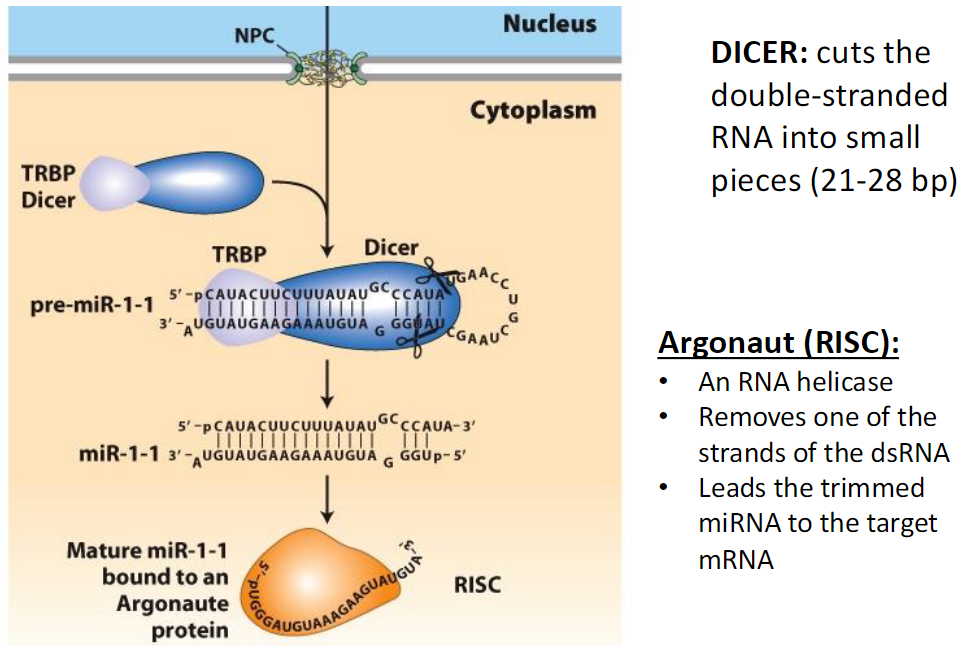
<p><strong>Dicer</strong><br> Cuts double-stranded RNA into small fragments (21–28 bp)</p><p><strong>Argonaute (RISC)</strong><br> An RNA helicase<br> Removes one strand of the double-stranded RNA<br> Guides the remaining miRNA/siRNA to its target mRNA</p>
23
New cards

miRNA vs siRNA: Similarities and Differences

Similarities
 Both are short RNAs (21–28 bases)
 Both are generated from double-stranded RNA by Drosha, Pasha, Dicer, and RISC

Differences
 miRNA – binds imperfectly to target mRNA → suppresses translation (reversible)
 siRNA – binds perfectly to target mRNA → causes rapid degradation (permanent), quickly stopping gene expression
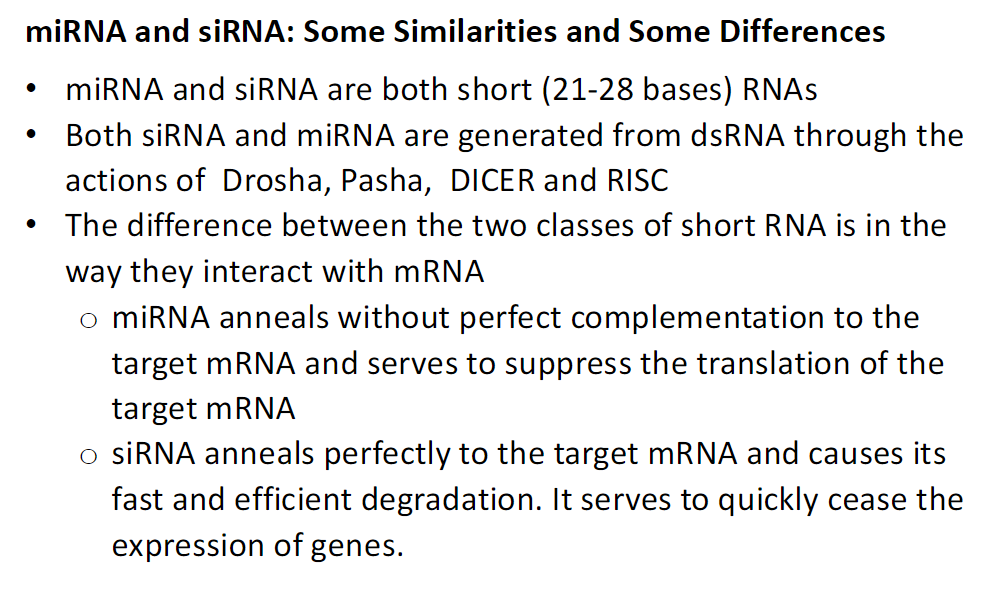
<p><strong>Similarities</strong><br> Both are short RNAs (21–28 bases)<br> Both are generated from double-stranded RNA by Drosha, Pasha, Dicer, and RISC</p><p><strong>Differences</strong><br> miRNA – binds imperfectly to target mRNA → suppresses translation (reversible)<br> siRNA – binds perfectly to target mRNA → causes rapid degradation (permanent), quickly stopping gene expression</p>