PZT and ultrasound arrays
 Call Kai
 Learn
Learn Practice Test
 Spaced Repetition
 Match
Match Flashcards
 Knowt Play
1/36

There's no tags or description
Looks like no tags are added yet.
Name | Mastery | Learn | Test | Matching | Spaced | Call with Kai |
|---|
No analytics yet
Send a link to your students to track their progress
37 Terms
what must an ultrasound probe be able to do and how does it do it?
generate sound waves: converts electric signal → sound waves
detect incoming sound waves: converts sound wave → electrical signal
uses piezoelectric material
when was PZT effect discovered
1880
types of PZ effects
direct piezoelectric effect: when a substance is subjected to mechanical stress it produces an electric charge → 10nM deformation = 100mV charge
converse piezoelectric effect: applying a potential difference over a material results in compression of extension of the material depending on polarity
→ 100mV = 10nM
what makes a material PZE
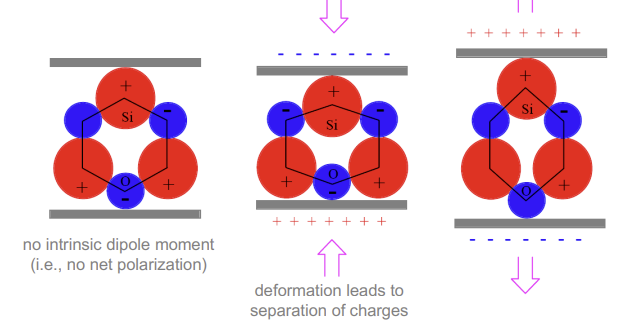
when a material is relaxed the crystal structure has a perfectly balanced charge of 0
when the structure is deformed:
crystal structure changes to have more -ve charge carriers closer to one side and +ve charge carriers on the other (net amount of +ve and -ve particle changes)
produces a dipole moment (separation of charges)
results in a PD
types of PSE materials
Quartz: is naturally occurring but is weakly piezoelectric
Piezoelectric ceramics: requires poling to become piezoelectric → made from ferroelectric materials
Ex: PZT, PZT5A, PZT4
Piezoelectric polymers (PVDF): is a thin film material with an acoustic impedance that closely matches that of tissue
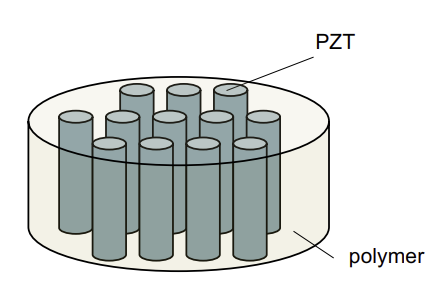
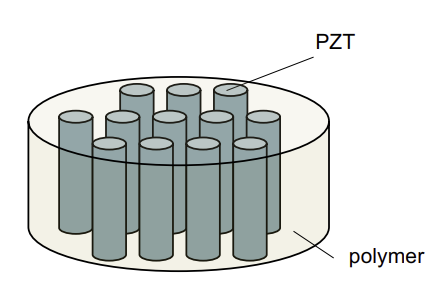
Piezocomposites: are comprised of pieces of PZT embedded into a polymer material in order to have improved impedance match to tissue
what are the properties of PZE materials
transmission/strain constant (D)
receiving/voltage constant (G)
electromechanical coupling factor (k)
what is the transmission/strain constant
units?
it is a measure of how good the material is at generating US
quantifies the resulting mechanical strain a material undergoes when an electric field is applied
measured in m/v
what is the receiver/voltage constant
units?
it is a measure of how efficient a material is at receiving US and producing a resulting voltage change/image
measured in electric field per unit applied stress (V.m/N)
what is the electromechanical coupling factor
measure of effectiveness in converting electrical energy ←→ mechanical energy
PZT vs PVDF
PZT:
high d → good producer of US
low g → not as good of a receiver
high k → good conversion efficiency
large impedance missmatch to water → narrow bandwidths/high q (Q = 500)
PVDF:
LOW D → poor US transmitter (rarely used as such)
high g → good US receiver
low k: poor conversion efficiency
good impedance matching to water → broad bandwidth/low q (Q = 3)
what are ferroelectric materials
materials with a permanent electric polarisation which can be reversed by applying an external electric field
difference between PZE materials and ferroelectric materials
PZ does not have a permanent pole but ferroelectric materials do
what is poling
naturally occurring PZE materials have a weak piezoelectric effect due to disorderes polycrystaline structure
crystal structure contains several domains with a net dipole moment in different directions → dipole moments cancel each other → weak PZE effect
poling:
heat to 200c (for PZT) or above curie temperatures
apply an electric field whilst material is still hot (2000v/m DC voltage)
material cooled whilst voltage is still being applied
result → each unit orients in the same direction as the electric field
only applied to ferroelectric materials as they retain the changes
what special considerations are there when poling piezoelectric polymers
piezoelectric polymers have molecular dipoles that are antiparallel at room temp causing them to cancel each other out
the material is first stretched in 1 or 2 directions to 5 times the original length
this changes the molecular conformation → all -ve charges on one side +ve charges the other
material can then be poled to force it to retain this conformation
types of PZE elements
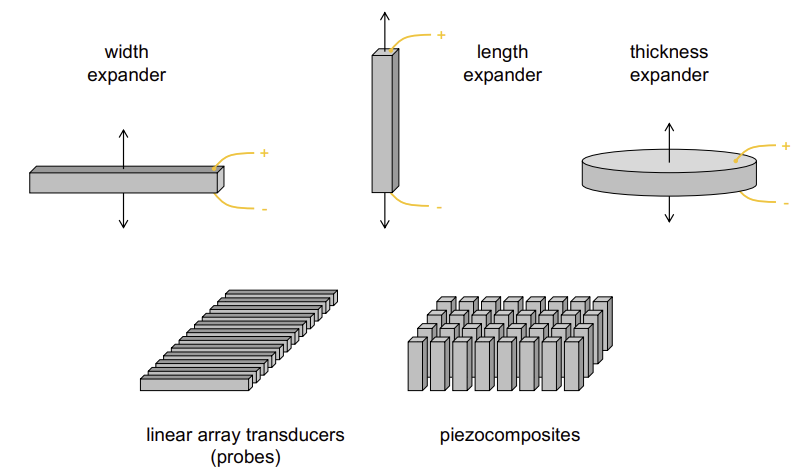
width expander
length expander
thickness expander
linear array transducers
piezocomposites
what are ultrasound arrays
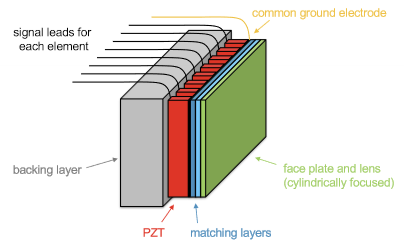
solid block of PZT (piezoelectric ceramic) that is cut to form a grid of elements (usually 128)
elements share a matching layer and ground electrodes
usually used in diagnostic imaging
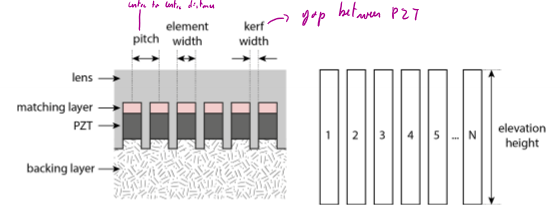
what are the dimensions of an US array
pitch: distance between the center of adjacent element
element width
kerth width: distance between adjacent elements
elevation height: height of element
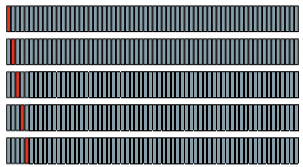
what mode allows for the maximum amount of information in an array
full matrix capture:
one element of the array fires a pulse (red)
rest of the elements act as a receiver/detector (blue)
process repeats for every element
what are the drawbacks of FMC
extremely time consuming causing frame rate to drop a lot + computationally intensive
what is usually used instead of FMC
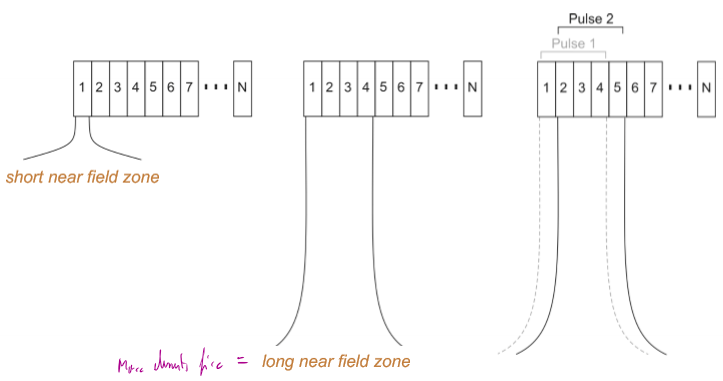
elements are fired in groups → groups are then fired sequentially
how does aperture size affect image
increasing the number of element firing increases aperture size → increased nearfield strength and length → beam is more directional
remember that aperture: \frac{\left(4a^2-\lambda\right)}{4\lambda}=\frac{a^2}{\lambda}-\frac{\lambda}{4}
in this case a=\frac{group~length}{2}
what is electronic focusing → advantages?
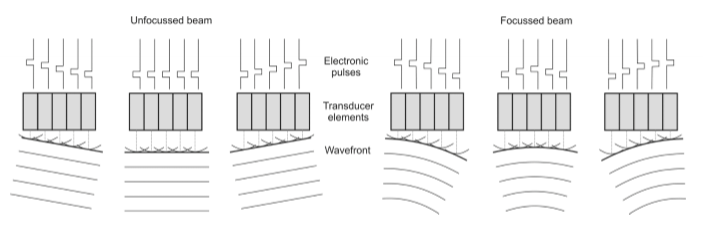
firing the elements in the periphery first and the other elements with a time/phase delay producing a converging pulse
can control the time/phase delay → alter focal length at different points along the scan line → optimise lateral resolution at different depths
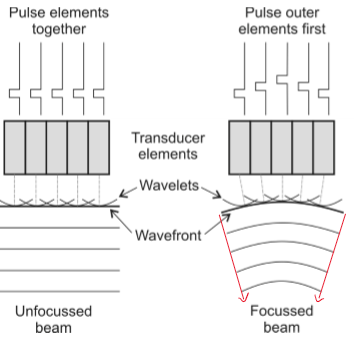
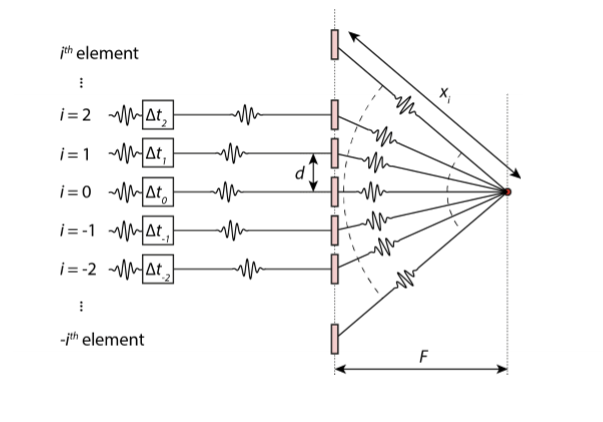
how is electronic focusing time shift calculated
\delta t_{i}=\frac{\delta x_{i}}{c_{o}}=\frac{1}{c_{o}}\left(\sqrt{\left(id\right)^2+F^2}-F\right)
where:
x_i: distance from element to focus
F: focal length
d: pitch
i:element number
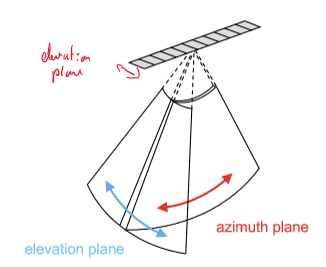
what are the planes of a transducer
azimuth plane → US produces a slice in this plane → lateral resolution
elevation plane → thickness of the slice defined by the length of the element
elevation plane field dimensions with no focusing
near field: thickness is defined by the length of the elements (S = b)
far field: thickness is is defined by the divergence angle
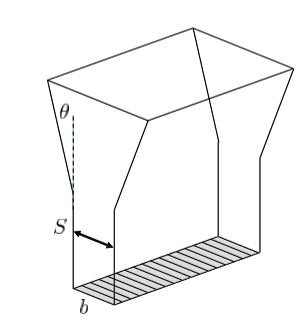
how is focusing done in the elevation plane → how are the focuses dimensions defined
done using a lens on the transducer
focus thickness: S = 1.41\lambda \frac{F}{b}
focal zone length: D=9.7\lambda(\frac{F}{b})^{2}
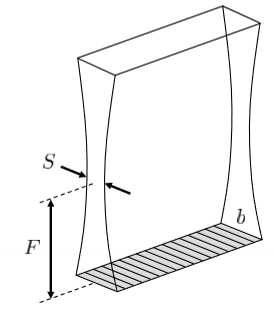
what is electronic beam steering
follows the same principles as electronic focusing where a time delay is used to fire some elements first causing the beam to go to one direction
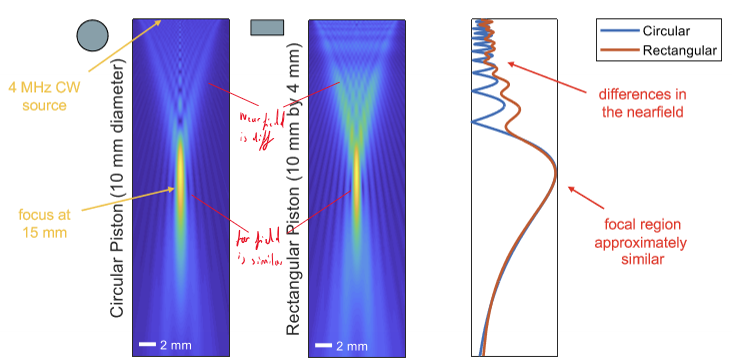
difference between a rectangular and circular element field
focus and far field are the same
near field is different
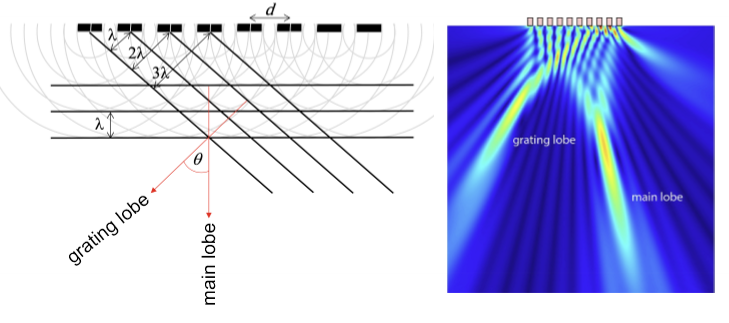
what are grating lobes?
bi-product of using any sort of phase delay element firing, produces:
main lobe: projects in the intended direction
grafting lobe: beam that goes in an unwanted direction
occurs when:
path length difference between adjacent elements = wavelength
due to the finite pitch distance
if we take the main lobe direction as the x line:
dsin(\theta)=n\lambda
how do we reduce grating lobes?
reducing pitch → does not remove the grating lobe completely but just steers it in a direction that doesn’t interfere with the main lobe
if pitch is small enough the path length difference will be smaller than the wavelength
d<\frac{\lambda}{2} is required to prevent grating lobes even is the beam is steered
reducing kerf width → reduces energy in the grating lobe
types of transducers
linear arrays
curvilinear arrays
sector arrays
endoscopic/endocavity
intravascular
3d imaging probes
cable free probes
linear arrays:
elements are in a straight line and are fired as a group
beam electronically focused
used in musculoskeletal and vascular imaging
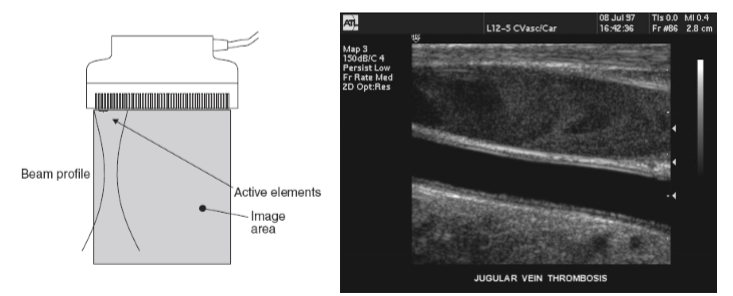
curvilinear array
elements are arranges in a curve
fired in groups + electronically focused
used in abdominal and obstetrics
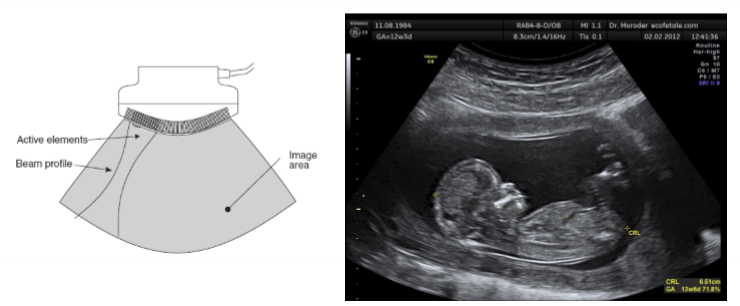
sector array
all elements are fired simultaneously
beam is electronically focused and steered
used in cardiac and brain imaging
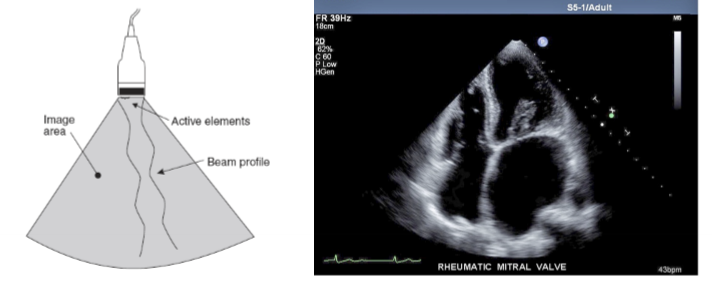
endocavity/endoscopic
can be linear, curvilinear or sector
intravascular
multi or single element transducer
transducers can rotate or use an acoustic mirror
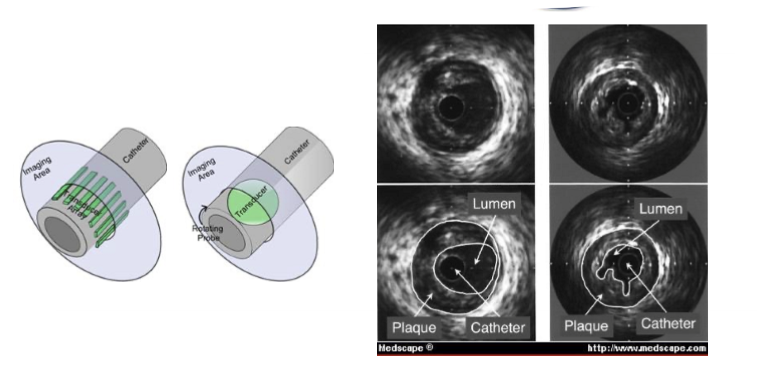
3D probe
can be made of:
2d sector probe where all elements are fired together
moving 1D array
beam is electronically focused and steered
used in cardiac and obstetric imaging

