Ch 2: Tools of the Laboratory
 Call Kai
 Learn
Learn Practice Test
 Spaced Repetition
 Match
Match Flashcards
 Knowt Play
1/54

There's no tags or description
Looks like no tags are added yet.
Name | Mastery | Learn | Test | Matching | Spaced | Call with Kai | Chat |
|---|
No analytics yet
Send a link to your students to track their progress
55 Terms
What is inoculation?
Clinical specimens are obtained from body fluids, discharges, anatomical sites, or diseased tissue.
__ is to grow microorganisms.
Culture
__ are the nutrients for the growth of microbes.
Medium (plural, media)
__ is a small sample of microbes.
Inoculum
__ is the introduction of an inoculum into media to culture microbes.
Inoculation
__ is a temperature-controlled chamber to encourage the multiplication of microbes.
Incubator
Temperatures used in laboratory propagation of microorganisms are __.
20°C to 45°C.
Atmospheric gases such as __ or __ may be required for the growth of certain microbes.
oxygen, carbon dioxide
During __, microbes grow and multiply, producing visible growth in the media.
incubation
__ is a growth media contains only a single known species or type of microorganism.
Pure
__ is a container that holds two or more identified, easily differentiated species.
Mixed
__ was once a pure or mixed culture, but has since had __ (unwanted microbes) introduced into it (like weeds in a garden)
Contaminated, contaminants
Culture media may be contained in __.
test tubes, flasks, & petri dishes.
Media may inoculated with __.
loops, needs, pipettes, & swabs.
__ technique is necessary.
Sterile
What are the three physical states?
liquid, solid, semisolid
What has the following characteristics:
Complex polysaccharide isolated from Gelidium
Solid at room temperature
Liquefies at 100°C, solidifies at 42°C
Flexible and moldable
Not a digestible nutrient for most microorganisms!!
Agar
Which chemical content of media:
Composition is precisely chemically defined
Contain pure organic and inorganic compounds that vary little from one source to another
Molecular content specified by means of an exact formula
defined (synthetic)
Which chemical content of media:
One or more components is not chemically defined
Contains extracts of animals, plants, or yeasts
Blood, serum, meat extracts or infusions, milk, yeast extract, soybean digests, and peptone
complex
A medium can be both __ and __.
selective, differential.
Which type of media:
Contains a substance that absorbs oxygen or slows the penetration of oxygen
Important for growing anaerobic bacteria
Reducing medium
Which type of media:
Used to maintain and preserve specimens that have to be held for a period of time before clinical analysis
Transport media
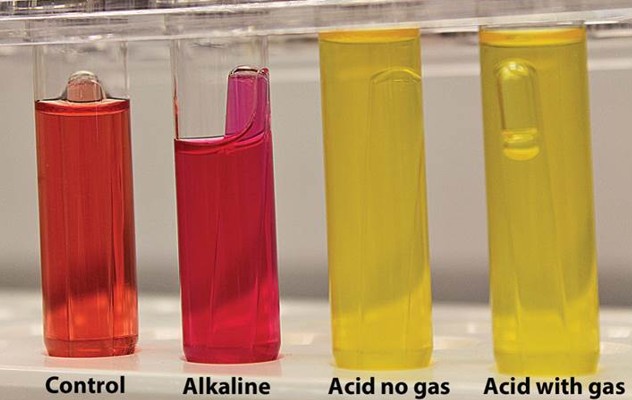
Which type of media:
Contains sugars that can be fermented with a pH indicator to show this reaction
Carbohydrate fermentation media
Which type of media:
Used by technologists to test the effectiveness of antimicrobial drugs
Used by drug manufacturers to test the effectiveness of disinfectants, antiseptics, cosmetics, and preservatives on microorganisms
Assay media
__ requires the following:
A medium with a firm surface
A Petri dish
An inoculating loop
Isolation
__ is a macroscopic cluster of cell appearing on a solid medium arising from the multiplication of a single cell.
Colony
The dimensions of macroscopic organisms are given in __ and __.
centimeters (cm), meters (m).
Protozoa and algae measure __.
3 to 4 mm.
Yeast are generally __.
3 to 4 µm
The smallest bacteria measure around __; largest around __.
200 nm, 750 um
Most __ measure between 20 nm and 400 nm; some can be as big as 800 nm or 1500 nm (as big as cells).
viruses
What are order of microbes from smallest to largest?
viruses, bacteria, yeasts, protozoa
__ is formed by the objective.
Real image
__ is formed when the image is projected through the microscope body through the ocular lens.
Virtual image
__ is the capacity of an optical system to distinguish two adjacent objects or points from one another.
Resolution
Resolving power of the human eye is __.
0.2 mm.
__ consists of a drop or two of culture placed on a slide and overlaid with a cover slip.
Wet mount
__ is a drop of culture is placed in a concave (depression) slide, Vaseline, adhesive or sealant, and cover slip are used to suspend the sample.
Hanging drop
__ is any procedure that applies colored chemicals (dyes) to specimens.
Staining
__ have a positive charge.
Basic dyes
__ have a negative charge.
Acidic dyes
__ dye sticks to the specimen and gives it color.
Position stain
__ does not stick to the specimen but settles some distance from its outer boundary forming a silhouette.
Negative stain
__ only require a single dye and uncomplicated procedure.
Simple stain
__ use two differently colored dyes: the primary dye and the counterstain.
Differential stain
Different results in the __ stain are due to differences in the structure of the cell wall.
gram
The __ stain remain the universal basis for bacterial classification and identification.
gram
Endospore stain distinguishes between __ and __ cells.
endospores, vegetative
Which special stain has the following:
Used to observe the microbial capsule, an unstructured protective layer surrounding the cells of some bacteria and fungi
Negatively stained with India ink
Capsular staining
Which special stain has the following:
Used to reveal tiny, slender filaments used by bacteria for locomotion
Flagella are enlarged by depositing a coating on the outside of the filament and then staining it
Flagellar staining
Identify the following staining techniques as simple, differential, or special.
capsule stain
special
Identify the following staining techniques as simple, differential, or special.
acid-fast stain
differential
Identify the following staining techniques as simple, differential, or special.
crystal violet
simple
Identify the following staining techniques as simple, differential, or special.
Gram stain
differential
Identify the following staining techniques as simple, differential, or special.
flagellar stain
special