climate
 Call Kai
 Learn
Learn Practice Test
 Spaced Repetition
 Match
Match Flashcards
 Knowt Play
1/23

There's no tags or description
Looks like no tags are added yet.
Name | Mastery | Learn | Test | Matching | Spaced | Call with Kai |
|---|
No analytics yet
Send a link to your students to track their progress
24 Terms
physical factors drive the distribution of organisms at the global scale
climate:
light
temperature
precipitation
ex: road runner vs. snow leopard, high temperature, low precip vs. low temperature high precip. environment
what drives global climate?
sunlight, particularly to the tropics
movement of the planet
atmospheric and ocean circulation
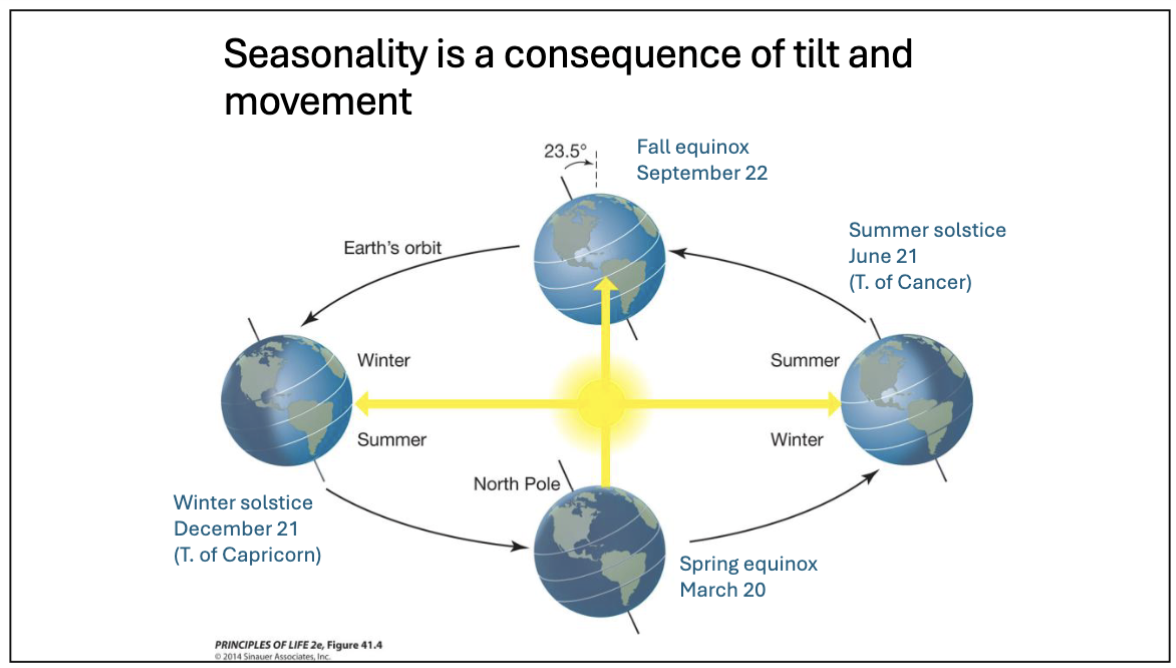
seasonality is a consequence of tilt and movement
What gives us seasonality is the fact that the Earth is tilted relative to the plane of its yearly orbit. Earth goes counter clockwise around the sun.
Different latitudes receive different solar energy input at different times of the year
Starting at the bottom, since this is the approximate time of year: is it an equinox or a solstice? Just passed the Spring equinox. Sun is at the equator, so in the northern hemisphere, it is the spring equinox. And around the globe, both day and night are equal lengths
Rotation: Earth turns on its internal axis (counter clockwise)
Revolution: Circles an external axis
Latitude of greatest solar energy shifts between the Tropic of Cancer (23.5 N) and Tropic of Capricorn (23.5 S) over the course of a year.
As viewed from the north pole star, Earth turns counter clockwise
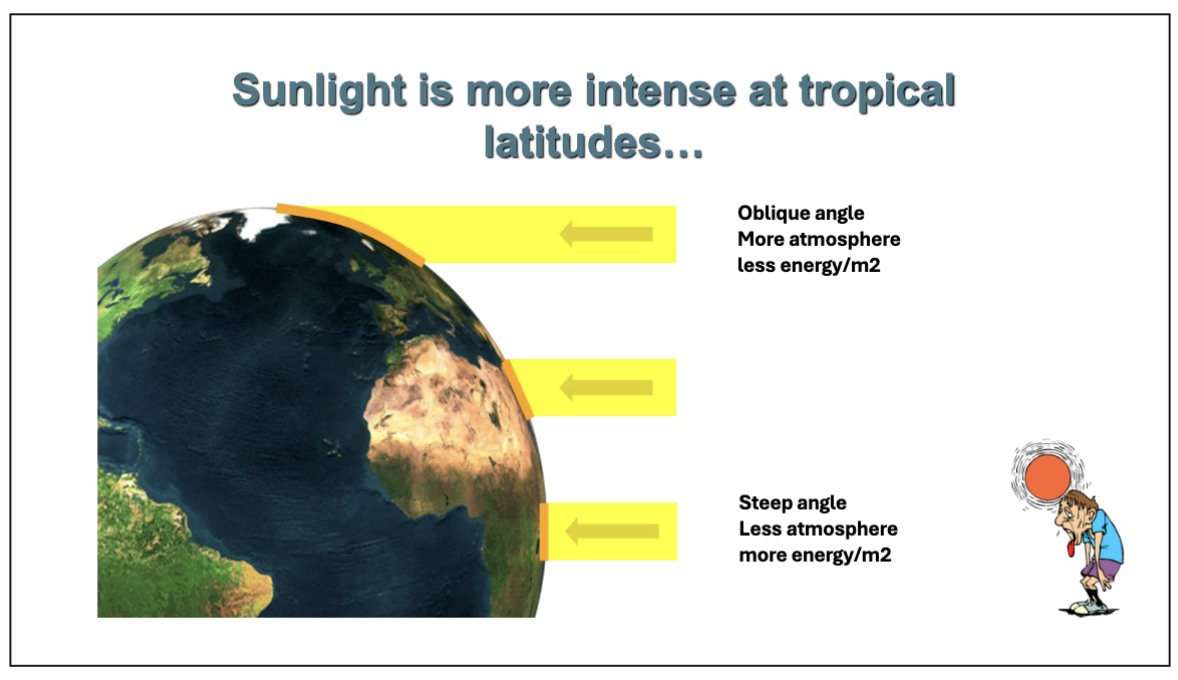
sunlight is more intense at tropical latitudes
sun travels through more atmosphere (so more energy reflected back), and is spread across larger surface area, at poles
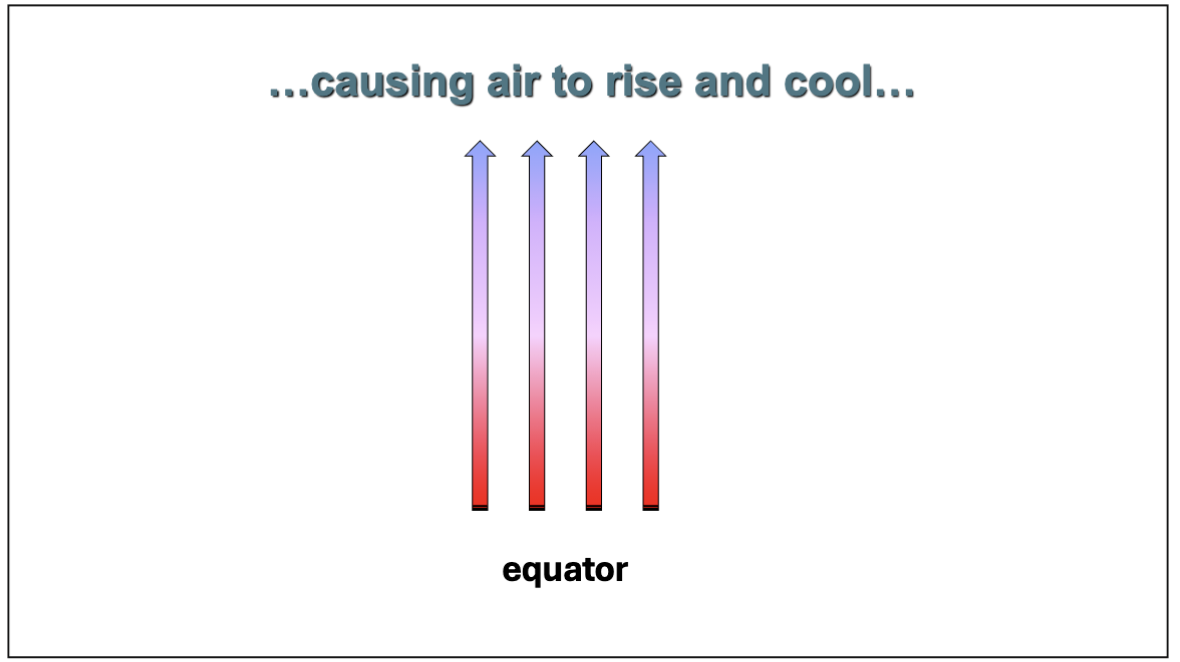
sunlight being more intense at tropical latitudes causes air to rise and cool from the equator
As sun beats down on the tropics, the molecules move faster and the heated ear expands, becoming less dense and rises
As it rises, it cools adiabatically (ad). As compressed gas expands, it cools, which is how air conditioners work
what happens to the water in the air as it cools?
as you cool vapor, it loses energy and water condenses
as air rises and cools it loses moisture…so it rains a lot
The reason that water is found in a vaporous form is that the water molecules have enough energy to be in that form. If the molecules are colder (have less energy) they will be solids and liquids.
Warm air transfers its energy to liquid water molecules, helping them achieve a gaseous state.
Basically, think of water going to vapor as things get hot, reverse in other direction.
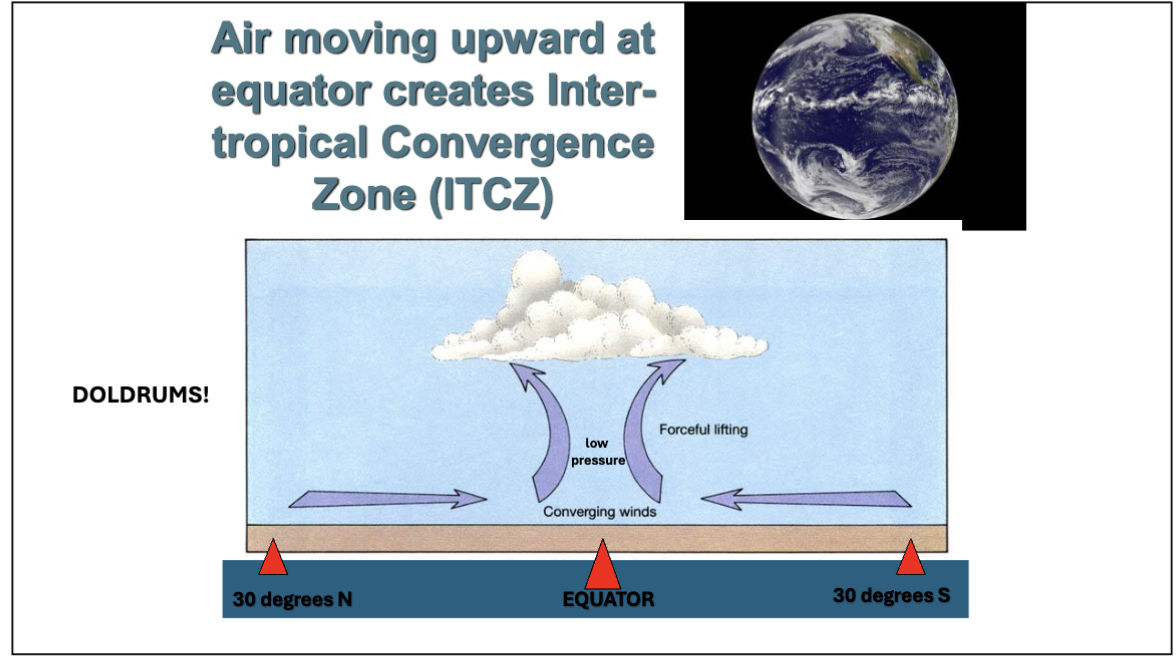
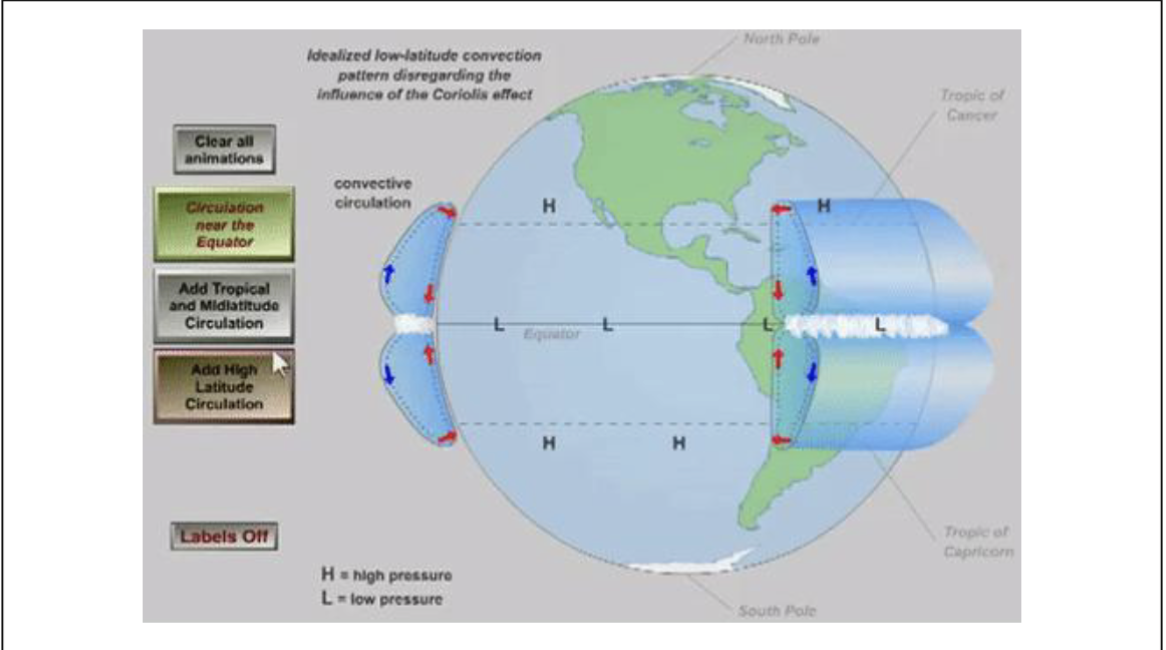
air moving upward at equator creates intertropical convergence zone (ITCZ)
The air is basically rising up because of intense heating. This zone called the Inter-tropical Convergence Zone.
Also called the "doldrums" from maritime usage, which is where the NE and SE trade winds converge and result in calm winds at equator when sailing ships could get caught for days or weeks with no wind to push their sails.
Can change seasonally or annually.
Air rises to top of the troposphere (about 7 miles up)
dry, cold air is dense—so begins to fall, picking up moisture
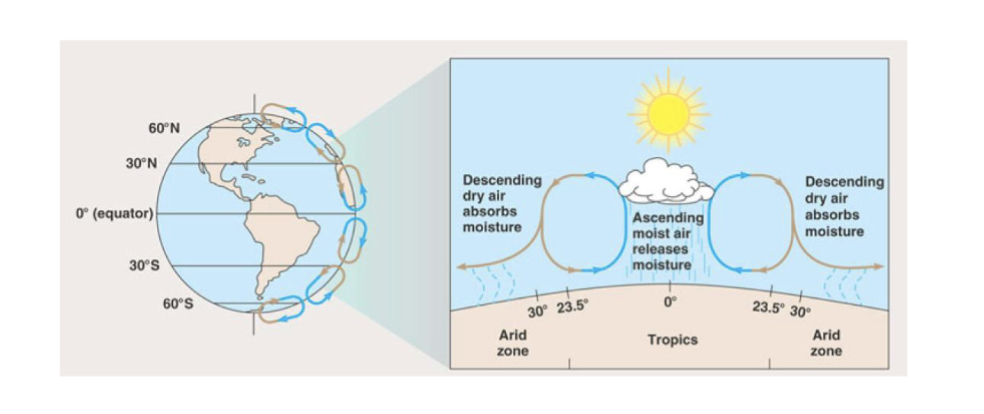
Air gets to upper troposphere about 11 or 12 miles up (before stratosphere) and then comes down, and as it descends it is very dry and absorbs moisture.
and so you have deserts around 30 degrees north and south where the cool air is falling
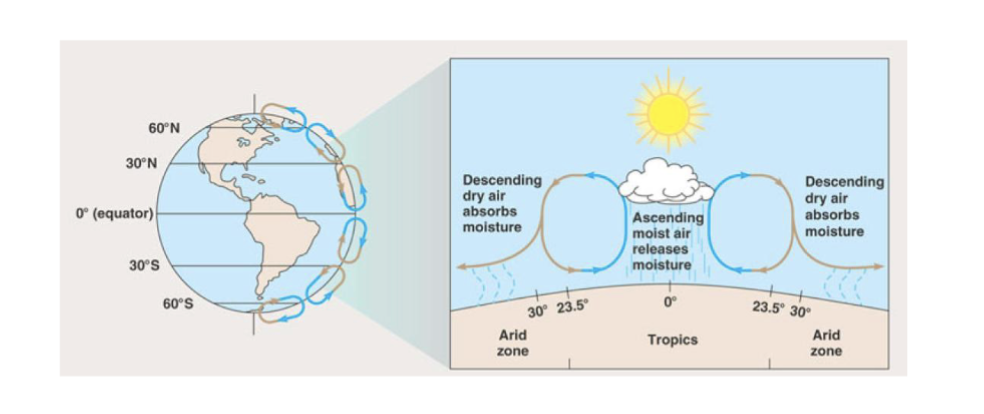
formation of hadley cells
Between 0 and 30 degrees, you have the formation of Hadley Cells
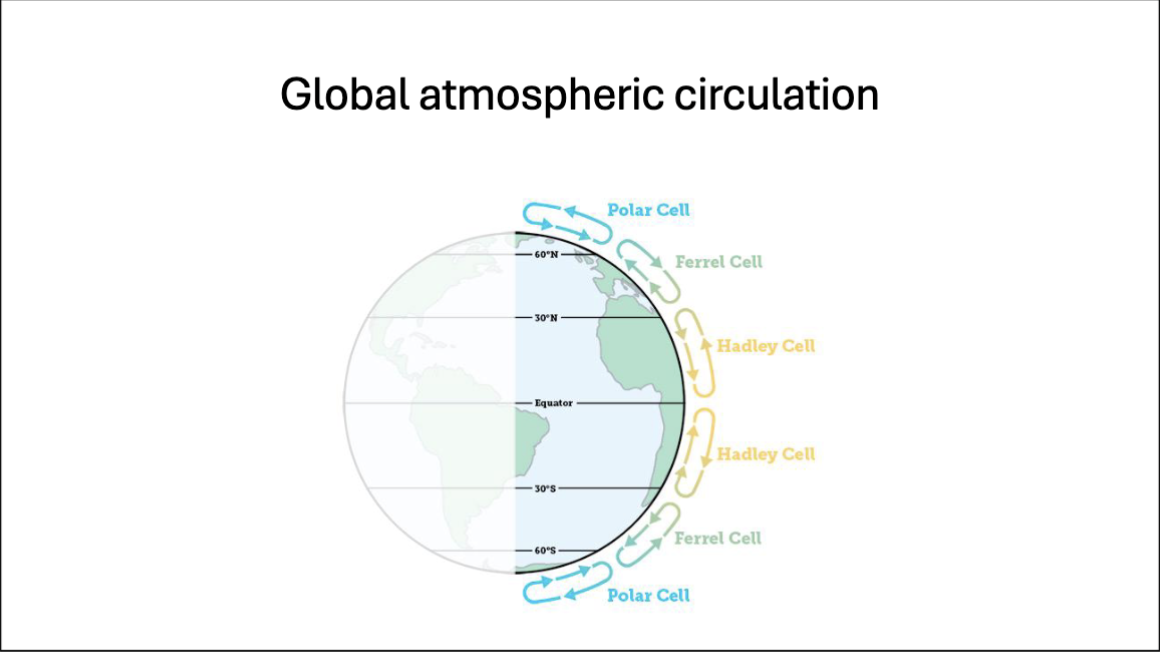
Latitudinal patterns of atmospheric circulation have a powerful effect on climate patterns by transferring an immense amount of heat energy from the hot tropics to the cold poles. Without this transfer, the poles would sink toward absolute zero in winter, and the equator would reach fantastically high temperatures throughout the year.
global atmospheric circulation
Warm and cold air masses meet between Hadley, ferrel and polar cells, which generates uplift and the turbulent, spinning storms that sweep sinuously from west to east through the middle latitudes
how are prevailing winds that blow east and west generated?
in addition to this rising warm air that then causes movement north and south, you also have something called prevailing winds. the question is, what causes this?
Gaspard-Gustave de Coriolis was a French mathematician and scientist who first described this phenomenon in 1835.
Merry-go-round is spinning counter clockwise
Who will receive the ball while the merry-go-round is in motion?
Ball caught by the thrower
Ball caught opposite thrower
Ball caught to thrower's left
Ball caught to thrower's right
the coriolis force
The Coriolis effect is the apparent curving of moving objects — like wind and ocean currents — caused by Earth's rotation. Paths curve to the right in the Northern Hemisphere and to the left in the Southern Hemisphere.
Imagine rolling a ball from the North Pole toward the equator. Because the Earth spins eastward, and lower latitudes move faster than higher ones, the target area shifts before the ball arrives - making the path look curved. This same deflection shapes global wind patterns, ocean currents, and weather systems.
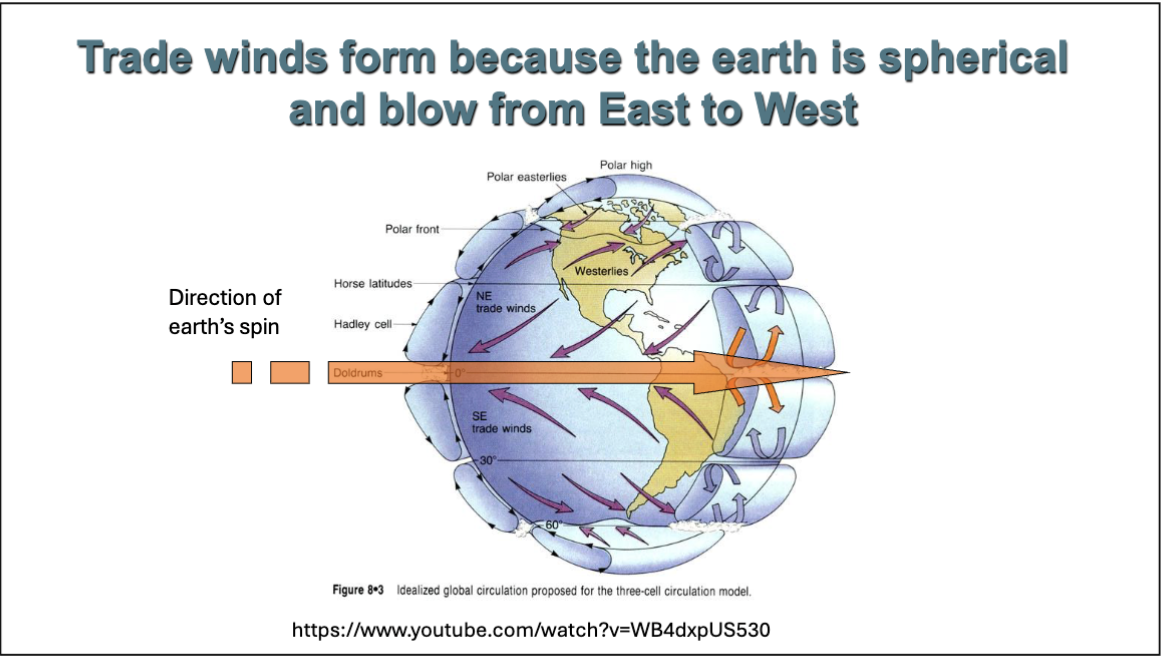
trade winds form because the earth is spherical and blow from east to west
note that the “doldrums” occur at equator where the air is basically rising up because of intense heating
air rises to top of the troposphere (about 7 miles up)
what factors affect ocean circulation?
at ocean surface, large-scale gyres are driven by winds and Coriolis forces
shallow current are driven by prevailing winds
Drivers of water movement: Gradients in heat and salinity, and the winds. Ocean has a huge effect on local land surface temperatures. A lot of our warmth is owed to the Gulf Stream. Takes water about 1000 years to totally circle the globe, but circle it does.
global climate is modified to produce regional climate by: 1. landmasses
landmasses: heat faster than oceans (ex: monsoons, land-sea breeze)
regional climate is then created by these global climate cycles in addition to land…which has a lower heat capacity (requires less energy to heat it a degree) relative to water
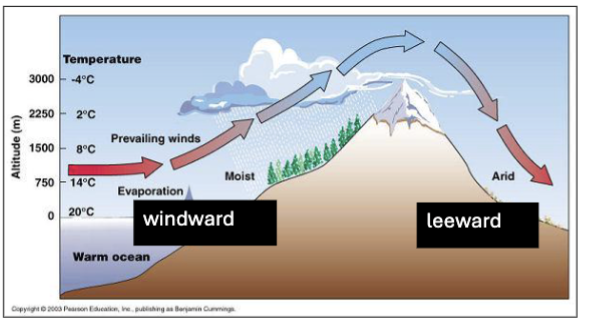
global climate is modified to produce regional climate by: 2. mountain ranges
mountain ranges: deflect winds, produce rain gradients
mountain ranges affect wind current and precipitation patterns
global climate is modified to produce regional climate by: 3. ocean
ocean: moderates temp. and rainfall
microclimate
a local zone where the climate differs from the surrounding area
what’s the difference between climate and weather?
weather: the day-to-day state of the atmosphere, and its short-term variation in minutes to weeks
climate: how the atmosphere behaves over a relatively long period of time
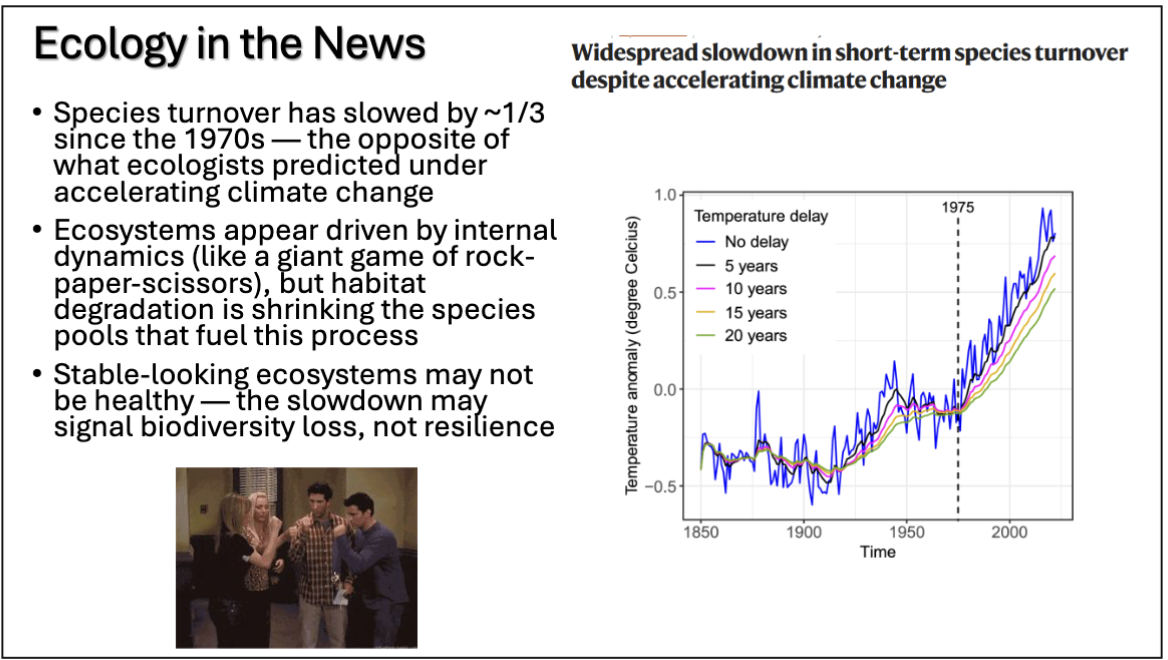
ecology in the news
Species turnover has slowed by ~ 1/3 since ecologists predicted unite o accelerating climate change
Ecosystems appear driven by internal paper-scissors), but habitat of rock-degradation is shrinking the species pools that fuel this process
Stable-looking ecosystems may not signal biodiversity loss, not resilience
greenhouse gases
greenhouse gas: a gas that absorbs and emits infrared (heat) radiation, but not radiation in or near the visible spectrum
water
CO2
methane
N2O (nitrous oxide)
O3 (ozone)
CFCs (chlorofluorocarbons)
impacts of global warming
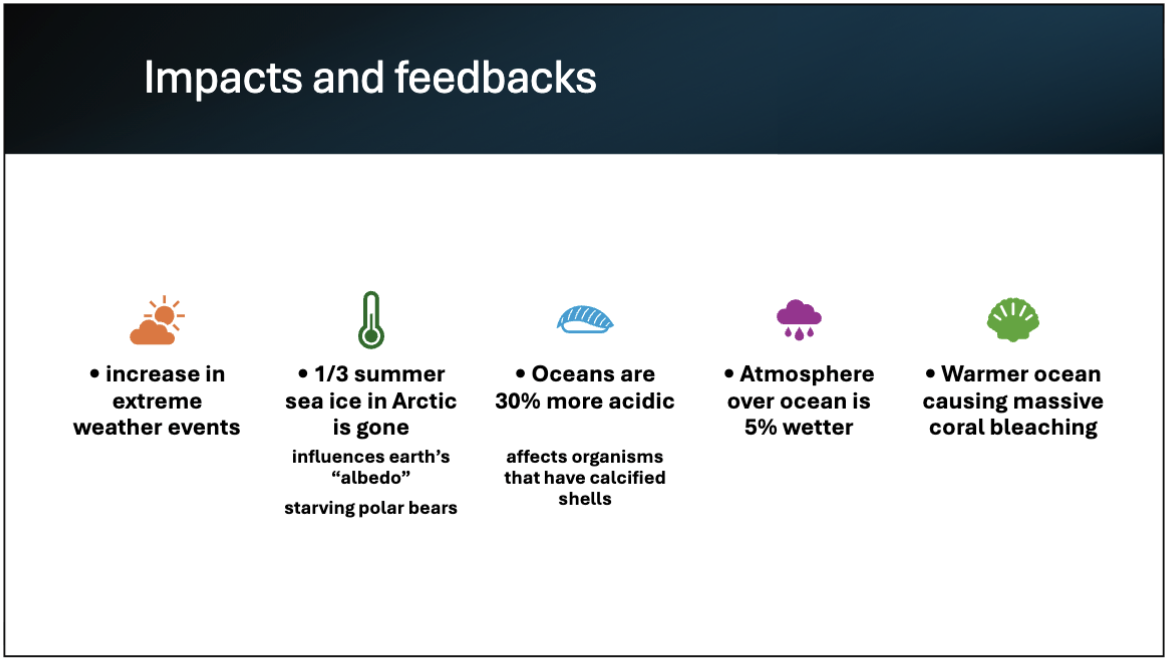
Polar bears use sea ice to hunt, and it's melting earlier, restricting the time they can hunt
High ocean temperatures have already caused massive coral bleaching Rising CO2 causes more dissolved CO2 in ocean, combining with H20 to become H2CO3 (carbonic acid), which dissociates to H+ ions and Bicarbonate (HCO3).
Excess H+ ions (from acidity) suck up carbonate ions in ocean, which are needed for calcification of shells of many marine critters.
in summary!
Coriolis forces cause the prevailing winds (East to West)
Global Climate driven by sun, planet movement, and circulation (atmospheric and oceanic)
• “Climate” = long term patterns
• “Weather” = short term patterns
• Regional climate a product of global climate + land mass + mountain ranges + ocean (water mass)
• Climate changing due to greenhouse gas effect

