Competitive Markets
 Studied by 0 people
 Call with Kai
 Learn
Learn Practice Test
 Spaced Repetition
 Match
Match Flashcards
 Knowt Play
1/94

There's no tags or description
Looks like no tags are added yet.
Name | Mastery | Learn | Test | Matching | Spaced | Call with Kai |
|---|
No study sessions yet.
95 Terms
What are markets?
Markets are where Goods and Services are Bought and Sold
What are sub-markets?
Smaller markets that make up a market. (For example, the labour market
is made up of lots of sub-markets, e.g. the market for teachers, engineers and doctors.)
How are prices charged and quantities sold determined?
The levels of supply and demand in a market
What is the definition of demand?
The quantity of a good/service that consumers are WILLING AND ABLE to pay, at a given price, at a given time.
Technical terms for demand decreasing & increasing respectively?
Contraction in demand & Extension in demand
How does a contraction in demand occur?
It occurs when the price increases.
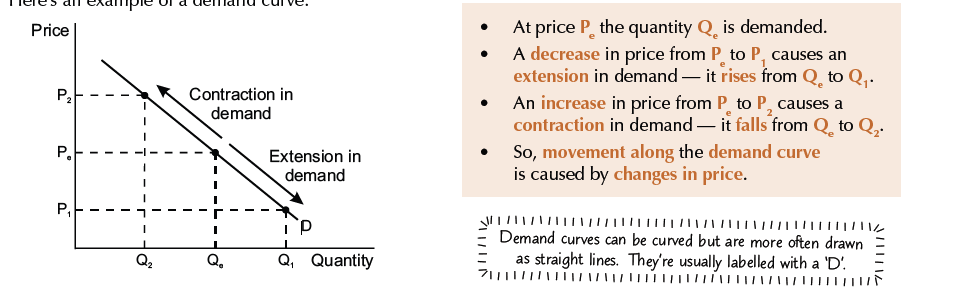
How does an extension in demand occur?
The price decreases.
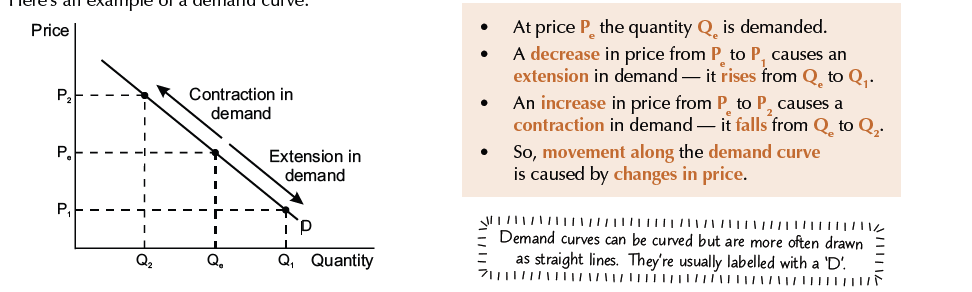
How does demand change?
By price changes. This is movement along the demand curve, NOT A SHIFT.
The relationship between price and quantity demanded can also be explained using the law of diminishing marginal utility. How?
The law of diminishing marginal utility explains why demand curves slope downwards: as consumption increases, the marginal utility from each additional unit falls, so consumers are only willing to purchase extra units at lower prices.
What is real income?
Real income is income adjusted for prices and inflation; it shows the quantity of goods and services that a given amount of money can buy.
What is the income effect?
Assuming a fixed level of income, the income effect means that as a price falls the amount that consumers can buy with their income increases, and so demand increases.
What is the substitution effect?
A fall in the price of a good makes it relatively cheaper than other goods, so consumers will increase demand for the cheaper good and reduce demand for the more expensive good
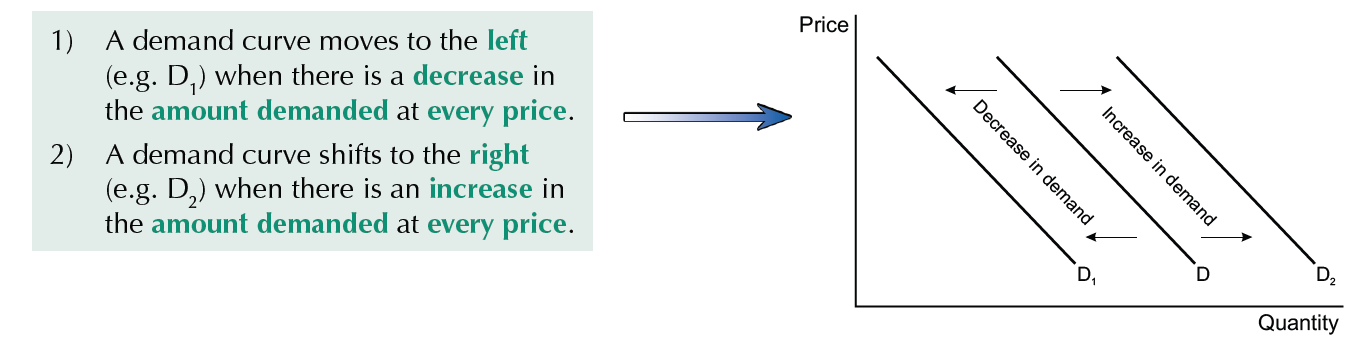
What causes a shift in the demand curve?
A change in demand
How does the demand curve change if demand AT EVERY PRICE decreases and increases respectively?
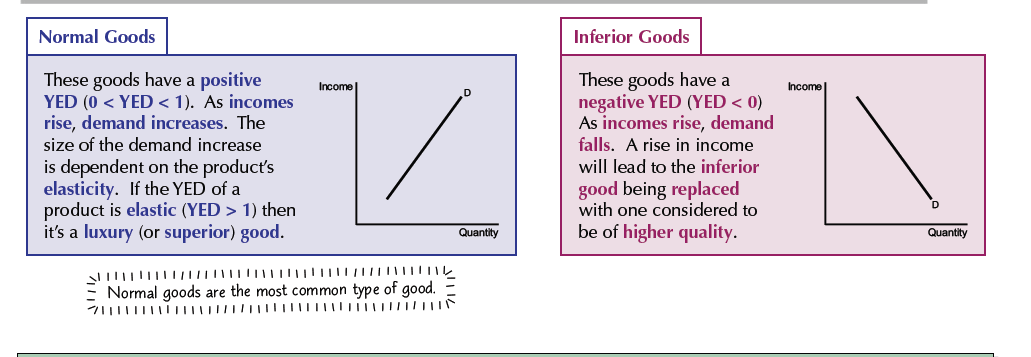
Difference between normal and inferior goods?
When real income increases, normal goods increase in demand (expensive clothes). Inferior goods decrease in demand (pot noodles)
What are some factors that cause a shift in the demand curve?
A common mnemonic:
PINTS WEG
Population
Income
Neighbouring goods (substitutes & complements)
Tastes
State policies
Weather
Expectations
Government / advertising
What would a more equal distribution of income do to a demand curve for luxury goods?
Shift to left, since fewer MEGA rich people buying these luxury items…
What are interrelated markets?
Changes in one market affect a related market.
What are substitute goods?
Those which are alternatives to each other — e.g. beef and lamb.
What does the price change of an item mean for its substitute?
e.g Beef and Lamb are substitutes. If Beef prices increase, whilst Lamb remains the same, then the demand for Lamb will be higher, Beef demand will fall
What is competitive demand?
Competitive demand occurs when an increase in the demand for one good leads to a decrease in the demand for another, as consumers switch between substitute products.
What are complementary goods?
Goods that are often used together, so they’re in joint demand
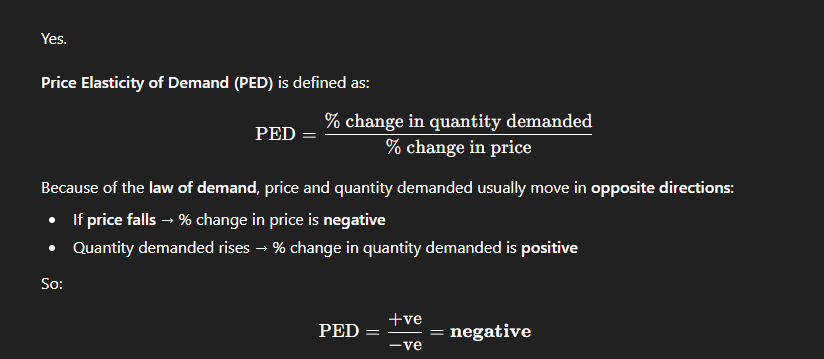
What is price elasticity of demand?
Shows how demand changes with price
How is PED calculated?

Would PED be negative if the % change in quantity demanded was positive?
Yes, it is usually positive
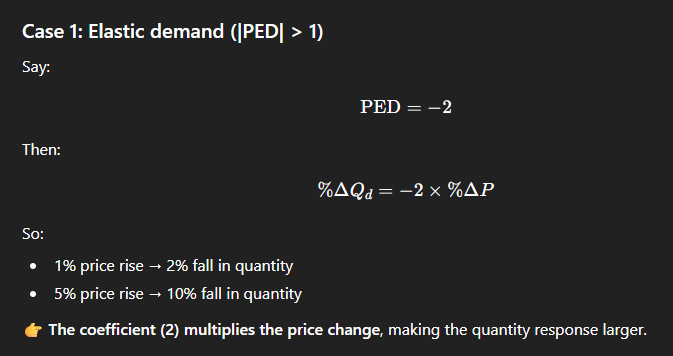
What does it mean for a good to have an elasticity greater than 1 (or less than -1) ?
It is elastic. The higher the PED, the more elastic the demand is for the good. This occurs when the
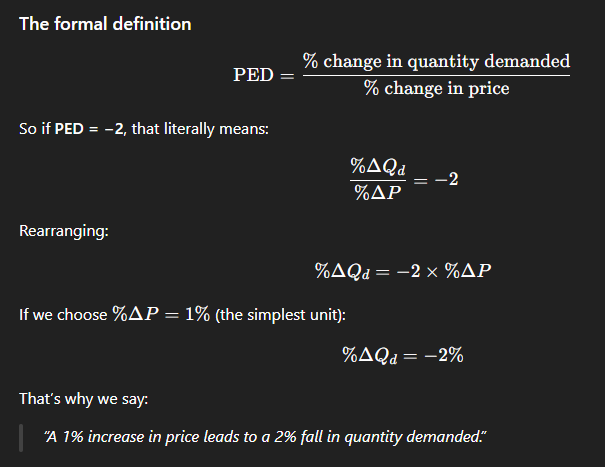
Why is PED defined per 1% change in price?
Other words for Elastic & Inelastic?
RELATIVELY Elastic/Inelastic
What does it mean for % change in demand if elastic?
This means a percentage change in price will cause a larger percentage change in quantity demanded.
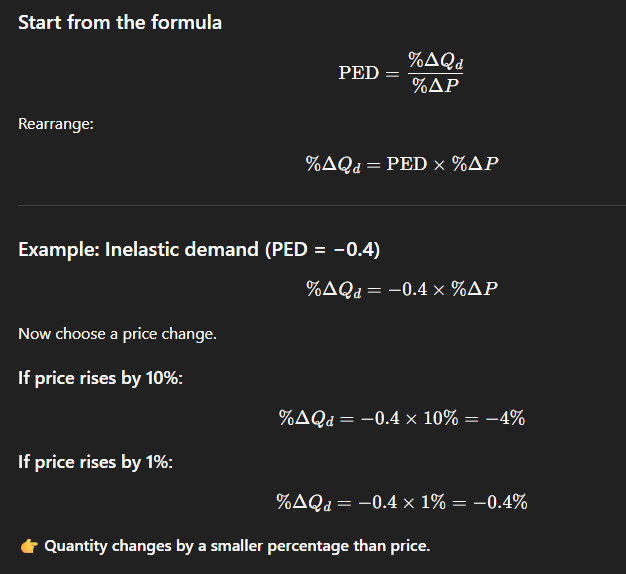
What is Inelastic Demand?
0 < PED < 1
What does it mean for the % change of quantity demanded if % change in price occurs (INELASTIC)?
% change in quantity demanded will DECREASE
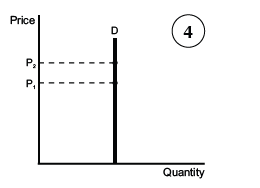
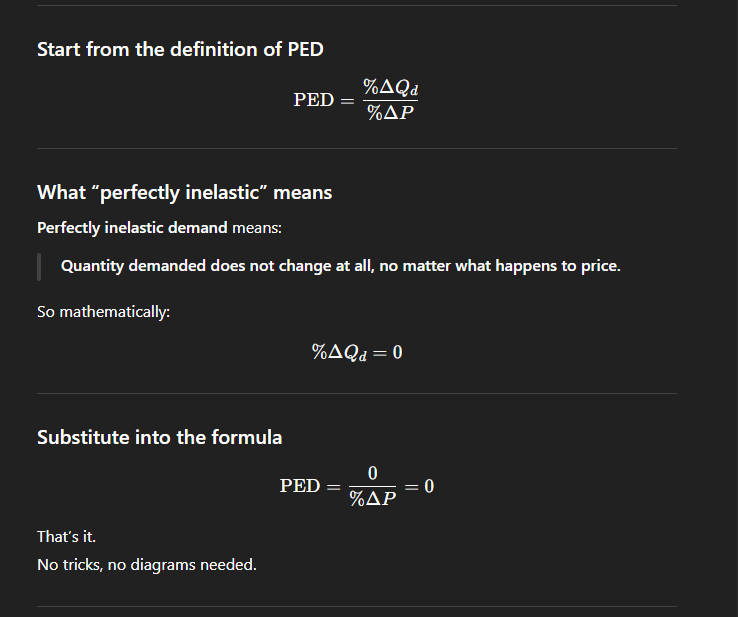
What is the PED for perfectly inelastic demand?
0
What does it mean if the PED of a good is 0?
ANY change in price will have no effect on the quantity demanded
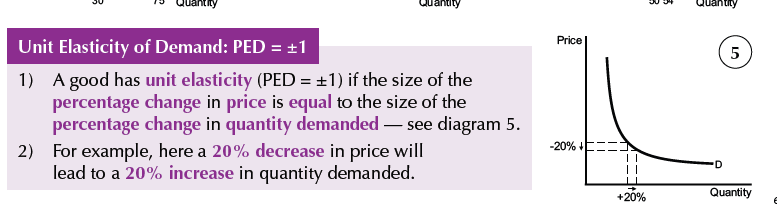
What is the PED of unit elasticity of demand?
1
What causes some goods to be inelastic?
No substitutes (Petrol)
Essentials for survival (Insulin)
Addiction (Drugs)
Is the PED of a perfectly inelastic = 0
Yes
What does Income Elasticity of Demand (YED) show?
How demand of a quantity changes with REAL income

Difference between an Income-inelastic normal good vs income-elastic normal good?
0 < YED < 1 = Income-inelastic normal good (quantity demanded change smaller) - necessities
YED > 1 = Income elastic normal good (Holidays, expensive goods) - if price changes, larger % change in quantity.
What does XED show?
Cross Elasticity of Demand. It show how the quantity demanded of one good responds to a change in PRICE of another.

What is the XED if A & B are substitutes or complements?
The closer the substitute, the higher the positive XED!
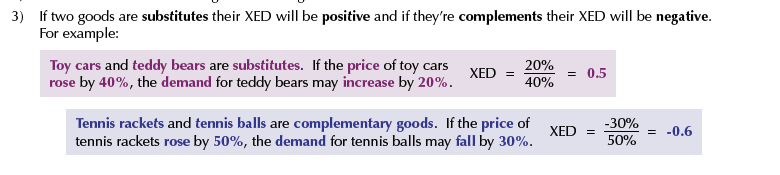
What if the XED for two goods = 0
They are independent
What are the 3 Elasticity of Demands?
PED, XED, YED
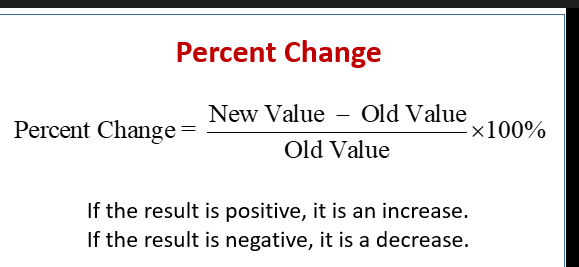
What is the percentage change formula?
NEW-OLD/OLD
How does time affect elasticity?
Time increases elasticity because it increases consumers’ ability to adjust their behaviour.
How do total revenue and PED link (Graphs)?
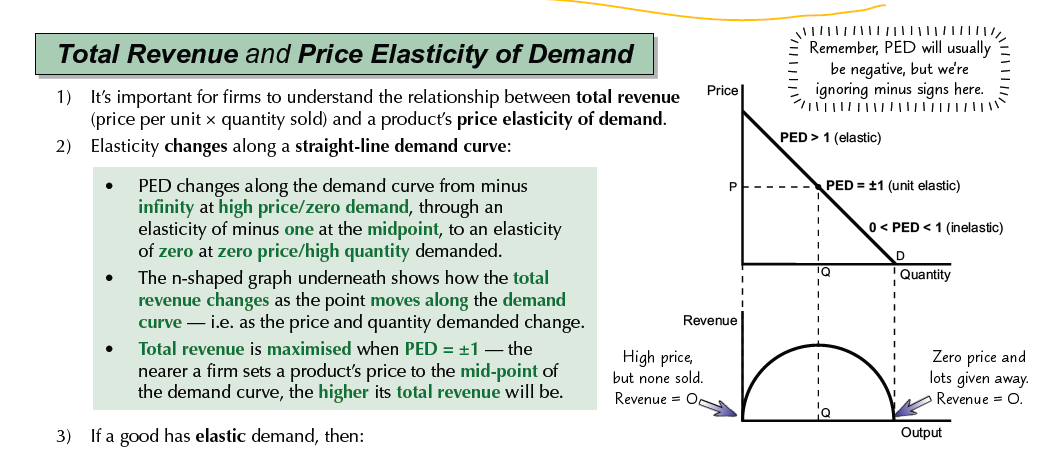
How is revenue of a good with elastic demand affected if price increase/decreases?

How is revenue of a good with inelastic demand affected if price increase/decreases?

How does YED change for normal goods and inferior goods?
What is pricing policy?
Pricing policy is about how a firm decides the prices it will charge for its products over time, in order to achieve its objectives.
How can YED be used for pricing policy making?
If a change in income levels is expected, firms can adjust prices to offset the resulting change in quantity demanded, helping to achieve objectives such as revenue or profit maximisation.
What is supply definition?
Supply is the quantity of a good or service that producers supply to the market at a given price, at a particular time.
What are the terms for supply when an increase/decrease in price occur?
Extension and contraction
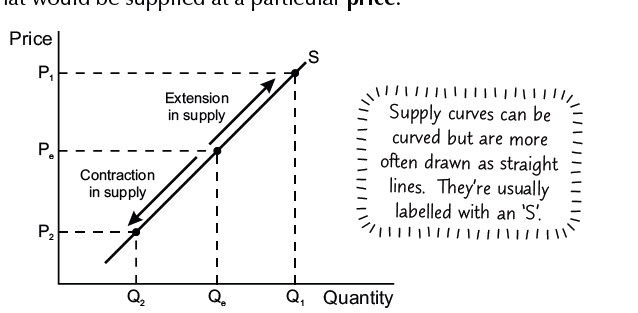
What does increasing supply also increase?
Costs. Firms will only produce more if the price increases by more than the cost.
How can a supply curve shift?
When there is an increase/decrease in supply AT EVERY PRICE
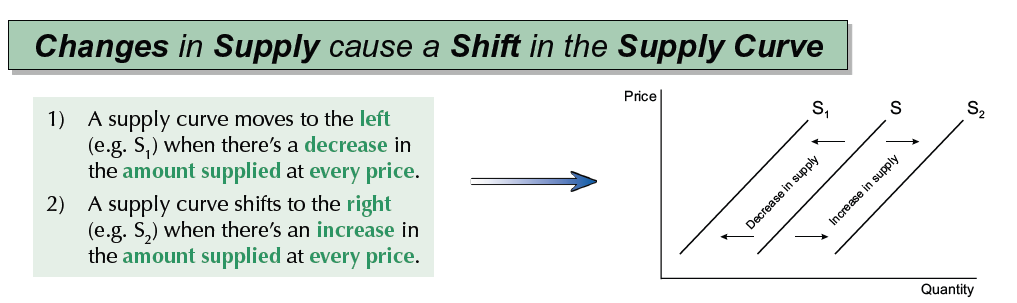
What are the 6 factors that cause a shift in the supply curve?
Changes to the cost of production - if cheaper to produce, supply curve shifts to right.
Improvements in technology - can increase supply as they reduce the cost of production.
Changes to productivity of factors of production - more output from a unit of the factor (e.g more productive staff lead to increase in output and shift the supply curve to the right)
Indirect taxes and subsidies - Indirect tax on good effectively increase cost for producer, meaning supply is reduced and supply curve shifts to left. Subsidy REDUCES cost for producers, leading to increased level of supply (shift to right)
Changes to price of other goods - A rise in the price of one good makes it more profitable relative to others, causing firms to divert resources away from alternative products, reducing their supply. (opportunity cost)
Number of suppliers - Increase in number of suppliers in a market will increase supply (curve shift to right)
What is PES?
Price Elasticity of Supply measures how the quantity supplied of a good responds to a change in its price.
What are the units of PES and PED?
NO UNITS!
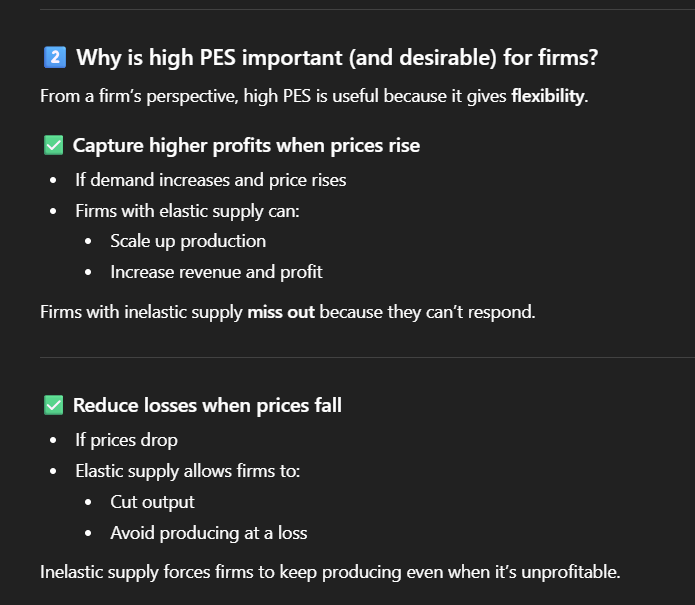
Why is high PES important to firms?
A high PES means quantity supplied changes a lot in response to a change in price. If firms can raise/reduce output quickly, they can capture higher profits/ reduce losses.
How can firms be best suited to improve the elasticity of supply? (3 things)
Flexible working patterns
Using latest technology
Having spare production capacity
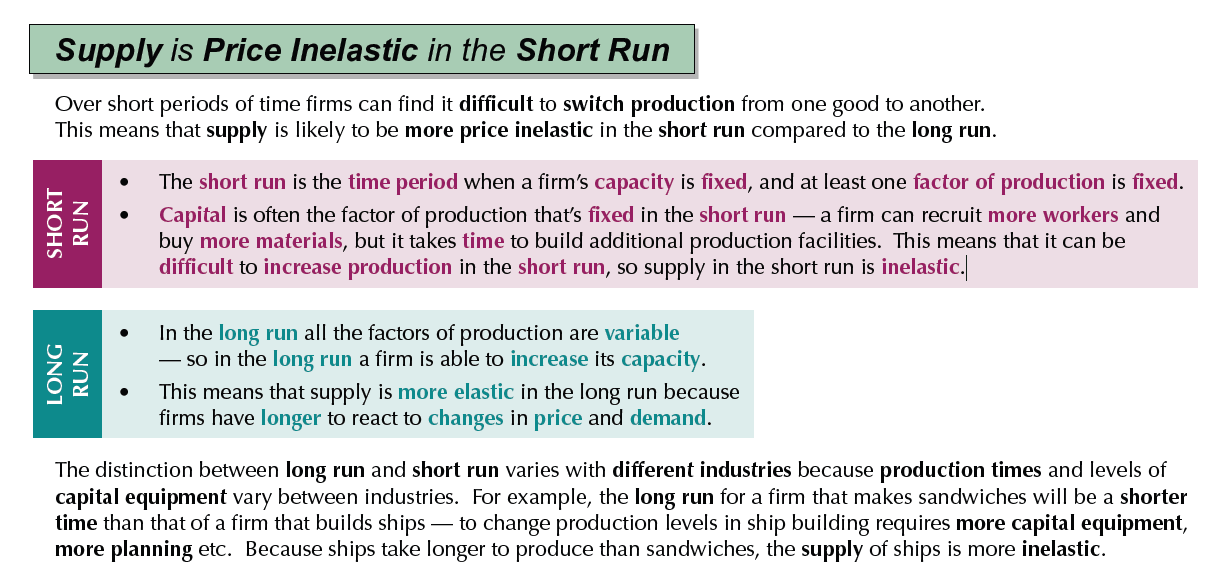
Why is supply price inelastic in short run?
The short run is the time period when a firm’s capacity is fixed, and at least one factor of production is fixed.
• Capital is often the factor of production that’s fixed in the short run — a firm can recruit more workers and buy more materials, but it takes time to build additional production facilities. This means that it can be difficult to increase production in the short run, so supply in the short run is inelastic.
Difference between short term and long term for PES?
What does it mean if a company is in the Short Run?
The time period when a firm’s capacity is fixed, and at least one of the firm’s factors of production (Land, Labour, Capital, Enterprise) is FIXED.
e.g Capital is often the factor of production that is fixed in short run - recruiting more workers and buying more materials is much easier to achieve than to build additional production facilities (so its difficult to increase production in the short run)
What does it mean when a firm’s capacity is fixed?
The firm has a maximum level of output it cannot exceed in the short run, no matter how high the price goes.
What is the difference between factors of production that are fixed vs variable?
Fixed factors are inputs whose quantity cannot be changed in the short run, regardless of output level.
Variable factors are inputs whose quantity can be changed in the short run to alter output.
When is a market in equilibrium?
Supply = Demand
What does it mean if the market is cleared?
The amount sellers wish to sell is equal to the amount that buyers demand.
What is a “free interaction”?
“Free interaction” means that price and quantity are determined naturally by buyers and sellers, without outside interference.
When is a market in disequilibrium?
When supply and demand ARE NOT equal
How do market forces act to remove excess supply & demand?
Market forces remove excess supply and demand through price changes: surpluses cause prices to fall, while shortages cause prices to rise, restoring equilibrium.
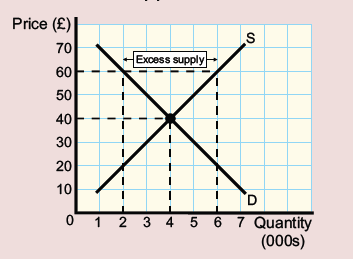
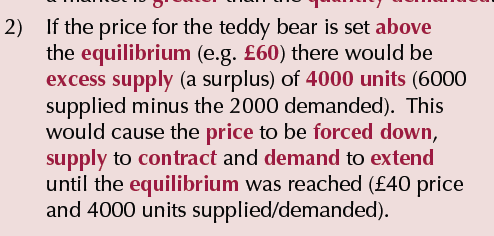
How much excess supply is generated?
4000 (Always Supply - Demand if Excess supply or other way round for excess demand)
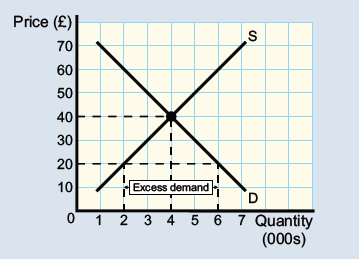
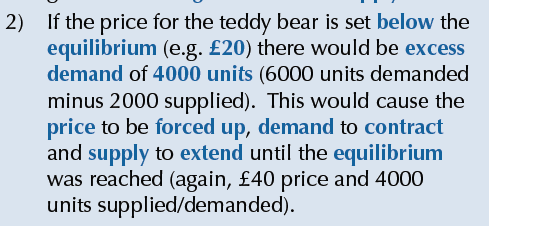
How much excess demand?
4000
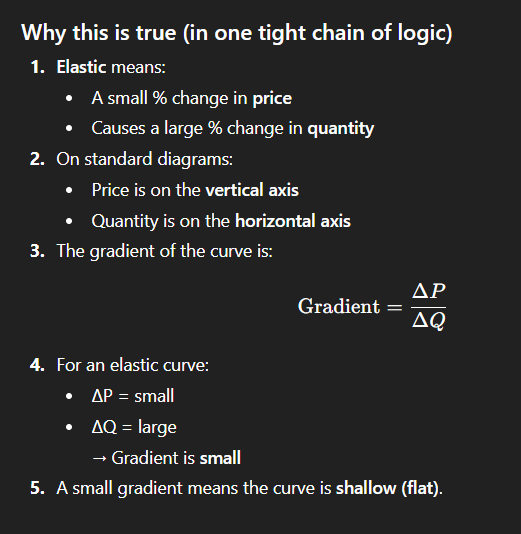
What does the gradient look like for an elastic curve vs inelastic curve?
Elastic = shallower (since quantity responds a lot to price or responsive to a change in price)
Inelastic = steeper (quantity unresponsive to price, so must be a large change in quantity demanded for price to increase a lot)
Assuming gradient = 1
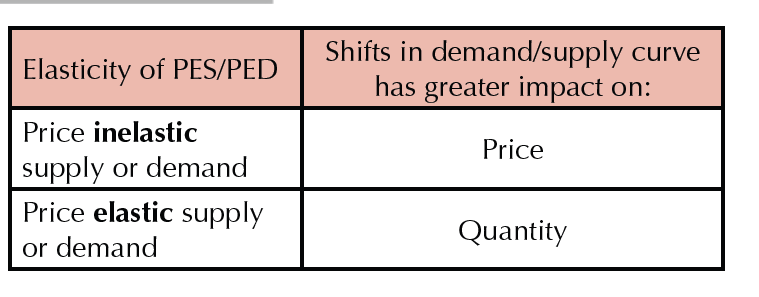
How does elasticity affect the position of the new equilibrium price?
What 3 assumptions are made with the demand & supply models?
Supply and demand are independent of each other.
• All markets are perfectly competitive.
Ceteris paribus
Why for demand & supply models do we assume supply & demand are independent of each other?
Supply and demand are assumed to be independent so that consumer and producer behaviour can be analysed separately, allowing economists to clearly explain how price and quantity are determined through their interaction.
What does it mean for a market to be perfectly competitive?
A perfectly competitive market is one in which many buyers and sellers trade identical products with perfect information and free entry and exit, so firms are price takers and prices are determined SOLELY by market forces.
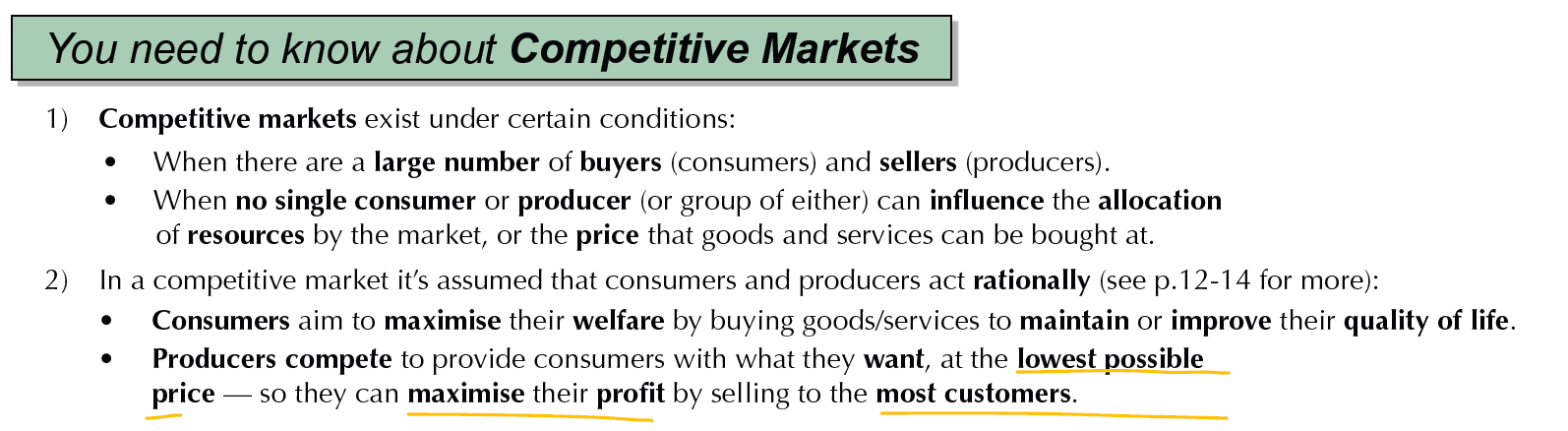
What conditions do competitive markets exist under?
Large number of buyers (consumer) AND sellers (producers)
No single consumer OR producer can influence allocation of recourses by the market, OR the price that goods/services can be bought at.
Consumers aim to maximise their welfare, producers aim to maximise profits.
What is the main way of allocating resources in a market economy?
Price!
What is the definition of price?
The value at which a good or service is EXCHANGED.
What is the price mechanism?
Allocates goods/services in an IMPERSONAL WAY (invisible hand), as prices change until equilibrium is achieved (supply = demand).
Incentives being e.g the supplier will supply more if the price is high, consumers will demand more if price is low.
Why is price mechanism important?
Free from bias and opinions. Coordinates decision of buyers and sellers without cooperation.
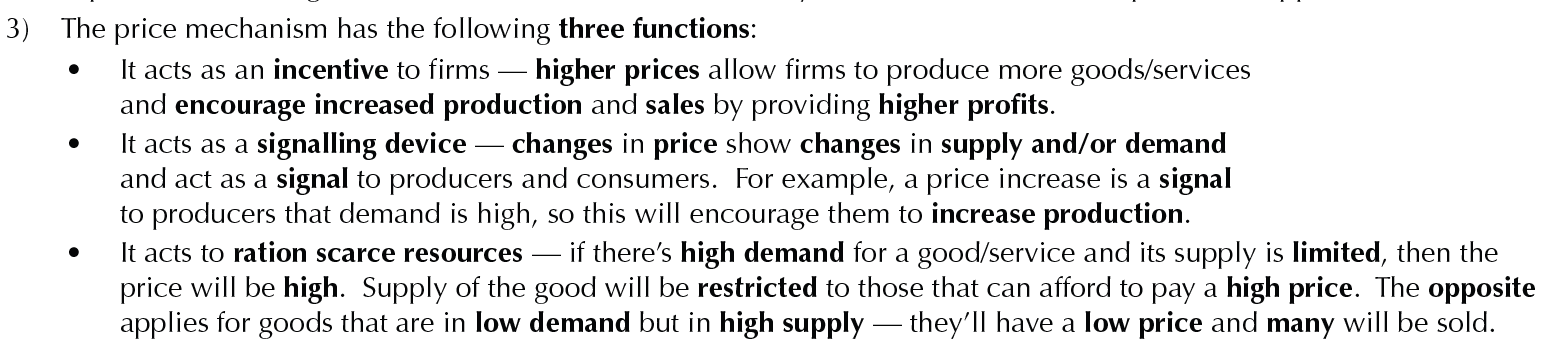
What is the price mechanism’s 3 functions?
Acts as:
Incentive to firms (higher prices allow firms to produce more goods/services and encourage increased production and sales by providing higher profits.)
Signalling device (changes in price show changes in supply/demand, signalling to producers that demand is high, and encourages them to increase production)
Rationing scarce resources (e.g housing)
What is meant by a scarce resource?
Scarce means that resources are limited in supply relative to unlimited wants.
Scarcity can exists even with goods that are abundant. Scarcity is about relative shortage, not absolute shortage (e.g water in desert, oil during embargo)
Does the price mechanism also allocate resources used to produce goods/services?
Yes
What are merit goods?
Merit goods are goods whose social benefits exceed their private benefits, leading to under-consumption if left to the market.
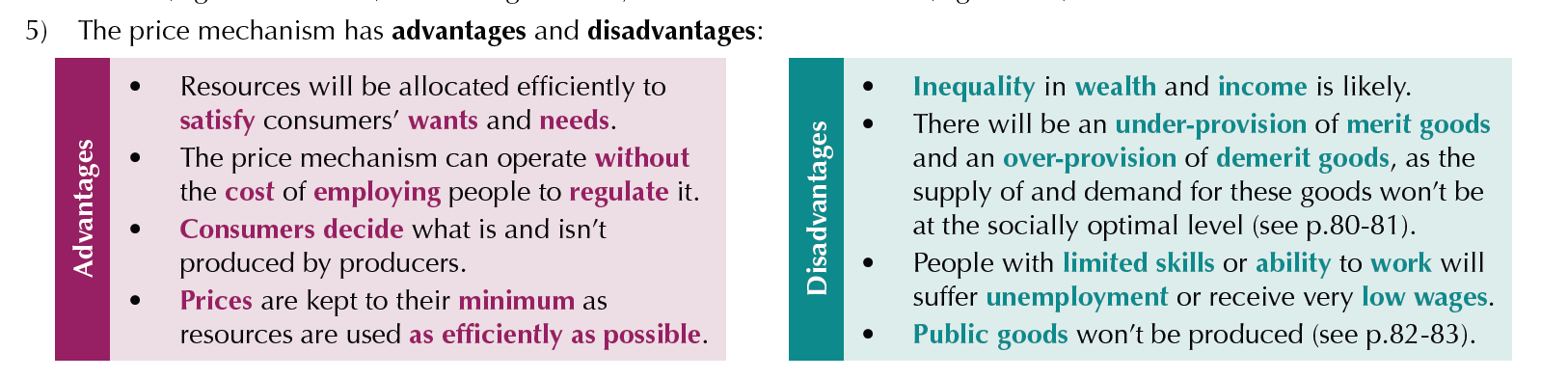
Advantages & disadvantages of price mechanism?
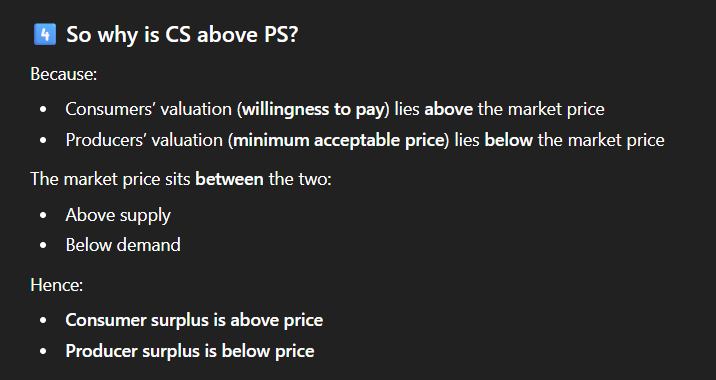
What is consumer surplus?
The difference between the prices consumers are willing to pay and what they actually pay (equilibrium price)
What is producer surplus?
The difference between the prices producers are willing to supply at and what they actually receive (equilibrium price)
Where is CS and PS on P-Q graph?
• Consumer surplus — the area below the demand
curve and above the equilibrium price line.
• Producer surplus — the area above the supply
curve and below the equilibrium price line.
What are subsidies?
A subsidy is money paid by the government to the producer of a good to make it cheaper than it would be otherwise.
What are indirect taxes?
Taxes levied on a good to reduce the demand for it (alcohol).
What does it mean if a tax is levied on a good?
A tax is levied when it is imposed by the government on producers or consumers.
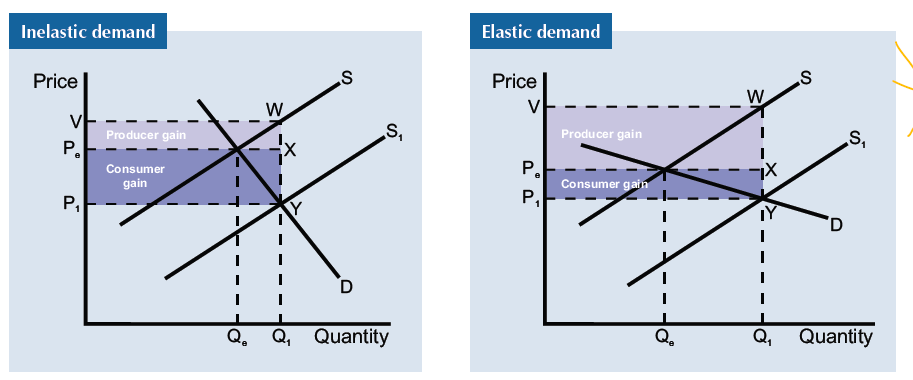
How are the benefits of subsidies dependent on the price elasticity of demand?
• The more price inelastic the demand curve is, the greater the consumer’s gain is from the subsidy.
• The more price elastic the demand curve, the greater the producer’s gain is from the subsidy.
What is the difference between decrease and reduction in demand?
Decrease - consumer WANT less AT EVERY PRICE, cause by non-price factors and shift the demand curve to the left.
Reduction (contraction) - consumer BUY less due to price rise. Demand is unchanged. Simply moving up the demand curve.
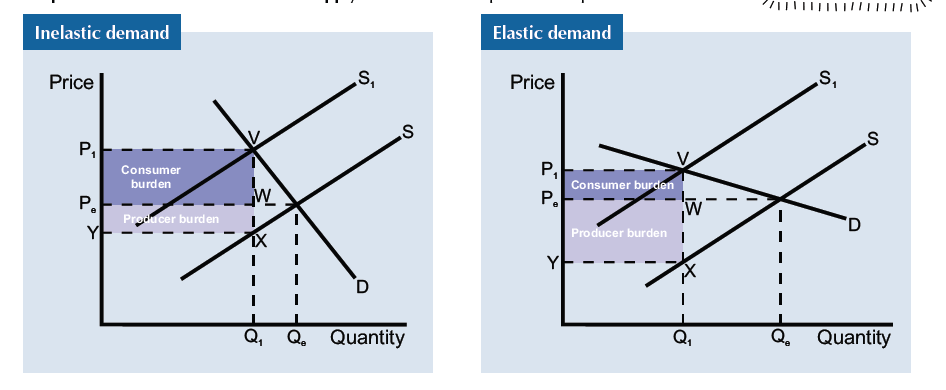
How are the benefits of indirect taxes dependent on the price elasticity of demand?
• The more price inelastic the demand curve, the greater the tax burden for the consumer.
• The more price elastic the demand curve, the greater the tax burden for the producer.
 Note
Note  Flashcards (47)