ch 52
0.0(0)
 Studied by 0 people
 Call Kai
 Learn
Learn Practice Test
 Spaced Repetition
 Match
Match Flashcards
 Knowt Play
Card Sorting
1/103

There's no tags or description
Looks like no tags are added yet.
Last updated 11:03 PM on 4/21/23
Name | Mastery | Learn | Test | Matching | Spaced | Call with Kai |
|---|
No analytics yet
Send a link to your students to track their progress
104 Terms
1
New cards
what is ecology?
the scientific study of the interactions between organisms and the environment
2
New cards
what is the biosphere?
the global ecosystem; the sum of all the planet’s ecosystems
3
New cards
global ecology examines….
the influence of energy and materials on organisms across the biosphere
4
New cards
what is a landscape?
a mosaic of connected ecosystems
5
New cards
landscape ecology focuses on…
the exchanges of energy, materials, and organisms
6
New cards
what is an ecosystem?
the community of organisms in an area and the physical factors with which they interact
7
New cards
what does ecosystem ecology emphasize?
energy flow and chemical cycling among the various biotic and abiotic components
8
New cards
what is a community?
a group of populations of different species in an area
9
New cards
what does community ecology examine?
the effect of interspecific interactions on community structure and organization
10
New cards
what is a population?
group of individuals of the same species living in an areaqw
11
New cards
what does population ecology focus on?
factors affecting population size over time
12
New cards
what is organismal ecology?
study of how an organism’s structure, physiology, and (for animals) behavior meet environmental challenges
* physiological, evolutionary, and behavioral ecology
* physiological, evolutionary, and behavioral ecology
13
New cards
the long-term prevailing weather conditions in an area constitute its …..?
climate
14
New cards
what are 4 major abiotic components of climate?
temperature, precipitation, sunlight, and wind
15
New cards
what is macroclimate?
consists of patterns on the global, regional, and landscape level
16
New cards
what is microclimate?
consists of very fine patterns, such as those encountered by the community of organisms underneath a fallen log
17
New cards
Global climate patterns are determined largely by…
solar energy and Earth’s movement in space
18
New cards
The warming effect of the sun causes ____ variations, which drive ______ and the circulation of air and water. This causes _____ variations in climate
temperature; evaporation; latitudinal
19
New cards
where is the intensity of sunlight the strongest?
in the tropics (between 23.5° north latitude and 23.5° south latitude) where sunlight strikes Earth most directly
20
New cards
what plays major roles in determining climate patterns?
global air circulation and precipitation patterns
21
New cards
Water evaporates in the tropics, and warm, wet air masses flow from the tropics toward the _____
poles
22
New cards
Rising air masses release water and cause high _____, especially in the tropics.
precipitation
23
New cards
___ , descending air masses create arid climates, especially near 30° north and south
Dry
24
New cards
does air flowing close or far away from Earth’s surface create predictable global wind patterns?
close
25
New cards
Cooling trade winds blow from __ to ___in the tropics; prevailing westerlies blow from _____ in the temperate zones
east to west; west to east
26
New cards
what three things is climate affected by?
seasonality, large bodies of water, and mountains
27
New cards
seasonality:
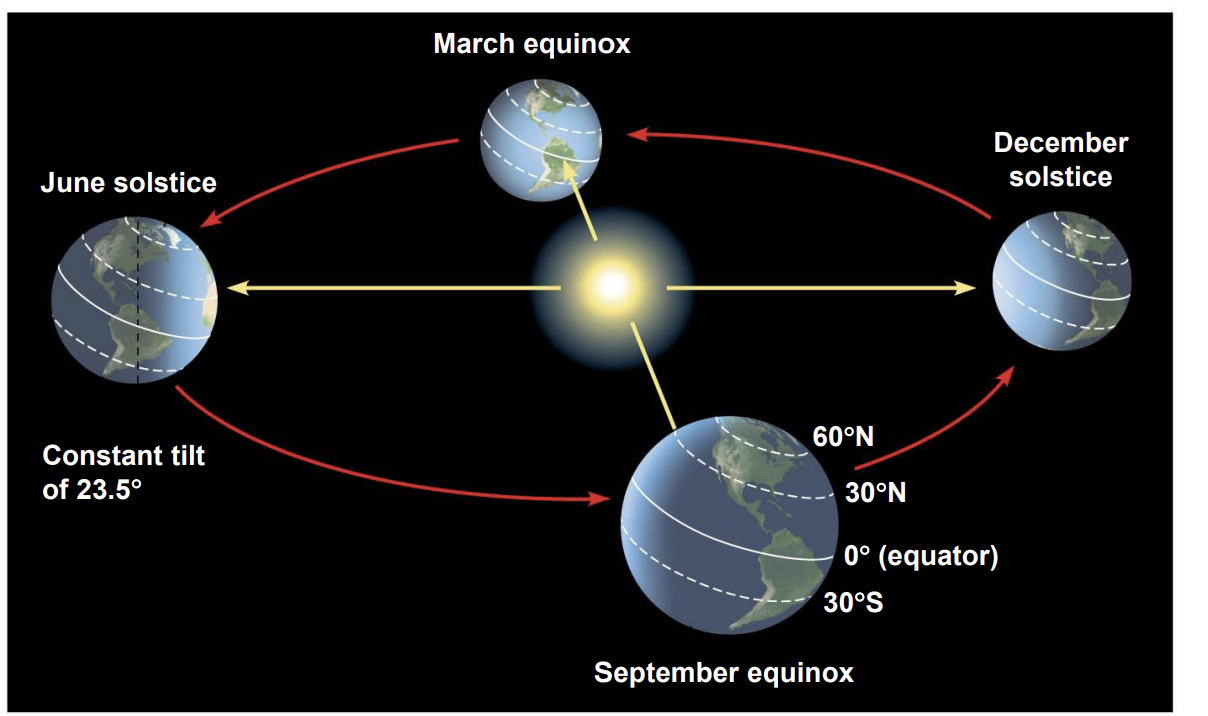
Belts of wet and dry air straddling the equator shift throughout the year with the changing angle of the __*___*__. Changing ___ patterns affect ocean currents
Belts of wet and dry air straddling the equator shift throughout the year with the changing angle of the __*___*__. Changing ___ patterns affect ocean currents
sun; wind
28
New cards
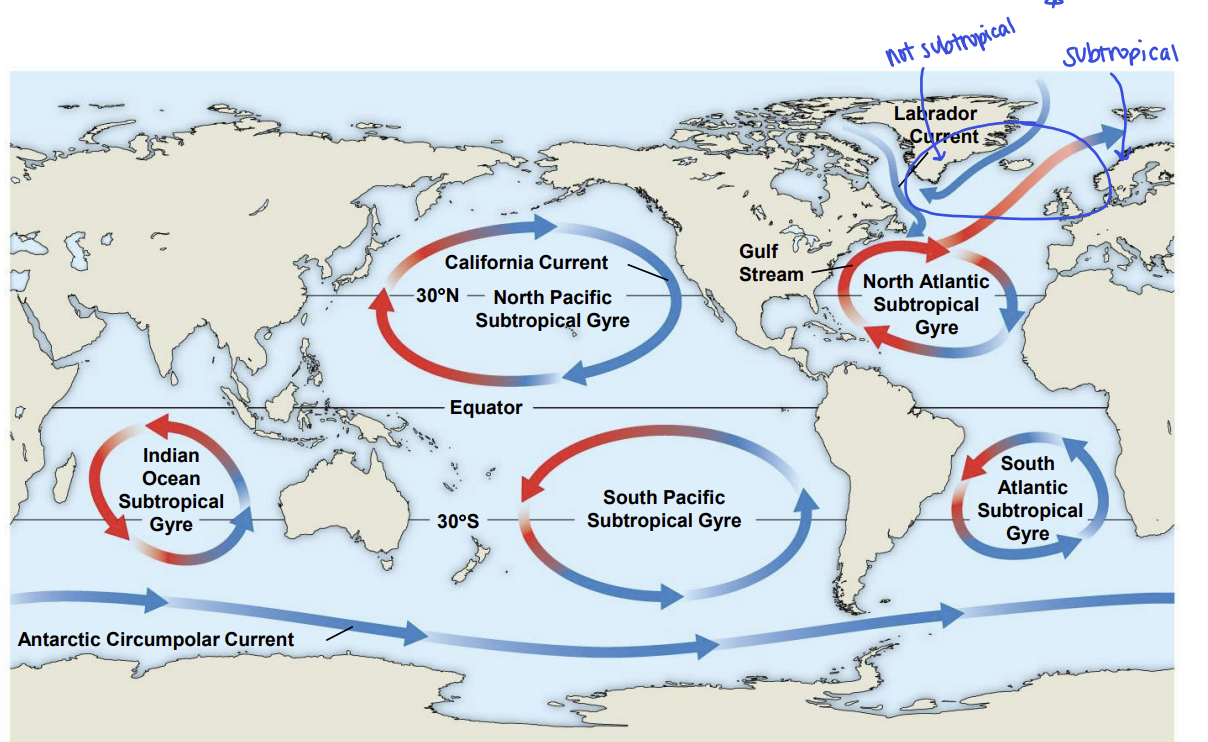
bodies of water affect on climate: (currents)
Currents flowing toward the equator carry cold water from the poles; currents flowing away from the equator carry warm water toward the poles
29
New cards
bodies of water affect on climate: (air)
* During the day, air rises over warm land and draws a cool breeze from the water across the land
* As the land cools at night, air rises over the warmer water and draws cooler air from land back over the water, which is replaced by warm air from offshore
* As the land cools at night, air rises over the warmer water and draws cooler air from land back over the water, which is replaced by warm air from offshore
30
New cards
mountain affect on climate:
* air/moisture
* sunlight
* air/moisture
* sunlight
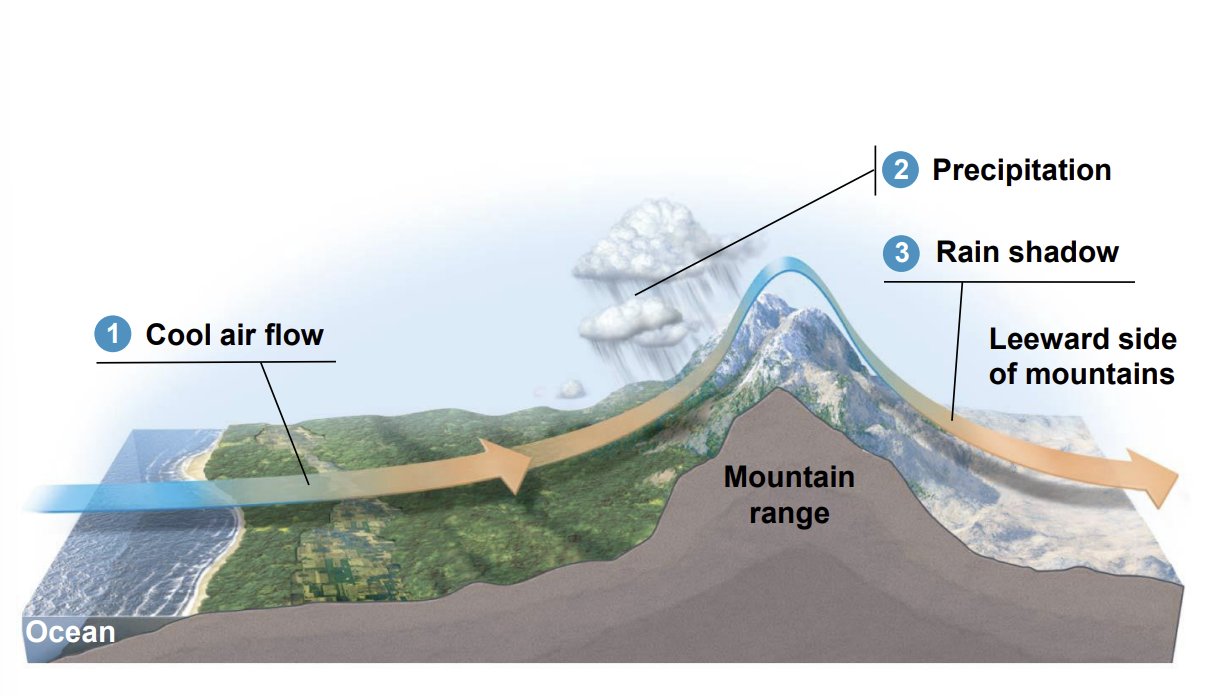
* Rising air releases moisture on the windward side of a peak and creates a “rain shadow” as it absorbs moisture on the leeward side
* Mountains affect the amount of sunlight reaching an area
* In the Northern Hemisphere, south-facing slopes receive more sunlight than north-facing slopes
* Mountains affect the amount of sunlight reaching an area
* In the Northern Hemisphere, south-facing slopes receive more sunlight than north-facing slopes
31
New cards
how is microclimate determined?
by fine-scale differences in the environment that affect light and wind patterns
32
New cards
give examples of abiotic factors in an environment
nonliving attributes such as temperature, light, water, and nutrients
33
New cards
biotic factors are
other organisms that are part of an individual’s environment
34
New cards
what is one way to predict the effect of future global climate change?
study previous years
35
New cards
what are the major life zones characterized by vegetation type (terrestrial) or physical environment (aquatic)?
biomes
36
New cards
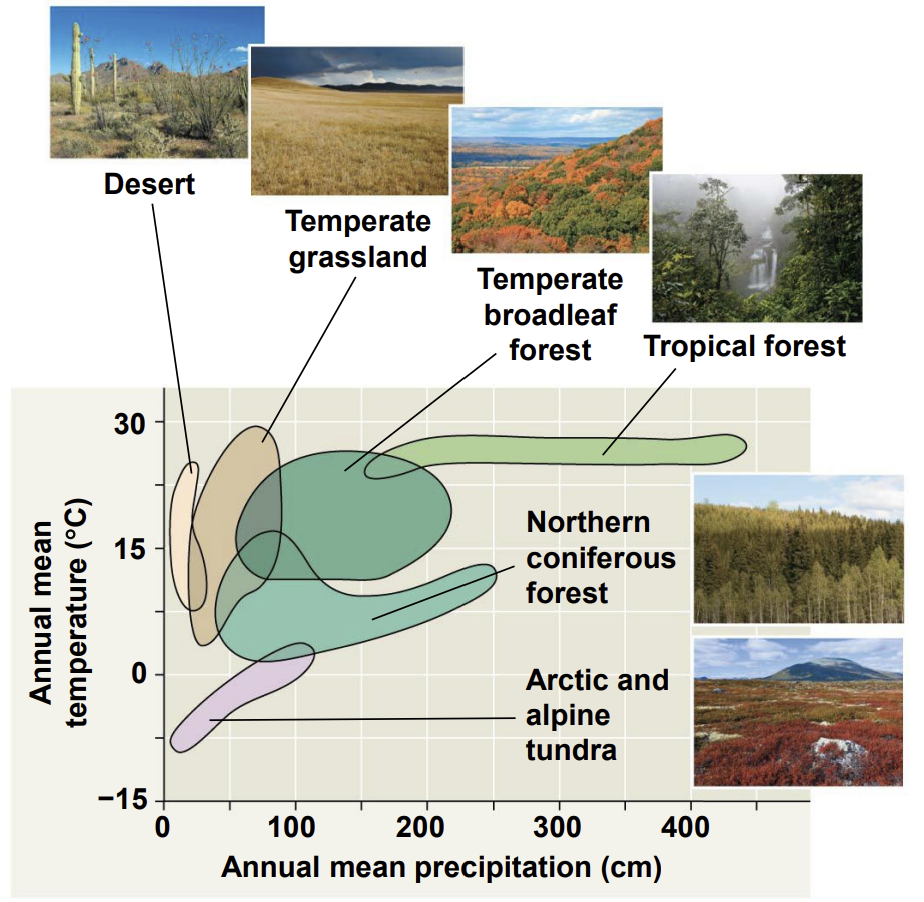
what is used to plot the annual mean temperature and precipitation in a region?
climograph
37
New cards
terrestrial biomes usually show what pattern?
gradation (there are no sharp boundaries, they just flow into one another)
38
New cards
what is the term for the area of intergradation (overlap) in a terrestrial biome?
ecotone
39
New cards
what strategy provides diverse habitats for all animals and can consist of an upper canopy, low-tree layer, shrub understory, ground layer of herbaceous plants, forest floor, and root layer?
vertical layering
40
New cards
what type of evolution can cause similar characteristics to arise in distant biomes?
convergent evolution
41
New cards
what is the term for an event such as a storm, fire, or human activity that changes a community?
disturbance
42
New cards
what are terrestrial biomes characterized by?
distribution, precipitation, temperature, plants, and animals
43
New cards
explain a tropical forest. (distribution, rainfall/precipitation, and temperature, layering, animals, how its being destroyed)
* Distribution is in equatorial and subequatorial regions
* In tropical rain forests, rainfall is relatively constant, while in tropical dry forests, precipitation is highly seasonal
* Temperature is high year-round (25–29 degrees C) with little seasonal variation
* Tropical forests are vertically layered, and competition for light is intense
* Tropical forests are home to millions of animal species, including an estimated 5–30 million still undescribed species of insects, spiders, and other arthropods
* Rapid human population growth is now destroying many tropical forests
* In tropical rain forests, rainfall is relatively constant, while in tropical dry forests, precipitation is highly seasonal
* Temperature is high year-round (25–29 degrees C) with little seasonal variation
* Tropical forests are vertically layered, and competition for light is intense
* Tropical forests are home to millions of animal species, including an estimated 5–30 million still undescribed species of insects, spiders, and other arthropods
* Rapid human population growth is now destroying many tropical forests
44
New cards
explain a desert (where are they, precipitation, temperature, plant adaptations, animals, reduction of biodiversity)
* Deserts occur in bands near 30 degrees north and south of the equator, and in the interior of continents
* Precipitation is low and highly variable, generally less than 30 cm per year
* Temperature is variable seasonally and daily; Deserts may be hot or cold
* Desert plants are adapted for heat and desiccation tolerance, water storage, and reduced leaf surface area
* Common desert animals include many kinds of snakes and lizards, scorpions, ants, beetles, migratory and resident birds, and seed-eating rodents; many are nocturnal
* Urbanization and conversion to irrigated agriculture have reduced the natural biodiversity of some deserts
* Precipitation is low and highly variable, generally less than 30 cm per year
* Temperature is variable seasonally and daily; Deserts may be hot or cold
* Desert plants are adapted for heat and desiccation tolerance, water storage, and reduced leaf surface area
* Common desert animals include many kinds of snakes and lizards, scorpions, ants, beetles, migratory and resident birds, and seed-eating rodents; many are nocturnal
* Urbanization and conversion to irrigated agriculture have reduced the natural biodiversity of some deserts
45
New cards
explain a savanna (distribution, precipitation, temperature, what covers the area, plants, animals, how it is maintained)
* Distribution includes equatorial and subequatorial regions
* Precipitation is seasonal with dry seasons lasting 8–9 months
* Savanna temperature averages (24–29C) but is more seasonally variable than in the tropics
* Grasses and forbs make up most of the ground cover
* The dominant plant species are fire-adapted and tolerant of seasonal drought
* Common inhabitants include insects and mammals such as wildebeests, zebras, lions, and hyenas
* Fires set by humans may help maintain this biome
* Precipitation is seasonal with dry seasons lasting 8–9 months
* Savanna temperature averages (24–29C) but is more seasonally variable than in the tropics
* Grasses and forbs make up most of the ground cover
* The dominant plant species are fire-adapted and tolerant of seasonal drought
* Common inhabitants include insects and mammals such as wildebeests, zebras, lions, and hyenas
* Fires set by humans may help maintain this biome
46
New cards
explain chaparral biome (where, precipitation, temperature/seasons, plants, animals, how they have been reduced)
* Chaparral occurs in midlatitude coastal regions on several continents
* Precipitation is highly seasonal with rainy winters and dry summers
* Summer is hot (30 degrees C); fall, winter, and spring are cool (10–12 degrees C)
* The chaparral is dominated by shrubs, small trees, grasses, and herbs; many plants are adapted to fire and drought
* Animals include amphibians, birds and other reptiles, insects, small mammals, and browsing mammals
* Humans have reduced chaparral areas through agriculture and urbanization
* Precipitation is highly seasonal with rainy winters and dry summers
* Summer is hot (30 degrees C); fall, winter, and spring are cool (10–12 degrees C)
* The chaparral is dominated by shrubs, small trees, grasses, and herbs; many plants are adapted to fire and drought
* Animals include amphibians, birds and other reptiles, insects, small mammals, and browsing mammals
* Humans have reduced chaparral areas through agriculture and urbanization
47
New cards
explain the temperate grassland biome (where, precipitation, temperature/seasons, plants/adaptations, animals, how have they been affected)
* Temperate grasslands are found on many continents
* Precipitation is highly seasonal
* Winters are cold (often below -10 degrees C) and dry; summers are hot (often near 30 degrees C) and wet
* The dominant plants, grasses, and forbs, are adapted to droughts and fire
* Native mammals include large grazers such as bison and wild horses and small burrowers such as prairie dogs
* Most grasslands have been converted to farmland
* Precipitation is highly seasonal
* Winters are cold (often below -10 degrees C) and dry; summers are hot (often near 30 degrees C) and wet
* The dominant plants, grasses, and forbs, are adapted to droughts and fire
* Native mammals include large grazers such as bison and wild horses and small burrowers such as prairie dogs
* Most grasslands have been converted to farmland
48
New cards
explain the northern coniferous forest (where, size, precipitation, seasons/temperatures, plants + adaptations, animals, what’s happening to them)
* The northern coniferous forest, or taiga, spans northern North America and Eurasia and is the largest terrestrial biome on Earth
* Precipitation varies; some have periodic droughts and others, especially near coasts, are wet
* Winters are cold; summers may be hot (e.g., Siberia ranges from -50 degrees C to 20 degrees C)
* Conifers such as pine, spruce, fir, and hemlock dominate
* The conical shape of conifers prevents too much snow from accumulating and breaking their branches
* Animals include migratory and resident birds and large mammals such as moose, brown bears, and Siberian tigers
* Some forests are being logged at an alarming rate
* Precipitation varies; some have periodic droughts and others, especially near coasts, are wet
* Winters are cold; summers may be hot (e.g., Siberia ranges from -50 degrees C to 20 degrees C)
* Conifers such as pine, spruce, fir, and hemlock dominate
* The conical shape of conifers prevents too much snow from accumulating and breaking their branches
* Animals include migratory and resident birds and large mammals such as moose, brown bears, and Siberian tigers
* Some forests are being logged at an alarming rate
49
New cards
explain the temperate broadleaf forest (distribution, precipitation, temperatures/seasons, layers, plants, animals)
* Distribution is primarily at midlatitudes in the Northern Hemisphere, with smaller areas in Chile, South Africa, Australia, and New Zealand
* Significant amounts of precipitation fall during all seasons as rain or snow
* Winters average 0 degrees C; summers are hot and humid (near 35 degrees C)
* A mature temperate broadleaf forest has vertical layers, including a closed canopy, understory trees, a shrub layer, and an herb layer
* The dominant plants are deciduous trees in the Northern Hemisphere and evergreen eucalyptus in Australia
* Mammals, birds, and insects make use of all vertical layers in the forest
* In the Northern Hemisphere, many mammals hibernate in the winter
* These forests have been heavily settled on all continents but are recovering in places
* Significant amounts of precipitation fall during all seasons as rain or snow
* Winters average 0 degrees C; summers are hot and humid (near 35 degrees C)
* A mature temperate broadleaf forest has vertical layers, including a closed canopy, understory trees, a shrub layer, and an herb layer
* The dominant plants are deciduous trees in the Northern Hemisphere and evergreen eucalyptus in Australia
* Mammals, birds, and insects make use of all vertical layers in the forest
* In the Northern Hemisphere, many mammals hibernate in the winter
* These forests have been heavily settled on all continents but are recovering in places
50
New cards
explain the tundra (where, precipitation, seasons/temperatures, plants/soil, animals, what is it a focus for?)
* Tundra covers expansive areas of the Arctic; alpine tundra exists on high mountaintops at all latitudes
* Precipitation is low in arctic tundra and higher in alpine tundra
* Winters are cold (below -30 degrees C); summers are relatively cool (less than 10 degrees C)
* Vegetation is herbaceous (mosses, grasses, forbs, dwarf shrubs and trees, and lichen)
* Permafrost, a permanently frozen layer of soil, restricts the growth of plant roots
* Mammals include musk oxen, caribou, reindeer, bears, wolves, and foxes; many migratory bird species nest in the summer
* Settlement is sparse, but tundra has become the focus of oil and mineral extraction
* Precipitation is low in arctic tundra and higher in alpine tundra
* Winters are cold (below -30 degrees C); summers are relatively cool (less than 10 degrees C)
* Vegetation is herbaceous (mosses, grasses, forbs, dwarf shrubs and trees, and lichen)
* Permafrost, a permanently frozen layer of soil, restricts the growth of plant roots
* Mammals include musk oxen, caribou, reindeer, bears, wolves, and foxes; many migratory bird species nest in the summer
* Settlement is sparse, but tundra has become the focus of oil and mineral extraction
51
New cards
* Aquatic biomes are characterized by their _____ environment
* They show less _____ variation than terrestrial biomes
* Marine biomes have salt concentrations of about ___
* The largest marine biome is made up of ____, which cover about 75% of Earth’s surface and have an enormous impact on the biosphere
* Freshwater biomes have salt concentrations of less than ___
* _____ biomes are closely linked to soils and the biotic components of the surrounding terrestrial biome
* They show less _____ variation than terrestrial biomes
* Marine biomes have salt concentrations of about ___
* The largest marine biome is made up of ____, which cover about 75% of Earth’s surface and have an enormous impact on the biosphere
* Freshwater biomes have salt concentrations of less than ___
* _____ biomes are closely linked to soils and the biotic components of the surrounding terrestrial biome
* physical
* latitudinal
* 3%
* oceans
* 0.1%
* Freshwater
* latitudinal
* 3%
* oceans
* 0.1%
* Freshwater
52
New cards
Many aquatic biomes are stratified into zones or layers defined by ???
light penetration, temperature, and depth
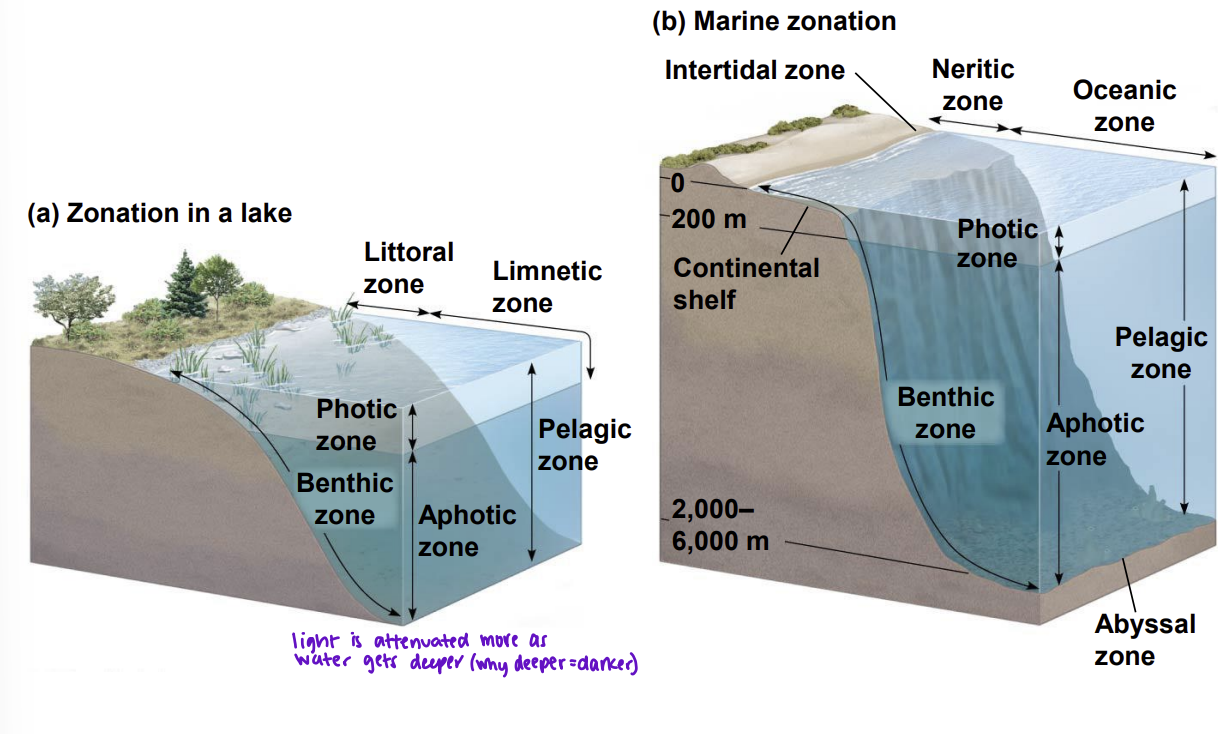
53
New cards
The upper __ zone has sufficient light for photosynthesis, while the lower __ zone receives little light
photic zone; aphotic zone
54
New cards
The photic and aphotic zones make up the _____?
pelagic zone
55
New cards
Deep in the aphotic zone lies the _____ zone with a depth of 2,000 to 6,000 m
abyssal
56
New cards
The organic and inorganic sediment at the bottom of all aquatic zones is called the ___ zone. The communities of organisms in the benthic zone are collectively called the ____.
benthic; benthos
57
New cards
______, dead organic matter, falls from the productive surface water and is an important source of food
Detritus
58
New cards
look at the zones in aquatic environment
..
59
New cards
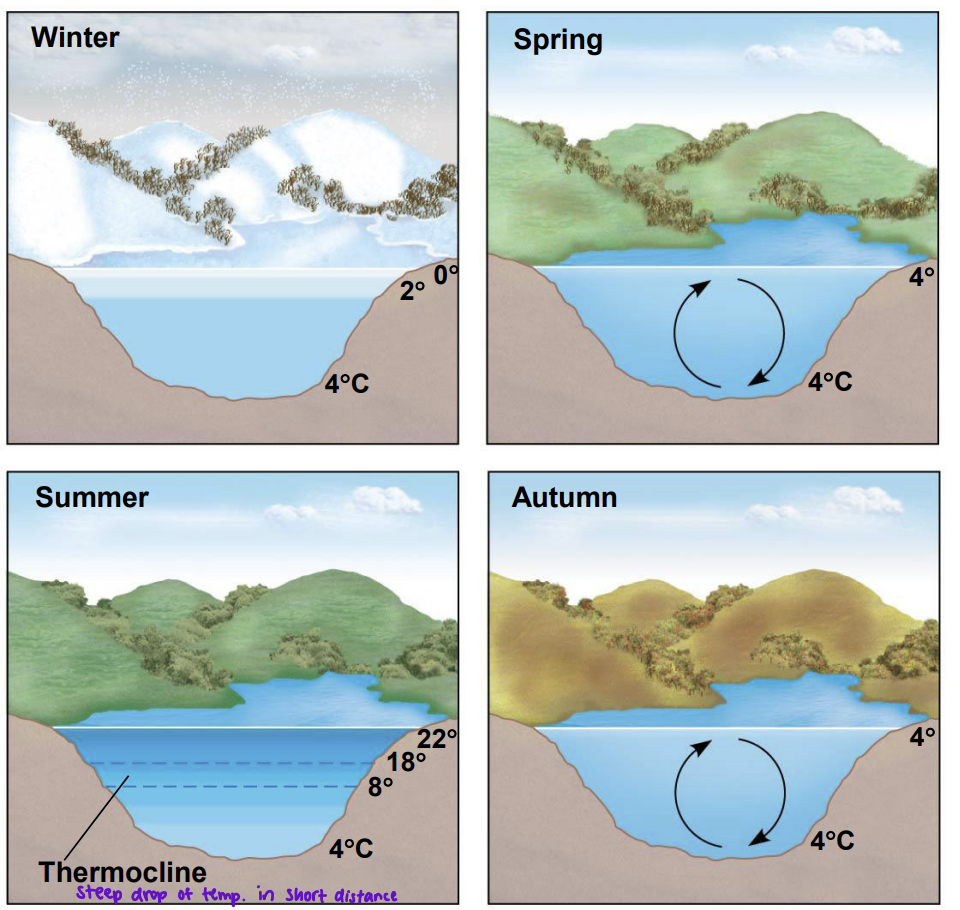
In oceans and most lakes, a temperature boundary called the _____ separates the warm upper layer from the cold deeper water
thermocline
60
New cards
Many lakes undergo a semiannual mixing of their waters called _____.
turnover
61
New cards
turnover mixes what?
oxygenated water from the surface with nutrient-rich water from the bottom
62
New cards
* Communities in aquatic biomes vary with (4 things)?
* Most organisms occur in the relatively shallow ____ zone
* The aphotic zone in oceans is extensive. Is there a lot or little life here?
* Most organisms occur in the relatively shallow ____ zone
* The aphotic zone in oceans is extensive. Is there a lot or little life here?
* depth, light penetration, distance from shore, and position in the pelagic or benthic zone
* photic
* little life here
* photic
* little life here
63
New cards
what are aquatic biomes characterized by?
physical environment, chemical environment, geological features, photosynthetic organisms, and heterotrophs
64
New cards
lakes:
* Size?
* different thermoclines?
* Size?
* different thermoclines?
* varies from small ponds to very large lakes
* Temperate lakes may have a seasonal thermocline; tropical lowland lakes have a year-round thermocline
* Temperate lakes may have a seasonal thermocline; tropical lowland lakes have a year-round thermocline
65
New cards
what is the difference between oligotrophic lakes and eutrophic lakes?
* Oligotrophic lakes are nutrient-poor and generally oxygen-rich
* Eutrophic lakes are nutrient-rich and often depleted of oxygen in deep zones or throughout if ice covered in winter
* Oligotrophic lakes have less surface area relative to depth than eutrophic lakes
* Eutrophic lakes are nutrient-rich and often depleted of oxygen in deep zones or throughout if ice covered in winter
* Oligotrophic lakes have less surface area relative to depth than eutrophic lakes
66
New cards
* Rooted and floating aquatic plants live in the shallow and well-lighted _____ zone close to shore
* Water is too deep in the ___ zone to support rooted aquatic plants; small drifting animals called ____ graze on the phytoplankton
* Water is too deep in the ___ zone to support rooted aquatic plants; small drifting animals called ____ graze on the phytoplankton
* littoral
* limnetic
* zooplankton
* limnetic
* zooplankton
67
New cards
* Zooplankton are …..
* drifting heterotrophs that graze on the phytoplankton
68
New cards
* Invertebrates live in the _____ zone
* Fishes live in all zones with insufficient/sufficient oxygen
* Fishes live in all zones with insufficient/sufficient oxygen
* benthic
* sufficient
* sufficient
69
New cards
in lakes, human-induced nutrient enrichment can lead to …… (3)
algal blooms, oxygen depletion, and fish kills
70
New cards
what is a wetland?
a habitat that is inundated by water at least some of the time and that supports plants adapted to water-saturated soil
71
New cards
Wetlands have high/low organic production and decomposition and have high/low dissolved oxygen
high; low
72
New cards
where can wetlands develop?
in shallow basins, along flooded river banks, or on the coasts of large lakes and seas
73
New cards
what are among the most productive biomes on Earth?
wetlands
74
New cards
what plants and animals live in wetlands? what have humans done to these areas and what do wetlands do for the envrionment?
* Plants include lilies, cattails, sedges, tamarack, and black spruce
* Wetlands are home to diverse invertebrates and birds, as well as otters, frogs, and alligators
* Humans have destroyed up to 90% of wetlands
* wetlands purify water and reduce flooding
* Wetlands are home to diverse invertebrates and birds, as well as otters, frogs, and alligators
* Humans have destroyed up to 90% of wetlands
* wetlands purify water and reduce flooding
75
New cards
what is the most prominent physical characteristic of streams and rivers?
current
76
New cards
streams and rivers:
* Headwaters are (temp and shape/ground)
* _______ waters form rivers and are generally warmer, more turbid, and well-oxygenated; they are often wide and meandering and have silty bottoms
* Headwaters are (temp and shape/ground)
* _______ waters form rivers and are generally warmer, more turbid, and well-oxygenated; they are often wide and meandering and have silty bottoms
* generally cold, clear, turbulent, swift, and oxygen-rich; they are often narrow and rocky
* Downstream
* Downstream
77
New cards
* Headwater streams may be rich in ____ or_____
* A diversity/no of fishes and invertebrates inhabit unpolluted rivers and streams
* A diversity/no of fishes and invertebrates inhabit unpolluted rivers and streams
* phytoplankton or rooted aquatic plants
* a diversity
* a diversity
78
New cards
explain some negative things that affect streams and rivers?
* Pollution degrades water quality and kills aquatic organisms
* Damming and flood control impair natural functioning of stream and river ecosystems
* Damming and flood control impair natural functioning of stream and river ecosystems
79
New cards
what is a transition area between river and sea?
estuary
80
New cards
in estuaries:
* ______ varies with the rise and fall of the tides
* Estuaries are nutrient-poor/rich? and highly ______
* Estuaries include ?
* ______ varies with the rise and fall of the tides
* Estuaries are nutrient-poor/rich? and highly ______
* Estuaries include ?
* Salinity
* rich; productive
* a complex network of tidal channels, islands, natural levees, and mudflats
* rich; productive
* a complex network of tidal channels, islands, natural levees, and mudflats
81
New cards
what are the major produces in estuaries?
saltmarsh grasses and algae
82
New cards
what attracts marine invertebrates, fish, waterfowl, and marine mammals to estuaries?
an abundant supply of food
83
New cards
explain human interaction with estuaries?
1. Humans consume oysters, crabs, and fish
2. Human interference upstream has disrupted estuaries worldwide
84
New cards
what is an intertidal zone? (make sure to know how this is different from estuary!)
periodically submerged and exposed by the tides
85
New cards
what are intertidal organisms challenged by?
variations in temperature and salinity and by the mechanical forces of wave action
86
New cards
in intertidal zones…
* Oxygen and nutrient levels are high
* Substrate varies from rocky to sandy
* Substrate varies from rocky to sandy
87
New cards
intertidal zones:
sandy zones support ? and rocky zones support ?
sandy zones support ? and rocky zones support ?
* Sandy zones protected from vigorous waves support sea grass and algae
* rocky zones support attached marine algae
* rocky zones support attached marine algae
88
New cards
intertidal zones:
* In rocky zones, many animals have structural adaptations for what?
* In sandy zones, worms, clams, and crustaceans do what?
* Other animals include ??
* In rocky zones, many animals have structural adaptations for what?
* In sandy zones, worms, clams, and crustaceans do what?
* Other animals include ??
* attaching to the hard substrate
* bury themselves in sand
* sponges, sea anemones, echinoderms, and small fishes
* bury themselves in sand
* sponges, sea anemones, echinoderms, and small fishes
89
New cards
what has disrupted intertidal areas?
oil pollution
90
New cards
what is the oceanic pelagic zone constantly mixed by?
wind-driven oceanic currents
91
New cards
oceanic pelagic zones:
* Oxygen levels are low/high
* ___ in temperate oceans renews nutrients in the photic zones; year-round ___in tropical oceans leads to lower/higher nutrient concentrations
* This biome covers approximately ?% of Earth’s surface
* Oxygen levels are low/high
* ___ in temperate oceans renews nutrients in the photic zones; year-round ___in tropical oceans leads to lower/higher nutrient concentrations
* This biome covers approximately ?% of Earth’s surface
* high
* Turnover ; stratification
* 70
* Turnover ; stratification
* 70
92
New cards
what are the dominant organisms in the oceanic pelagic zone biome? what else lives here and explain what each of these broader categories includes
* Phytoplankton and zooplankton and also free-swimming animals
* zooplankton: protists, worms, copepods, krill, jellies, and invertebrate larvae
* others: squids, fishes, sea turtles, and marine mammals
* zooplankton: protists, worms, copepods, krill, jellies, and invertebrate larvae
* others: squids, fishes, sea turtles, and marine mammals
93
New cards
explain how humans have affected the oceanic pelagic biome (2)
1. Overfishing has depleted fish stocks
2. Humans have polluted oceans with dumping of waste
94
New cards
what biome is formed from the calcium carbonate skeletons of corals (cnidarians)?
coral reefs
95
New cards
where do shallow reef-building corals live? how about deep-sea corals?
* Shallow reef-building corals live in the photic zone in warm (about 20–30C), clear water
* deep-sea corals live at depths of 200–1,500 m
* deep-sea corals live at depths of 200–1,500 m
96
New cards
* Corals require low/high oxygen concentrations and a solid ? for attachment
* A coral reef progresses from a __ reef to a _ reef to a coral atoll
* A coral reef progresses from a __ reef to a _ reef to a coral atoll
* high ; substrate
* fringing ; barrier
* fringing ; barrier
97
New cards
* Corals form what type of relationship with unicellular algae? what does this provide?
* In addition to corals, what else is diverse here?
* In addition to corals, what else is diverse here?
* a mutualistic relationship ; provides them with organic molecules
* other invertebrates and fish are also exceptionally diverse
* other invertebrates and fish are also exceptionally diverse
98
New cards
what things (5) are threats to coral reef ecosystems?
* Collection of coral skeletons, overfishing, global warming, pollution, and aquaculture are threats to coral reef ecosystems
99
New cards
what is the marine benthic zone?
consists of the seafloor below the surface waters of the coastal, or neritic, zone and the offshore pelagic zone
100
New cards
explain how organisms in the benthic (abyssal) zone adapted?
to continuous cold and extremely high water pressure
 Note
Note  Flashcards (22)