1.4 DNA and protein synthesis
 Call Kai
 Learn
Learn Practice Test
 Spaced Repetition
 Match
Match Flashcards
 Knowt Play
1/62

There's no tags or description
Looks like no tags are added yet.
Name | Mastery | Learn | Test | Matching | Spaced | Call with Kai |
|---|
No analytics yet
Send a link to your students to track their progress
63 Terms
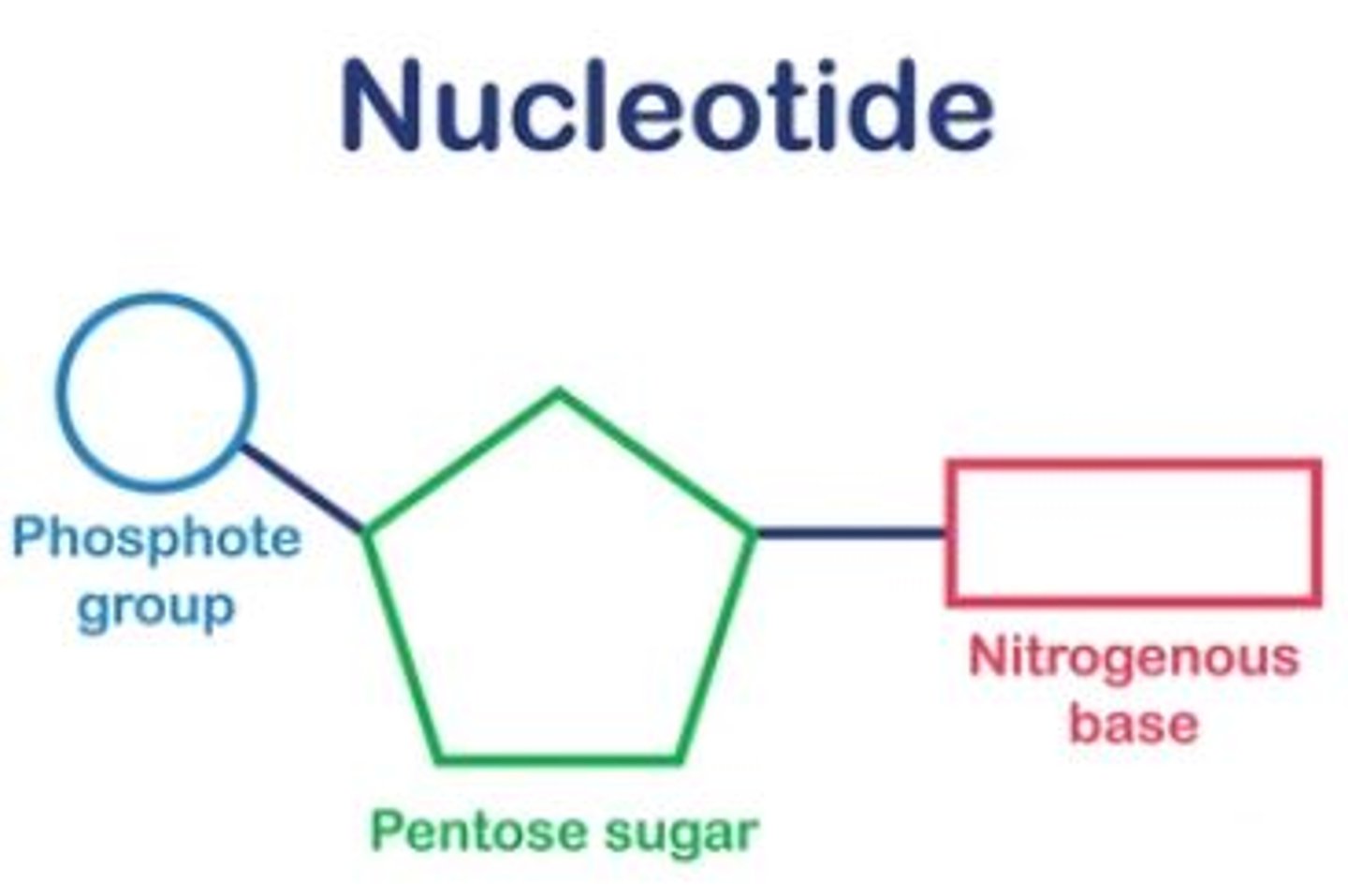
What are the components of a DNA nucleotide? (3)
- A deoxyribose sugar.
- A phosphate group.
- One of four organic bases: adenine, cytosine, guanine, or thymine.
How is DNA packaged into chromosomes? (3)
- Strands of DNA wrap around histone proteins to form a structure called a nucleosome.
- A chain of nucleosomes, known as chromatin, is then further compacted.
- The chromatin is wound up to form a single chromosome.
What are the components of an RNA nucleotide? (3)
- A ribose sugar.
- A phosphate group.
- One of four organic bases: adenine, cytosine, guanine, or uracil.
What are purines and pyrimidines? (2)
- Purines, such as adenine and guanine, are bases that have two nitrogen-containing rings.
- Pyrimidines, such as cytosine, thymine, and uracil, are bases that have a single ring structure.
How is a polynucleotide formed? (3)
- Nucleotides polymerise through condensation reactions.
- This reaction results in the formation of phosphodiester bonds.
- A sugar-phosphate backbone is formed, with the nitrogenous bases exposed.
What is the structure of a DNA molecule? (3)
- A DNA molecule is a double helix.
- It is composed of two polynucleotide chains.
- The chains are joined by hydrogen bonds between complementary bases.
What is meant by complementary base pairing? (3)
- Two DNA polynucleotide strands combine through hydrogen bonding between their bases.
- A purine base will always bind with a pyrimidine base.
- There are two hydrogen bonds between adenine and thymine and three between cytosine and guanine.
What is the structure of RNA and how many types are found in cells? (2)
- RNA is single-stranded.
- It comes in multiple forms, such as mRNA, tRNA, and rRNA, which are involved in protein synthesis.
What are three differences between the structure of RNA and DNA molecules? (3)
- RNA molecules are single-stranded, whereas DNA molecules are double-stranded.
- RNA contains the pentose sugar ribose, whereas DNA contains deoxyribose.
- RNA contains the nitrogenous base uracil in place of thymine, which is found in DNA.
What is semi-conservative replication? (2)
- Semi-conservative replication is the process by which DNA produces a copy of itself.
- Two new helices are produced, each containing one original strand and one new strand of DNA.
Why is semi-conservative replication important? (2)
- It ensures genetic continuity between generations of cells.
- This means that genetic information is accurately passed on from one generation to the next.
What is the process of DNA replication? (3)
- The enzyme helicase unwinds the DNA helix and breaks the hydrogen bonds between the polynucleotide strands.
- Each of the separated strands acts as a template for the creation of a new strand.
- Freely floating nucleotides within the cytoplasm are attracted to their complementary exposed bases on the template strands and hydrogen bonds form.
What is meant by the 5' and 3' ends of a DNA strand? (2)
- The 5' end is where the phosphate group is exposed on the C5 end of the sugar.
- The 3' end is where the C3 of the sugar at the end of the chain has not bonded with another phosphate group.
What are the roles of helicase and DNA polymerase in DNA replication? (2)
- Helicase unwinds the helix and breaks the hydrogen bonds to separate the two strands.
- DNA polymerase catalyses the formation of phosphodiester bonds between adjacent nucleotides to form the new strand.
What is the difference between the leading strand and the lagging strand? (3)
- DNA polymerase can only catalyse reactions in the 5' to 3' direction.
- The leading strand is the new strand that is formed continuously.
- The lagging strand is polymerised discontinuously in short sections, which are then joined together by the enzyme DNA ligase.
What is the genetic code? (2)
- The genetic code consists of triplets of bases called codons.
- Each codon codes for a specific amino acid, which are then joined to form a polypeptide chain.
What is a gene and a gene mutation? (2)
- A gene is a sequence of bases on a DNA molecule that codes for the sequence of amino acids in a polypeptide chain.
- A gene mutation is a change in the sequence DNA bases and it can either be a frameshift mutation or a point mutation.
What are introns and exons? (2)
- Introns are the non-coding regions of DNA within a gene.
- Exons are the coding regions of DNA that are expressed.
What are four features of the genetic code? (3)
- It is non-overlapping, meaning that each triplet is only read once and does not share any bases.
- It is degenerate and contains start and stop codons which either start or stop protein synthesis.
- It is universal, meaning it is the same in all organisms and species.
Why is the genetic code described as degenerate? (2)
- The code is degenerate because more than one codon can specify the same amino acid.
- This feature reduces the negative effects of mutations, as a change in the DNA base sequence may not result in a change to the amino acid coded for.
Why is an insertion or deletion mutation often more harmful than a substitution mutation? (2)
- An insertion or deletion is more likely to be harmful because it causes a 'frameshift'.
- A frameshift means that all codons 'downstream' of the mutation are read differently, altering the entire amino acid sequence from that point onwards.
What are the two stages of protein synthesis and where do they occur? (2)
- The first stage is transcription, which occurs in the nucleus.
- The second stage is translation, which occurs at the ribosomes in the cytoplasm.
What is transcription? (2)
- Transcription is the process of creating a messenger RNA (mRNA) molecule from a DNA template.
- It occurs in the nucleus of a eukaryotic cell.
What is the structure of an mRNA molecule? (3)
- mRNA is a single-stranded molecule made up of nucleotides that contain the bases uracil (U), adenine (A), cytosine (C), and guanine (G).
- The bases are arranged in groups of three, known as codons.
- The nucleotides are joined together by phosphodiester bonds, forming a sugar-phosphate backbone.
How is gene expression regulated by non-coding regions of DNA? (3)
- Promoters are non-coding regions where transcription factors bind to activate gene expression.
- Enhancers are non-coding regions that can be located far from a gene and also bind transcription factors to enhance gene expression.
- Insulators are non-coding regions that can bind inhibitors to decrease or completely stop the expression of a particular gene.
What is the difference between the sense and antisense strands of DNA? (2)
- The antisense strand is the template strand that is used to build the mRNA molecule.
- The sense strand is the original strand of interest, and the newly synthesised mRNA will be identical to it, except that it will contain uracil instead of thymine.
How is the initial mRNA transcript is modified to become mature mRNA? (3)
- The initial mRNA molecule contains both coding sequences, called exons, and non-coding sequences, called introns.
- The introns are removed from the mRNA molecule in a process called splicing.
- The remaining exons are then linked together to form the mature mRNA, which can then leave the nucleus.
What is the process of transcription? (3)
- Transcription begins at a specific promoter region on the DNA, which signals the start of a gene.
- The enzyme RNA polymerase binds to the DNA and unwinds the double helix by breaking the hydrogen bonds between the bases.
- RNA polymerase uses the antisense strand of the DNA as a template to build a complementary mRNA molecule, working in a 5' to 3' direction.
What is translation? (2)
- Translation is the process where the genetic code on an mRNA molecule is used to synthesise a polypeptide.
- This process occurs at the ribosome in the cytoplasm.
What is the pathway for proteins that are destined to leave the cell? (3)
- Ribosomes involved in their synthesis attach to the rough endoplasmic reticulum.
- The translated polypeptide chain is released into the lumen of the rough ER where it is folded and packaged for secretion.
- It is then sent to the Golgi apparatus for further processing and transport.
What are codons? (2)
- Three bases form a single codon.
- Each codon codes for an amino acid.
What is a structural gene? (2)
- A structural gene is a specific sequence of DNA nucleotides.
- These genes code for a polypeptide, which in turn determines the primary structure of a protein.
What is the function of a stop signal? (2)
- A stop signal, or stop codon, does not code for an amino acid; instead, it signals for the termination of protein synthesis.
- The codons that code for a stop signal are UGA, UAA, and UAG.
What is the role of start and stop codons? (2)
- Start codons signal where translation begins.
- Stop codons signal the end of polypeptide synthesis.
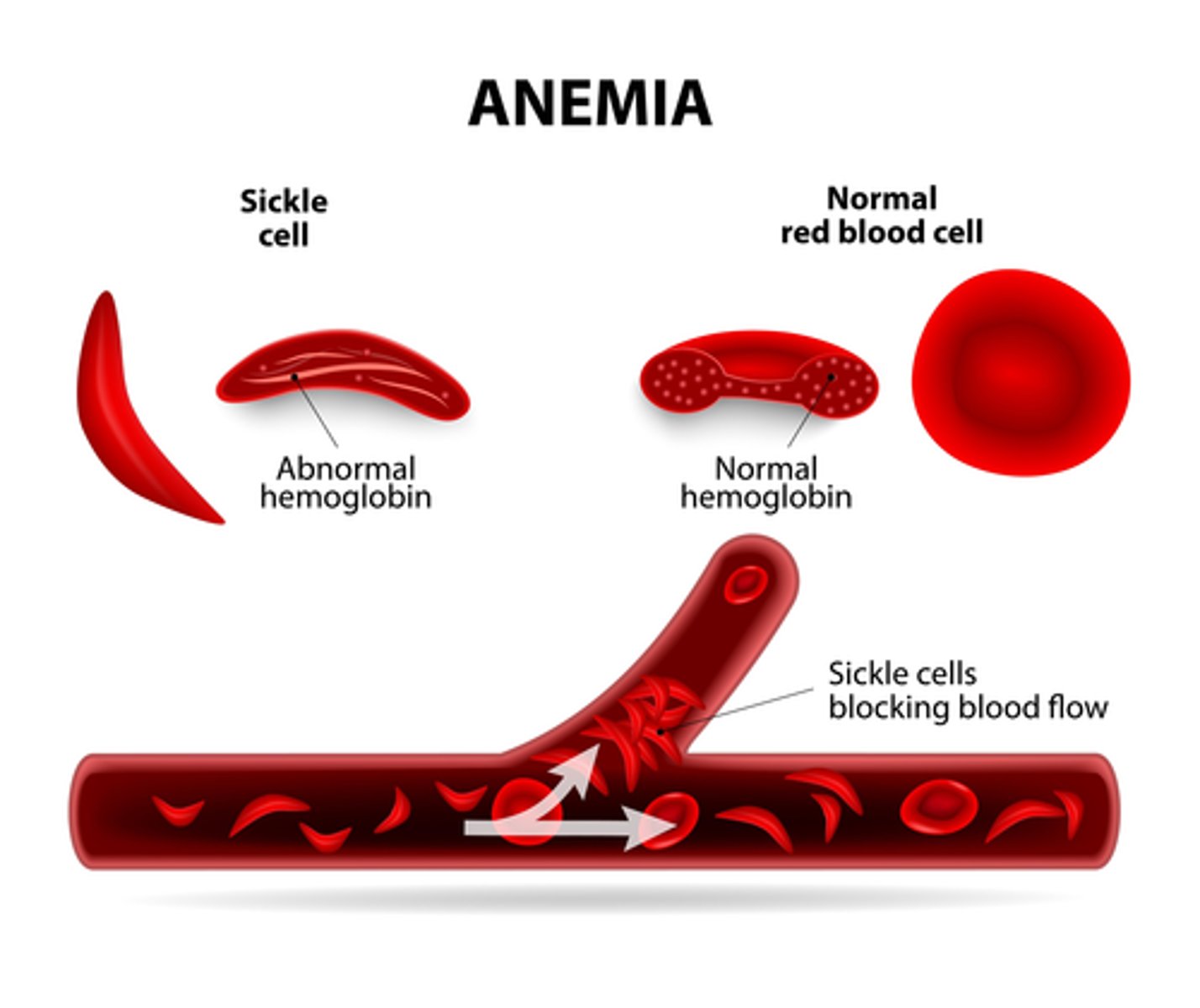
How can a mutation lead to sickle cell anaemia? (5)
- A base substitution occurs in the 6th triplet of the DNA molecule.
- This changes the triplet from GAG, which codes for glutamic acid, to GTG, which codes for valine.
- Valine is a hydrophobic molecule, which causes the haemoglobin chain to clump together into insoluble fibres.
- This alters the shape of haemoglobin, causing red blood cells to sickle and carry less oxygen.
- These sickled cells are less flexible and can get stuck in small blood vessels, blocking blood flow preventing oxygen from reaching the tissues.
What is the process of translation? (3)
- An mRNA molecule attaches to a ribosome, and a tRNA molecule with a complementary anti-codon forms temporary hydrogen bonds with the mRNA codon.
- As the tRNA molecules are held in place, neighbouring amino acids are joined together by peptide bonds.
- This process continues until a stop signal on the mRNA is reached, producing a polypeptide chain.
What is the structure and function of a tRNA molecule? (3)
- tRNA is a single-stranded molecule containing the bases U, A, C, and G, which is folded up into a characteristic cloverleaf shape.
- It has two important attachment sites: one for a specific amino acid and one for an anti-codon.
- tRNA carries and transfers specific amino acids to the ribosomes during the process of translation.
What is the relationship between mRNA codons and tRNA anti-codons? (3)
- During translation, the ribosome reads a three-base sequence on the mRNA called a codon.
- A tRNA molecule has a complementary three-base sequence called an anti-codon.
- The tRNA with the matching anti-codon binds to the mRNA codon, ensuring the correct amino acid is added to the growing polypeptide chain.
What is the role of the enzyme aminoacyl transferase? (1)
It is an enzyme that catalyses the formation of a peptide bond between two amino acids.
How is the process of translation terminated? (3)
- Translation continues until the ribosome reaches a stop codon on the mRNA.
- The three stop codons are UAA, UGA, and UAG.
- A terminating factor recognises the stop codon, as tRNAs do not have anti-codons for it.
What happens to the polypeptide chain after it is released from the final tRNA? (2)
- After translation is complete, the polypeptide chain is folded.
- This folding can be a spontaneous process but is also guided by specialised proteins.
What are two examples of post-translational modifications? (2)
- Carbohydrate chains can be added to the protein depending on its function.
- The initial amino acid, methionine, can be removed or cleaved off the polypeptide chain.
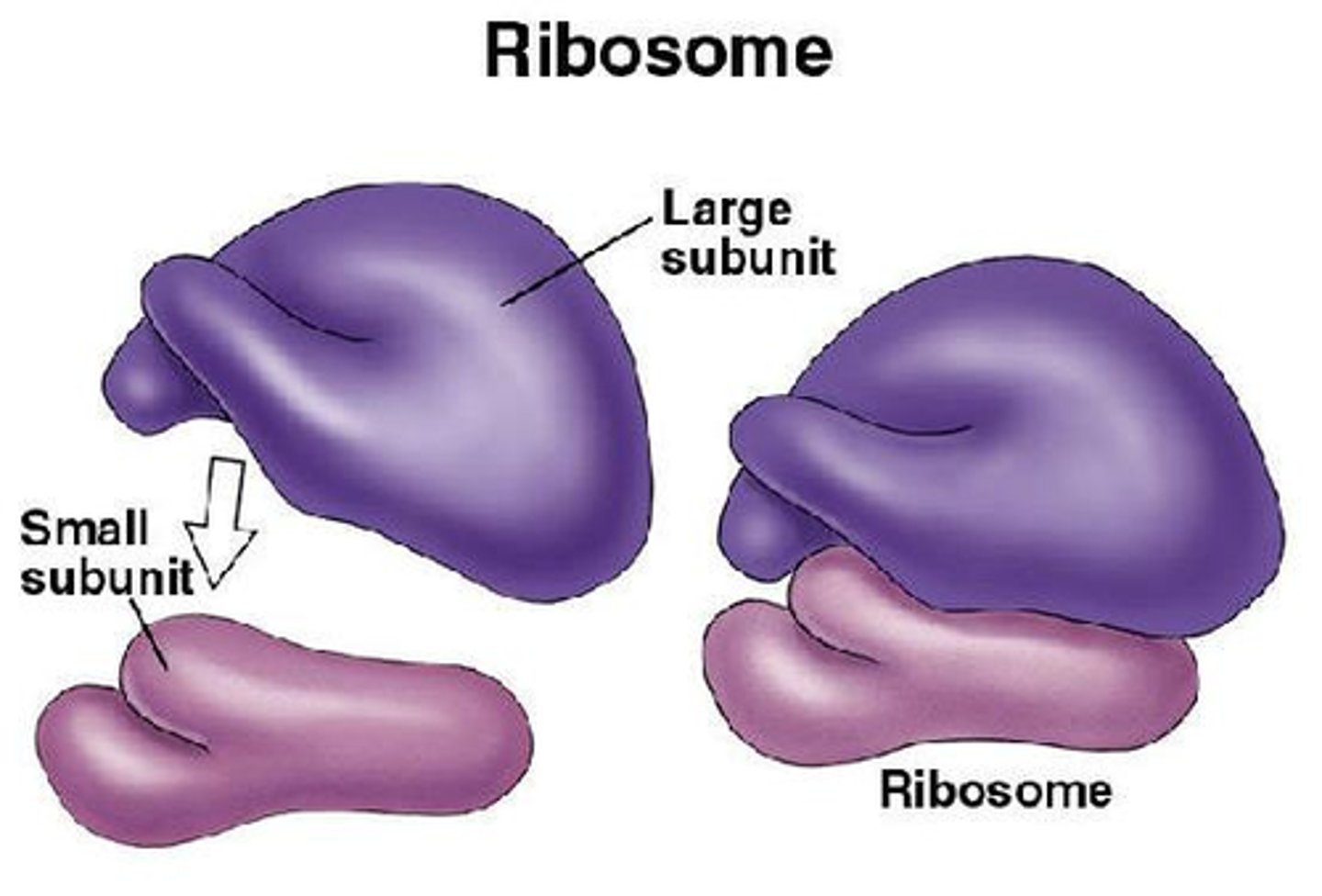
What is the structure of a ribosome? (2)
- It is made up of proteins and ribosomal RNA (rRNA).
- It is made up of two ribosomal units.
What is the role of ribosomes in protein synthesis? (2)
- They are the site of translation.
- They hold the tRNA onto the mRNA, while peptide bonds form to join adjacent amino acids together.
What is the process of splicing and why is it significant? (3)
- The mRNA first produced during transcription, known as pre-mRNA, includes copies of both introns and exons, but before it leaves the nucleus, it is edited to remove the non-coding introns.
- The remaining exons can then be assembled in different combinations to form the mature mRNA.
- Splicing increases the possibility for a single gene to code for multiple different polypeptides, such as antibodies.
What is a polysome? (1)
A polysome is formed when many ribosomes work together to read the same mRNA strand and form polypeptides.
What are the terms genome and proteome? (2)
- The genome of a cell is the complete set of genes in that cell.
- The proteome of a cell is the full range of proteins that the cell can produce.
What is a point mutation? (3)
- Point mutations are chance alterations in the sequence of nucleotides in the DNA.
- They are random events and are not influenced by environmental conditions.
- They can occur when DNA polymerase does not recognise an incorrect combination of bases during replication.
What is a silent mutation? (3)
- A silent mutation occurs as a result of the redundant nature of the genetic code.
- This means that the new codon codes for the same amino acid as before.
- Therefore, the phenotype is not altered, and the formed protein retains its effectiveness.
What is the effect of a base deletion or addition? (2)
- The removal or insertion of a base results in a frameshift during translation.
- This means that all the genetic code read after the point of the mutation is read wrongly.
What is a duplication mutation and inversion mutation? (2)
- A duplication mutation is when one or more bases are repeated in the sequence.
- An inversion mutation is when a sequence of bases is reversed.
What is meiosis? (2)
- Meiosis is a process of cell division.
- It is a process that gives rise to gametes.
What are the names of the male and female gametes? (2)
- The male gametes are sperm.
- The female gametes are eggs.
What is the process of fertilisation? (3)
- During fertilisation, the sperm and egg cells fuse.
- They join to form a zygote.
- The zygote then divides by mitosis to produce more cells.
Why is meiosis essential for sexual reproduction? (2)
- Meiosis is necessary for sexual reproduction to occur.
- Without meiosis, there are no sex cells, and therefore no fertilisation can take place.
What is the outcome of meiosis? (3)
- Meiosis produces four daughter cells.
- These daughter cells are haploid.
- The four daughter cells produced are not genetically identical.
How is a diploid cell formed during fertilisation? (3)
- Two haploid cells, the egg and sperm, join together.
- This fusion forms one diploid cell.
- In the diploid cell, half the chromosomes come from the egg and half come from the sperm.
How does meiosis lead to genetic diversity? (3)
- The four daughter cells produced in meiosis are not genetically identical.
- This means that sperm cells can vary from each other, and egg cells can also be different from one another.
- Any sperm cell can be matched with any egg cell, which allows for many different combinations to occur.
What are the roles of three named enzymes involved in DNA replication? (3)
- DNA helicase breaks the hydrogen bonds between the complementary base pairs, causing the DNA double helix to unwind and separate into two strands.
- DNA polymerase joins adjacent nucleotides together by catalysing the formation of phosphodiester bonds, which creates the new sugar-phosphate backbone.
- DNA ligase joins the short sections of newly synthesised DNA, known as Okazaki fragments, together to create a continuous strand.
How do antibiotics that bind to RNA polymerase inhibit protein synthesis and why do they affect different types of cells? (3)
- These antibiotics work by inhibiting transcription, the process of synthesising mRNA from DNA.
- They bind to the enzyme RNA polymerase, which prevents it from functioning correctly and catalysing the transcription process.
- The reason they affect different cell types is that the structure of RNA polymerase in prokaryotic cells is different from the structure of RNA polymerase in eukaryotic cells, leading to specific binding.
What is the process by which a protein, such as amylase, is synthesised and secreted from a cell? (5)
- The mRNA molecule, carrying the code for the protein, leaves the nucleus through a nuclear pore.
- mRNA travels to a ribosome on the rough endoplasmic reticulum, where translation takes place.
- During translation, codons on the mRNA pair with anticodons on tRNA molecules, and peptide bonds form between the amino acids to create a polypeptide chain.
- The synthesised protein then enters the Golgi apparatus, where it is modified, processed, and packaged into a secretory vesicle.
- These vesicles then move towards the plasma membrane, fuses with it, and releases the protein out of the cell in a process called exocytosis.
How does the formation of thymine dimers in DNA help to produce aseptic conditions? (2)
- Thymine dimers bend the DNA backbone and prevent DNA replication.
- This means that bacteria and other microbes are unable to reproduce, for example by binary fission, thus keeping the environment free from microbial contamination.
Still learning (1)
You've begun learning these terms. Keep up the good work!

