aep 5 pt 1
 Call Kai
 Learn
Learn Practice Test
 Spaced Repetition
 Match
Match Flashcards
 Knowt Play
1/91

There's no tags or description
Looks like no tags are added yet.
Name | Mastery | Learn | Test | Matching | Spaced | Call with Kai |
|---|
No analytics yet
Send a link to your students to track their progress
92 Terms
Human thermoregulation
Internal body temperature is kept constant (usually) despite environmental temperature changes; heat sensors in brain, skin, and spinal cord
Thermoneutral zone
Minor adjustments to skin blood flow minimize heat loss or gain
Exercise in the heat responses
↑ core temp, ↑ heart rate, ↓ stroke volume (blood sent to skin for cooling), ↓ max cardiac output
Cardiovascular drift
Blood volume decreases from sweat → stroke volume cannot increase → heart rate increases to compensate
Critical temperature limit
Brain shuts down exercise around 40–41°C to prevent damage
ATP breakdown and heat
~1/4 used for cellular work; remainder produces metabolic heat
Heat balance requirement
Heat gained must equal heat lost to maintain core temperature
Conduction (K)
Heat transfer through direct molecular contact (negligible)
Convection (C)
Heat transfer via movement of air/liquid across skin; major thermoregulatory factor
Radiation (R)
Heat loss via infrared rays; major thermoregulatory factor
Dry heat exchange
C + K + R
Insulation (I)
Resistance to dry heat exchange; still air is ideal insulator
Evaporation (E)
Heat loss via liquid to gas; primary heat loss during exercise (~80%)
Clothing effect on evaporation
Clothing increases resistance to evaporation
Heat balance equation
M − W ± R ± C ± K − E = 0 → balance;
POAH (pre-optic anterior) hypothalamus function
Body thermostat; senses temperature and activates responses
Heat response
Vasodilation and sweating decrease body temperature
Eccrine sweat glands
Critical when air temperature exceeds skin temperature
evaporation (sweating) and humidity
High humidity reduces evaporation
Sex differences in sweating
Females sweat less output per gland but have more active glands
Sweat loss effect
Leads to dehydration
Sweat gland stimulation
Sympathetic cholinergic (acetylcholine)
Sweat gland sensitivity
More responsive to core temperature than skin temperature
Sweating in hot environments
C, K, R cause heat gain; evaporation is only heat loss mechanism
Sweat adaptation with training
More Na+ and Cl− reabsorbed; electrolyte conservation
Sweat losses during exercise
1.6–2.0 L/hour (2.5–3.2% body weight)
Sweating effect on circulation
Increased sweating decreases blood volume and cardiac output
Dehydration effects
Less sweating, less skin blood flow
Cardiovascular effects of dehydration
↑ heart rate, ↓ stroke volume, ↓ blood flow to muscles/brain
Fluid intake effect
Reduces body heat storage after prolonged exercise (~45 min+)
Heat acclimation
Timeframe: 9–14 days
Heat acclimatization
Months to years
Heat acclimation benefit
Plasma volume expansion
Acclimation effects
Improved cardiovascular function and sweating responses
Core temperature with acclimation
Lower during exercise
Heart rate with acclimation
Reduced during exercise
Sweating changes with acclimation
Earlier onset and higher rate
Sweat electrolyte changes with training
Lower Na+ and Cl− loss in trained individuals
WBGT importance
Better than heat index for measuring thermal stress
WBGT components
Dry-bulb (air temp), wet-bulb (evaporation), globe temp (radiation)
Heat index limitation
Does not reflect physiological stress
Heat cramps
Painful large muscle cramps from Na+ loss and dehydration
Heat cramps prevention
Adequate Na+ and water intake
Heat exhaustion
Symptoms: fatigue, dizziness, nausea, weak/rapid pulse
Heat exhaustion cause
Severe dehydration and low blood volume
Heatstroke
Failure of thermoregulation; core temp >40°C or CNS dysfunction
Heatstroke treatment
Immediate whole-body cooling (ice bath)
Heat stress factors
Metabolic heat, air temp, humidity, wind, radiation, clothing
Preventing hyperthermia
Avoid WBGT >28°C; hydrate frequently; minimize clothing
Fluid replacement guideline
1 kg body weight lost = 1 L fluid intake. via frequent breaks every 15 to 30 min
Preventing High Body Temperature (Hyperthermia)
1. Avoid outdoor activities when WBGT >28° C (82 ° F).
2. Never restrict fluid intake
3. Minimize clothing impeding sweating
Precooling methods
Cold water, cold air, cooling vest, icy drink
Precooling effect
Improves long-duration performance; may impair short events
Cold exercise muscle effects
↓ contractile force, ↓ shortening velocity, ↓ power
Cold fatigue effect
↓ metabolic heat production → ↑ hypothermia risk
Cold metabolism
Catecholamines (adrenaline) increase but no free fatty acid mobilization
Cold glucose response
Blood glucose maintained; ↑ glycogen use
Hypoglycemia (low blood sugar) effect
Shivering suppressed
Windchill definition
Enhanced heat loss due to wind; not just air temperature
Windchill effect
↑ convective heat loss; ↑ freezing risk
Cold response
Vasoconstriction and shivering increase body temperature
Cold hormones
Thyroxine and catecholamines released
Behavioral response to cold
Controlled by cerebral cortex
pre-optic anterior) hypothalamus
controls body temperature
Shivering thermogenesis fuels
Shift from carbohydrates to fats over time
Body composition and heat loss
More fat and less surface area reduce heat loss
Water vs air heat loss
Heat loss is 4× faster in water
Core temp in water
Stable until water <32°C 90 F
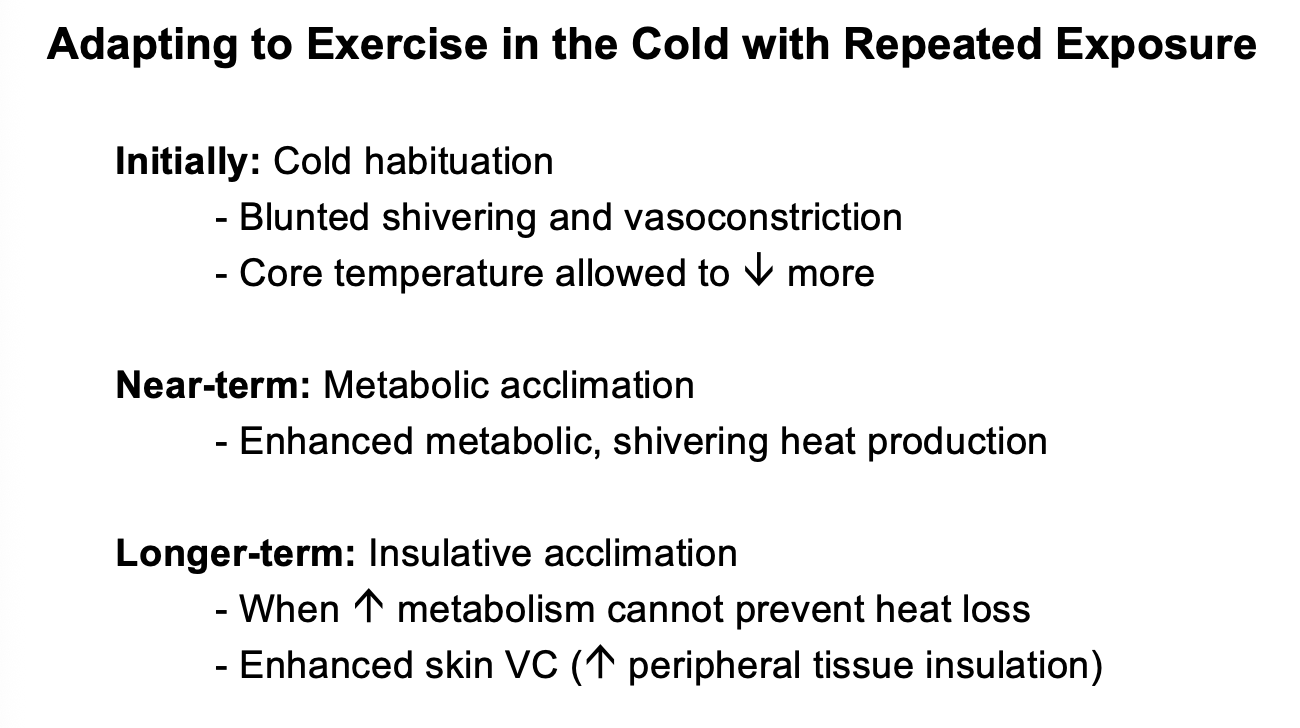
Cold adaptation stages
Habituation, metabolic acclimation, insulative acclimation
Cold habituation
Reduced shivering and vasoconstriction core temp drop more
Metabolic acclimation
Enhanced heat production, shivering heat production
Insulative acclimation
Increased peripheral vasoconstriction
Exercise-induced asthma
Caused by airway drying in cold air; treated with inhalers affects up to 50% of winter sport athletes . treated by beta antagonist and steroid inhalers
Hypothermia mild
Core 34.5–29.5°C; impaired hypothalamus func
Hypothermia severe
Core <29.5°C; loss of thermoregulation metabolism slowed; drowsiness, lethargy, coma possible
Cardiorespiratory effects of cold
–Low core temperature slows heart rate (via SA node)
–Cold may lower ventilation
Hypothermia treatment mild
Core temp 34.5 to 29.5 ° C
- Remove from cold + provide dry clothing, blankets, warm beverages
Hypothermia treatment severe
Core temp <29.5 ° C
- Rewarm gradually to avoid arrhythmias; May require hospital facilities/medical care
Frostbite
Peripheral tissue freezing
- From excess vasoconstriction limiting O2 supply
- Gradually rewarm only when no risk of refreezing
- Untreated frostbite à gangrene, tissue loss
Frostbite treatment
Rewarm gradually only if no refreezing risk
Frostbite complication
Gangrene and tissue loss if untreated
Thermoregulation summary POAH (pre-optic anterior hypothalamus)
Acts as body thermostat controlling vasodilation and sweating
Thermoregulation summary evaporation
Most important cooling method; limited by humidity
Thermoregulation summary heat exercise
↓ stroke volume → compensatory ↑ heart rate
Thermoregulation summary heatstroke
Core temp >40°C; WBGT best risk measure
Thermoregulation summary cold
Excess vasoconstriction can lead to frostbite
The _________ acts as the body's thermostat, regulating internal temperature by initiating skin ______ and ________
pre-optic anterior hypothalamus,vasodilation, sweating.
While the body can lose heat through conduction, convection, and radiation, _______from sweat is the most critical cooling mechanism, though its effectiveness is heavily restricted in environments with ________
evaporation, high humidity.
Exercising in the heat causes a decrease in __________ because blood must be redirected to the _____ for cooling, which forces a compensatory increase in ______ to maintain cardiac output.
stroke volume, skin, heart rate
_______ is a life-threatening emergency characterized by a thermoregulatory failure and a core temperature ______, and the environmental risk for such illnesses is most accurately measured using the _____________________
Heatstroke, >40° C, Wet-Bulb Globe Temperature (WBGT).
In extreme cold environments, excessive peripheral _________ limits oxygen and nutrient delivery to the skin, which can lead to ________and___________
vasoconstriction, tissue death and frostbite.

