practical 5 membrane permeability
 Studied by 0 people
 Call Kai
 Learn
Learn Practice Test
 Spaced Repetition
 Match
Match Flashcards
 Knowt Play
1/3

There's no tags or description
Looks like no tags are added yet.
Name | Mastery | Learn | Test | Matching | Spaced | Call with Kai |
|---|
No analytics yet
Send a link to your students to track their progress
4 Terms
outline the method
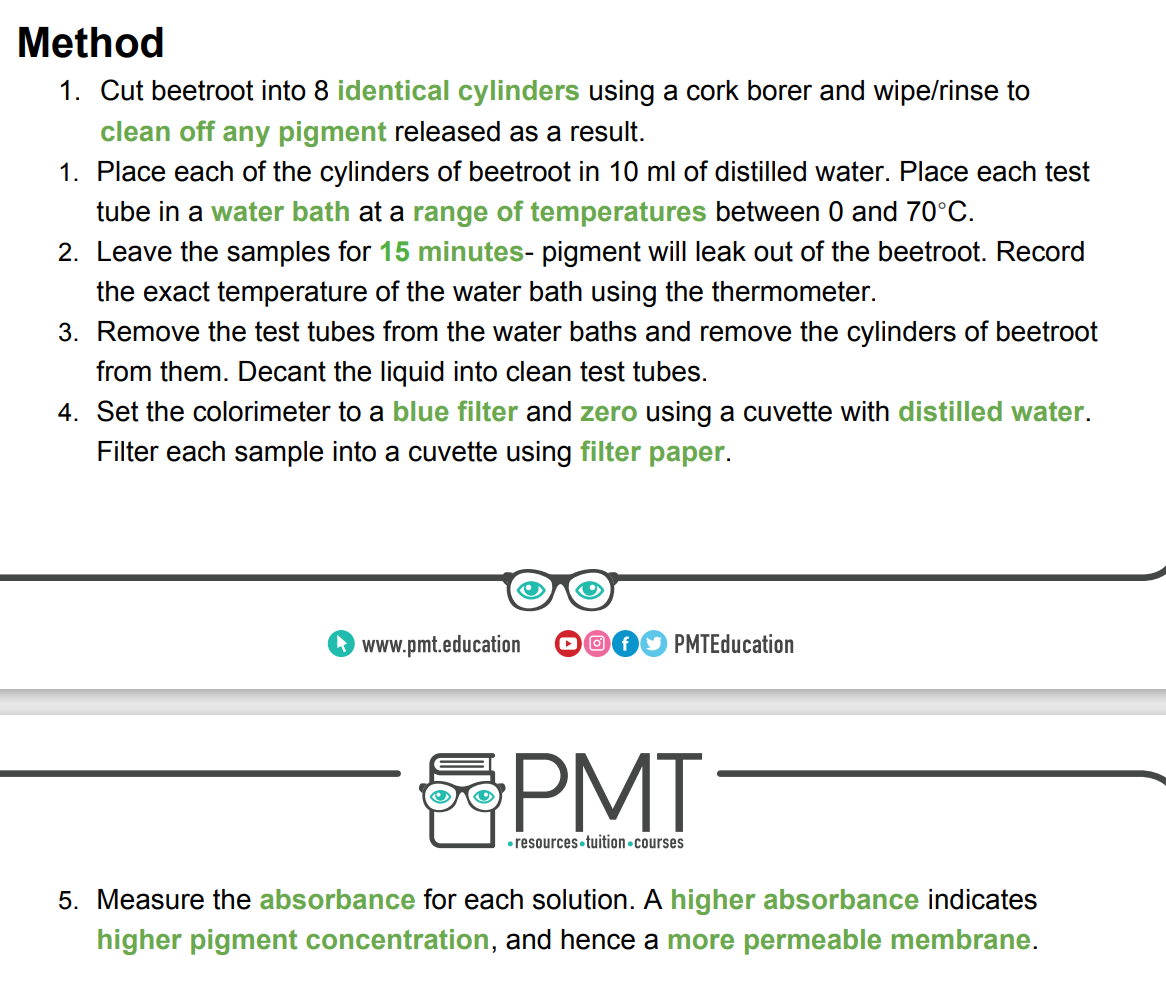
why do we wash the beet root
Cutting the beetroot damages some cells, releasing pigment (betalain) immediately.
If you don’t rinse them, that pigment would already be in the water before the experiment starts.
That would make your results inaccurate, because it wouldn’t all be due to temperature — some pigment would have leaked out just from cutting.
Rinsing removes any surface pigment released during cutting so that:
Any pigment measured later comes only from temperature-induced membrane damage, not from the initial cutting process.
why do we use blue filter
Why you use a blue filter (blue light) in the colorimeter:
Beetroot cells contain the red/purple pigment betalain.
This pigment absorbs green/yellow light most strongly and reflects red light (which is why beetroot looks red).
In a colorimeter, you want to use the complementary color of the pigment — the color that the solution absorbs the most.
Blue light (the complement of red) is used so that changes in pigment concentration produce maximum absorbance differences.
In simple terms:
Using blue light gives the most sensitive and accurate measurement of how much red pigment has leaked out.
a
a
 Note
Note  Flashcards (43)