Topic 7 - Animal Hormones and Homeostasis
 Call Kai
 Learn
Learn Practice Test
 Spaced Repetition
 Match
Match Flashcards
 Knowt Play
1/220

Earn XP
Description and Tags
221 Terms
What is the endocrine system?
A network glands that secrete hormones directly into the bloodstream.
What is a hormone?
A chemicals messanger produced by endocrine glands and released into the body.
What do hormones do?
Travels to a target organ and binds receptors on effectors, initiating a response.
How are hormones transported around the body?
Bloodstream.
Compare the endocrine and nervous system.
Endocrine
Uses hormones that travel in the bloodstream to the target organ.
A slower response.
Lasts until all hormones have been broken down, which takes a long time.
Nervous System
Uses nerve impulses that travel via neurones to effectors.
A faster response.
Lasts until the nerve impulses stop which takes a short amount of time.
Is the endocrine or nervous system faster?
Nervous system.
Is the endocrine or nervous system slower?
Endocrine system.
Does the endocrine or nervous system last longer?
Endocrine system.
Does the endocrine or nervous system last for a short amount of time?
Nervous system.
What is negative feedback?
A Ccontrol mechanism that reverses any change in condition to return to the set point.
It detects a substance below or above normal level which triggers a response to bring it back to normal.
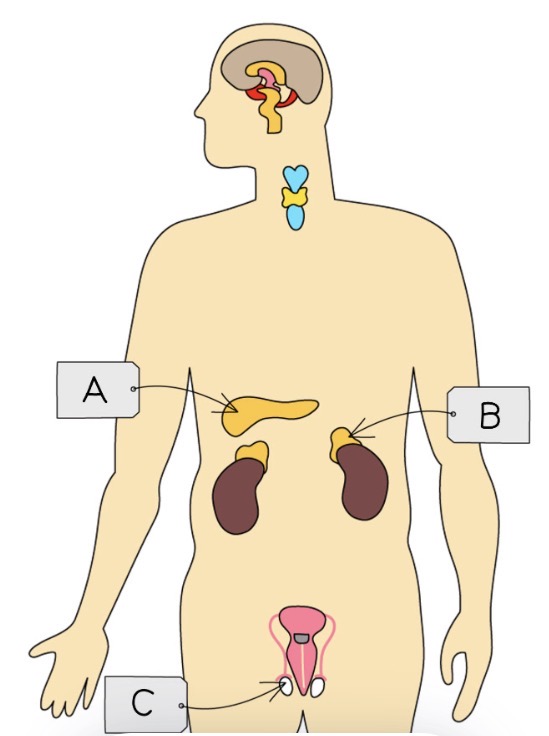
Identify labels A, B and C.
A = Pancreas.
B = Adrenal gland.
C = Testes.
Which gland is known as the master gland?
Pituitary gland.
What is the pituitary gland?
The master gland that secretes several hormones into the bloodstream. These hormones act on other gland to stimulate the release of more hormones.
Which hormones are released by the ovaries?
Oestrogen and progesterone.
Which gland secretes oestrogen and progesterone?
Ovaries.
Which gland secretes testosterone.?
Testes.
Which hormone is released by the testes?
Testosterone.
What are the three sex hormones?
Oestrogen, progesterone and testerone.
Which hormone is released by the pancreas?
Insulin.
Which gland secretes insulin?
Pancreas.
Which hormone is released by the thyroid gland?
Thyroxine.
Which gland secretes thyroxine?
Thyroid gland.
Where is the thyroid gland located?
In the neck.
Which gland is located in the neck?
Thyroid gland.
Which hormone is released by the adrenal glands?
Adrenaline.
Which gland secretes adrenaline?
Adrenal glands.
Where are the adrenal glands located?
Above the kidneys.
Which gland is located above the kidneys?
Adrenal glands.
What is the role of adrenaline?
Adrenaline prepares the body for fight or flight response.
Which hormone prepares the body for fight or flight response?
Adrenaline.
State the effects of adrenaline on the body.
Increased heart rate.
Increased blood pressure.
Increased blood flow to the muscles.
Increased blood glucose levels.
Why does blood glucose level increase due to adrenaline?
Adrenaline stimulates the liver to change glycogen into glucose, which is then released into the blood.
Why do our cells respire faster when adrenaline is released?
Increased blood flow allows more oxygen and glucose to reach the muscles for respiration.
Why does increased blood flow to the muscles help the body prepare for fight or flight?
Greater amounts of glucose and oxygen can be delivered to the cells. Used for aerobic respiration, which releases energy.
Describe how adrenaline increases respiration.
Greater amounts of glucose and oxygen are delivered the cells due to increased heart rate and greater blood flow to muscles.
Adrenaline binds to receptor cells in the liver to breakdown glycogen into glucose.
Used for aerobic respiration, which releases energy.
Describe how adrenaline increases heart rate and blood pressure.
Adrenaline travels in the bloodstream to the heart.
Binds to specific receptors on cells in the heart which causes the heart muscle to contract more forcefully and frequently.
What is the role of thyroxine?
Controls metabolic rate, heart rate and temperature.
What is metabolic rate rate?
The rate at which chemical reactions occur in cells.
Which hormone controls metabolic rate?
Thyroxine.
Describe how thyroxine is released.
TRH is released by the hypothalamus.
This stimulates the release of TSH from the pituitary gland.
TSH stimulates the thyroid to release more thyroxine.
What happens if the level of thyroxine falls below normal?
TRH is released by the hypothalamus.
This stimulates the release of TSH from the pituitary gland.
TSH stimulates the thyroid to release more thyroxine.
Thyroxine levels return to normal.
What happens if the level of thyroxine is too high?
TRH production is inhibited.
This inhibits the release of TSH from the pituitary gland.
Less TSH stimulates the thyroid so less thyroxine is released.
Thyroxine levels return to normal.
Describe how a negative feedback system control blood thyroxine levels.
If thyroxine levels are too low, TRH is released by the hypothalamus. This stimulates the release of TSH from the pituitary gland. TSH stimulates the thyroid to release more thyroxine so thyroxine levels return to normal.
If thyroxine levels are too high, TRH production is inhibited. This inhibits the release of TSH from the pituitary gland. Less TSH stimulates the thyroid so less thyroxine is released. Thyroxine levels return to normal.
Which part of the brain releases TRH?
Hypothalamus.
What does TRH stimulate the release of?
TSH.
Where is TSH released from?
Pituitary gland.
What is the menstrual cycle?
A cycle in women, usually lasting 28 days, and involving shedding of uterus lining, repair of lining, release of an eg and maintenance of thick lining.
How long does the menstrual cycle typically last?
28 days.
Describe the stages of the menstrual cycle.
Days 1-4: if fertilisation and implantation do not occur the uterus, lining sheds and the egg is expelled with it (menstruation)
Days 4-14: uterus lining thickens in preparation for the implantation of an egg.
Day 14: egg released from a follicle into the oviduct (ovulation)
Days 14-28: uterus lining thickened and maintained so implantation can happen if fertilisation happens.
When does ovulation occur?
Days 14.
What happens on day 14 of the menstrual cycle?
Ovulation.
What is ovulation?
An egg is released from the follicle.
Name the hormones that control the menstrual cycle.
Oestrogen, Progesterone, LH and FSH.
Which gland secretes FSH?
Pituitary gland.
Describe the role of FSH in the menstrual cycle.
Transported in the bloodstream to ovaries and triggers the development/maturing of a folice/egg here, which releases oestrogen.
Which hormone triggers the development/maturing of a folice/egg in the ovaries?
FSH.
What does FSH trigger?
Development/maturing of an egg in the ovaries.
Which type of cell is triggered to mature by FSH?
Egg cell.
In which part of the reproductive system is ostrogen produced?
Ovaries.
Which hormone stimulates production of oestrogen?
FSH.
Describe the role of oestrogen in the menstrual cycle.
Stimulates the repair and thickening of the uterus lining.
Inhibits secretion of FSH.
Stimulates secretion of LH.
Does an increase in oestrogen levels thicken or thin the uterus lining?
Thickens.
What does oestrogen inhibit the release of?
FSH.
Which hormone inhibits the release of FSH?
Oestrogen and progesterone.
What does oestrogen stimulate the release of?
LH.
Which hormone stimulates the release of LH?
Oestrogen.
How are FSH and LH levels affected by oestrogen?
Oestrogen inhibits the production of FSH but stimulates production of LH.
What is the process involving the release of a mature egg form the ovaries?
Ovulation.
Describe the role of LH in the menstrual cycle.
Triggers ovulation - stimulates the release of an egg.
Which hormone triggers ovulation?
LH.
Which hormone stimulates the release of an egg?
LH.
Name the hormone that is released by the pituitary gland to stimulate ovulation.
LH.
Describe the role of progesterone in the menstrual cycle.
Stimulates growth of blood vessels in uterus lining and maintains lining to prepare for egg.
Inhibits release of FSH and LH.
Does a decrease in progesterone levels thicken or thin the uterus lining?
Thin.
Which hormone inhibit the release of FSH and LH?
Progesterone.
What does progesterone inhibit the release of?
FSH and LH.
How are FSH and LH levels affected by progesterone?
Progesterone inhibits the release.
What is an egg follicle?
Layer of tissue surrounding each of the immature eggs in the ovaries.
What is corpus luteum?
Temporary endocrine structure; a mass of cells that releases progesterone.
What does the follicle become after ovulation?
Corpus luteum.
What does the corpus luteum release?
Progesterone.
What secretes progesterone?
Corpus luteum/Ovaries.
Which hormone does the corpus luteum secrete?
Progesterone.
What happens to progesterone levels if fertilisation an implantation occur?
Placenta produces progesterone so levels remain high. This prevents further ovulation and maintains the uterus lining.
Which hormone maintains the uterus lining?
Oestrogen and progesterone.
What happens during menstruation?
Uterus lining is shed.
When do oestrogen levels peak in the menstrual cycle?
Just before day 14.
What happens to progesterone levels during the menstrual cycle?
Low from day 1-14.
Rise once evolution occurs.
Decrease towards the end of the cycle.
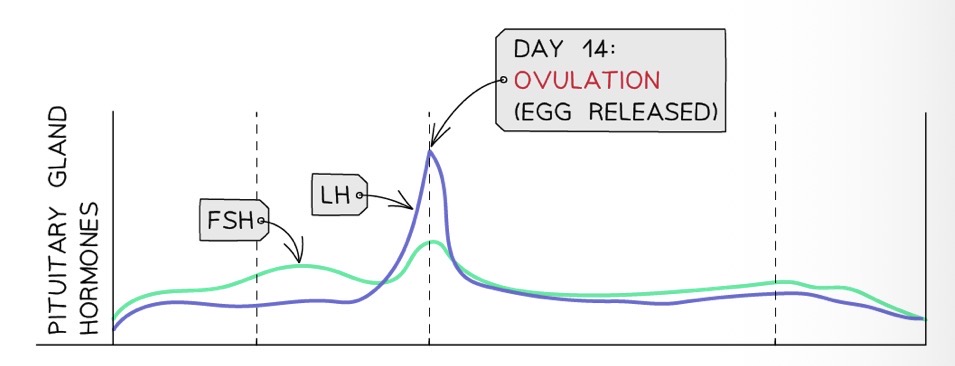
What causes LH to peak at day 14?
Rising oestrogen levels.
What happens when an egg is not fertilised?
Corpus luteum breaks down. Progesterone oestrogen levels drop.
Name the hormones involved in the menstrual cycle.
FSH, Oestrogen, LH and Progesterone.
There are four hormone produced in the menstrual cycle. Which ones are produced by the pituitary gland?
FSH and LH.
There are four hormone produced in the menstrual cycle. Which ones are produced by the ovaries?
Oestrogen and progesterone.
What is a contraceptive?
A method or device to prevent pregnancy.
How do hormonal contraceptives prevent pregnancy?
They prevent the release of a mature egg cell during the menstrual cycle.
Hormonal contraceptives prevent the maturation of a follicle by inhibiting the release of oestrogen. True or False?
False - Oestrogen is not the hormone responsible for the maturation of the egg. Hormonal contraceptives that inhibit FSH production will ensure that no egg cells mature.
Hormonal contraceptives can prevent the maturation of a follicle by inhibiting the release of FSH. True or False?
True.
How does progesterone in contraceptives prevent pregnancy?
Thickening cervical mucus to block sperm, preventing ovulation, and thinning the uterine lining to reduce implantation.
How does oestrogen in contraceptives prevent pregnancy?
Inhibts FSH, preventing ovulation.
How can progesterone be administered as a contraceptive?
Daily pill or injection.