PHL 116 Bioethics Mod 6 Cloning and Philosophical Conversation Skills
 Studied by 0 people
 Call Kai
 Learn
Learn Practice Test
 Spaced Repetition
 Match
Match Flashcards
 Knowt Play
1/31

There's no tags or description
Looks like no tags are added yet.
Name | Mastery | Learn | Test | Matching | Spaced | Call with Kai |
|---|
No analytics yet
Send a link to your students to track their progress
32 Terms
cloning
asexually producing a biological organism that is virtually genetically identical to another
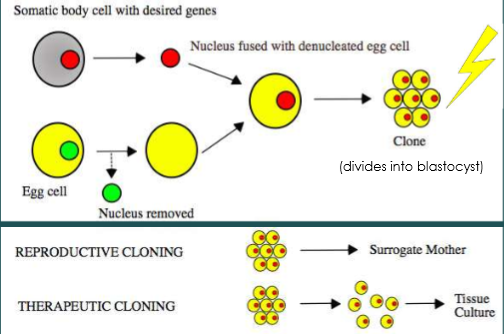
reproductive cloning
make an new organism
therapeutic cloning
use genetic tissue for research/treatment purposes (ex: creation of embryonic stem cells)
stem cells
undifferentiated cells that have the potential to differentiate/develop into many different types of cells in the body
somatic cell nuclear transfer (SCNT) Cloning
places nucleus from the cell with desired genetics into a different egg cell; egg cell divides into blastocysts with the new DNA
Dolly the Sheep (1996-2003)
first mammal to be cloned; univ. of edinburgh. scotland by Sir Ian Wilmut; seems that the cloning did not cause early arthritis
national bioethics advisory commission
started by Pres. Clinton in 1996
President’s council on bioethics
started by Pres. Bush in 2001
Chance the Bull (2000)
cloned in 2000; Second Chance was similar in most ways but turned out to be aggressive
Zhong Zhong the monkey (2018)
the first primate to be cloned
Moral foundations for cloning
care, authority, liberty
moral foundations against cloning
sanctity, loyalty, authority
Leon Kass
author of “The Wisdom of Repugnance;” physician and bioethicist; led bush’s council on bioethics
argues: human cloning is unethical in itself and dangerous in its likely consequences; to ban reproductive and therapeutic cloning
Human embryos and stem cells
human embryos can be used to create embryonic stem cells, which are then used in therapies such as regenerating tissues in patients
Dickey-Wicker Amendment (1996)
prevents federal funding of research that creates or destroys human embryos
funding only allowed for existing lines of stem cells
reproductive cloning legality
no federal ban, but some states have bans
Wisdom of repugnance?
in crucial cases, repugnance is the emotional expression of deep wisdom, beyond reason’s power to fully articulate it
Kass asks, “can anyone really give an argument fully adequate to the horror which is father-daught incest, having sex with animals, mutilating a corpse, or eating human flesh?”
Kass’s cloning concerns
health risks to clone, without consent
disrupts the clone’s identity and individuality
degreading b/c it treats reproduction as human engineering (against sanctity)
eugenics
arranging reproduction in human population to increase the occurrence of heritable characteristics as desirable
Virginia’s 1924 Eugenical Sterilization Act
more than 7,000 virginians were sterilized under the law which remained until 1979.
nationwide, 65,000 sterilizations were conducted nationwide
Dr. He Jiankui on Lulu and Nana
gene edited two twin girls who were then born and are living healthily
ethical concerns of designer babies
didn’t get IRB approval, poor informed consent, not based on animal models, enhanced rather than treated a disease
Kass’s slope argument
where does full reproductive freedom take us? It justifies treating human embryos as mere objects (sanctity)
And so, justifies: genetic manipulation, designer babies, ectogenesis, eugenics
Gregory Pence
author of “please dont criminalize human cloning;” philosopher and bioethicist at UAB
argues: there is no basis for the national bioethics advisory commission or the federal govt to tell married couples when and how to have children; avoid alarmism, including the pejorative term “clone” (rather, use “delayed twin”).
Pence on Kass’s widespread repugnance argument
it is just the ad populum fallacy, or an appeal to majority
Why clone humans? presumptive case in favor
genetic connection with child: if 50% genetic connection is good, why not 99%?
another form of assisted reproductions: suppose a couple carries a genetic disease, this allows them to have a child “within the family” without using a donor; couple with bad gametes could each have a genetic connection to one of two children
Objection to Pence 1: Dignity; lack of individuality, attempts to engineer life; flouts sanctity
Pence’s reply:
reductionism to genes is false
just a delayed twin (and twins aren’t morally problematic)
Objection to Pence 2: Harm; why risk harm, physical or mental?
Pence’s reply:
double standard: sexual reproduction has risks too, yet we allow it on the grounds of procreative freedom
treat these like cases alike: cloning humans is ethical if risks are similar
What is philosophy good for?
transferable soft skills: critical thinking and analysis (justify beliefs, evaluate arguments), effective communication (negotiation, active listening, persuasion)
arguments/debates can be for
combat and competition or collaboration and curious inquiry
4 conversation poisons
criticism
contempt
defensiveness
stonewalling
4 conversation antidotes
gentle start up
build culture of appreciation
take responsibility
physiological self-soothing
 Note
Note  Flashcards (24)