Operations Management chap 5, 6, 7, 8, 11, 16
 Studied by 0 people
 View linked note
 Call Kai
 Learn
Learn Practice Test
 Spaced Repetition
 Match
Match Flashcards
 Knowt Play
1/22

Earn XP
Description and Tags
Final definition study guide.
Name | Mastery | Learn | Test | Matching | Spaced | Call with Kai |
|---|
No analytics yet
Send a link to your students to track their progress
23 Terms
What are the three types of Integer Programming Models?
Total Integer Model, 0-1 (Binary) Integer Model, and Mixed Integer Model.
What is a Total Integer Model?
A model where all decision variables are required to be integers.
What is a 0-1 (Binary) Integer Model?
A model where all decision variables are constrained to be either 0 or 1 (typically used for 'yes/no' decisions).
What is a Mixed Integer Model?
A model where some decision variables are required to be integers, while others can be non-integers (continuous).
Traditional approach used to solve integer programming problems?
The Branch and Bound Method.
What is the primary issue with rounding non-integer solutions in Integer Programming?
Rounding can lead to solutions that are either infeasible or sub-optimal compared to the true integer optimum.
How does rounding a non-integer solution up affect an IP problem?
Rounding a non-integer solution up can frequently lead to a solution that violates one or more constraints, making it infeasible.
How does rounding a non-integer solution down affect an IP problem?
Rounding a non-integer solution down usually results in a feasible solution, but it is often sub-optimal (less than the best possible value).
What is the difference between a Mixed Integer Model and a Total Integer Model?
In a Mixed Integer Model, only a subset of decision variables must be integers, whereas in a Total Integer Model, all variables must be integers.
Integer Programming Graphical Solution always guarantees the optimality of an obtained solution.
False
Branch and Bound Method
Feasible solutions can be partitioned into smaller subsets and the smaller subsets are evaluated until best solution is found.
Branch and Bound Method Drawbacks
Method is a tedious and complex mathematical process.
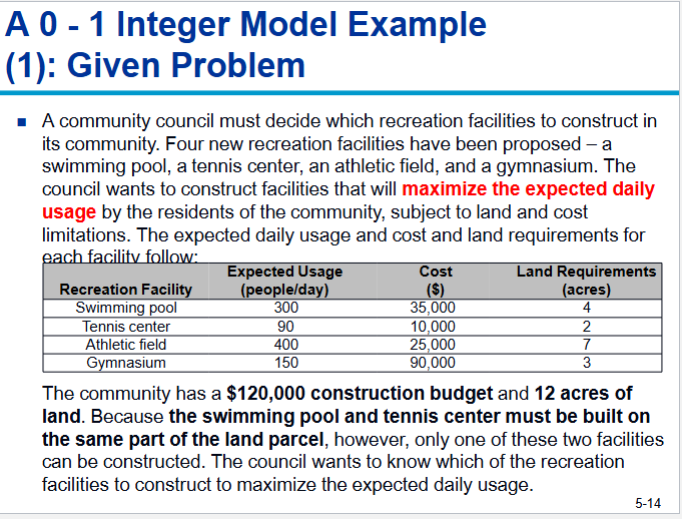
Chap 5 slide 14 example of a integer model. Solve.
Decision Variables: x1 = a swimming pool, x2 = a tennis center, x3 = an athletic field, and x4 = a gymnasium
OBJ func: Max Z= 300x1 + 90x2 + 400x3 + 150x4
Constraints:
Budget of $120,000-
35,000x1 + 10,000x2 + 25,000x3 + 90,000x4 <= 120,000
Available lands-
4x1 + 2x2 + 7x3 + 3x4 <= 12 acres
Designated land parcel for the swimming pool or tennis center=-
x1 + x2 <= 1
Constraints for decision variables-
x1, x2, x3, x4 =0 or 1
Transportation Model
A mathematical model used to determine the most cost-effective way to transport goods from multiple suppliers to multiple consumers, while satisfying supply and demand constraints.
Resource Allocation Optimization for Transportation problem.
A product is transported from a number of sources to a number of destinations at the minimum possible cost.
The linear programming model has constraints for supply at each source and demand at each destination.
-Each source is able to supply a fixed number of units of the product, and each destination has a fixed demand for the product.
Types of Transportation Model: Balanced.
All constraints are equalities and supply = demand.
Types of Transportation Model: Unbalanced.
Constraints have inequalities in them and supply does not equal demand.
The Transshipment Model Characteristics
Extension of the transportation model.
Intermediate transshipment points are added between the sources and destinations.
For a transhipment model, items can be transported from:
Sources through transshipment points to destinations
One source to another
One transshipment point to another
One destination to another
Directly from sources to destinations
Some combination of these
Assignment model
Special form of linear programming model similar to the transportation model.
Supply at each source and demand at each destination limited to one unit.

Transhipment example problem: network routes
Number of tons of wheat transported from location i to j =Xij
For ij= (i, j)= (1, 3), (1, 4), (1, 5), (2, 3), (2, 4), (2, 5), (3, 6), (3,7), (3, 8), (4, 6), (4, 7), (4, 8), (5, 6), (5, 7), (5, 8)
Obj Func:
Min Z= 16×13 + 10×14 + 12×15 + 15x23 + 14x24 + 17x25 + 6x36 + 8x37 + 10x38 + 7x46 + 11x47 + 11x48 + 4x56 + 5x57 + 12x58
S.T.
Sources-
x13 + x14 + x15 = 300
x23 + x24 + x25 = 300
Destinations
x36 + x46 + x56 = 200
x37 + x47 + x57 = 100
x38 + x48 + x58 = 300
Transshipments
x13 + x23 - x36 - x37 - x38 = 0
x14 + x24 - x46 - x47 - x48 = 0
x15 + x25 - x56 - x57 - x58 = 0
xij >= 0
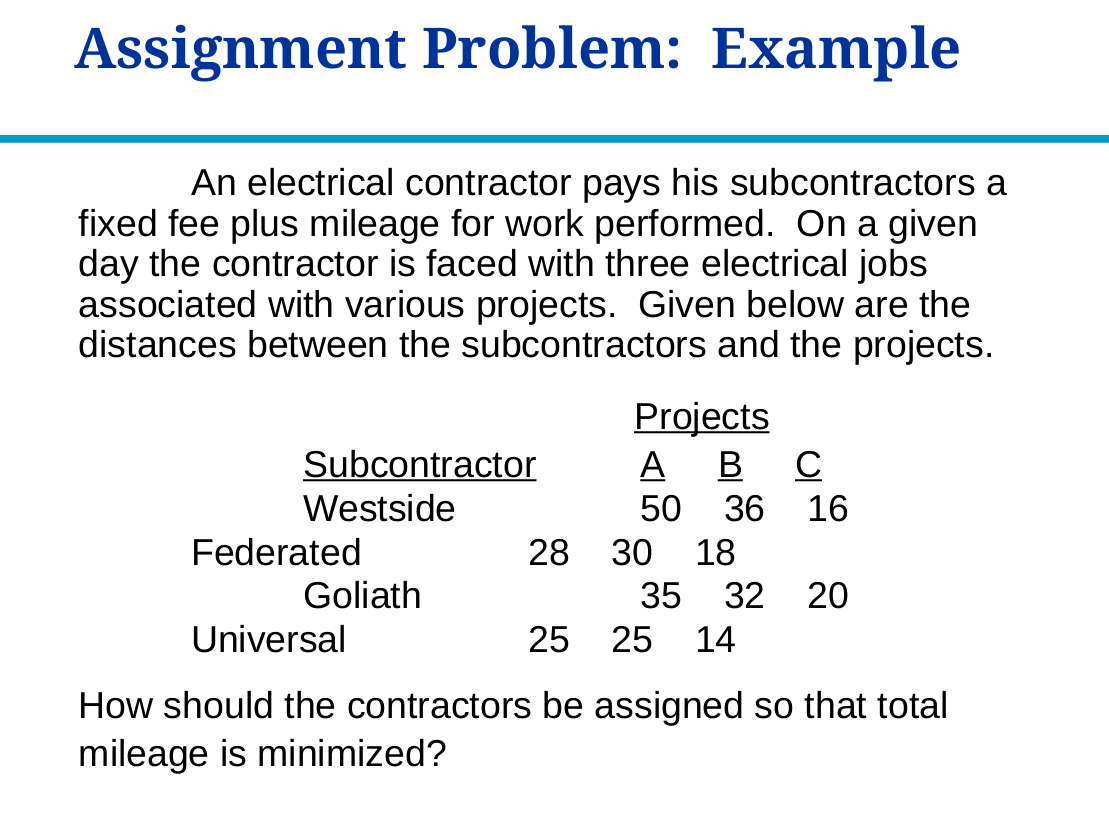
Assignment Problem: Example
LP formulazation:
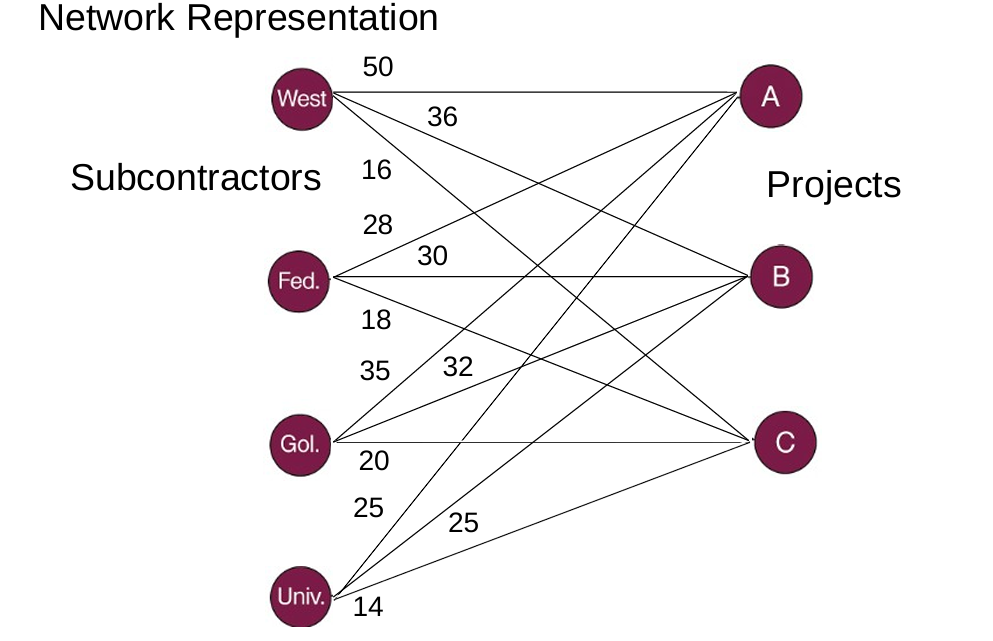
Min Z= 50x11 +36x12 +16x13 +28x21 +30x22 +18x23 +35x31 +32x32 +20x33 +25x41 +25x42 +14x43
S.T.:
x11 + x12 + x13 <= 1
x21 + x22 + x23 <=1
x31 + x32 + x33 <=1
x41 + x42 + x43 <=1
xij = 0 or 1 for all I and j
 Flashcards (42)