Functional Organization of the Corpus Callosum
 Call Kai
 Learn
Learn Practice Test
 Spaced Repetition
 Match
Match Flashcards
 Knowt Play
1/28

There's no tags or description
Looks like no tags are added yet.
Name | Mastery | Learn | Test | Matching | Spaced | Call with Kai |
|---|
No analytics yet
Send a link to your students to track their progress
29 Terms
What is the corpus callosum?
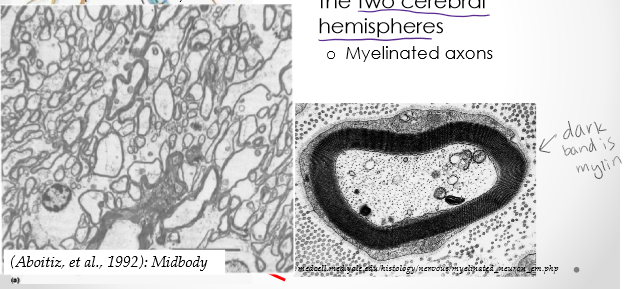
Largest white matter tract that crosses and connects the two cerebral hemispheres. Myelinated axons. Composed of: 200-350×106 fibers. These axons constitute only 2% of all neocortical neurons.
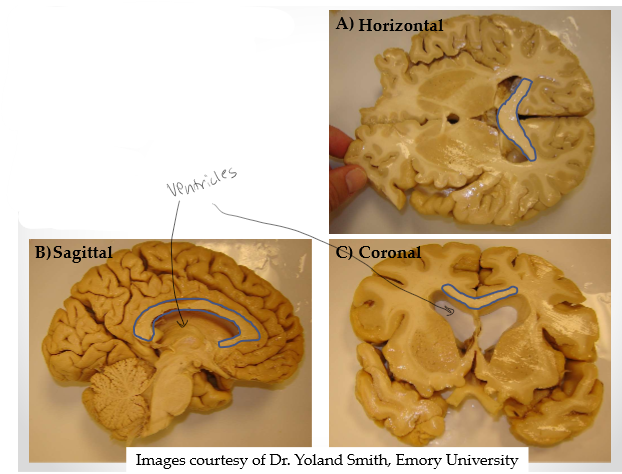
One brain structure, three different views
Spaces are lateral ventricles
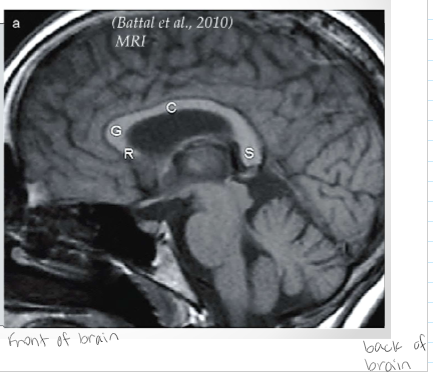
How is the corpus callosum organized?
Generally into 4 parts: 1. Rostrum 2. Genu 3. Corpus/Body/Trunk 4. Splenium *Be able to label them*
General overview of the functional connectivity of the corpus callosum
Most are homotopic interconnections
o Connecting the same functional areas of the brain
• Some are heterotopic fibers
o Linking functionally different cortical areas
• Majority are excitatory
o Integrate information across hemispheres
• Some are inhibitory
o Hemispheres inhibit each other to maximize independent functions
• In healthy individuals all fibers are present at birth
o The actual functional connectivity through the CC increases as
fibers increase their myelination
o Occurs from about 4 months of age to young adulthood. Amount of myelin on axon changes over time.
How did we first know what the corpus callosum connects?
13 Patients with unilateral focal cortical lesions due to:
o Ischemic Infarctions
• Stroke and cell death due to oxygen/ blood supply cut off
o Circumscribed Contusions
• Form of traumatic brain injury; Defined area of bruising of brain
• Crude Method: Examined the degeneration of fibers in CC to determine what parts of the cortex cross through each area of the CC.
• Note: after examination of brains, some lesions were more diffuse than expected
Ischemic Infarctions
Stroke and cell death due to oxygen/ blood supply cut off
Circumscribed Contusions
Form of traumatic brain injury; Defined area of bruising of brain
Crude Method
Examined the degeneration of fibers in CC to determine what parts of the cortex cross through each area of the CC.
Homotopic Interconnections
Connecting the same functional areas of the brain
Heterotopic fibers
Linking functionally different cortical areas
Prefrontal and anterior parietal region
Rostrum and genu. Prefrontal area
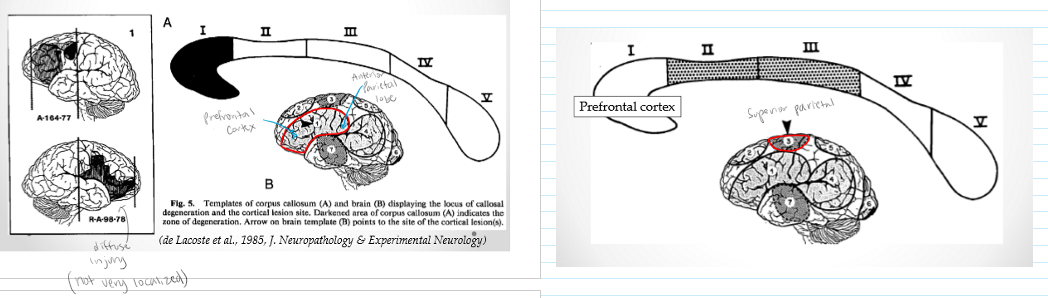
Posterior Superior frontal area
Rostral and mid body. Connecting motor areas of the brain. Motor area
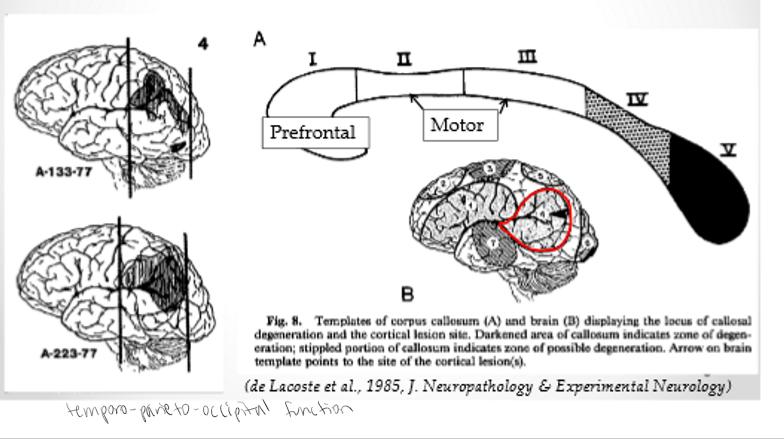
Temporo-Parieto-Occipital Junction
Caudal body and splenium. Temporal/Parietal lobe
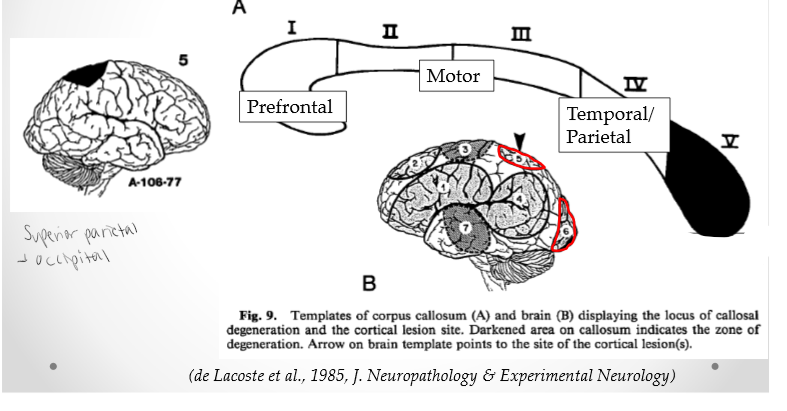
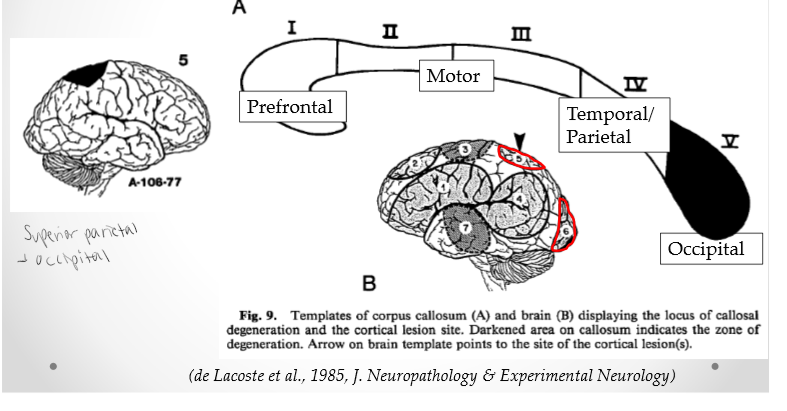
Superior-Parietal and Occipital Cortices
Splenium. Occipital lobe
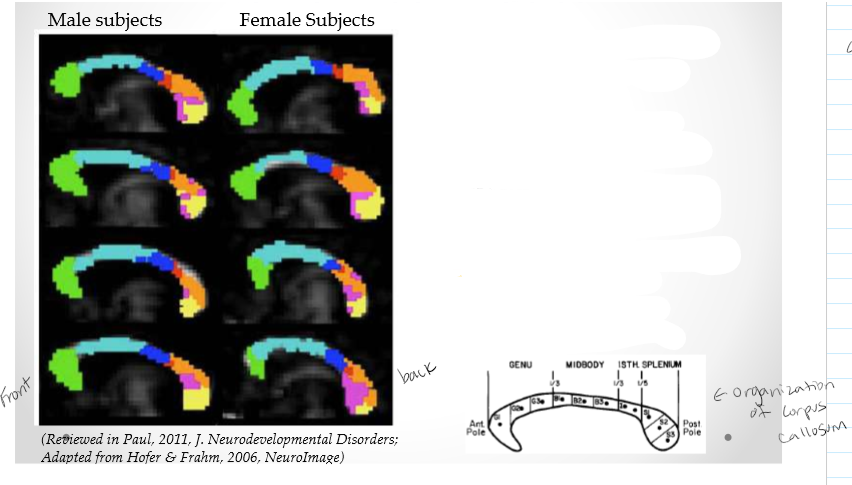
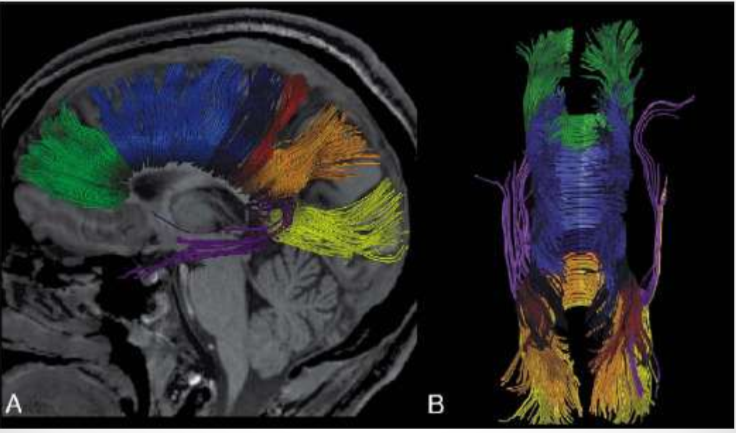
Summary of connections using newer techniques
Functional maps of the CC (slightly modified from earlier studies):
• Green: Prefrontal lobe
• Light Blue: Premotor & supplementary motor areas
• Dark Blue: Primary motor cortex
• Red: Primary Sensory cortex
• Orange: Parietal lobe
• Violet: Temporal lobe
• Yellow: Occipital lobe
Not that much is different between male and female
What are some characteristics of each of these areas?
20 Human subjects
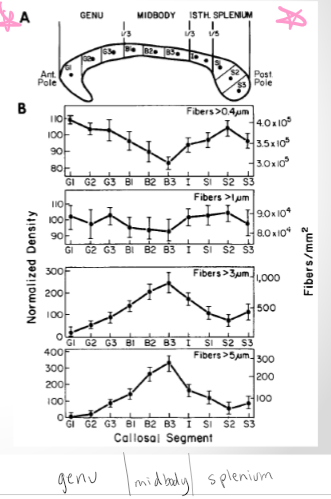
• Thin fibers most dense in genu & splenium (<0.2μm)
o Low myelination, slow conductance velocities
• Large fibers most dense in mid-body(>0.2μm)
o High myelination, high conductance velocities
Measure density of corpus callosum from front to back of brain. Density of fibers. Thin fibers most dense diameter of corpus callosum. Motor areas have highest myelin and conductance and thickest diameters.
How did we come to understand the functions of the corpus callosum & lateralization of the brain?
Dr. Roger Sperry & Dr. Michael Gazzaniga (student at the time) at California Institute
of Technology o Dr. Sperry had been observing those with lesions in the left hemisphere were speechless. Was there something unique to each hemisphere or do they both perform the same functions? 1960s: Way to treat grand mal epileptic seizures: Severe the corpus callosum, but no obvious side effects!
What are some other complications of being a split-brain patient?
Joe. Blocks the interhemispheric transfer of perceptual, sensory, motor and other forms of information. Memory of split-brained patients is generally lower than normal. Two different attentional systems in the two hemispheres. Overall though, you would never know when meeting someone that they have a split-brain.
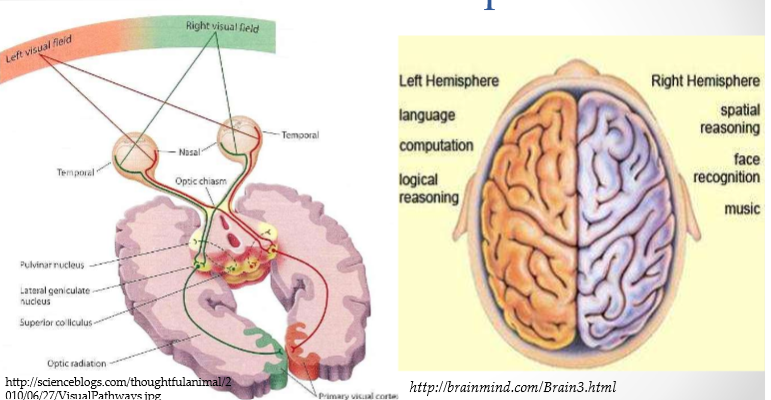
Language: A Rare Asymmetrical Neural Action
Broca’s Area: Language output; speech
• Wernicke’s Area: Language inputs; comprehension
• BOTH found in the left hemisphere
• Around Sylvian fissure, creates the arcuate fasciculus=
o Our overall concept of language
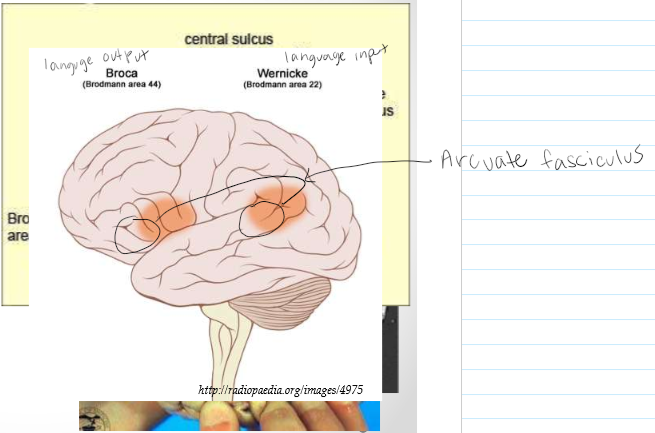
Arcuate fasciculus
Concents Broca’ and Wernicke’s area
Broca’s Area
Language output; speech
Wernicke’s Area
Language inputs; comprehension
Sex differences in the corpus callosum?
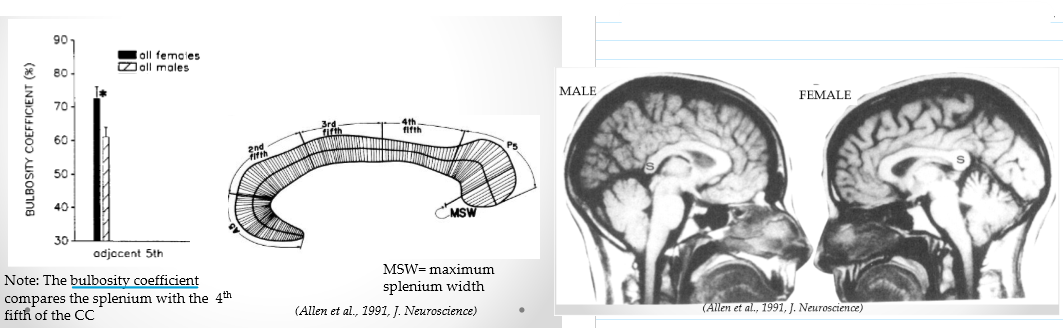
Using MRI of 73 age-matched pairs of males & females. Splenium in females is a little thicker than males. Females have higher bulbosity coefficient in splenium than males. Brains are usually about the same size between males and females.
How we look at the corpus callosum
MRI: Magnetic resonance imaging. dMRI or DTI: Diffusion tensor magnetic resonance imaging. Map connectivity of the brain noninvasively. Diagnose conditions affecting integrity of nervous tissue. Measures: 1. Anisotropy: measures the direction and axon alignment. Higher anisotropy=greater alignment of fibers. 2.Diffusivity: Measures the degree to which cells restrict movement of water within a fiber sample. Higher diffusivity=less developed cellular structure (i.e., reduced myelination)
What does DTI look like?
Early DTI images. Color superimposed on images
Agenesis of the Corpus Callosum
Lack or partial lack of the CC. Fibers migrate ipsilaterally & course along the lateral
ventricles forming Probst bundles. Not connected. Can function without the corpus callosum. Few observable symptoms.
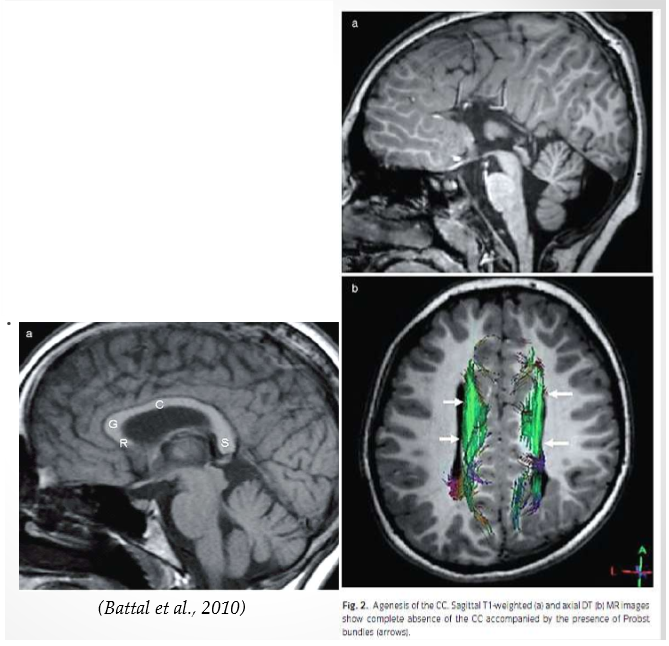
Ipsilaterally
Make more connections on same side of brain instead of across
Agenesis of the CC (AgCC)
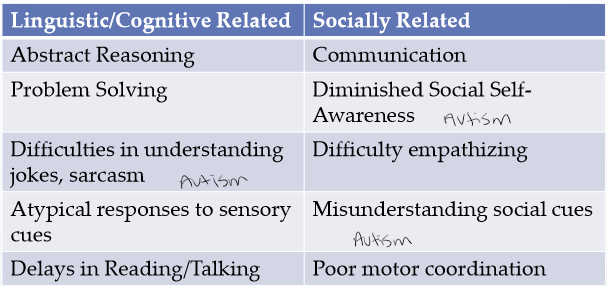
1:4000 live births. Few observable symptoms…is there compensation by other connections (i.e., the anterior commissure)? Actually perform better than adults on the split-brain test. Developmentally not the same, however have average IQ scores. These symptoms occur in various combinations and severity. Spectrum of how effected you are and of symptoms. Sounds similar to Autism.
Famous quote from Dr. Sperry
Sperry concluded (1974): “each hemisphere is indeed a conscious system in its own right, perceiving, thinking, remembering, reasoning, willing, and emoting, all at a characteristically human level, and . . . both the left and the right hemisphere may be conscious simultaneously in different, even in mutually conflicting, mental experiences that run along in parallel.”

