Speaking Neuroscience
 Studied by 0 people
 Call Kai
 Learn
Learn Practice Test
 Spaced Repetition
 Match
Match Flashcards
 Knowt Play
1/54

There's no tags or description
Looks like no tags are added yet.
Name | Mastery | Learn | Test | Matching | Spaced | Call with Kai |
|---|
No analytics yet
Send a link to your students to track their progress
55 Terms
Phonological lexicon
A store of the abstract speech sounds that make up known words
Lexical access
The process of matching a perceptual description of a word on to a stored memory description of that word
Cohort model (auditory word recognition)
In lexical access, a large number of spoken words are initially considered as candidates but works get eliminated as more evidence accumulates
Uniqueness point
The point at which the acoustic input unambiguously corresponds to only one known word
Amodal
Not tied to one or more perceptual systems
Imageability
The extent which a word can evoke a concrete image; e.g. “table,” is high on this measure but “truth” is low
N400
An event-related components in EEG found when a word meaning appears out of context or unexpectedly
Proper name/Proper noun
A type of noun denoting a unique entity such as people and place names like “Alice Walker” or “Washington DC”
Symbol grounding problem
The problem of defining concepts without assuming some pre-existing knowledge
Embodied cognition
The idea that the body (its movement or internal state) can be used in cognition (like to understand words or social situations)
Hub-and-spoke model
A model of semantic memory that contains both amodal concepts and semantic features that are grounded in sensory, motor, and bodily coordination
Sensory-functional distinction
The hypothesis that semantic features are clustered in the brain according to what are used for and what their physical properties are
Wernicke’s Aphasia
A type of aphasia associated with damage to the area and fluent yet nonsensical speech and poor comprehension
Broca’s aphasia
Aphasia associated with damage to this area and to symptoms like agrammatism and articulatory deficits
Syntax
The order and structure of the words within a sentence
Agrammatism
Halting, “telegraphic” speech production that is devoid of function words (such as of, at, the, and), bound morphemes (like ing, s) and other verbs
Parsing
The process of assigning a syntactic structure to words
Garden-Path sentence
A sentence in which the early party biases a syntactic interpretation that turns out to be incorrect
P600
An event related brain potential (ERP) typically associated with the processing of grammatical anomalies
Repetition priming
A stimulus seen previously will be identified faster on a subsequent occasion
Lexicalization
In speech production, the selection of a word based on the meaning that one wishes to convey
Freudian slip
The substitution of one word for another that is sometimes thought to reflect the hidden intentions of the speaker
Malapropisms
A speech error that consists of a word with a similar phonological form to the intended word
Spoonerism
A speech error in which initial consonants are swapped between words
Inner speech
Use of words or images without audible or physical speaking
Tip of the tongue phenomenon
A state in which a person knows, conceptually, the word that he or she wishes to say but is unable to retrieve the corresponding spoken form
Anomia
Word finding difficulties
Lemma
A modality-independent word-level entry that specifies the syntactic components of the word
Lexeme
A phonological code that drives articulation
Apraxia of speech
Difficulties in sharping the vocal tract
Dysarthria
Impaired muscular contractions of the articulatory apparatus
Dual routes of speech
What and how
Ventral “what” speech route
Ventrally along the temporal lobe. Recognizes speech acoustically, important for speech comprehension. Semantic knowledge is located in the anterior temporal lobe
Dorsal “How” speech route
Dorsal route involve in the parieto-frontal circuit. Recognizes speech motorically (motor theory of speech perception). This path can be used to say and learn unfamiliar words.
Evidence for the “How” route
Part of Wernicke’s area respond to silent speech. Angular Gyrus: Phonological STM
Linguistic levels of analysis
Phonology, morphology, syntax, semantics, pragmatics.
Phonology
The sounds of a language and rules for how they can be combined
Phoneme
Smallest units of sound (in a language)
Morphology
How words are formed in a language
Word
Smallest unit of a reply (in a language)
Syntax
Rules about how words come together to form meaning
Semantics
Meaning (words, sentences, etc.)
Pragmatics
How context influences meaning
How do we recognize words
•Phonological lexicon
• lexical access (relies on both bottom up and top down factors)
Uniqueness point in lexical access of auditory word recognition
The point at which the acoustic input unambiguously corresponds to only one word
Bottom up processing in cohort model
Acoustic input
Top down processing in cohort model
Context.
Frequency: low frequency
Imageability: imageable words are more likely to be considered
Word Recognition in Context
“The Dutch trains are yellow The Dutch trains are white The Dutch trains are sour” You see the same N400 magnitude when the target word is incorrect (white) or semantically incoherent (sour). Demonstrates that word and world knowledge influence processing simultaneously
How do we understand word meanings? Amodal
not tied to any one perceptual system
How do we understand word meanings? • The symbol grounding problem:
The problem of defining concepts without assuming some preexisting knowledge
How do we understand word meanings? Embodied cognition:
The idea that the body (in its movement or internal state) can be used in cognition (e.g., to understand words)
Grounded / Embodied Concepts
• Concepts are not defined in terms of each other, but in terms of our experiences and interactions with the world • Concepts of “green” and “kick” are linked to sensory and motor experiences rather than abstract/amodal representations
Fully-Grounded Semantics
Words are represented in networks that access multiple domains of knowledge
networks that access multiple domains of knowledge in Fully-Grounded Semantics
Action oriented elements, kinesthetic elements (3D), visual elements (form, color), tactile elements, auditory elements.
Word forms: phonological elements and orthographic elements
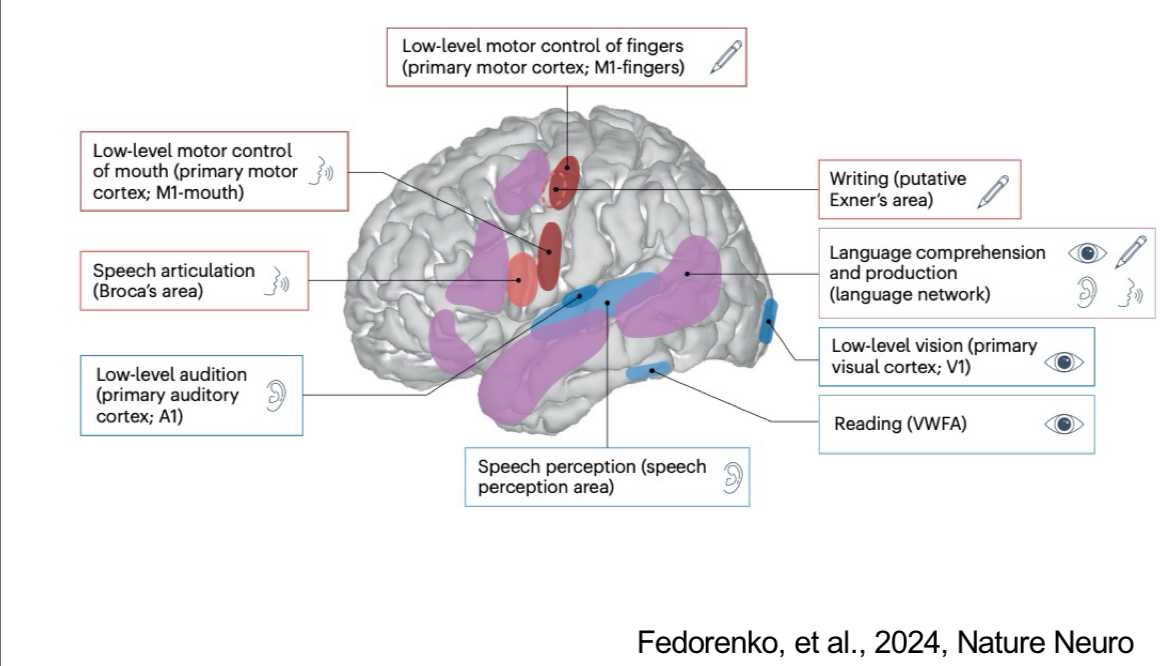
Language areas
 Note
Note  Flashcards (73)