BIOC202 - Blood glucose
 Studied by 0 people
 Call Kai
 Learn
Learn Practice Test
 Spaced Repetition
 Match
Match Flashcards
 Knowt Play
1/40

There's no tags or description
Looks like no tags are added yet.
Name | Mastery | Learn | Test | Matching | Spaced | Call with Kai |
|---|
No analytics yet
Send a link to your students to track their progress
41 Terms
why is maintaining blood glucose vital in humans?
bc the brain always needs some glucose in order to survive. Its only viable fuels are glucose and ketone bodies. Fatty acids don’t cross the blood-brain barrier in high amount and thus are not a viable fuel source
when are ketone bodies used as a fuel source for the brain? how much of the brain’s energy needs can they meet (%)?
during times of starvation, the brain retools its metabolism to use ketone bodies as an energy source. However, ketone bodies can only meet up to 70% of the brains energy needs. The other 30% must be glucose.
ketone body is a way for the ___ to ship ___ units to other parts of the body
ketone body is a way for the liver to ship acetyl units to other parts of the body
what is the ideal blood glucose level?
around 5mM
in the fasting state, what are the blood glucose levels? what is this called?
≥ 7 mM
hyperglycemia (high BG lvls)
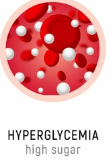
what can long term hyperglycemia cause?
can lead to neurological, cardiovascular, renal, and vision dmg
chronic over decades
what can very high [BG] (20-30mM) cause?
glucose can now act as an osmolyte (mlc that retains water - pulls away water from everything else) and an ind. can become unconscious
if BG lvls are ≤ 4mM, what is this called? what can it cause in a person?
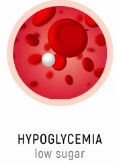
hypoglycemia (low BG)
an ind. can lose consciousness, and possibly brain damage or death
what cells in the body require glucose? why?
RBCs and the cells of the eye lens bc they lack mitochondria
why do different tissues respond differently to some hormones?
different tissues have different metabolic profiles (i.e., the brain, muscle, liver, adipose tissue) all carry out different metabolic roles, therefore they respond differently to some hormones and may have different isoforms of the same enzyme
what are isoforms?
enzymes that catalyze the same rxn, but the structure and sequence are different (also diff Km’s and Kcat's)
what are the “big 3” hormones that regulate BGL?
insulin
glucagon
epinephrine
what insulin? what does it promote?
it is a peptide hormone secreted when BGL are high to promote the synthesis of fats, glycogen, and proteins (anabolic pathways), also decreasing gluconeogenesis and promoting uptake of glucose.
most cells cant take up large amount of glucose w/o ____
insulin
what is insulin produced by? what does insulin target?
beta-islet cells in the pancreas
targets most cells in the body
what is glucagon? what does it promote?
it is a peptide hormone secreted when glucose is scarce (low BGL). It promotes lipolysis (release FAs), promotes gluconeogenesis, glycogen breakdown, and protein catabolism. Additionally, promotes the release of glucose from the liver. catabolism rxns
what is glucagon produced by? what does it primarily target?
alpha-islet cells of the pancreas
primarily targets liver and adipocytes
what is epinephrine also known as?
adrenaline
what is epinephrine? what does it target?
catecholamine hormone released when glucose is needed in a stress situation. Targets muscle cells (and a lesser extent the liver)
in the fed state, what is the insulin:glucagon ratio?
high insulin:glucagon
in the fed state, what are all cells doing?
consuming glucose
in the fed state, what happens to glucose?
it is stored as glycogen or converted to FAs
in the fed state, what is happening in terms of fats?
FA synthesis and TAG (triacyl glyceride) storage (FATs building up)
in the fed state, what is happening in terms of proteins?
aa and PRO synthesis is at a max
in the fed state, what is happening in terms of gluconeogenesis?
little gluconeogenesis unless on a high PRO/low CHO diet
where are dietary TAGs stored?
in adipocytes
in the short fast state (btwen meals, few hrs), what is the insulin:glucagon ratio?
low insulin:glucagon
in the short fast state, what are cells doing?
most cells slowly stop consuming glucose and start consuming FAs
in the short fast state, what happens to glycogen?
it is broken down in the liver to maintain blood glucose
in the short fast state, is gluconeogenesis occuring?
yes, there is a little bit of gluconeogenesis occurring, using lactate and glycerol as carbon sources (however, this is not the main way to generate glucose)
in the short fast state, what is happening to proteins and ketone bodies?
no significant PRO breakdown and only limited ketone body production
what happens if fasting continues (> 18hr)?
glycogen stores in the liver begin to run out and fats become the main source of energy for most cells. Additionally, gluconeogenesis begins to increase and there is some protein breakdown (however, we don’t want large amounts of protein breakdown as we don’t want to eat ourselves).
what happens around 2 days of fasting?
the liver starts producing higher [ketone bodies] from FAs which reduces the brains need for glucose, therefore gluconeogenesis and protein breakdown slows but does not stop
what happens if fasting continues for weeks to months?
eventually, all FAs are exhausted thus ketone body lvls fall and body consumes more proteins (from ur own body) thus muscles waste away. Additionally, immune sys fails and person will usually die of infection
glucose transporters (GLUTs) transport glucose via _____
facilitated diffusion
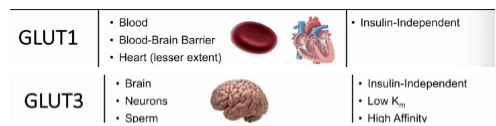
what cells are GLUT 1&3 found in? what is the Km? what is their function?
all cell types, but their expression lvls vary from cell to cell (brain and RBCs have high lvls of GLUT 1&3)
low Km: 1mM
fnc to continuously bring glucose into cells
where is GLUT 2 found at high lvls? what is the Km?
pancreas and liver
high Km: 15-17 mM

what does GLUT 2 ensure in the liver?
ensures glucose is only metabolized at high rates, when glucose is high
what does GLUT 2 result in in the pancreas?
results in signal transduction and insulin release which is one of the ways to detect high BGL
where is GLUT 4 found at high lvls in? what is the Km?
in high lvls in the muscle, adipocytes, and heart
Km: 5mM

where are GLUT 4 found? when do they use large amounts of glucose?
found in intracellular vesicles that move to the plasma membrane when cells are stimulated by insulin. Only use large amounts of glucose when it is abundant
 Note
Note  Flashcards (20)