OCR A Level Bio. 3.1.3 - Transport in Plants
 Call Kai
 Learn
Learn Practice Test
 Spaced Repetition
 Match
Match Flashcards
 Knowt Play
1/67

There's no tags or description
Looks like no tags are added yet.
Name | Mastery | Learn | Test | Matching | Spaced | Call with Kai |
|---|
No analytics yet
Send a link to your students to track their progress
68 Terms
why do plants need transport systems? (×3)
• low SA:V - direct diffusion would be to slow
• are large (multicellular) organisms - so have a greater demand for substances - so mist move sub.s quickly
• have high metabolic rate - so require lots of sub.s to be provided & removed quickly - direct diffusion would be to slow to meet metabolic needs
what do xylem vessels transport?
water & (dissolved) mineral ions
what is the role of the xylem aside from transporting substances?
provide plant w/ mechanical strength & support
what do phloem vessels transport? (specific)
nutrients, sugars - sucrose, amino acids
where are the xylem & phloem found in the roots?
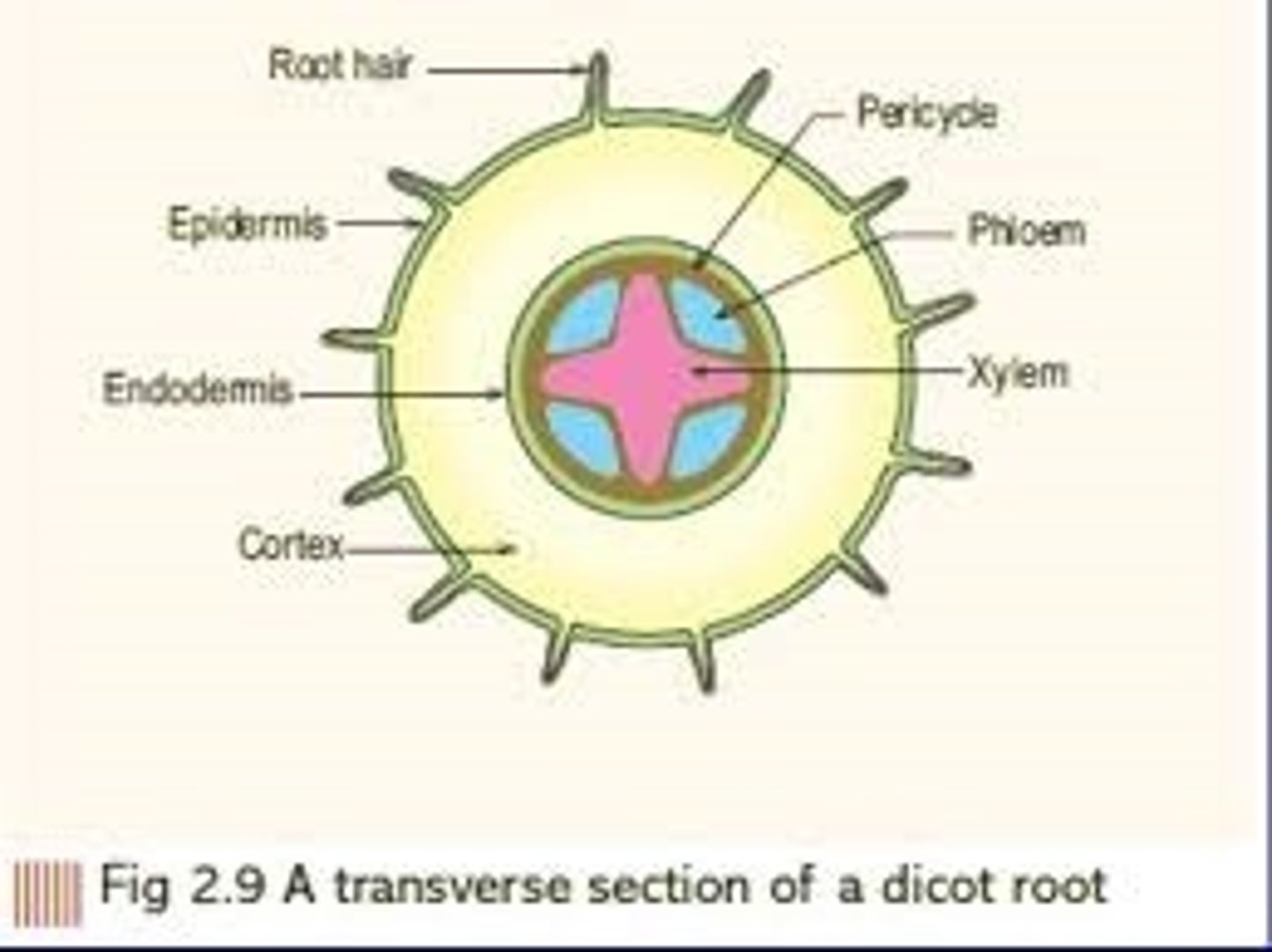
they are bundled together in the centre of the root w/ the xylem in the middle (star shaped) & the phloem on the outside
where are the xylem & phloem found in the stem?
• they make up vascular bundles in the stem
• arranged in a ring surrounding the centre of the stem
• xylem on inside
• phloem on outside
• vascular bundles (xylem & phloem) are separated (from each other) by the cambium

where are the xylem & phloem found in the leaves? & what is their function here?
• make up vascular tissue of the leaf (vein)
• xylem found on upper side of vein
• phloem found on under side
• provide support for leavesh
what are the structural adaptations of xylem vessels? (×5)
• are long, continuous, hollow tubes - have no end wall between cells => quick transport
• made of dead tissue
• long empty lumen (no cytoplasm => fast transport
• thickened walls strengthened w/ lignin - provide mechanical strength & support
• lignin contains pits so water --> in & out of lignin/xylem
what 2 types of cells are phloem vessels made up of?
• sieve tubes
• companion cells
what structural adaptations do sieve tubes (phloem) have?
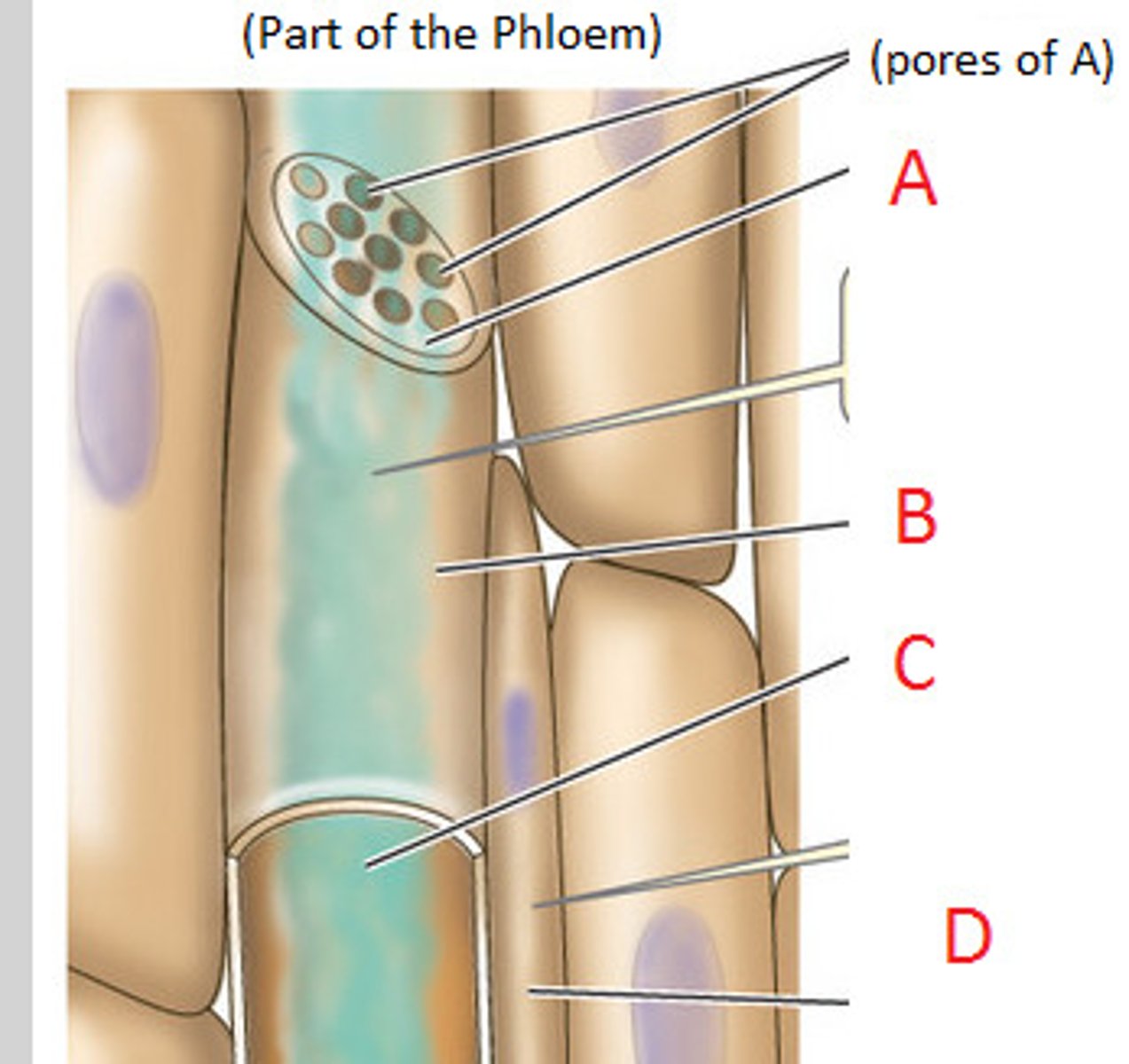
• separated by sieve plates - contain plasmodesmata (pores) - allow continuous connection of consecutive cells' cytoplasm
• contain no nucleus, vacuole, organelles - more space for sub.s
what is the function of companion cells (phloem)? what structural adaptations do they have to aid this function?
• provide energy to sieve tubes
• contain lots of mitochondria
[• narrow cell wall - easy diffusion of ATP into sieve tubes]
what is the transpiration stream?
when water is pulled up roots-->leaves due to the water evaporation from leaves and the cohesive forces between water molecules
through what process does water move through a plant?
osmosis
in which direction does water move through a plant in relation to water potential?
high water potential (e.g. -10) --> low water potential (e.g. -30) (down/across w.p. conc.n gradient)
what are 2 pathways water can take to move from the soil --> xylem (through the roots)
• symplast pathway
• apoplast pathway
where (in a cell) does water move through in the symplast pathway (water = soil --> xylem)?
cytoplasm
outline the process of the symplast pathway (water = soil --> xylem)
1) water moves through cytoplasm
2) cytoplasms between cells = continuous as connect through plasmodesmata
3) water moves cell by cell from roots --> xylem, down a w.p. conc.n gradient
where (in a cell) does water move through in the apoplast pathway (water = soil --> xylem)?
cell walls
outline the process of the apoplast pathway (water = soil --> xylem)
1) water moves through cell walls
2) water moves cell by cell until it reaches the casparian strips in the endodermis layer of the root
3) water moves from the casparian strips --> xylem by the symplast pathway (through cytoplasm) (down w.p. conc.n gradient)
what is the importance/effect of casparian strips for the apoplast pathway (water movement --> xylem)?
• is waxy
• is hydrophobic
• is impermeable to water
• forces water to take the symplast pathway for the last few cells to get to the xylem
transpiration definition
loss of water vapour through evaporation from the upper parts of a plant (leaves)
where is most water lost from in transpiration?
stomata
during what time of day is most water lost?
day time - stomata = open to allow gaseous exchange for photosynthesis
where, other than the stomata, can water be lost from during transpiration? why is water loss here limited?
upper surface of the leaf; limited by the waxy cuticle
outline the process of transpiration (x3 steps)
1. water enters the leaf through the xylem and moves to the spongy mesophyll layer by osmosis (apoplast path.?)
2. water evaporates from mesophyll cell walls
3. water vapour diffuses out of the leaf through the stomata
what condition/environment is needed for transpiration to occur? therefore in what condition would transpiration be limited?
water vapour potential gradient - higher water vapour potential inside the leaf than out - water vapour diffuses down the gradient.
less transpiration in humid environments
Why is transpiration important for plants? (x4)
• transports mineral ions and water around plant
• allows water to evaporate - keeps plant cool
• maintains cell turgidity
• consequence of gas exchange
what environmental factors affect transpiration rate? (x5)
• light intensity
• temperature
• relative humidity
• air movement/wind
• water availability
what effect does increasing light intensity have on rate of transpiration? why?
transpiration rate increases - stomata are open more for gaseous exchange (photosythesis)
what effect does increasing temperature have on rate of transpiration? why?
transpiration rate increases -
• evaporation rate increases
• so diffusion through stomata increases
• which decreases relative water vapour potential (gradient) in the air
what effect does increasing relative humidity have on rate of transpiration? why?
transpiration rate decreases - there's a lower water vapour potential gradient (which decreases diffusion rate)
what effect does increasing air movement/wind have on rate of transpiration? why?
transpiration rate increases - wind carries away water vapour which increases water vapour potential gradient so increases diffusion rate
what effect does increasing water availability have on rate of transpiration? why?
transpiration rate increases - the water lost can be replaced which keeps stomata open
what effect does low water availability have on rate of transpiration? why?
low rate of transpiration - if there's not much water in the soil, water lost can't be replaced so stomata close
what piece of apparatus is used to estimate transpiration rate? what does this apparatus measure?
potometer - measures rate of water uptake => can be used to estimate transpiration rate
outline 6 precautions to take to get the best results when measuring transpiration rate
• set up the potometer underwater
• use a healthy plant
• cut the plant underwater
• cut at an angle
• dry the leaves
• only measure the effect of 1 factor at a time
equation for transpiration rate
volume (of capillary tube)/time
transpiration stream definition
the continuous movement of water from roots through the xylem to the leaves as a result of evaporation of water from the leaves and the cohesive properties of water molecules
outline water movement through a plant from root to xylem
root -> cortex -> endodermis -> xylem/medulla
what does the endodermis contain which aids with movement of water? how does it help?
contains starch granules - provide energy for active process of water movement (in roots)
what effect do casparian strips have on the movement of water & mineral ions?
block the apoplast pathway so water & ions (nitrates) move to the cytoplasm; & stop water backflow
what doe porter proteins in the plasma membrane do? what is the effect on water potential gradient?
pump mineral ions in cortex cell cytoplasms to the medulla/xylem by active transport. maintains the w.p. gradient as xylem w.p. becomes more negative
by what process is water transported up the stem?
mass flow
outline how water moves up the stem by mass flow (incl. root pressure, transpiration pull, cohesion-tension theory/cohesive forces)
1. as water move by active transport & osmosis to the medulla, root pressure increases so more water is pulled up the xylem
2. this causes a transpiration pull: water molecules are attracted to each other by cohesive forces - hold water mol.s in a strong chain => as water evaporates, the whole chain moves up (tension) - is continuous
• this shows the cohesion tension theory
• so the xylem must be strengthened by lignin - to prevent collapse due to the tension
what is capillary action?
adhesive forces that hold water molecules together and pull water up the sides of a vessel (xylem)
how does water leave from a plant?
• mostly from stomata -> air - evaporates from cells linig the cavity above guard cells, causes transpiration stream
• a little lost through waxy cuticle
xerophyte definition & 2 examples
a plant adapted to living in arid/dry/harsh conditions (low water in environment) e.g. cacti, marram grass
4 general adaptations of xerophytes
• waxy cuticle
• stomata on underside of leaf
• stomata close at night (reduce water loss)
• deciduous plants lose leaves in winter (less water decreases photosynth.)
5 adaptations of marram grass
• leaves can roll up- increases humidity so reduces water loss
• thick cuticle with no stomata
• sunken stomata - increases humidity so decreases water loss
• many hairs - increased SA to trap water, decrease air movement
• dense mesophyll - reduces SA for water evaporation
3 adaptations of cacti
• store water in stems
• has spines - reduces SA for water loss
• widespread roots - take up as much water as possible
3 xerophytic adaptations/features to decrease water potential gradient & so decrease transpiration
• stomata close in low water availability
• increased salt concentration in cells
• long roots reach deep underground to reach underground water
hydrophyte definition & 1 example
a plant that lives in water e.g. water lily
what problems can hydrophytes face? (x2)
problems getting oxygen to submerged tissues & problems w/ staying afloat so leaves are in the sun for photosynthesis
3 adaptations of a water lily
• large air spaces in leaves - plant floats so can absorb sunlight
• stomata on upperside of leaves - increases gas exchange
• large air spaces in leaves - increases buoyancy so oxygen diffuses to roots for resp.
what are hydathodes? in what way do they help plants?
structures in tips/margins of leaves to allow transpiration - glands that release water which evaporates - help plants expel excess water
assimilates definition
the products of photosynthesis that are transported around a plant, e.g., sucrose
translocation definition
movement of assimilates through phloem
Is translocation an active or passive process?
active
source definition, process used, high/low hydrostatic pressure
part of a plant that loads assimilates into sieve tubes by active loading, high hydrostatic pressure
sink definition, process used, high/low hydrostatic pressure
part of a plant that removes assimilates from sieve tubes by diffusion/active transport, low hydrostatic pressure
what can sucrose be used for? (x3)
respiration, meristem growth, to make starch
what is active loading?
the process of loading sucrose into the sieve tube elements, involving companion cells
where does ATP come from for active loading?
companion cells
outline the process by which sucrose is transported to sieve tube elements
• must have a higher con of H+ ions outside of companion cells (so 1. H+ ions move out of cells)
2. H+ ions move into companion cells by cotransport, through cotransporter proteins attached to sucrose mol.s - sucrose mol.s move against the conc. grad.
3. sucrose conc. increases in companion cells so sucrose diffuses into sieve tube elements, through plasmodesmata
through what process is sucrose transported in the phloem/in a plant?
mass flow
outline how sucrose moves through a plant by mass flow (source, sink, pressure)
sap (containing sucrose, amino acids etc.) flows up/down phloem as needed - movement = caused/controlled by difference in hydrostatic pressure between tube ends - moves down pressure gradient
• source -> sink - water enters the tube at the source so increases pressure; water leves tube at sink so reduces pressure
how does water potential & hydrostatic pressure at the source change as sucrose is loaded into sieve tube elements?
w.p. becomes more negative so water osmoses from tissues to sieve tube elements, increases hydrostatic pressure (high)
how does water potential & hydrostatic pressure at the sink change as sucrose diffuses out of sieve tube elements?
removal of sap increases water potential (less negative) so water osmoses from sieve tubes to surrounding cells, decreases hydrostatic pressure (low)

