Biology Lecture 5 - Cell Communication
 Studied by 0 people
 Call Kai
 Learn
Learn Practice Test
 Spaced Repetition
 Match
Match Flashcards
 Knowt Play
1/43

There's no tags or description
Looks like no tags are added yet.
Name | Mastery | Learn | Test | Matching | Spaced | Call with Kai |
|---|
No analytics yet
Send a link to your students to track their progress
44 Terms
cell communication
cells communicate to call on each other for help, signals to manage the body, detect and respond to environmental signals
quorum sensing
bacteria can sense population density
modulate gene expression accordingly
multicellular organisms coordinate their cells
to survive, grow and divide, differentiate, and die
apoptotic cell
dead cell
autocrine signals
act on the same cell that secretes them
paracrine signals
diffuse locally and act on neighboring cells
endocrine signals
are hormones carried between cells by blood or other body fluids
contact dependent signals
membrane bound signal molecule
neural signals
diffuse a short distance between neurons
neuroendocrine signals
are released from neurons but are carried by blood or other body fluids and act on distant cells
signal receptors
differnt cell types produce distinct sets of receptors, can be extracellular or cytoplasmic
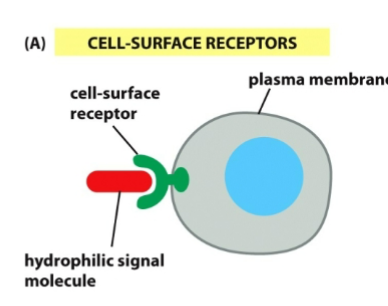
cell surface receptors
external
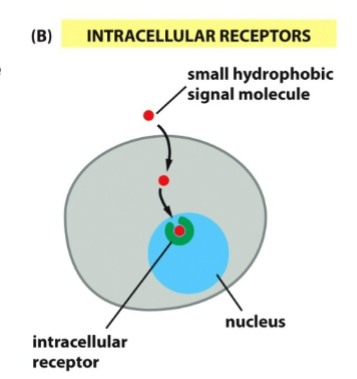
intracellular receptors
internal
signal generation
another cell (or self)
signal reception
cytoplasmic or extracellular receptor
changes in cell signaling component
direct effect or signal amplification
mediate response
metabolism, cytoskeleton, transcription factor
extracellular reception and cytoplasmic resption process
generation - signal made, released
reception - receptor/ligand meet
changes in signaling component - movement of signal into cell
response
extracellular reception of signals
large, hydrophilic signaling molecules
relatively slow response to signal
significant amplification of signal at each step
cytoplasmic reception of signals
small, hydrophobic signals
very fast signaling
signla to transcription factor activation
changes in protein structure can dramatically alter protein function
binding another protein
binding to a small molecule
phosphorylation
reversible activation of signaling components
on switch and off switch
secondary messengers
small non portein signaling molecules
adrenaline
signaling stimulates glycogen breakdown
Which statement about signal transduction in cells can be used to explain how specificity is achieved in a signal transduction pathway?
A receptor protein changes its conformation only when its binding site is occupied by a small molecule with a shape complementary to the site.
In designing a drug to bind to a receptor and block the binding of a natural ligand in the human body, a pharmaceutical chemist would focus on mimicking which aspect of the natural ligand?
Orientation of functional groups
Which statement about membrane receptors in a signal transduction pathway is true?
Ligands bind to the extracellular binding domain and do not enter the cell.
In order to respond to a signal, a cell must have a specific _______ that can detect the signal.
receptor
Paracrine signals bind to
receptors on neighboring cells.
Which statement about ligand‒receptor complexes is false?
After binding to a cell membrane receptor, a ligand participates in the cellular response.
A deer smells a predator as it passes by and quickly bounds to safety. Which sequence represents the correct order of steps in the signal transduction pathway that is involved?
Signal travels to target cell receptor binds signal conformational change occurs in receptor signal is transduced within cell effects from signal transduction occur
After a signal arrives at a target cell, the next step in a signal transduction pathway involves
receptor binding.
Signals that travel to distant cells through the circulatory system are
hormones.
Which statement about cyclic AMP is false?
It possesses enzymatic activity.
How does an external chemical signal initiate a response in a cell?
It causes a change in conformation of a receptor protein.
Acetylcholine is a compound released by one neuron that diffuses across a synapse to a nearby neuron, where it binds and initiates a response. How would you classify acetylcholine?
Paracrine signal
Autocrine signals bind to
receptors on the cell that produced them.
To respond to a signal, a cell must have a(n) _______ molecule that can detect the signal.
receptor
Which molecule acts as a second messenger in the cascade by which epinephrine stimulates the activation of the enzyme glycogen phosphorylase in liver cells?
Cyclic AMP
Aldosterone is a steroid compound synthesized in the adrenal glands that binds to receptors in kidney cells. How would aldosterone be classified?
Hormone
Which is the correct order of the steps in a generalized signal transduction pathway?
Signal molecule binds to receptor molecules within cell transduce signal cell responds
The concentration of cAMP in a cell is usually increased by activity of
adenylyl cyclase.
The major difference between a cell that responds to a signal and one that does not is the presence of a
receptor.
An entire cell signaling process is known as a signal _______ pathway.
transduction

