Proof
 Studied by 0 people
 Call Kai
 Learn
Learn Practice Test
 Spaced Repetition
 Match
Match Flashcards
 Knowt Play
1/32

There's no tags or description
Looks like no tags are added yet.
Name | Mastery | Learn | Test | Matching | Spaced | Call with Kai |
|---|
No analytics yet
Send a link to your students to track their progress
33 Terms
Define a statement
Declarative sentence that is either true or false but not both
Can check if a sentence is a statement by adding “Is it true that” before it, and see if it makes sense
Define an axiom
Statement agreed to be true, e.g. commutative law a + b = b + a
Define definition
Precise statement of the meaning of a mathematical word, don’t require proof (e.g. an even number = 2n)
Define a theorem
Describes the relationship between two or more mathematical ideas, using axioms and/or definitions. E.g. quadratic formula
What is the key difference between axioms and theorems
Theorems require proof, they start as a proposition
Define lemma
A minor, proven statement used to help prove a larger theorem
What is a corollary
Theorem of less importance which is deduced after proving another theorem
Define a predicate
Sentence containing one or more variables that becomes a statement if we know the values of the variables
(If you can’t say it’s true/false it’s a predicate)
Maps domain of discourse to true or false
What is the domain of discourse
The values a variable in a predicate can take
Come back to if Pn Q , P V Q is statement or predicate
What is a tautology
A predicate whose truth value is always true, whatever the value of the variables (truth table true for whole column)
What are mathematical arguments made from
Premises and a conclusion
Define a premise
A statement used as evidence in an argument, intended to be true
What is a conclusion
Statement that follows logically from the premises
What does it mean for an argument to be:
a) valid
b) sound
a) Conclusion follows logically from the premises, regardless if the premises are true
b) Valid and all premises true
What are the two key tautology examples
Modus ponens and Modus Tollens
What is modus ponens
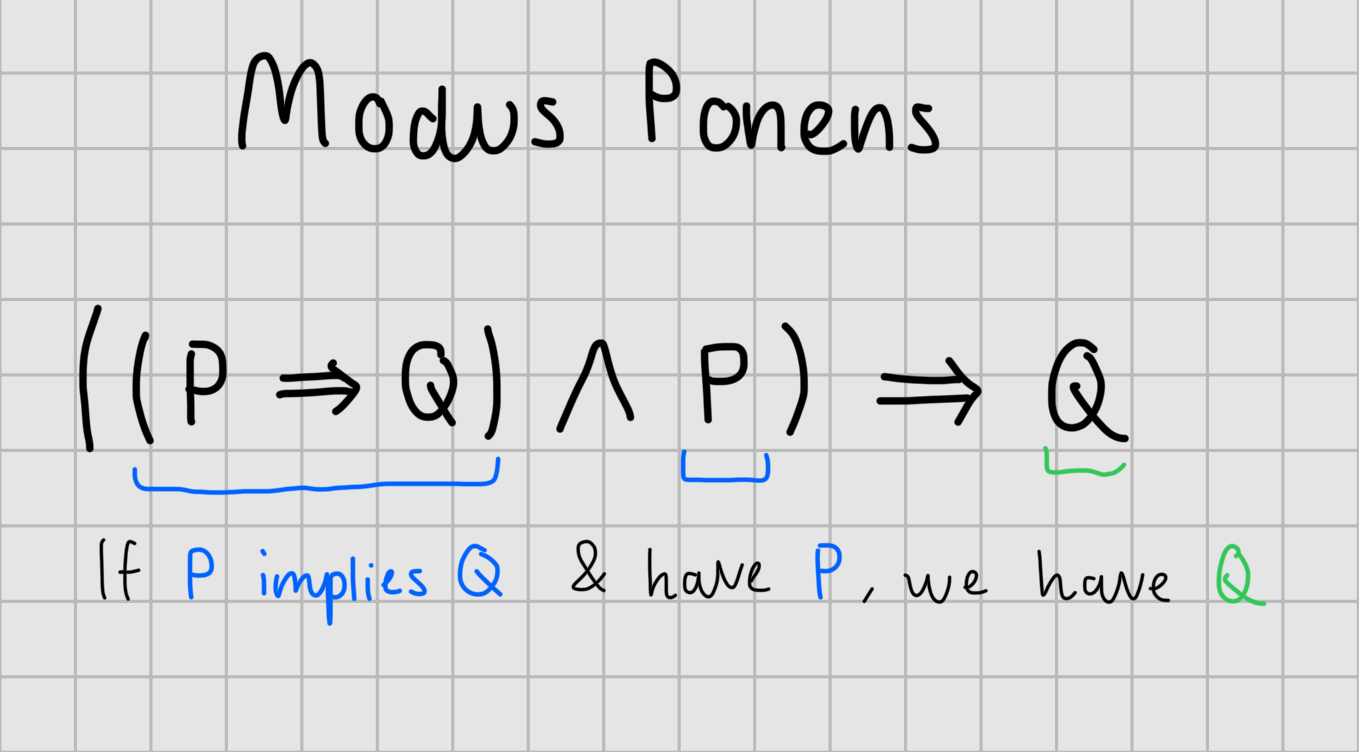
Give a mathematical example of Modus Ponens
This argument is sound, valid and premises true

What is Modus Tollens
Once again always valid, even though premises may not be true
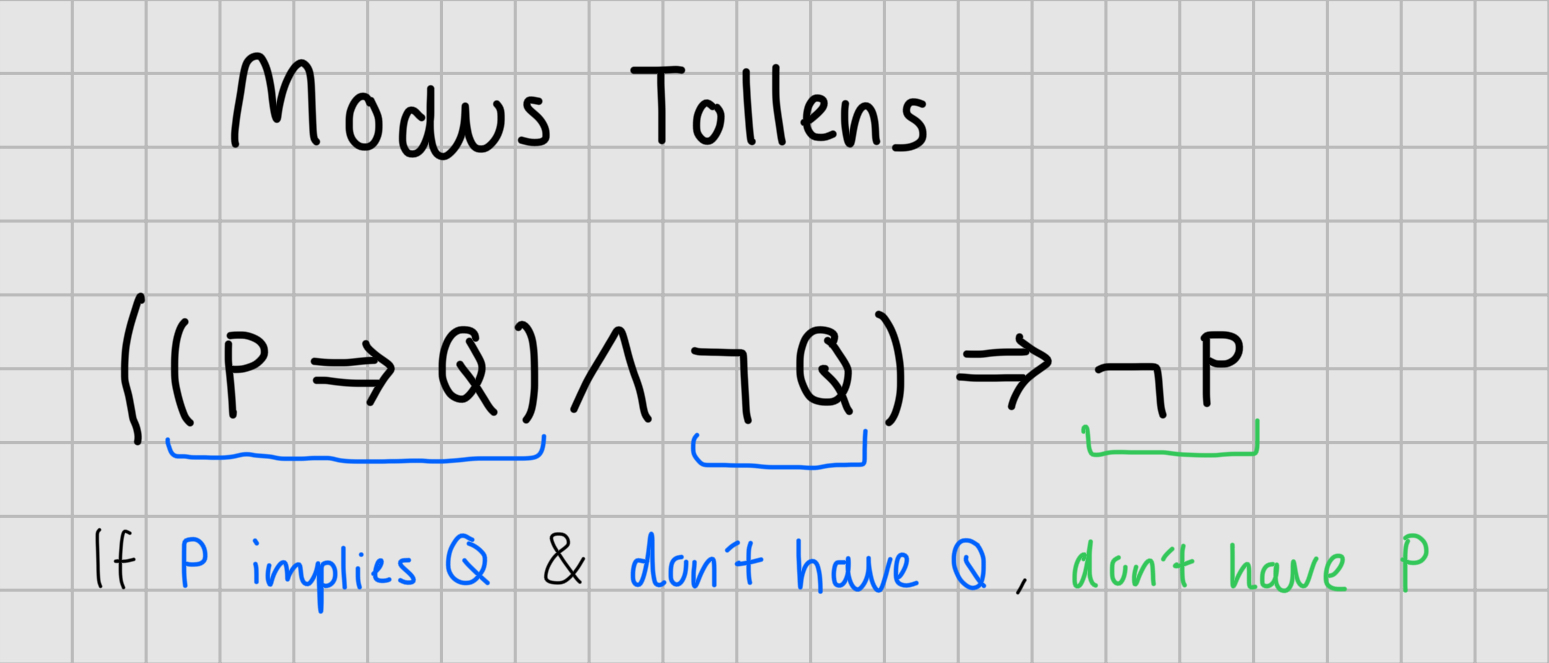
What can be said about all arguments that follow Modus ponens or Modus Tollens
Always valid, not always sound
What is the contrapositive of P implies Q ( P → Q)
Not Q → Not P
When are two statements logically equivalent
When P ←→ Q
What can be said about th contrapositive
A statement and its contrapositive are logically equivalent ( P ←→ Q)
Give an example of how a new predicate can be formed from Q(x, y, z)
New predicate’s only variable is x

What rule from set theory can be applied to proof as a tautology
de Morgan’s laws
What tautologies are formed from de Morgan’s Laws
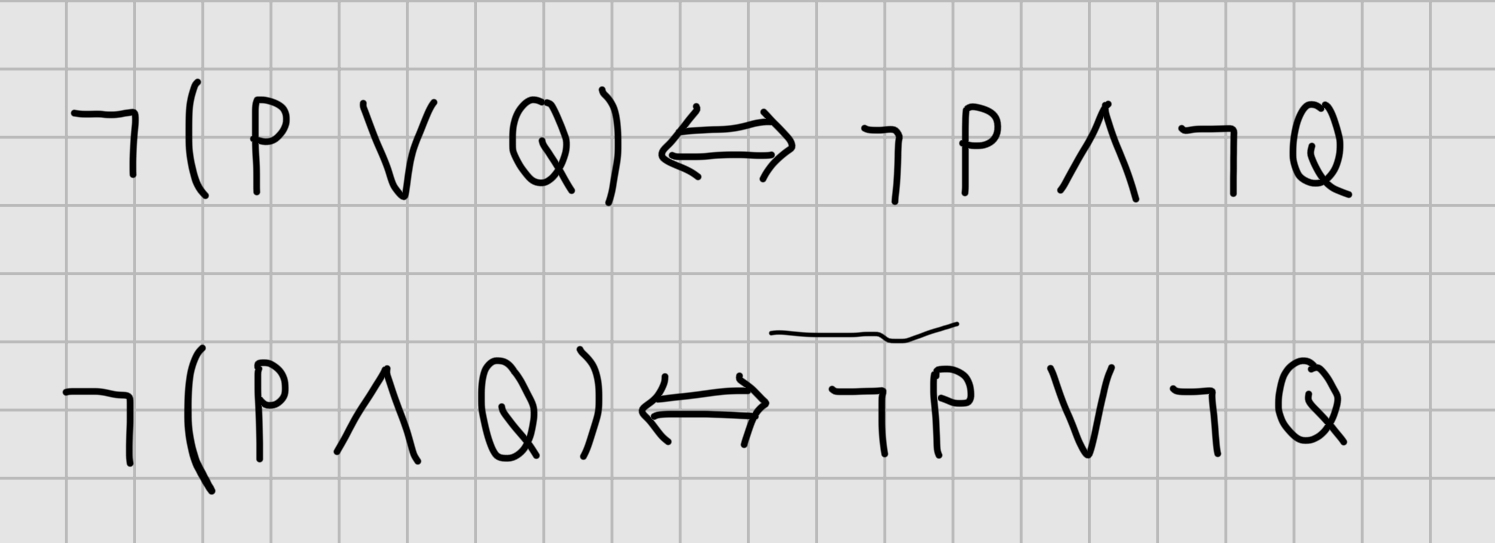
What tautologies involve the negative of quantifiers?
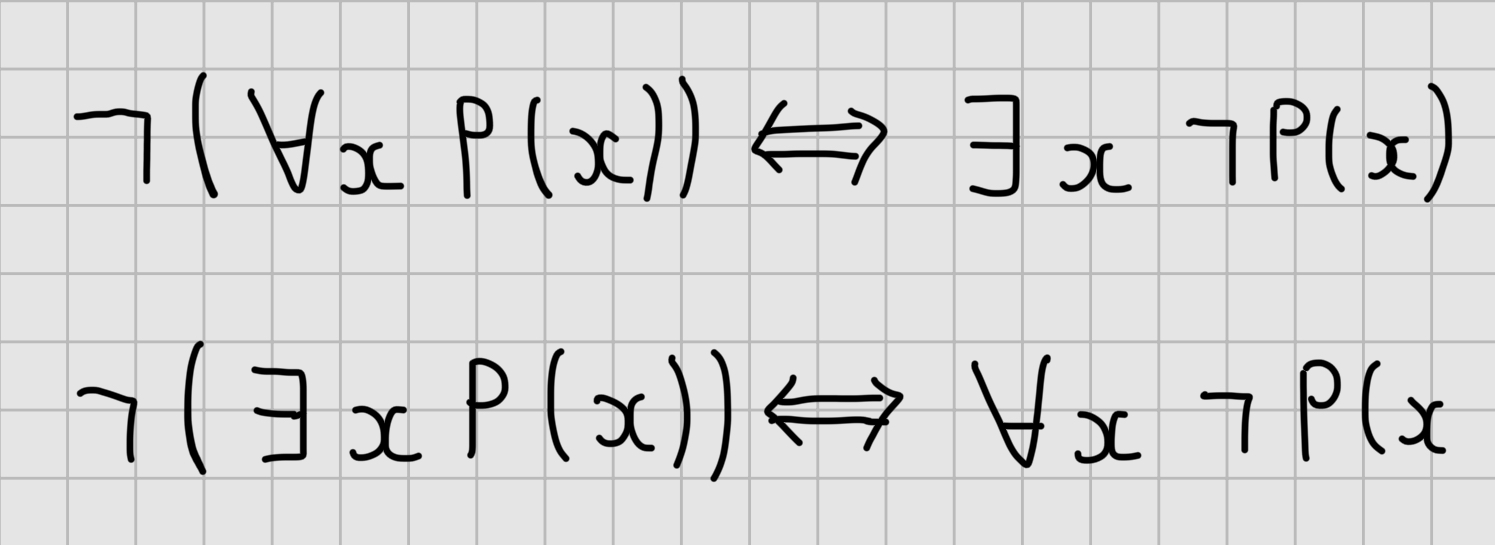
Why is it useful to negate statements involving quantifiers
Easier to prove “there exists an x…”, than to prove “that for all x…”
Therefore can negate statement with. “For all” and can check veracity of negation

Negate the following statement. Is the statement true? Is the negation true?
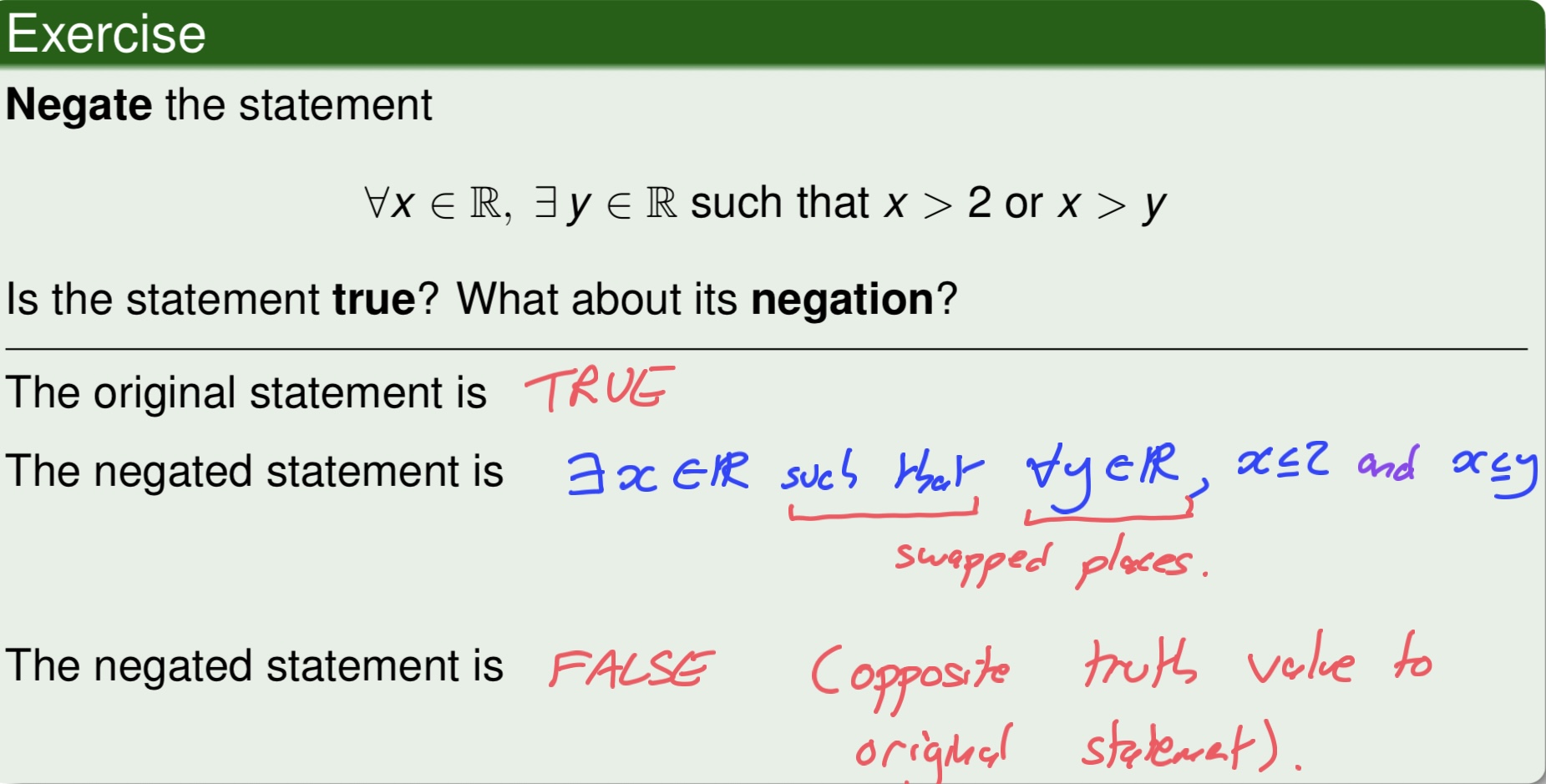
How would you prove a statement of the form A ← → B
Assume A is true, show A → B
Assume B is true, show B → A
Name all the types of direct or indirect proofs you can use
Direct:
Proof by deduction (simply showing P → Q)
Existence proof: constructive (example) and non constructive (showing some n does exist)
Counter example
Proof by exhaustion
Indirect:
Contradiction (show not P → Q, where Q is false, so P true)
Contrapositive ( not Q → not P)
What is the converse of the statement P implies Q
Q implies P
What is the contrapositive of the statement P → Q
Not Q → not P
 Note
Note  Flashcards (20)